Table of Contents |
Humans have always formed groups, and this tendency is deeply rooted in our biology, psychology, and cultural history. From early human societies that gathered in tribes for survival to modern-day social, professional, and political affiliations, grouping is an intrinsic part of human life. Understanding the dynamics of why and how humans form groups provides critical insights into social behaviors, identity formation, and the potential for conflict.
Let’s first explore the evolutionary roots that drive our innate need for social connections and group survival. From there, we can examine how groups naturally form around shared values, goals, and interests, providing a deeper understanding of the powerful forces that bind individuals together in pursuit of common objectives. These insights will begin to help you understand the profound impact of group dynamics on human behavior and social structures.
Historically, humans have grouped together as a fundamental strategy for survival. In the earliest stages of human evolution, being part of a group increased an individual’s chances of survival in a hostile environment. These early human groups, or tribes, provided protection from predators, assisted in hunting and gathering food, and offered collective knowledge that was vital for survival.
The need to belong to a group extends beyond physical survival. It also includes psychological and emotional well-being. Being part of a group offers a sense of belonging, which is important for an individual’s identity and self-esteem. This need for belonging is evident in how humans continue to seek out social connections in various forms—family, friends, communities, and even online social networks.
In modern society, while the threat from predators is no longer a concern, the social needs that drive group formation remain significant. Humans are inherently social creatures, and relationships within groups provide emotional support, companionship, and a sense of security. This desire for social connection is so strong that isolation or exclusion from groups can lead to significant psychological distress.
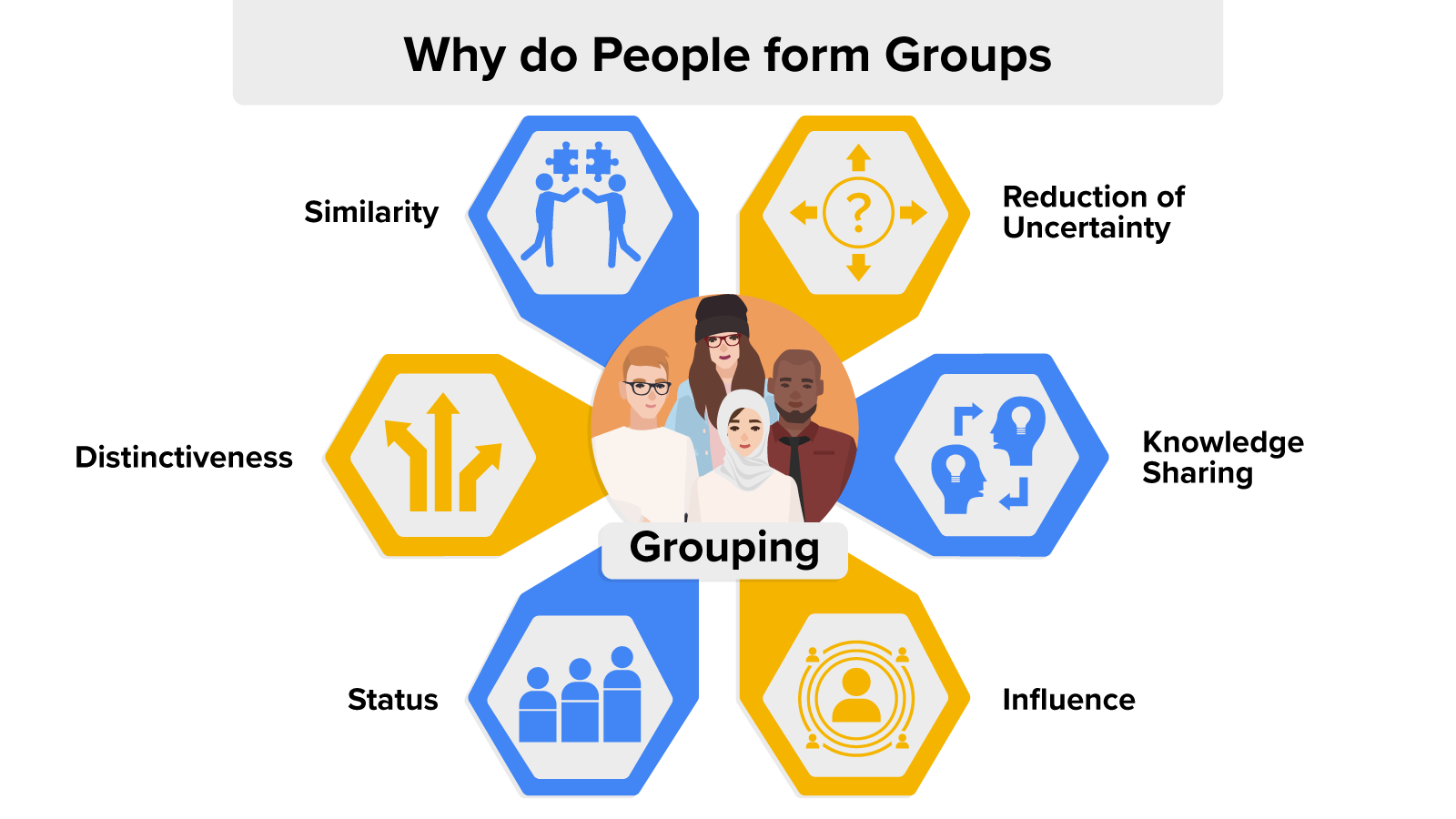
So, how are groups formed in modern society? Human groups are often formed around shared values, goals, and interests. These elements serve as the foundation for creating and maintaining group cohesion. When people share common values, they are likely to form bonds that go beyond superficial connections, resulting in more enduring and stable groups.
IN CONTEXT
Consider a community volunteer group formed to address local environmental issues, such as cleaning up a neighborhood park. The members of this group share a strong value of environmental stewardship and a common goal of improving their local environment. Their interest in making a tangible difference in their community drives them to commit their time and resources to the group’s efforts. Over time, the group members develop deep bonds through their shared experiences and successes in achieving their goals, leading to a strong and cohesive group that is likely to endure as long as the shared values and goals remain central to their mission.
What are some examples of groups you are a part of that were formed around shared values, goals, or interests? How do these common elements contribute to the strength and cohesion of the group?
How do shared values, goals, and/or interests help sustain a group during challenging times? Can you think of a situation where these elements were crucial in maintaining group unity?
Reflect on a time when you joined a group that didn’t last very long. What were your reasons for leaving the group? Were shared values, goals, or interests lacking or unclear?
How might understanding the importance of shared values, goals, and interests help you in forming or leading a group in the future? What steps would you take to ensure these elements are clearly defined and communicated?
Values are deeply held beliefs that guide behavior and decision-making. When individuals share similar values, they are more likely to form groups because these values create a sense of common purpose and understanding.
EXAMPLE
Religious groups often form around shared beliefs in specific doctrines, ethical principles, and practices. These groups provide not only spiritual guidance but also a strong sense of community and belonging.Values-based groups are not limited to religious contexts. They can also include political affiliations, social causes, and cultural groups. For example, people who value environmental conservation may join groups dedicated to promoting sustainability and protecting natural resources. These groups often engage in activities such as organizing events, lobbying for policy changes, and educating the public about environmental issues.
Collectivist societies prioritize group harmony and collective well-being over individual desires. In these cultures, individuals often align with groups that reflect communal values and societal expectations. For instance, in many Asian cultures, family loyalty and respect for elders are paramount, leading to tightly knit family groups that support each other across generations.
Goals are another powerful motivator for group formation. Whether these goals are professional, academic, or personal, individuals who share common objectives often come together to achieve them. This is particularly evident in professional organizations, where people with similar career aspirations collaborate to advance their careers, share knowledge, and provide mutual support.
EXAMPLE
Professional groups, such as associations of lawyers, doctors, or engineers, often provide networking opportunities, continuing education, and advocacy for industry standards. These groups not only help individuals achieve their professional goals but also create a sense of identity and belonging within the broader professional community.In the realm of personal goals, fitness groups or clubs dedicated to specific activities like running, cycling, or yoga are common examples of goal-oriented groups. Members of these groups often motivate each other to reach personal milestones, such as completing a marathon or achieving a certain level of fitness. The shared goal creates a bond among members, even if they come from diverse backgrounds.
Goal-oriented groups are also prevalent in educational settings. Students who share academic goals, such as excelling in a particular subject or preparing for a specific career, often form study groups or join academic clubs. These groups provide not only academic support but also a sense of camaraderie and shared purpose.

Interests, like values and goals, play a significant role in the formation of groups. When individuals share a passion for a particular activity or hobby, they naturally gravitate toward each other. This is evident in a wide range of social clubs, from book clubs and gardening societies to gaming communities and online forums.
Interest-based groups offer a space where individuals can share their knowledge, experiences, and enthusiasm with like-minded people. These groups often serve as a source of inspiration and motivation, as members encourage each other to pursue their passions.
EXAMPLE
In a photography club, members might share tips, participate in photo walks, and hold exhibitions to showcase their work.Online platforms have expanded the reach of interest-based groups, allowing people to connect with others who share their interests regardless of geographical location. Social media, forums, and specialized websites have made it easier than ever to find and join groups focused on specific hobbies or topics. This has led to the creation of global communities around niche interests, where individuals can engage in discussions, share resources, and collaborate on projects.
Now that you know a bit more about why humans group, let’s talk about how they group.
Humans often consciously choose the groups they join based on their personal needs, values, goals, and interests. This process of conscious decision-making is influenced by cultural factors, such as the distinction between individualism and collectivism, as well as personal identity and social identity.
Cultural worldviews play a significant role in how individuals approach group formation. In individualistic cultures, the needs and interests of the individual are often prioritized over those of the group. People in these cultures tend to consciously choose groups that align with their personal goals and preferences. They value personal achievement and autonomy, often seeking out groups that allow them to express their individuality.
EXAMPLE
In the United States, a highly individualistic culture, people might join professional networks or self-improvement groups that align with their personal aspirations. These groups provide opportunities for personal growth and achievement, which are highly valued in individualistic societies.In contrast, collectivist cultures emphasize the importance of group harmony and collective well-being. In these cultures, individuals are more likely to align with groups that reflect communal values and societal expectations. Group membership is often seen as a duty, and decisions about which groups to join are made with the group’s needs in mind rather than personal preferences.
EXAMPLE
In many East Asian cultures, family is the primary group, and individuals are expected to prioritize family needs over their own. This sense of duty extends to other groups, such as work teams or community organizations, where collective goals take precedence over individual desires. In collectivist societies, people are often socialized from a young age to think of themselves as part of a larger group, and their identity is closely tied to the groups to which they belong.Social identity theory provides another lens through which to understand conscious group formation. According to this theory, a portion of an individual’s identity is derived from the groups they belong to. These groups can range from family and friends to professional organizations, religious communities, and social clubs.
Social identity also plays a role in the formation of in-groups and out-groups. An in-group is any group that an individual identifies as being a part of, while an out-group consists of those who are not part of that group. The process of group affiliation is often driven by a desire to reinforce positive aspects of one’s identity while distancing oneself from groups that might reflect negatively on that identity.
In some cases, individuals may consciously join groups that challenge or redefine their social identity. For instance, someone might join a political or social movement that seeks to change societal norms, thereby aligning their personal identity with a broader cause. This conscious alignment with a group can lead to significant changes in an individual’s worldview and sense of self.
While conscious decision-making plays a significant role in group formation, much of the process is unconscious. In unconscious decision-making, humans are often drawn to certain groups without fully understanding why. This unconscious alignment is influenced by factors such as in-group favoritism, attribution bias, and socialization processes.
In-groups are characterized by a sense of similarity and belonging. Members of an in-group perceive themselves as sharing common traits, values, and experiences. This sense of similarity fosters trust and cooperation within the group. For example, people who attend the same school, work in the same organization, or support the same sports team are likely to see each other as part of the same in-group, even if they have never met before.
The formation of in-groups is often accompanied by the identification of out-groups. An out-group is any group that is perceived as different or dissimilar. The process of defining an in-group inherently involves the creation of a “them” in opposition to “us.” This distinction can lead to unconscious biases and prejudices against out-groups.
In some cases, in-group and out-group dynamics can lead to social exclusion or discrimination. For example, in a workplace, employees who share similar backgrounds or interests might form an in-group that excludes others who do not fit the same mold. This exclusion can lead to tension and conflict within the organization, particularly if the out-group members feel marginalized or undervalued.
Attribution bias is another unconscious process that influences group formation and dynamics. It refers to the tendency to attribute positive traits to in-group members and negative traits to out-group members. This bias reinforces the positive self-image of the in-group while devaluing those who are perceived as different.
EXAMPLE
If a member of an in-group succeeds, others within the group are likely to attribute that success to the person’s inherent qualities, such as intelligence or hard work. However, if someone from an out-group achieves the same success, in-group members might attribute it to external factors, such as luck or favoritism.Attribution bias can have significant implications for intergroup relations. It can lead to the perpetuation of stereotypes and the escalation of conflicts between groups. For instance, in political conflicts, members of opposing parties might view their own group’s actions as justified and noble while dismissing the other party’s actions as misguided or malicious.
This bias is often unconscious, meaning that individuals may not be aware that they are applying different standards to in-group and out-group members. As a result, attribution bias can be challenging to address, even in conflict resolution processes.
Through socialization, people learn which groups they are expected to align with based on factors such as gender, race, ethnicity, religion, and social class. These alignments are often unconscious, as individuals internalize societal expectations without actively choosing them.
For example, gender socialization teaches children different behaviors and attitudes that are considered appropriate for their gender. Boys might be encouraged to join sports teams and pursue leadership roles, while girls might be steered toward more nurturing or supportive roles. These early experiences shape the groups that individuals unconsciously align with throughout their lives.

Similarly, socialization processes reinforce racial and ethnic identities. In many societies, children are taught to identify with their racial or ethnic group and to see themselves as different from those in other groups. These distinctions can lead to unconscious biases and prejudices that persist into adulthood.
Socialization also plays a role in shaping class-based group identities. Individuals from different social classes may unconsciously align with groups that reflect their economic status, educational background, and lifestyle choices. These class-based groupings can influence social interactions, career opportunities, and even political affiliations.
Source: THIS TUTORIAL WAS AUTHORED BY MARLENE JOHNSON (2019) and STEPHANIE MENEFEE and TRACI CULL (2024). PLEASE SEE OUR TERMS OF USE.



