Table of Contents |
The concept of population health has emerged in recent years as a broader concept of public health that considers how society as a whole or communities are affected by health issues and how they respond to these issues. It provides a novel way of thinking about the array of factors that can and do affect individuals and the entire population.
Population health has been described variously as:
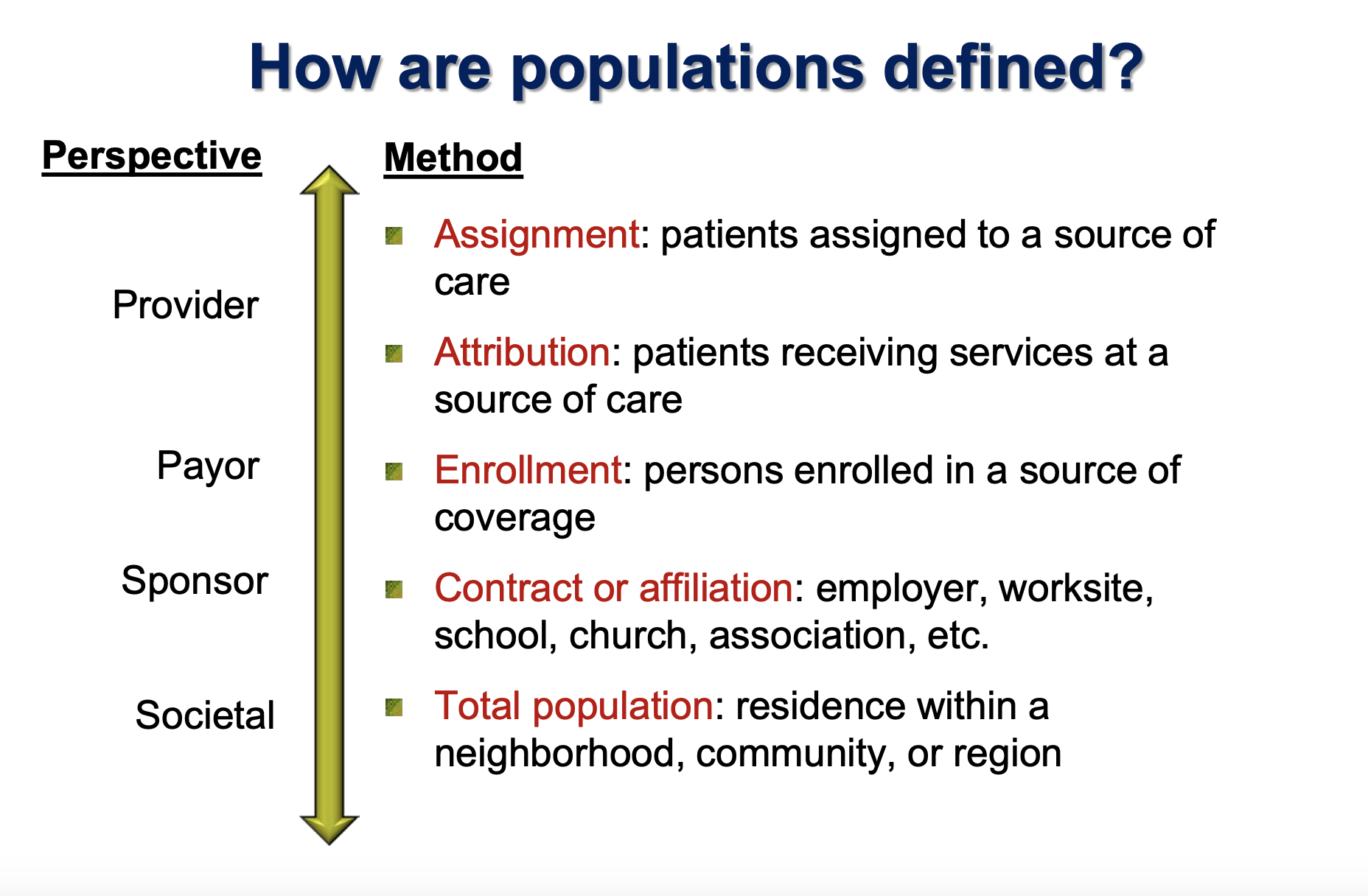
There is no consensus currently on a definition for a population. A population can be defined in several ways depending on your perspective. Businesses may use geographic boundaries to define a population, such as by city or county. Healthcare professionals may define a population by a disease condition or by provider, for instance. The image below provides additional ways to define a population.
Combined, the population health perspective creates a research framework to better understand and address the health and well-being of communities. The framework based on the work of Kindig (2008) serves as a means for identifying determinants of health, disease, and well-being in populations; creating and implementing preventive and treatment interventions that promote health; and measuring effectiveness. It turns a statistical concept into a way in which to study how health and well-being vary among populations.
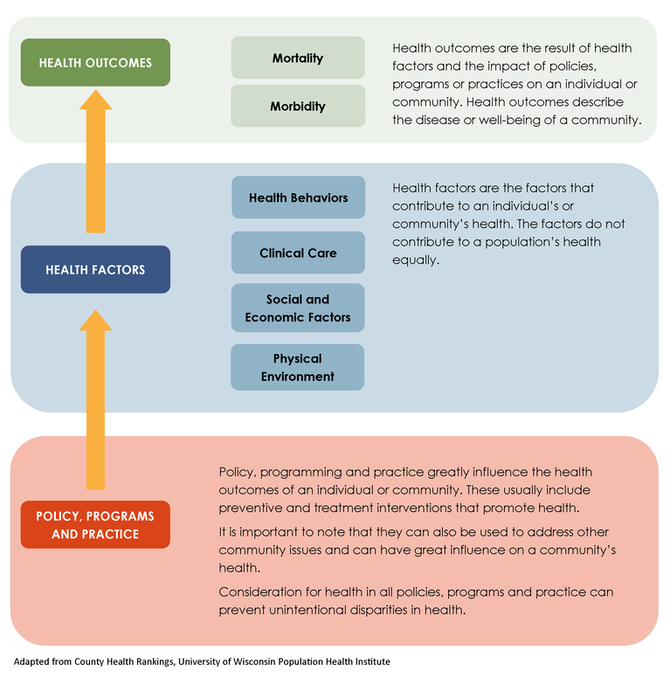
The population health framework appreciates the complexities of issues facing our communities and provides an approach that can assess, intervene, and evaluate the effectiveness of the intervention. Change must not be focused only on individuals or communities but include the key stakeholders. such as health, social service, or justice systems, government. and volunteer sectors. genuinely involved to affect change.
This framework also recognizes the importance of both internal and external risk factors at play. This is key in both identifying opportunities for intervention and inspiring cross-sector communities. The growing realization that healthcare only makes up roughly 20% of an individual’s overall health outcomes and the remainder (where they live, work, and play) contributes more has driven healthcare, public health, government, and other disciplines to pull together and create partnerships to address community-level issues affecting health and well-being. Together, they work to find appropriate, effective, and financially efficient solutions to our communities’ health challenges.
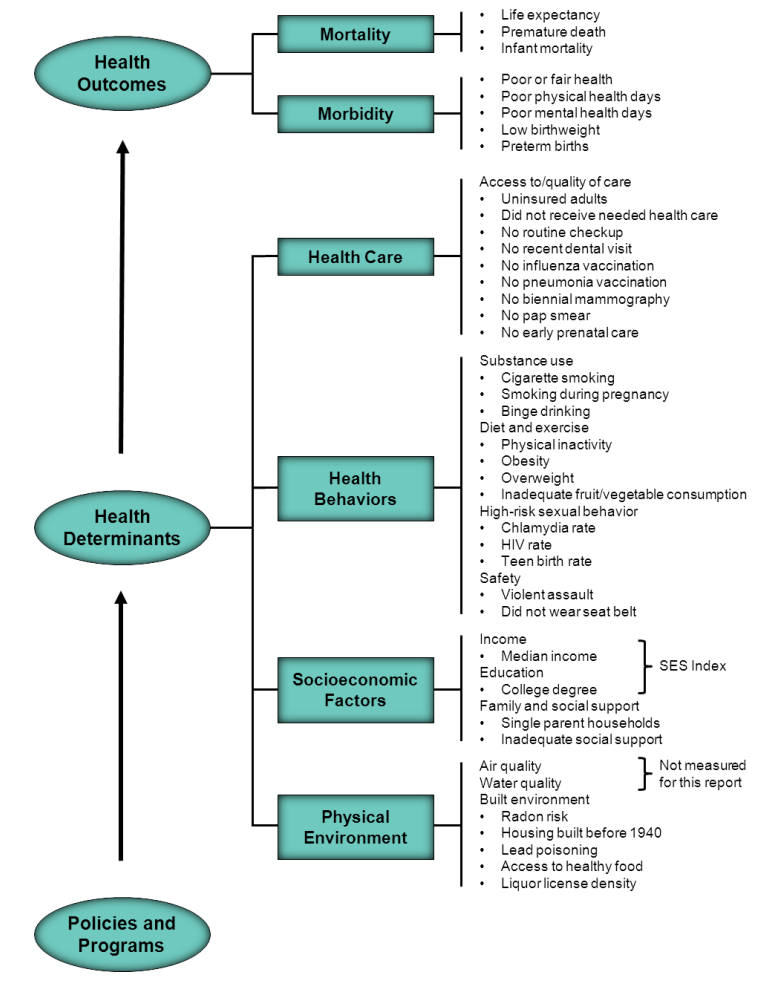
For instance, in 2009 the Center for Urban Population Health and partner organizations launched the first Milwaukee Health Report. It was based upon the population health framework, along with the foundational work of the University of Wisconsin Population Health Institute’s Wisconsin County Health Rankings. The Milwaukee Health Report provided information regarding health disparities among the Socioeconomic Status groups within the city and showed comparisons of health outcomes and health determinants between the City of Milwaukee, the state of Wisconsin, and the United States.
The measures assessed in the report using the population health framework are outlined below. Their findings from the Milwaukee Health Report support the concept that socioeconomic factors are a major driver of population-level health outcomes; these disparate environments result in unequal opportunities for individuals to initiate and sustain healthy choices. The chronic stress of living with poverty, racism, low educational attainment, and social disruption can cause physiologic effects, such as raising cortisol and adrenaline levels leading to diabetes, high blood pressure, and other chronic conditions. It beckons all sectors to work collaboratively to help change public policy so that individuals can live, work, and interact with environments that support healthy behaviors and improved population health outcomes.
Authored by Cindy Ebner, MSN, RN, CPHRM, FASHRM
Support
If you are struggling with a concept or terminology in the course, you may contact [email protected] for assistance.
If you are having technical issues, please contact [email protected].



