Use Sophia to knock out your gen-ed requirements quickly and affordably. Learn more
×

What Is Investing?

Author: Sophia

what's covered
In this lesson, you will learn about investing and the power of compound interest. Specifically, this lesson will cover the following:

Table of Contents

1. What Is Investing?

If you’ve ever set aside money for a future purchase—a dream vacation, a new laptop, or even a down payment on a home—you’ve already started thinking like an investor. Investing is about taking the money you have today and putting it to work so that it grows over time, ideally at a rate faster than inflation (the silent money thief that makes everything more expensive while your cash sits stagnant).

think about it
If you stuff $1,000 under your mattress and come back in 10 years, it’ll still be $1,000—but what you can buy with that money will be significantly less. That’s why investing matters. It allows you to not just keep up with inflation but to grow your money so that your future self has more financial options, freedom, and security.

But before we get into stocks, real estate, bonds, or crypto, let’s strip investing down to its simplest form: what it actually means and why it’s a game changer for your financial future.

This image illustrates the concept of financial growth and investment success. It features stacks of gold coins arranged in increasing height, symbolizing wealth accumulation over time. A rising arrow overlays the image, representing positive financial trends, investment gains, or economic growth. The background contains financial charts and data visualizations, further reinforcing the theme of market performance, stock investments, or financial planning. This image conveys prosperity, strategic financial planning, and the potential benefits of smart investments.

What Does Investing Actually Mean?

At its core, investing is using your money to acquire assets—things that have the potential to increase in value or generate income over time. The goal? To make your money work for you instead of just working for your money.

Imagine you have $100. You could do three things with it:

  1. Spend it: Buy a fancy dinner and enjoy the moment, but the money’s gone.
  2. Save it: Put it in a savings account, where it might earn a tiny bit of interest, but inflation will likely erode its value over time.
  3. Invest it: Put it into an asset (like stocks, real estate, or a business) that has the potential to grow into something bigger.
Think of investing like planting a tree. You start with a small seed (your initial investment) and nurture it with time and patience; eventually, it grows into a tree that produces fruit (your returns). The longer you let it grow, the more fruit you get—and if you keep reinvesting, you end up with an entire orchard of wealth. Let’s now dive into why people invest.

terms to know
Investing
Putting your money into something (like stocks, real estate, or a business) with the goal of making it grow over time.
Assets
Things you own that have value, like cash, stocks, real estate, or a business.

1a. Why Do People Invest?

People invest for all kinds of reasons, but at the core, investing is about expanding your financial possibilities and giving yourself more freedom and security. Here’s why it matters:

Building Wealth

Investing allows your money to grow over time, helping you build wealth without having to work harder for every dollar. Imagine you put $500 in a basic savings account earning 0.01% interest—you might have an extra 50 cents after a year. But if you invest that same $500 in a well-performing stock or index fund, it could grow into thousands over time, thanks to compound growth. The key is time and patience.

Beating Inflation

Inflation means that the cost of everything—groceries, rent, travel—goes up over time. If your money isn’t growing at least as fast as inflation, you’re actually losing purchasing power. Think about your grandparents’ stories of how a loaf of bread used to cost a quarter. If they had stashed all their money under a mattress instead of investing it, that money would be worth far less today. Investing helps you stay ahead so your money doesn’t lose value.

Creating Financial Security

One of the biggest benefits of investing is that it can generate income beyond your regular paycheck. If you’ve ever worried about losing your job or unexpected expenses, investments like dividend-paying stocks, rental properties, or even a side business can create additional streams of income. This gives you more flexibility and control over your financial future.

Funding Life Goals

Whether it’s buying a home, starting a business, traveling, or sending your kids to college, investing helps you afford the things that matter most. Let’s say you want to take a dream trip to Europe in 5 years. Instead of just saving for it, you could invest a portion of your money in a stock index fund. With a solid annual return, your investment could grow significantly over those 5 years, making it easier to fund the trip without derailing other financial goals.

Investing isn’t just about making money—it’s about creating opportunities and ensuring that your future self has more choices, not fewer.

Let’s dive deeper into the power of compound interest when you start investing.

terms to know
Stock
A piece of ownership in a company. If the company does well, the stock’s value can increase.
Index Fund
A type of investment that follows a group of stocks (like the S&P 500) to give broad market exposure with lower risk.
Dividend-Paying Stocks
Stocks from companies that share profits with investors by paying them cash (dividends) regularly.


2. Compound Interest

Albert Einstein supposedly called compound interest “the eighth wonder of the world.” If you’ve ever wondered why some people seem to build wealth effortlessly while others struggle, compound interest is a big part of the answer.

You’ve already learned about compound interest in terms of savings, but now let’s look at it through the lens of investing—because this is where the real magic happens.

What Makes Compound Interest So Powerful?

Unlike simple interest, where you only earn money on your initial investment, compound interest allows your earnings to generate more earnings. In other words, you’re not just making money on what you invested—you’re making money on the money your investment already earned.

Think of it like a snowball rolling down a hill. At first, it’s small and slow moving, but as it picks up snow, it grows bigger and faster. The longer it rolls, the more unstoppable it becomes. That’s exactly how compound interest works with investing. The earlier you start, the more time your money has to multiply.

EXAMPLE

Let’s say you invest $1,000 in a fund that earns an average return of 10% per year. At first, that might not seem like much, but here’s how it actually plays out:

  • Year 1: Your $1,000 grows to $1,100 (10% growth = $100).
  • Year 2: Instead of earning another $100, you earn $110, because you’re now making money on $1,100 (not just your original $1,000). Your total grows to $1,210.
  • Year 3: Your money grows to $1,331, as the interest compounds again.
  • Year 5: Your investment is worth $1,610, even though you haven’t added a single extra dollar.
  • Year 10: It has more than doubled to $2,593.
Now, imagine if you kept investing. If you added just $100 every month to this account, after 30 years, you’d have over $200,000, even though you only contributed $36,000 yourself. That’s the power of compounding in action.

In investing, time is your greatest ally. The earlier you start, the more you benefit from compounding. That’s why many wealthy investors say that time in the market matters more than trying to “time” the market.

Timing the market is when investors try to guess the best time to buy low and sell high to make the most money. The problem is that no one can predict exactly when prices will go up or down, so it’s risky and often leads to mistakes. Instead, investing regularly over time is usually a smarter and safer strategy.

Think of these two friends:

  • Anna starts investing at age 25, putting away $200 a month for 10 years, and then stops contributing.
  • Mike waits until age 35 to start investing, but he invests the same $200 every month until he’s 65.
Even though Mike invests for 30 years, he never catches up to Anna because her money has an extra 10 years of compounding growth.

Take a look at the image below for another visual explanation of the power of compound interest plus starting to invest earlier in life.
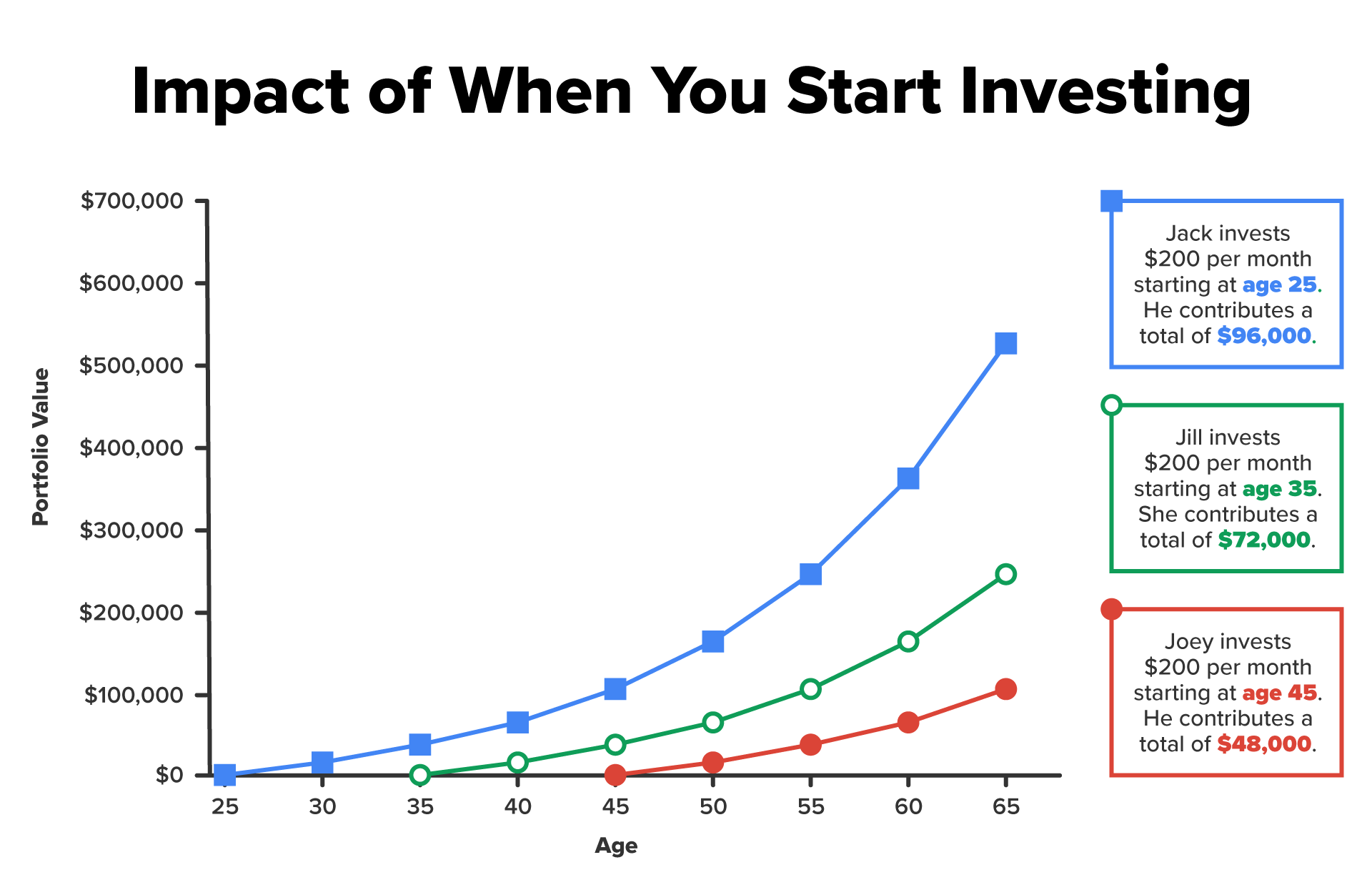
This image presents a graph illustrating the impact of when an individual begins investing. The x-axis represents age, ranging from 25 to 65, while the y-axis represents portfolio value, extending up to $700,000. The graph compares three individuals—Jack, Jill, and Joey—who each invest $200 per month but start at different ages. Jack, who begins investing at age 25, contributes a total of $96,000 and accumulates the highest portfolio value. Jill starts at age 35, contributing $72,000, resulting in a lower final portfolio value. Joey, who begins investing at age 45, contributes $48,000 and has the smallest portfolio. The graph demonstrates the power of compounding interest and the advantage of starting investments earlier, highlighting how earlier contributions yield significantly greater returns over time.
Source: 11 Charts Showing Why You Should Invest Today, by C. Hicks, U.S. News, 2024 (money.usnews.com/investing/articles/charts-showing-why-you-should-invest-today).

term to know
Timing the Market
Trying to guess the best time to buy low and sell high, which is risky because no one can predict the market perfectly.

2a. Risk Versus Reward

Investing isn’t just about putting your money into something and hoping for the best. It’s about understanding the relationship between risk and reward—how much uncertainty you’re willing to take on in exchange for potential gains.

At its core, higher risk often means higher potential rewards but also a greater chance of losing money. Lower-risk investments are more stable but usually grow much more slowly. Your job as an investor is to find the right balance based on your comfort level, timeline, and financial goals.

EXAMPLE

Imagine you’re choosing between three different ways to grow your money. Each one has different levels of risk:
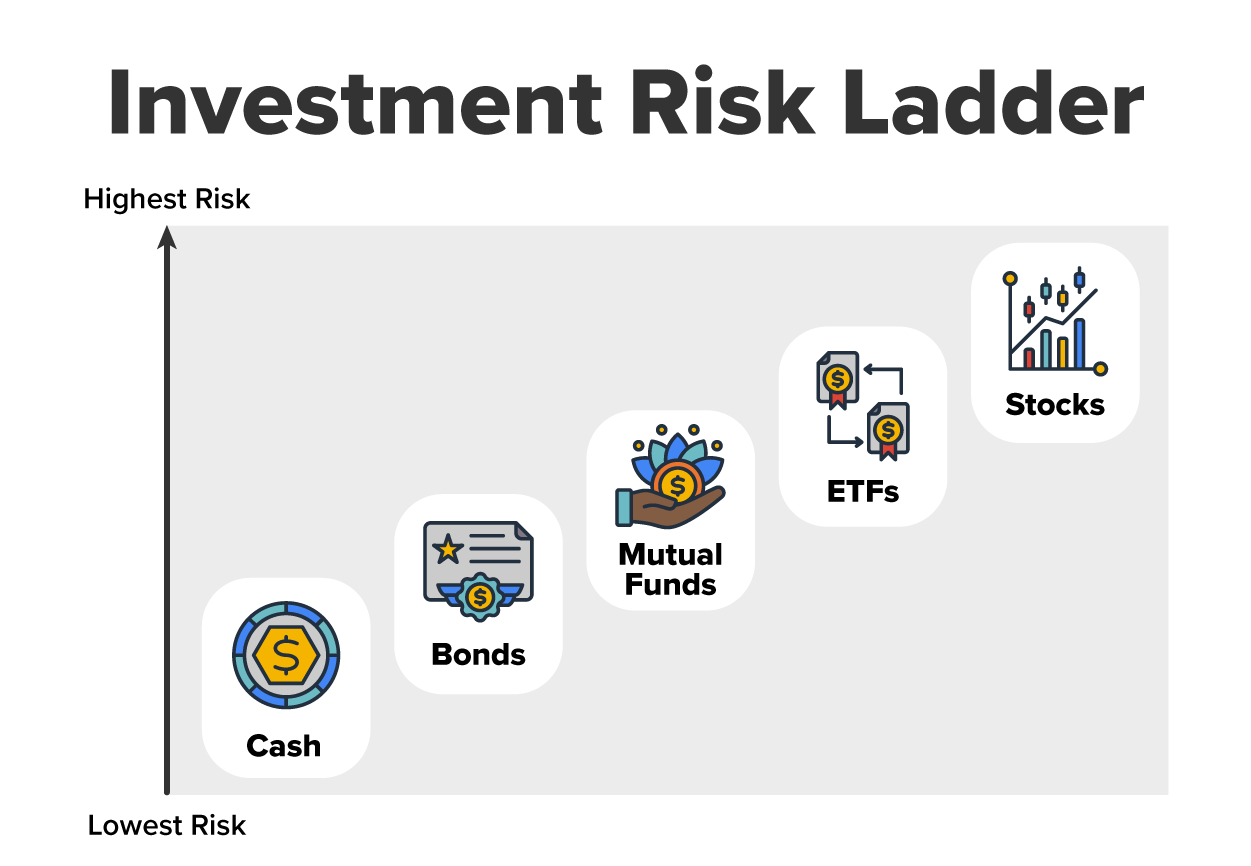
  • Low Risk = Low Reward → Safe but slow growth (e.g., savings accounts, government bonds, and CDs)
  • Moderate Risk = Moderate Reward → More growth potential but some ups and downs (e.g., index funds, real estate, and diversified stock portfolios)
  • High Risk = High Reward → Huge potential gains but also a chance of losing big (e.g., individual stocks, start-ups, and cryptocurrency)
Don’t worry; we’re going to dive into all of these terms and investments in upcoming lessons.

This image presents an ‘Investment Risk Ladder’, illustrating different investment types ranked by their level of risk. At the lowest risk level is cash, which carries minimal risk but also offers low returns. Moving up the risk ladder, bonds come next, providing a more stable return while still being relatively secure. Mutual funds follow, offering diversification but carrying some market-related risks. Exchange-traded funds (ETFs) are positioned higher, as they function similarly to mutual funds but trade like stocks, making them more volatile. At the highest risk level are stocks, which have the greatest potential for returns but also the highest level of risk due to market fluctuations. This visual highlights the varying degrees of risk associated with different investment options, helping individuals make informed decisions based on their risk tolerance.

To make this even easier to understand, think about it like choosing how to travel to a destination:

  1. Taking the Bus (Low Risk, Low Reward)
    1. It’s steady, predictable, and safe. You know where it’s going, and there’s little chance of anything going wrong.
    2. Example: Putting money in a high-yield savings account—it won’t grow much, but it’s secure.
  2. Driving Your Own Car (Moderate Risk, Moderate Reward)
    1. You have more control over how fast you get there, but there are still some risks—traffic, breakdowns, and unexpected detours.
    2. Example: Investing in a diversified stock portfolio or real estate—it has ups and downs, but over time, it can generate solid growth.
  3. Riding a Roller Coaster (High Risk, High Reward)
    1. It’s thrilling and could get you to your destination fast, but there’s also a chance it takes a sharp drop.
    2. Example: Investing in cryptocurrency or a start-up—if it takes off, you could make huge gains, but if it fails, you could lose everything.
How Do You Decide What’s Right for You?

Choosing the right investments comes down to your risk tolerance—how comfortable you are with the possibility of losing money in exchange for the chance of higher returns. We covered this term in a previous lesson, but let’s explore it in terms of investing.

Ask yourself these questions:

  • How soon do I need this money? If you’re investing for a long-term goal like retirement, you can afford to take more risk because you have time to recover from any stock market dips.
  • Can I handle big losses without panicking? If a sudden drop in the stock market would make you want to pull your money out, you may want to stick with lower-risk investments.
  • Do I want to be slow and steady, or am I willing to ride the ups and downs? There’s no right or wrong answer—just the approach that fits your personality and financial goals.
Most successful investors don’t go all in on just one risk level. Instead, they diversify—spreading money across different investments to balance risk and reward. For example, you might do any of these things:

  • Keep some money in a high-yield savings account for emergencies (low risk).
  • Invest in index funds or exchange-traded funds (ETFs) for steady, long-term growth (moderate risk). You’ll learn more about this in an upcoming lesson.
  • Put a small percentage into individual stocks or crypto for higher potential gains (high risk). You’ll learn more about crypto in an upcoming lesson.
This way, even if one part of your portfolio takes a hit, the others help keep you stable.

The bottom line? Risk is part of investing, but understanding your comfort level and diversifying wisely can help you grow wealth without unnecessary stress.

terms to know
Risk and Reward
The idea that higher-risk investments have the potential for bigger gains, while safer investments usually grow more slowly.
Diversify
To spread your money across different investments (like stocks, bonds, and real estate) to reduce risk.
Exchange-Traded Funds (ETFs)
A mix of investments (like stocks or bonds) that you can buy and sell like a stock, offering instant diversification with lower fees.

summary
In this lesson, you discovered what investing is and why people invest. You also learned about the power of compound interest when investing early as well as risk versus reward.

Source: THIS TUTORIAL WAS AUTHORED BY SOPHIA LEARNING. PLEASE SEE OUR TERMS OF USE.

Terms to Know
Assets

Things you own that have value, like cash, stocks, real estate, or a business.

Diversify

To spread your money across different investments (like stocks, bonds, and real estate) to reduce risk.

Dividend-Paying Stocks

Stocks from companies that share profits with investors by paying them cash (dividends) regularly.

Exchange-Traded Funds (ETFs)

A mix of investments (like stocks or bonds) that you can buy and sell like a stock, offering instant diversification with lower fees.

Index Fund

A type of investment that follows a group of stocks (like the S&P 500) to give broad market exposure with lower risk.

Investing

Putting your money into something (like stocks, real estate, or a business) with the goal of making it grow over time.

Risk and Reward

The idea that higher-risk investments have the potential for bigger gains, while safer investments usually grow more slowly.

Stock

A piece of ownership in a company. If the company does well, the stock’s value can increase.

Timing the Market

Trying to guess the best time to buy low and sell high, which is risky because no one can predict the market perfectly.

