In this lesson, you will learn about the meaning of the term “business” and get an overview of the basics of business. Specifically, this lesson will cover:
1. What Is Business?
When you hear the term "business," what do you think of? What do you think of businesses in general? Do you think of the study of business, like we’re doing now? Do you think of a small mom-and-pop grocery store down the street or, perhaps, a larger company?
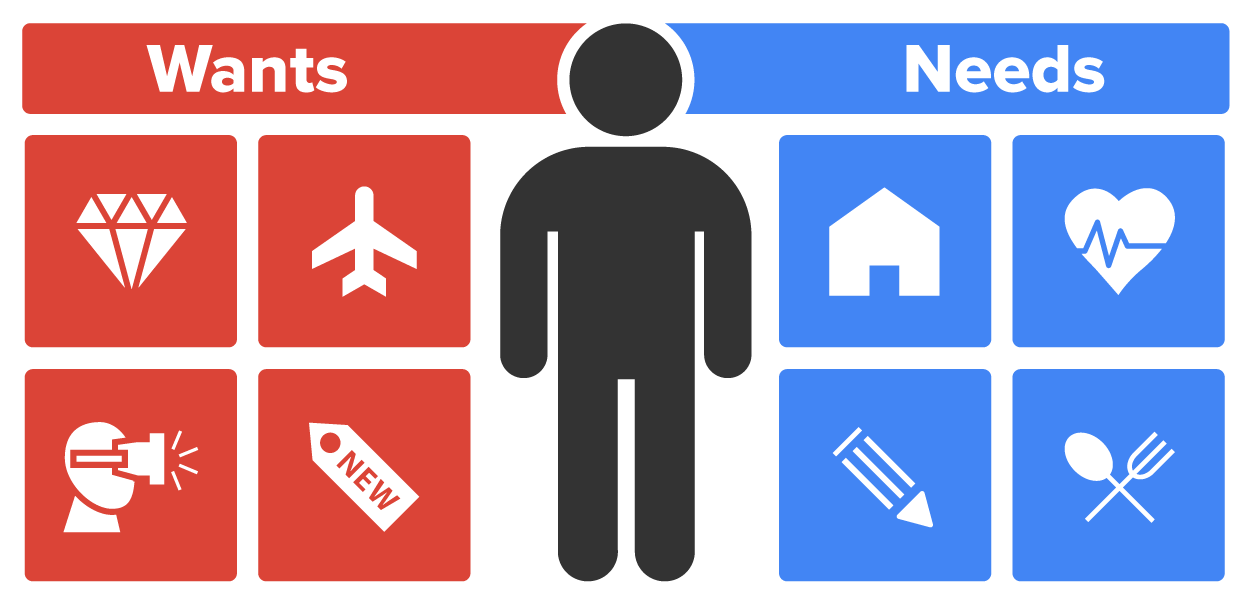
A business is simply an organization that attempts to earn a profit through the sale of goods or services. Those goods or services can be practically anything you can think of, but what they all have in common is that they fulfill a need or a want in our everyday life.
-
EXAMPLE
"Needs" may include things such as food, clothing, or shelter. "Wants," on the other hand, could be something like a new boat or the latest model car or electronic device—things that we don’t necessarily need to survive but we want.
-
- Business
- An organization that attempts to earn a profit through the sale of goods or services.
1a. What Do Businesses Do?
Businesses help do several things that add value to individuals’ lives and society as a whole. These include the following:
- They improve our quality of life by fulfilling our wants and needs and by providing goods and services that we consume every day.
- They provide a choice for what it is we want to buy. Do we want to buy a Mac, or do we want to buy a PC?
- They allow us to choose from a large array of products, and with that, new startup businesses are able to enter the market and fulfill societal gaps in our wants and needs.
- They provide job opportunities for people like you and me.
1b. Why Study Business?
What is important about business? Well, the study of business impacts your job and your job search, regardless of the field you’re in. Understanding what’s going on around you and the terminology of business not only helps you to be a better employee but also helps make you a more valuable and sought-after employee.
-
Having knowledge about how businesses work also helps you to be a better consumer. Understanding the terminology of business can help you understand, for example, if you are getting a good deal on a loan or not.
1c. Profits Versus Losses
Two important aspects of all businesses are the following:
- Profits
- Losses
Profit is what remains after all business expenses have been deducted. In order to continue, a business must be able to make money or create something of equivalent value for its owners and investors. Expenses might include things such as the cost of raw materials to make a product and the rent on a warehouse or building.
Loss is when expenses become larger or greater than sales or revenue.
Profits are always good. Losses, as you can probably guess, are not. A profit means you’re successful; you’re able to pay your employees, grow your business, and stay in business. A loss means you may need to make changes to the way your business is run, or you won’t be in business for much longer.
-
While most businesses are run with the intention of making a profit, nonprofit organizations exist to achieve some goal and can’t operate at a loss. Even so, nonprofit organizations often follow the many business concepts we’ll be addressing in this course.
-
- Profit
- The result when revenue and sales are greater than expenses.
- Loss
- The result when expenses are greater than sales.
2. The Free Enterprise System
The free enterprise system is defined as a market system with little control and regulation of businesses by the government. In this capitalistic system, consumers are free to choose the following:
- What products they want to buy
- What wants or needs they want to fulfill
- How they want to fulfill them
- How much they want to pay for those services
By doing this, they help guide something called the
invisible hand. The invisible hand was an idea that was first introduced by Adam Smith in his book
The Wealth of Nations. By “invisible hand,” we refer to the hand that guides the market in a free enterprise or capitalistic system. There’s no central authority or central planning that tells the market what it produces, where it sells it, and how much it sells it for. The consumers and businesses make those choices based on signals that they get from each other. It also addresses the idea that acting out of self-interest, such as making a profit, can help society as a whole.
-
EXAMPLE
Suppose you want to sell baked goods out of a food truck in your town. You bake the goods out of self-interest (you hope to make money), but you also provide something society wants—baked goods. That is the invisible hand at work.
Contrarily, John Maynard Keynes proposed that individual decisions are influenced by the concept of the animal spirit, which is affected by the widespread optimism and pessimism within the market, reflecting human psychological and behavioral tendencies. The combination of Adam Smith’s and John Maynard Keynes’ theories serves as the cornerstone of the contemporary free market or free enterprise system. Explore this system a little more:
-
Let’s look at other ways to compare the “invisible hand” with the “animal spirit” in the scenarios below:
|
Scenario
|
Adam Smith
(Invisible Hand)
|
John Maynard Keynes
(Animal Spirit)
|
A Market Boom and Bust
(A situation in which a period of great prosperity or rapid economic growth is abruptly followed by one of economic decline)
|
The fundamentals affecting the actual price of goods and services
|
Unproven actions
|
Economic Recovery
(The phase of the business cycle that follows a recession)
|
The market self-corrects.
|
Economic confidence (after an election) can drive spending and investment.
|
The 2008 Housing Crisis
(Began with a housing market collapse in the United States, caused by a housing bubble fueled by lax lending standards and the proliferation of subprime mortgages)
|
Supply meets demand.
|
Unrealistic optimism led to the lending crisis.
|
Economic Impact
(The effect that an event, policy, or project has on an economy, typically measured by changes in income, employment, and overall economic activity within a region or country)
|
Long-run market efficiency and correction
|
Short-run market instability and fluctuation
|
-
- Free Enterprise System
- A market system with little control and regulation of business (by the government).
- Capitalistic System
- An economic system where private individuals or businesses own and control the means of production, with prices and production determined by the market, mainly through supply and demand.
- Invisible Hand
- The incentives that free markets sometimes create for self-interested people to accidentally act in the public interest, even when that is not something they intended.
- Animal Spirit
- The instincts, emotions, and psychological factors that drive economic decision-making, particularly investment and consumption, beyond purely rational calculations.
3. Basic Economics of Business
When discussing the basic economics of business, the first thing we want to look at is the difference between microeconomics and macroeconomics. We’ll go into greater detail on these terms in upcoming lessons.
Microeconomics is an area of economic study that focuses on specific markets, choices, and behaviors that affect prices, costs, and demand.
-
EXAMPLE
Think of microeconomics as that individual transaction you have with an everyday business. It refers to small things, such as the following:
- How much can a business charge before the consumer stops buying?
- How much is a consumer willing to pay?
- How much of something will they want to buy, and how often will they come back to buy it?
Macroeconomics, on the other hand, is a wider field of study. It’s an area of study that focuses on the impact of variables on economic infrastructure in its entirety. This can be on a regional, national, or global level.
-
EXAMPLE
If you listen to business news, you’ll hear references to terms and phrases such as the consumer price index and stock markets or what the Federal Reserve (Fed) wants to do with interest rates by increasing or decreasing the amount of available money in the market. These are all things that have to do with the economy of the United States as a whole, and that is the macroeconomic view or larger picture.
Let’s look more closely at the differences in this table:
|
|
Microeconomics
|
Macroeconomics
|
|
Study Area
|
Individual economic units
(consumers, firms, and industries)
|
Whole economy
(local, national, and global)
|
|
Focus
|
Demand, supply, and pricing
|
GDP, inflation, and unemployment
|
|
Policy Focus
|
Limited government intervention in the market
|
Increased government participation in the market
|
|
Approach
|
Individual behavior shapes the market (bottom-up policy approach).
|
Economy-wide actions shape the market (top-down approach).
|
-
Microeconomics focuses on individuals, markets, and businesses.
Macroeconomics focuses on economies at local, state, national, and global levels.
-
- Microeconomics
- An area of economic study that focuses on specific markets, choices, and behaviors that affect price, cost, and demand.
- Macroeconomics
- An area of study that focuses on the impact of variables on economic infrastructure in its entirety. This can be on a regional, national, or global level.
4. Entrepreneurship
Entrepreneurship tends to attract highly creative, growth- and expansion-focused people. These people help fill the market’s unfilled needs and wants. They help drive that “invisible hand” that we were talking about earlier. An entrepreneur is a person who pursues a business venture with growth and expansion as primary goals.
-
Starting a business takes courage and effort, but not everyone who starts a business considers themselves an entrepreneur. Growth and expansion are going to be some of your primary goals in order for you to be called an entrepreneur by this definition.
Consider the following examples of entrepreneurship:
 Entrepreneur:
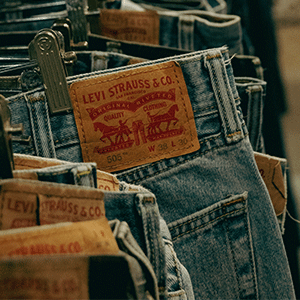
 Levi Strauss
Business: Levi Strauss and Company
Levi Strauss partnered with a man called Jacob Davis to start Levi Strauss and Company. They identified a need at the time, and they helped fill that need.
Workers back in the late 1800s were going through clothes very rapidly. The clothes kept ripping and tearing, and they used denim to patch those holes. First, they created a set of coveralls. Then, they created a set of jeans that lasted much, much longer. They filled the need to have durable clothing. Over time, the company has grown not only to provide a need—clothing—but also to provide a want, such as those 501s that consumers want to have.
 Entrepreneur:
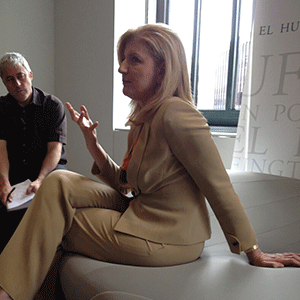
 Arianna Huffington
Business: Huffington Post
Arianna Huffington found a niche in the market. In this case, the gap in the marketplace that she found stemmed from the fact that the Drudge Report was wildly popular, but there wasn’t a liberal version of it to report on that side of the news. Therefore, that’s what the Huffington Post became. It focused on daily trends in the news.
The Huffington Post team didn’t worry about how many articles they had, necessarily; they simply put their resources into all of them. What they found was that they were getting home runs every once in a while. They didn’t worry as much about the misses because the home runs were what established the organization’s name. Basically, they found something that worked, and they put resources into it.
 Entrepreneur:
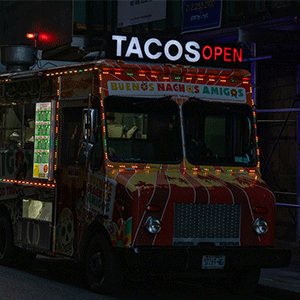
 Maria
Business: Maria’s Tacos
Not all entrepreneurs have to become large corporations. Suppose Maria enjoys making food and opens a taco truck. She chooses recipes people enjoy and uses fresh ingredients. She parks her truck at a number of music festivals in her city. Her goal is to eventually have several trucks that will allow her to grow her business. While this business may never earn millions, Maria is still an entrepreneur in her own right.
-
- Entrepreneur
- A person who pursues a business venture with growth and expansion as their primary goals.
In this lesson, you looked at what business is. You defined the term “business,” including what it does and why we study it. You learned about the dynamics of profit and loss as well as the free enterprise system. You learned about the basic economics of business, discussing the microeconomic and macroeconomic views of the economy in general. Lastly, you learned about entrepreneurship, which is shown by highly creative people who are growth focused and fill gaps in the market to help drive the “invisible hand.”



