Use Sophia to knock out your gen-ed requirements quickly and affordably. Learn more
×

What Are Proofs?

Author: Sophia

what's covered
In this lesson, you will begin to learn about proofs, a way of demonstrating validity for arguments that is both more efficient and specific than truth tables. Proofs literally prove validity. Specifically, this lesson will cover:

Table of Contents

before you start
Two key concepts from our discussion of logic so far must be clearly understood before we continue.
  • First, recall that validity has to do with whether the conclusion follows from the premises, and not whether any statement is true or false on its own.
  • Second, if we can identify any situation where the premises are true and the conclusion is false, we have shown the argument to be invalid. We have done this either by imagining counterexamples or by constructing truth tables, which will show every possible scenario for the constituents of the argument being true or false.

1. Why We Use Proofs

We’ve learned that truth tables can show us that an argument is valid or invalid, but it is less useful in showing why an argument is valid or invalid. Consider this argument:

  1. P ∨ Q
  2. ¬P
  3. ∴ Q
A truth table will show this is a valid argument. The only row with true premises also shows that the conclusion is true.

P Q P ∨ Q ¬P Q
T T T F T
F T T T T
T F T F F
F F F T F

But you probably don’t need a truth table to see that it is valid; if at least one of two things is true and one is removed from consideration, the other must be true. Furthermore, the truth table does not “explain” this premise or aid our understanding; it is a purely mechanical tool. By a mechanical tool, what we mean is that a truth table basically functions as a nondigital calculator. It cranks through every possibility and delivers an answer without really understanding or needing you to understand why the answer is what it is. It’s very similar to being able to plug in a math problem to a calculator and get a result even when you don’t know how to do that computation by hand. In this way, truth tables are a little bit like cheating, since they allow us to determine validity without deeply understanding the rules and structure of our logical language.

Another issue with truth tables is that for some arguments with lots of atomic sentences and several premises, a truth table becomes overly long and tedious to complete.

EXAMPLE

Consider this argument:
  1. A → F
  2. ∴ (A ∧ B ∧ C ∧ D ∧ E) → (F ∨ G ∨ H ∨ I ∨ J)
Although this is only two rows, constructing a truth table would take 100 lines because there are 10 unique atomic sentences in this argument. Even so, you might sense that the argument is valid (though you might not be able to explain why it is valid yet).


In principle, we can set a machine to grind through truth tables and report back when it is finished. In practice, complicated arguments in formal logic can become unwieldy if we use truth tables. Truth tables have limited usefulness in helping us sharpen our reasoning skills by analyzing arguments.

Another way to show not only that arguments are valid, but why they are valid, is by constructing a proof. A proof is a method for demonstrating the validity of a logical argument based on basic rules of inference. The rules of inference tell us what logical sentences follow from what other logical sentences. Essentially, a proof is a logical argument where we “show our work,” like you may have had to do in math class.

When we construct a proof, we show that an argument is valid, and demonstrate why that is the case. Proofs are thus more efficient than truth tables, especially for arguments with several atomic and complex sentences, and have the additional benefit of giving insight into the reasoning behind the argument or explaining it to others.

The development of a proof also poses more of a challenge to the logician than developing a truth table. Writing a proof requires us to understand and use the rules of logic in creative ways.

big idea
In terms of critical thinking, proofs are a way of thoroughly explaining and documenting validity, as we do when we adopt a position in legal work, science, medicine, and other pursuits. The field of logic is about reasoning and rigor, to develop good habits and skills we can bring to other disciplines.

In this challenge, we will learn what proofs look like, memorize some basic rules of inference that are employed in constructing proofs, and then construct a few proofs of our own. You may be a bit daunted at first, but trust that proofs will be a great asset to critical thinking. While knowing logic has helped us translate and test arguments for validity, proofs teach us how to grasp the reasoning behind arguments and give us a way to explain our reasoning to others.

terms to know
Proof
A method for demonstrating validity of a logical argument based on a set of inference rules.
Rules of Inference
A set of basic logical rules that tell us what logical sentences follow from what other logical sentences.


2. Basics of Constructing Proofs

There are multiple notations that symbolize the same logical concept. For example, while we’ve been using the arrow, →, to represent a conditional sentence, others use the horseshoe, ⊃. There is also more than one way to notate proofs. While the reasoning is the same, the proofs may look different. The practice we’ll follow in this class is called the Fitch System, developed by Frederich Fitch in 1952. Here is an example of a proof in this system.
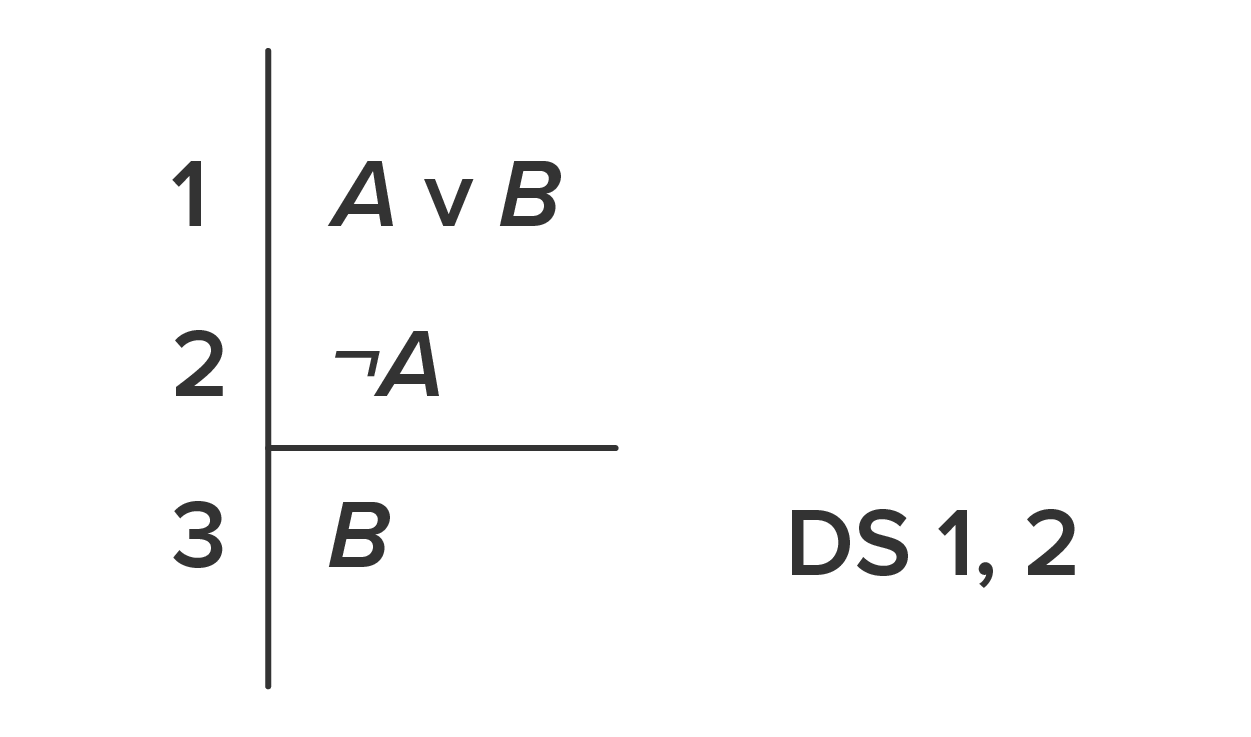
A logical argument that reads: 1. A ∨ B; 2. ¬A; horizontal line; 3. B. There is a vertical line between the numbers and the statements, and the symbols DS 1,2 to the right of 3. B.

You may notice that the proof looks a bit like an argument. There are numbered lines with premises and a conclusion. Of course, there are differences as well: we have a horizontal line under our premises, a vertical line between the numbers and the statements, and the conclusion has a mysterious tag to the right, “DS 1,2.” What do all of these things mean?

First, the sentences above the horizontal line are our premises. We assume that our starting premises are true, or in other words, we take their truth for granted. In this way, they’re like the assumptions we’ve discussed in earlier tutorials. Premises are the starting assumptions that get us to the conclusion.
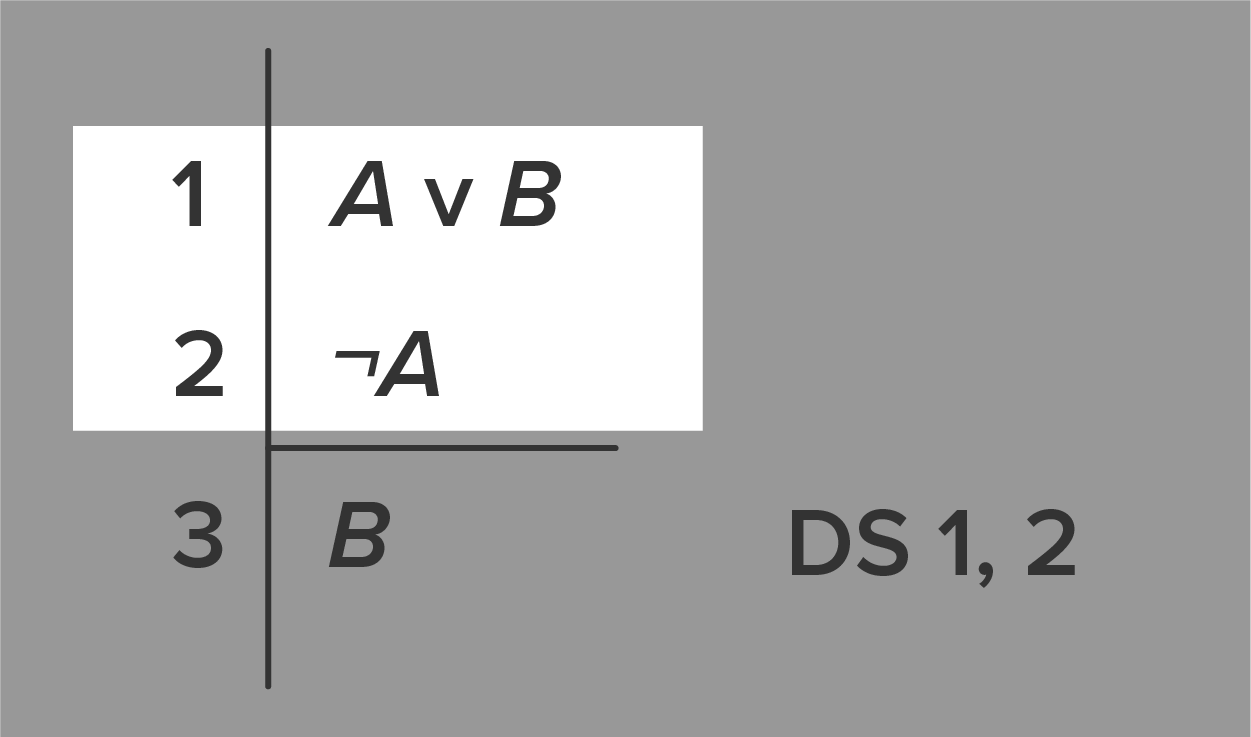
The premises from the earlier image are highlighted. 1. A ∨ B. 2. ¬A.

As with arguments, the bottom line is the conclusion.

The logical proof from the previous steps is shown with the conclusion highlighted. The conclusion is B. There is a notation to the right of B reading DS 1, 2.

Why the horizontal line? The example above has no sentences other than the premises and the conclusion, but other proofs might require additional steps, called derivations. These are neither premises nor conclusions, but sentences whose truth we have inferred (derived) from the premises and our inference rules of logic. They show how we are working toward the conclusion. One way to think about derivations is as subconclusions required to get us to the main conclusion. In this next example, the 4th and 5th lines are derivations.
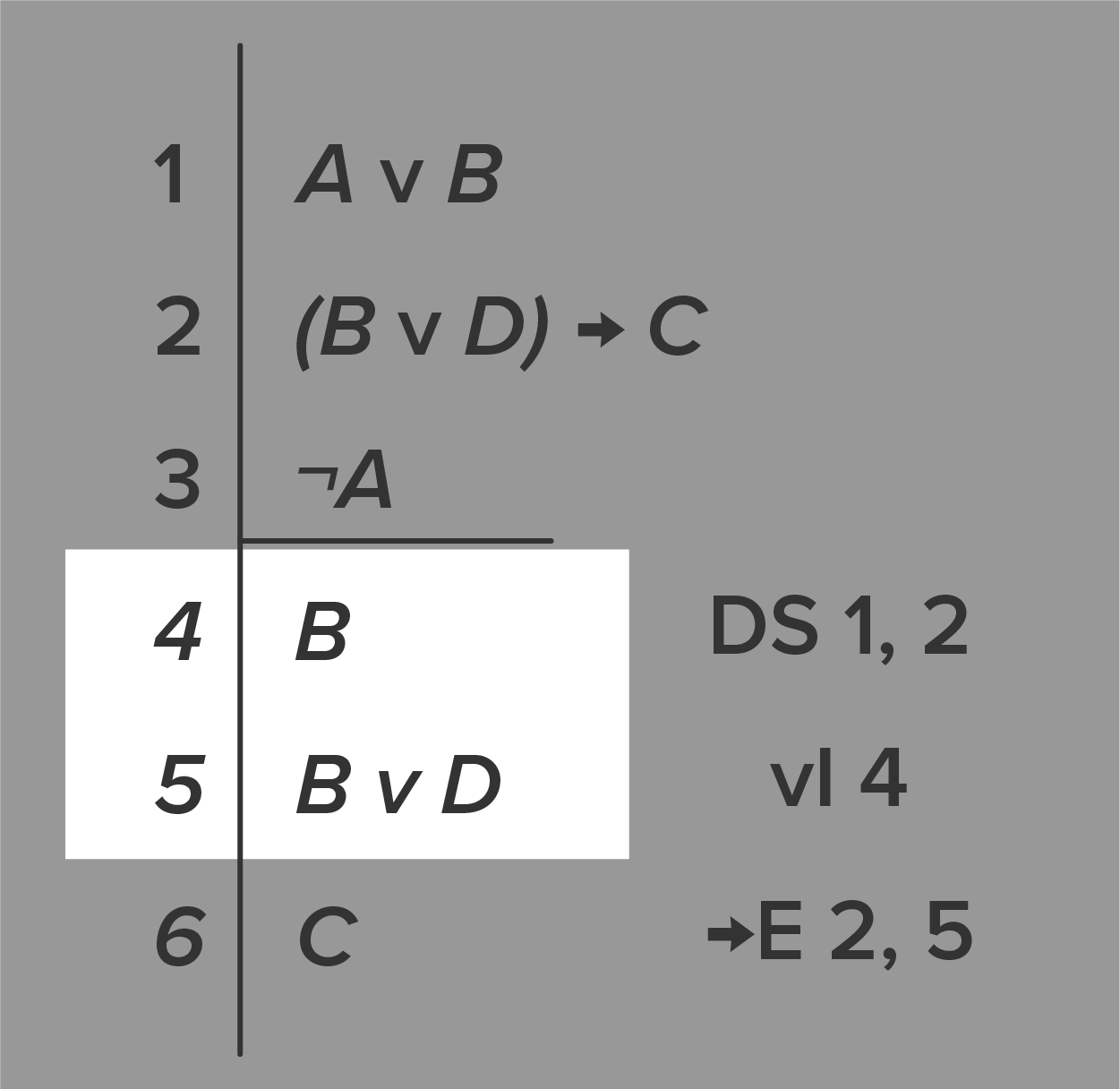
A long logical proof. 1. A ∨ B; 2. (B ∨ D) → C; 3. ¬A

The purpose of the horizontal line is thus to separate the premises from the derivations and conclusion.

Finally, you will see the derivations and the conclusion all have letters, symbols, and numbers at the right. These notations show how we derived the sentences on each line. The left part names the rule of inference used (in shorthand) and the numbers indicate the previous sentences we applied the rules to. Of course you have not yet learned the rules of inference, so these may be a bit mysterious, but for now it’s important to recognize the parts of a proof when you see one.
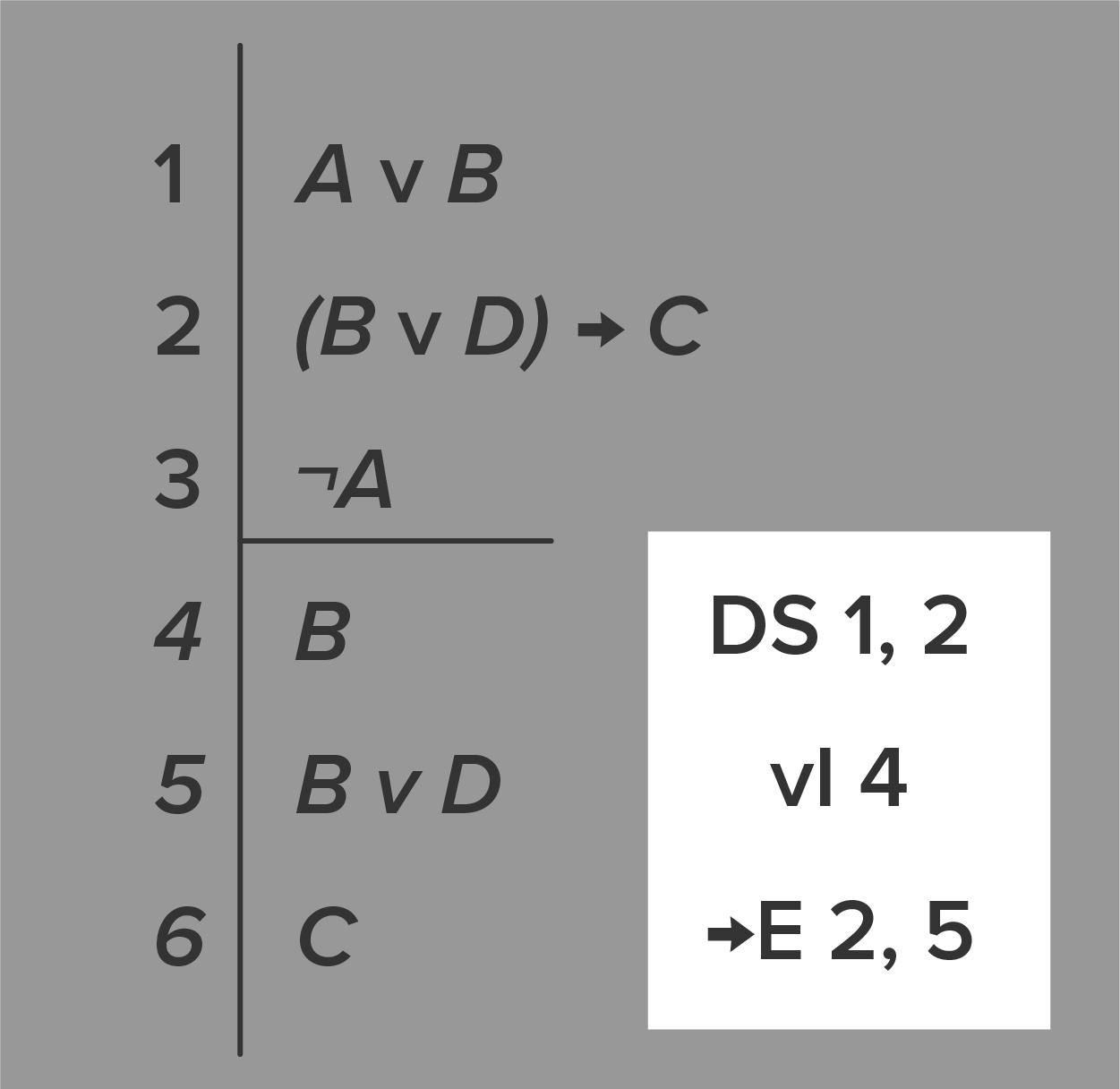
The same logical proof from the last image. The lines below the premises each have a notation, and these are highlighted. They read DS 1,3, ∨I 4, →E2, 5.

try it
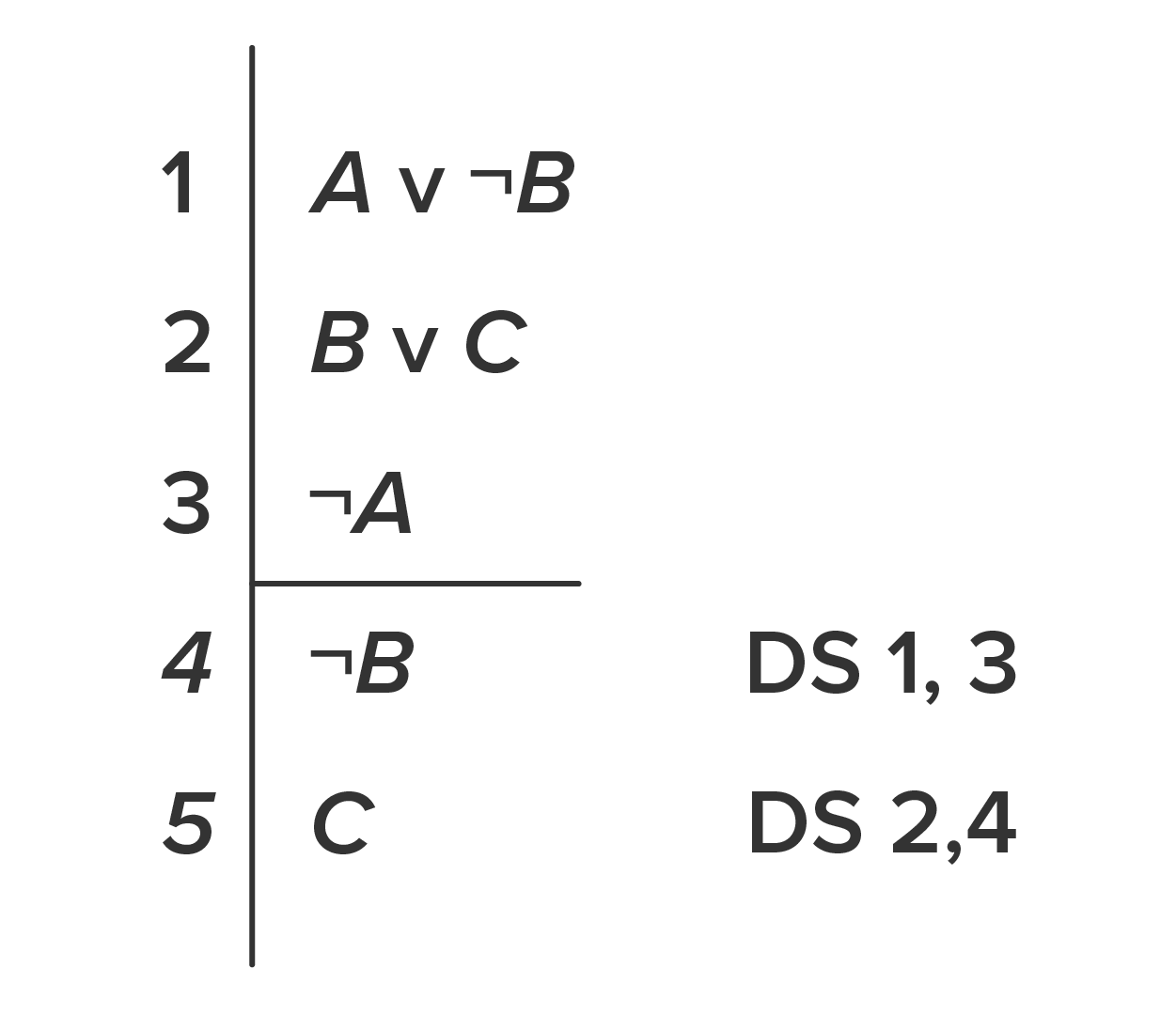
A logical proof. 1. A ∨ B; 2. B ∨ C; 3. ¬A; 4. ¬B (DS 1,3); 5. C (DS 2, 4).
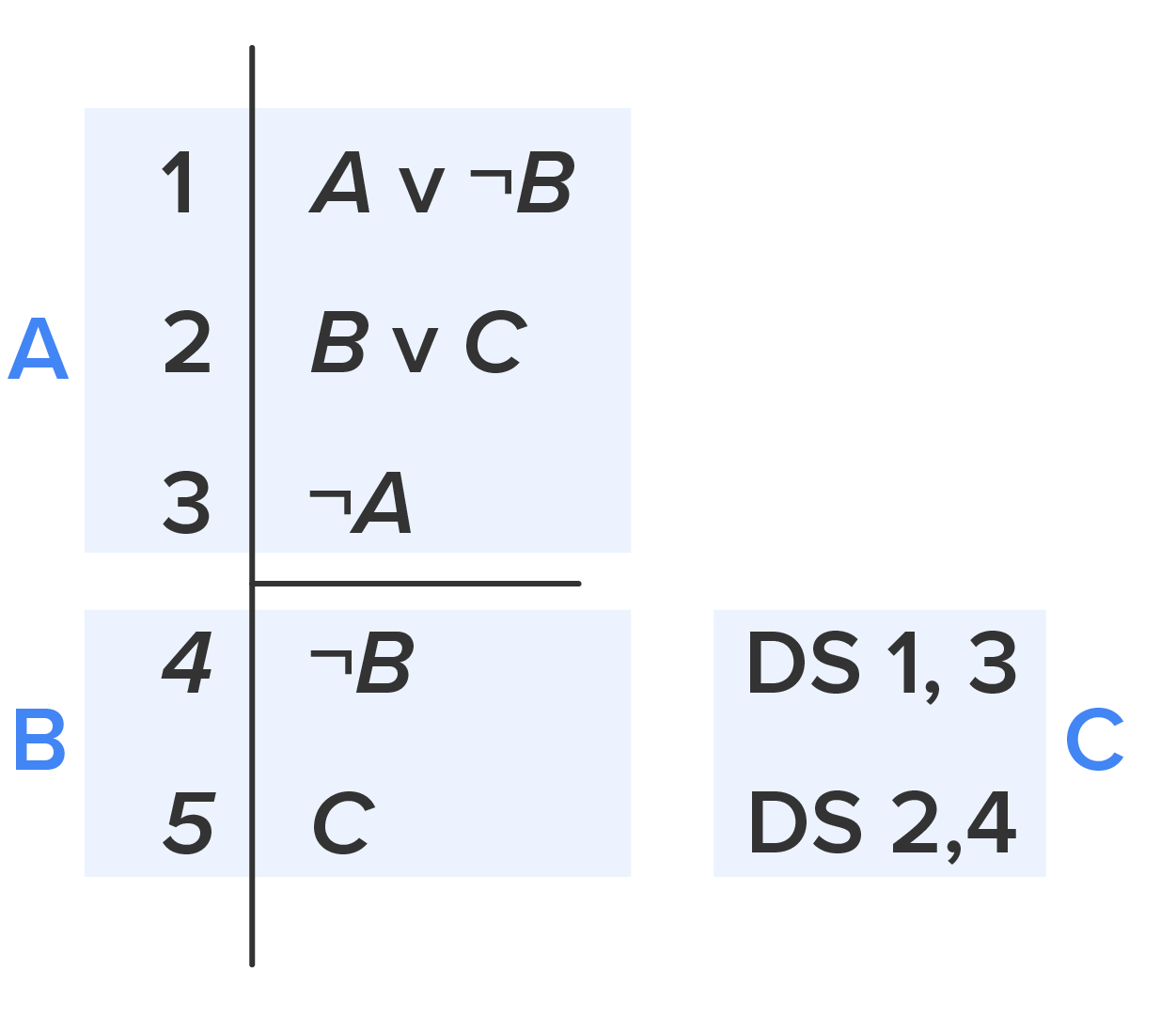
Can you identify each part of the argument below with the right term?
A logical proof. A ∨ B; B ∨ C; ¬A; ¬B (DS 1,3); C (DS 2, 4). Items 1-3 are labeled with A. Items 4-5 are labeled with B. The parenthetical notes are labeled with C
A are the premises.
B are the derivations, including the conclusion.
C are notations with the rules of inference used and the lines used for the derivation.

hint
While you are free to use pencil and paper, a word processor, or any other tool you'd like to write a proof for this class, there is a web-based tool at Open Logic Project openlogicproject.org/. While it takes a certain amount of familiarity with proofs to use, this tool has an added advantage of being able to check your work; the tool will tell you if there are any mistakes in your proof!

terms to know
Fitch System
One of several systems of notating logical proofs, developed by Frederich Fitch in 1952.
Derivation
A sentence in a proof whose truth we have inferred from the premises. They are intermediate steps which take us from the premises to the conclusion by way of the rules of inference.


3. Subproofs

Consider this argument in natural language.

Either Andy or Brenda is going to be at the presentation. If Brenda or Dan comes, they can bring the computer. Oh, I just learned Andy can’t be there. Therefore, there will be a computer there.

The conclusion is that there will be a computer present no matter what, but somebody might not quite follow the reasoning behind this paragraph and say, “Huh?”

The other person might try to explain by reconstructing a hidden premise/assumption:

“Well, if Brenda goes, you know there’ll be a computer.”

The person isn’t affirming that Brenda will be there, just reminding the other person that in any scenario where Brenda attends the presentation, the computer will be there.

If we assigned constants to these statements, we would get:

A = Andy will be at the presentation.
B = Brenda will be at the presentation.
C = A computer will be available at the presentation.
D = Dan will be at the presentation.

This translates into the argument:

  1. A ∨ B
  2. (B ∨ D) → C
  3. ¬A
  4. ∴C
Notice that B → C (our reconstructed assumption) is not, in fact, a premise of the argument. However, it can be derived in a proof. What would happen if we made the assumption that B is true? Since the sentence in line 2 is already a premise, i.e., a sentence whose truth we take for granted, we can then see that C immediately follows from our assumption that B is true. This is called a subproof, a secondary proof embedded in the main proof which temporarily makes assumptions and allows us to explore the space of possible consequences of those assumptions. We can refer to the steps in our subproof as subpremises, subderivations, and subconclusions. They mean more or less the same thing as they do in a main proof, but for the subproof.

So, why does the subpremise B help us? In obvious terms, it gets us to a subconclusion that helps us derive the main conclusion. But as it’s not a starting premise, when we adopt a subpremise, we must discharge it by the end of the subproof. To discharge a premise means that we no longer assume that it’s true. We do that by taking whatever subconclusion we’ve arrived at, and conditionalizing the subconclusion on the subpremise. That is, creating a conditional sentence where the subpremise is the antecedent and the subconclusion is the consequent.

Before continuing with our proof, let’s pause to think about why conditionals are so helpful in proofs. In a proof, we cannot arbitrarily make assumptions about what is or isn’t true. Our starting premises are the only truths that we can be certain about. So, conditionals are helpful because they give us what we call hypothetical truths—that is, things that we could learn are true given a set of conditions. To bring it back to a previous discussion, conditions allow us to explore possible truths. And those possible truths end up being things we might conclude in a proof given certain conditions, i.e., the truth of the antecedent.

If magic was real, then unicorns would exist.

If the conclusion that we need for our proof is that unicorns exist, all we need to do is derive the truth of the antecedent, that magic is real. So, the strategy for the proof becomes simple: prove the antecedent, and the consequent follows automatically. After all, the antecedent is a sufficient condition for the consequent.

Conditionals are powerful. In a proof, they set up conditions (antecedents) required to fulfill whatever is on the right-hand side (the consequent). If we can get ourselves to the truth of the right set of conditions, and we can get ourselves the right set of conditions, what we want to conclude becomes straightforward.

Let’s return to our working example. Note that the subproof is clearly marked and set apart in lines 4-6 from the main proof:
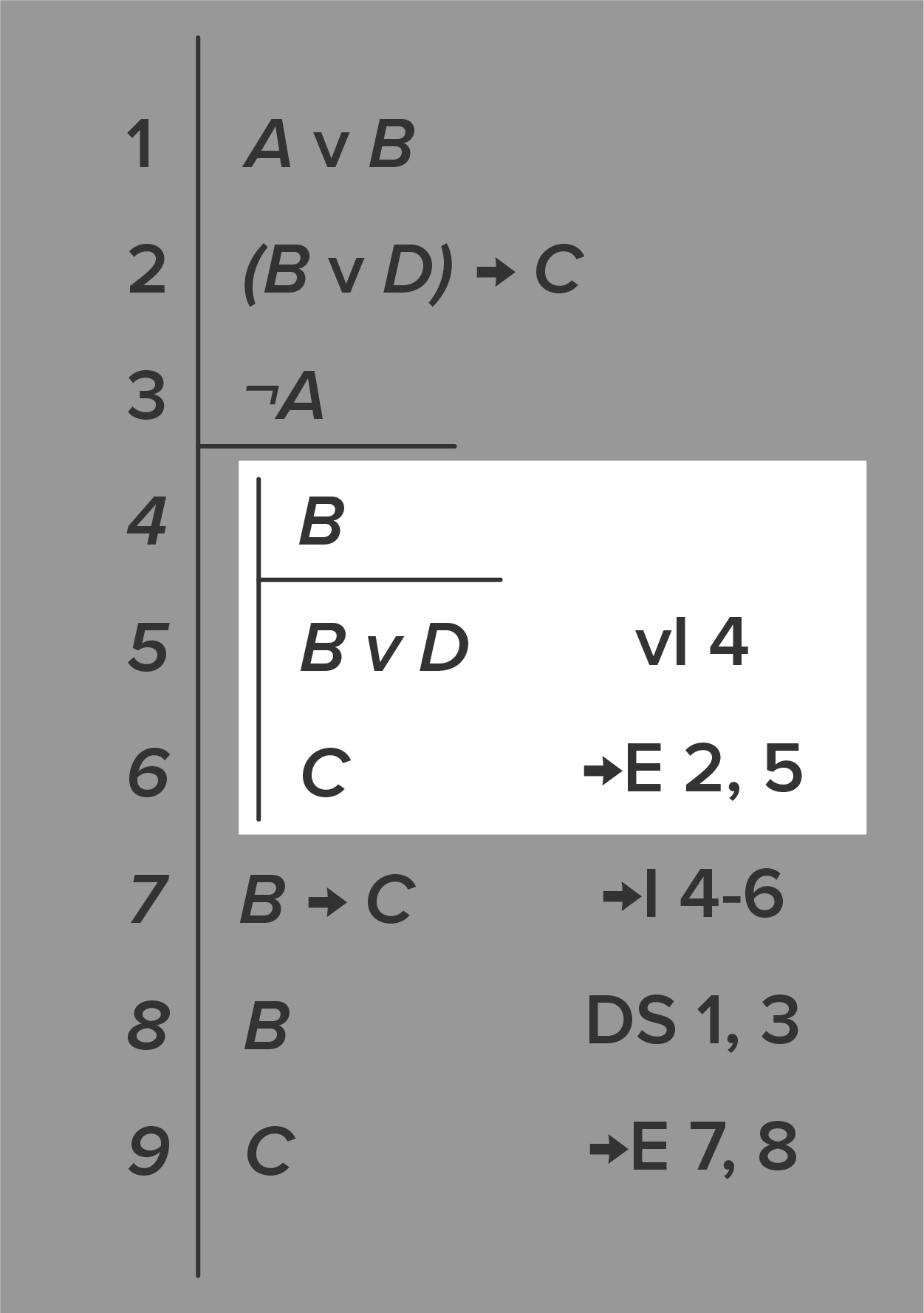
A longer logical proof is shown. The complete proof reads: 1. A ∨ B; 2. (B ∨ D) → C; 3. ¬A; horizontal line. There is now an additional vertical line to the left of the sentences; the next three sentences are indented and highlighted: 4. B; 5. horizontal line; 6. B ∨ D notation ∨I 4; C notation →E 2, 5. The vertical line ends and the numbered sentences continue, no longer indented. 7. B→C notation →I 4-6; 8. B Notation DS 1,3; 9. C notation →E 7,8.

As in the previous proofs, you can see a horizontal line under the subpremise, followed by numbered sentences. You can see the rules and numbers of the previous sentences that make each derivation possible. The additional vertical line helps demarcate the subproof with its subpremise(s). Our subpremise is that B is true, so there is also a new horizontal line underneath line 4. There is no notation on the right for this line, because the truth of B is an assumption, not a derivation of the proof. It is saying, “Let’s see what happens if B is true.” The subsequent lines in the subproof do require notations to show the logical rules that apply and the lines in the proof they apply to.
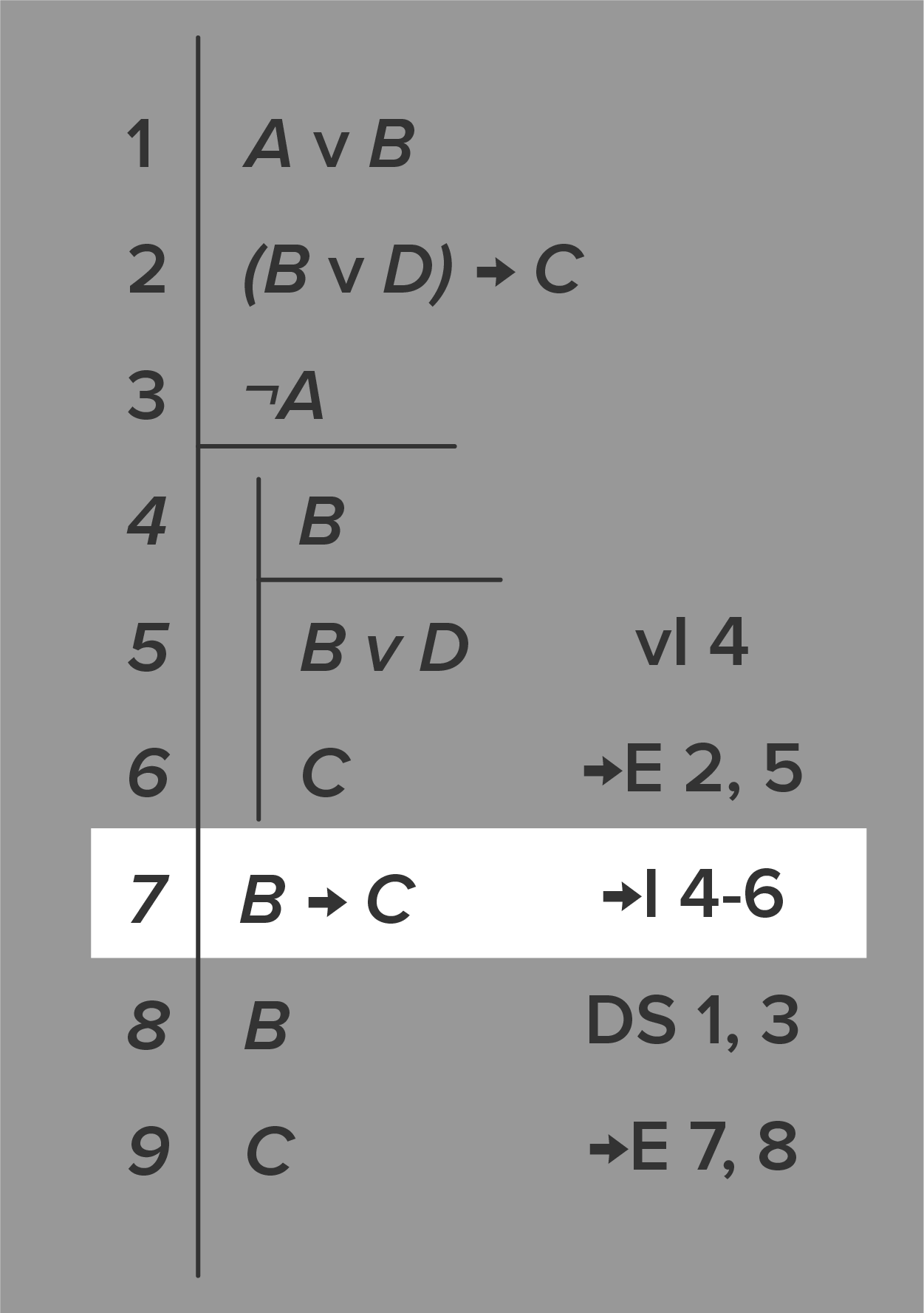
The same proof as before with line 7 highlighted. This is the conditionalization step immediately after the subproof. 7. B→C notation →I 4-6

Notice after we’ve concluded our subproof, the final step is conditionalization in line 7. We resume the main proof with the conditional sentence, If B, then C. This sentence is added to the main proof because it discharges the assumption from our subproof that B is true, but turns it into a sentence that we can use. It states that if B is assumed, then we can derive C, which the subproof has proven.

big idea
Subproofs will always end with a conditional sentence being added to the main proof.

This represents the natural language statement in that “if Brenda goes, you know there’ll be a computer.” You may see here how the subproof gives us an important shortcut to proving or explaining an argument.

think about it
How often do you give hypothetical scenarios and consider what would happen? How can these help come to a conclusion or make an argument?

terms to know
Subproof
A secondary proof embedded in the main proof which makes temporary assumptions to explore what outcomes they lead to.
Subpremise
A sentence that is temporarily assumed to be true for the purposes of a subproof.
Subderivation
An intermediate sentence in a subproof that is derived from the subpremises.
Subconclusion
The conclusion in a subproof.
Discharge
Eliminating the assumption of truth of a subpremise in a subproof via conditionalizing the subconclusion on the subpremise.
Conditionalize
Creating a conditional sentence in the main proof after a subproof, where the subpremise becomes the antecedent, and the subconclusion becomes the consequent. Conditionalizing demonstrates the relationship between these sentences without assuming additional premises.
Hypothetical Truth
A possible truth represented by a conditional sentence which shows us what would be true, given certain conditions.

summary
In this lesson, you began to learn about proofs, a method for explaining why arguments are logically valid. We first learned why we use proofs, because they reveal the reasoning behind arguments where our other methods only test for validity. We learned the basics of constructing proofs, which are essentially logical arguments with intermediary steps (called derivations) and each step is justified by the rule of logic applied and the previous sentence that are used to derive the new one. Finally, we learned that proofs may also include subproofs. Similar to cases, a subproof is proposing a particular scenario in the form of a temporary subpremise, and the subconclusion it leads to. While these temporary assumptions themselves cannot support the conclusion, a subproof can lead to a conditional sentence that can be used in the main proof.

SOURCE: THIS TUTORIAL HAS BEEN ADAPTED FROM 1)“INTRODUCTION TO LOGIC AND CRITICAL THINKING” BY MATTHEW J. VAN CLEAVE. ACCESS FOR FREE AT OPEN.UMN.EDU/OPENTEXTBOOKS/TEXTBOOKS/457 2) “FORALL X: CALGARY” BY TIM BUTTON. ACCESS FOR FREE AT FORALLX.OPENLOGICPROJECT.ORG. LICENSE: CREATIVE COMMONS ATTRIBUTION 4.0 INTERNATIONAL.


Terms to Know
Conditionalize

Creating a conditional sentence in the main proof after a subproof, where the subpremise becomes the antecedent, and the subconclusion becomes the consequent. Conditionalizing demonstrates the relationship between these sentences without assuming additional premises.

Derivation

A sentence in a proof whose truth we have inferred from the premises. They are intermediate steps which take us from the premises to the conclusion by way of the rules of inference.

Discharge

Eliminating the assumption of truth of a subpremise in a subproof via conditionalizing the subconclusion on the subpremise.

Fitch System

One of several systems of notating logical proofs, developed by Frederich Fitch in 1952.

Hypothetical Truth

A possible truth represented by a conditional sentence which shows us what would be true, given certain conditions.

Proof

A method for demonstrating validity of a logical argument based on a set of inference rules.

Rules of Inference

A set of basic logical rules that tell us what logical sentences follow from what other logical sentences.

Subconclusion

The conclusion in a subproof.

Subderivation

An intermediate sentence in a subproof that is derived from the subpremises.

Subpremise

A sentence that is temporarily assumed to be true for the purposes of a subproof.

Subproof

A secondary proof embedded in the main proof which makes temporary assumptions to explore what outcomes they lead to.