Table of Contents |
Ethics is the branch of philosophy that analyzes and defends concepts of value, seeking to determine right and wrong. While some ethical theories focus on consequences (utilitarianism) or duties (deontology), virtue-based ethics evaluates actions in terms of the kind of person someone is or is becoming. It can be useful to see how virtue ethics is doing something different by looking at key aspects of the theories.
EXAMPLE
Forcing oneself to engage in social situations may help cultivate the virtue of sociability.Aristotle defines the virtuous person as one who acts “at the right times, with reference to the right objects, towards the right people, with the right aim, and in the right way” (Aristotle, ca. 350 B.C.E./1908, 1106b20–24). This formulation highlights the complexity of moral action, not as a fixed rule but as a nuanced judgment relative to the agent and the situation. He compares ethical decision-making to practical arts such as medicine or navigation, where “the agents themselves must in each case consider what is appropriate to the occasion” without relying on “any art or set of precepts” (Aristotle, ca. 350 B.C.E./1908, 1104a6–9).
This agent-relative nature of virtue ethics means that moral evaluation is not about applying universal formulas but about cultivating the ability to perceive and respond to the morally salient features of each situation. As Aristotle puts it, “excellence is a state concerned with choice … determined by reason and the way in which the man of practical wisdom would determine it” (Aristotle, ca. 350 B.C.E./1908, 1106b36–1107a2).
Virtue-based ethics divides character traits into those that are morally desirable (virtues) and those that are morally undesirable (vices). Here are samples of both.
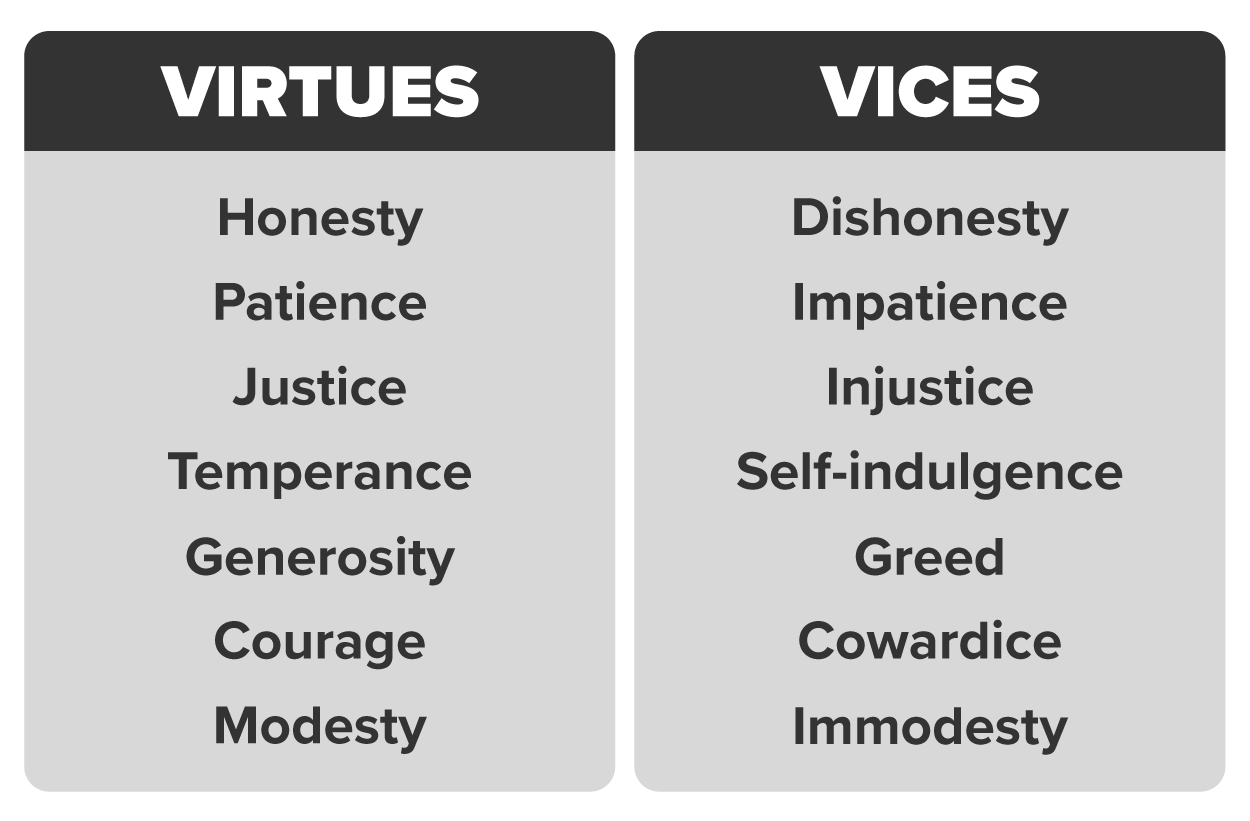
Philosophers who advance virtue-based ethics usually claim that everyone should try to cultivate virtues and avoid vices. This makes virtue ethics a realist theory, which holds that some ethical judgments are universally valid and related to facts about the real world.
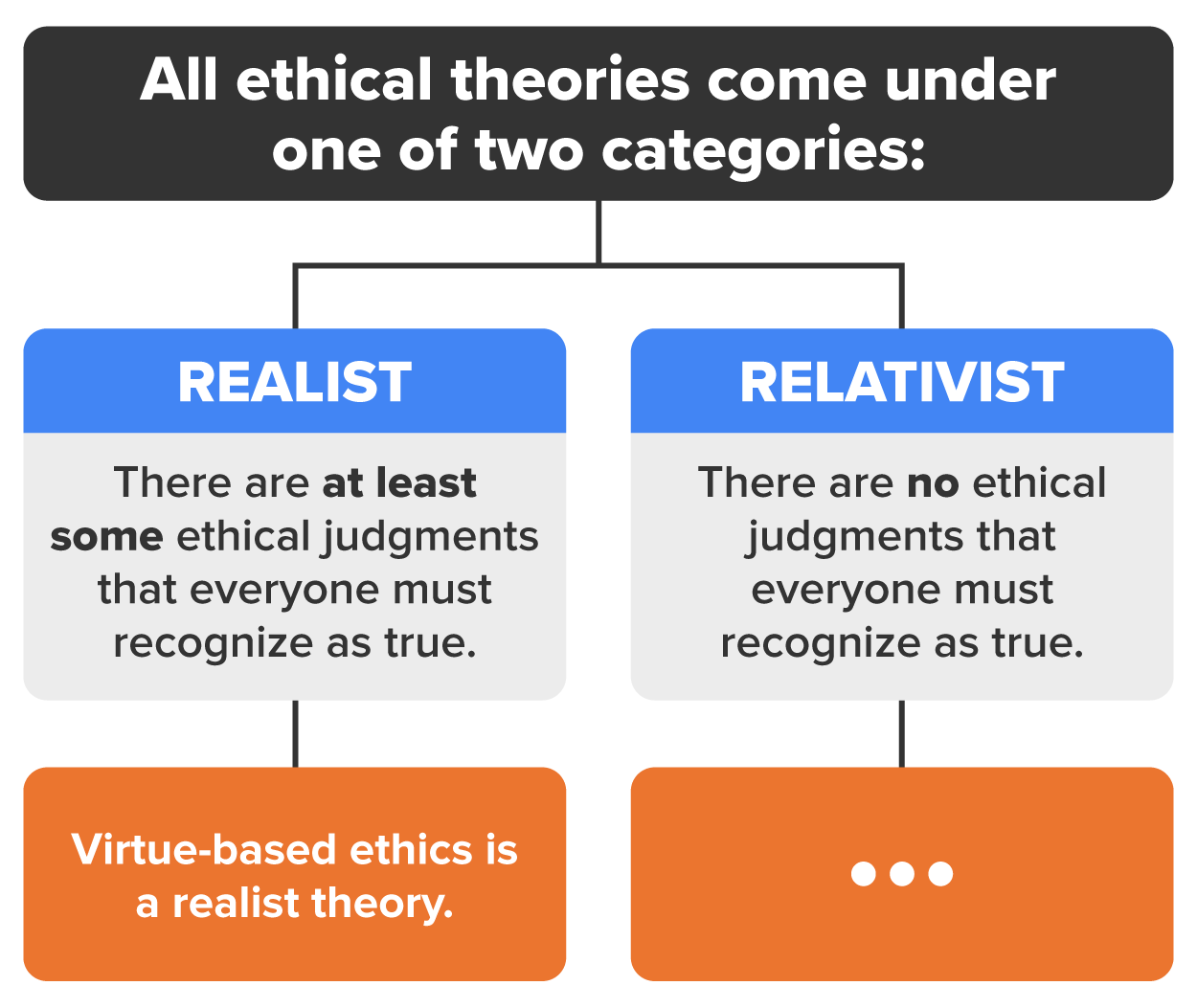
Aristotle’s approach to virtue is grounded in the idea of the mean: each virtue lies between two extremes: excess and deficiency. Courage is the mean between cowardice and foolhardiness (Aristotle, ca. 350 B.C.E./1908, 1104a19–22). Someone who runs from danger (cowardice) is displaying a deficiency of the attribute. Alternatively, someone who charges into battle with no plans and no hope of victory is acting in a foolhardy way. Both extremes are problematic, and what we desire is to find the proper middle point between them so that we can possess the virtue (in this case, of bravery).
Importantly, this mean is not the same for everyone. Aristotle writes that “excellence … is a state concerned with choice, lying in a mean relative to us, this being determined by reason and the way in which the man of practical wisdom would determine it” (Aristotle, ca. 350 B.C.E./1908, 1106b36–1107a2). This idea of the mean is not a fixed midpoint but a personalized balance that varies depending on the agent and the situation. Aristotle emphasizes that “the general concept of each specific virtue is equidistant from the extremes, while the specific excellence of each individual is that which is neither too much nor too little for that agent” (Aristotle, ca. 350 B.C.E./1908, 1106a30–35). He illustrates that the mean is particular to each person with the example of nutrition: “We know that we need to feed Milo the wrestler more than a non-athlete” (Aristotle, ca. 350 B.C.E./1908, 1106b1–4), showing that what is appropriate depends on the individual. Similarly, an action that is courageous for one person may be foolhardy for another.
Learning to be virtuous, then, is not immediate. This often involves failing first, either by doing too much or too little. This process of moral development can be likened to tacking a sailboat. When sailing against the wind, one cannot move directly forward but must zigzag, alternating between port and starboard, gradually making progress toward the destination. Similarly, in the pursuit of virtue, individuals often veer too far in one direction (excess), then overcorrect in the other (deficiency), before learning to adjust their course and find the balanced path.
Aristotle’s notion of virtue as a mean relative to us (Aristotle, ca. 350 B.C.E./1908, 1106a30–35) reflects this dynamic. Just as a sailor learns to read the wind and adjust the sails, the moral agent learns through experience to perceive the morally salient features of a situation and respond appropriately. The process is not mechanical but requires practical wisdom (what Aristotle calls phronesis) to “determine the mean” in each case (Aristotle, ca. 350 B.C.E./1908, 1106b36–1107a2).
Aristotle compares the process of acquiring a virtue to learning a craft: “Just as builders become such by building, and lyre-players by playing the lyre, we become just by doing just acts, temperate by doing temperate acts, brave by doing brave acts” (Aristotle, ca. 350 B.C.E./1908, 1103a3–b2). Through repeated action and reflection, individuals begin to recognize the appropriate mean.
American philosopher Nancy Sherman (1951–) elaborates on this developmental process, noting that “we become inspired to perfect our own competence by witnessing the exemplary performance of others” and that “activities are made more precise and more enduring by their proper pleasure” (Aristotle, ca. 350 B.C.E./1908, 1175b14–15; Sherman, 1999, pp. 64–65). As agents grow in moral skill, they begin to enjoy acting virtuously, which reinforces their habits and deepens their understanding.
This journey toward virtue often begins with imbalance. For example, someone learning courage might initially act recklessly, then swing toward excessive caution, before finally finding the balanced response appropriate to their character and context. Aristotle acknowledges this challenge, writing that “in matters of living … the agents themselves must in each case consider what is appropriate to the occasion” without relying on “any art or set of precepts” (Aristotle, ca. 350 B.C.E./1908, 1104a6–9). Thus, virtue is not a static trait but a dynamic achievement, cultivated through experience, error, and reflection. The process of learning virtue is deeply personal, requiring both internal judgment and external guidance.
Ethical theories can evaluate an agent’s actions and the character of the agent. Some theories, such as utilitarianism and deontology, make actions the primary object of evaluation. In these cases, the person’s character is only seen in light of their actions. Therefore, a person’s character is secondary in these theories. By contrast, virtue-based ethics makes character the primary object of evaluation. Here, actions are understood in terms of how they impact the agent’s character.
EXAMPLE
If is someone drinking excessively or taking drugs, people often take this as a sign of that person’s character, namely intemperance or self-indulgence.You would also evaluate actions in terms of how they encourage certain virtues or discourage certain vices.
EXAMPLE
If a naturally shy person made an effort to take up public speaking, any opportunity they got, you would see this as a good action because it’s an attempt to overcome the vice of excessive shyness or bashfulness.However, if someone was already very confident, speaking publicly all the time might be seen as a sign of arrogance. In this case, the action is bad because it encourages the vice of arrogance. Because of this emphasis on character, the kind of question you would ask yourself is different than the kind that you would ask yourself if you were primarily concerned with evaluating actions.
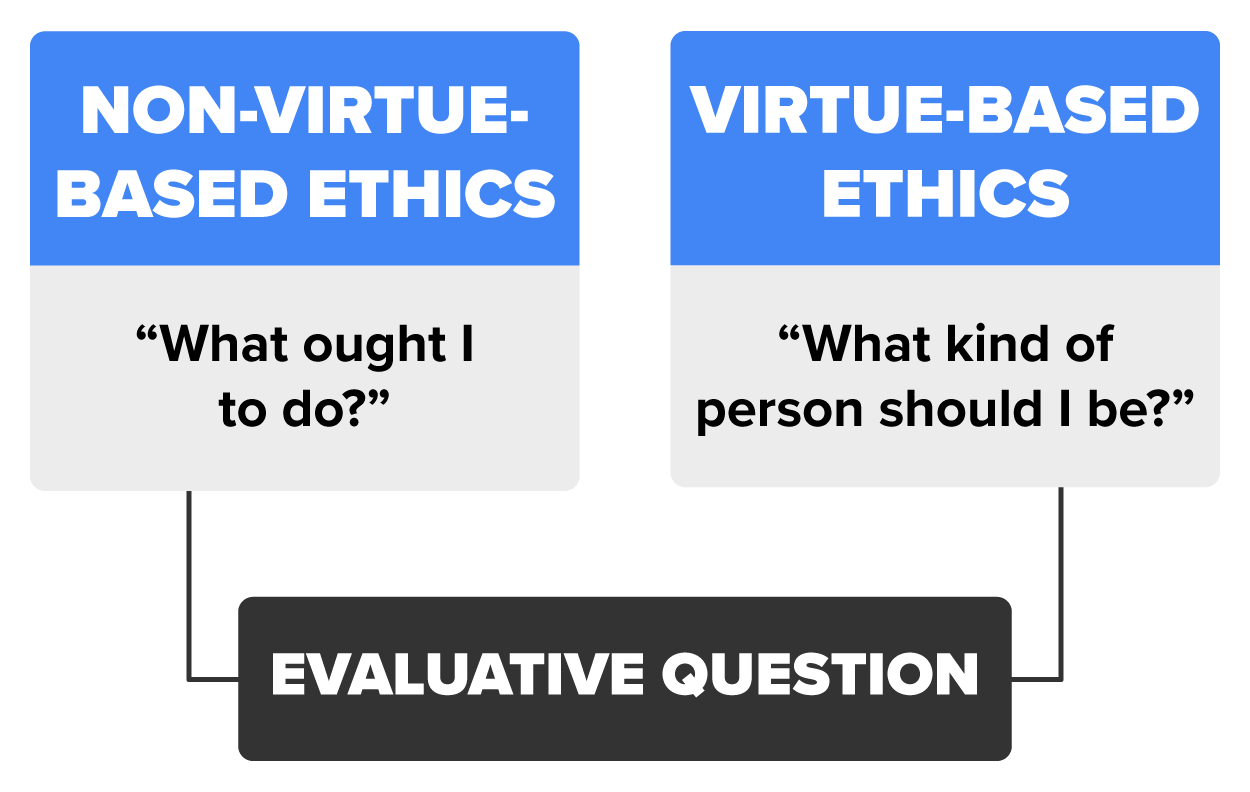
This emphasis on character shifts the central ethical question from “What ought I to do?” to “What kind of person should I be?” Aristotle believed that moral excellence is not innate but developed through habituation. He writes, “we become just by doing just acts, temperate by doing temperate acts, brave by doing brave acts” (Aristotle, ca. 350 B.C.E./1908, 1103a3–b2). This process begins in youth, and Aristotle insists that “forming the right habits from youth on … makes all the difference” (Aristotle, ca. 350 B.C.E./1908, 1103b24–26).
Nancy Sherman likens moral education to learning a skill like tennis. Just as players improve through repetition and guidance, moral agents develop virtue through repeated exposure to ethical situations and reflection. Over time, perception of morally salient features becomes “habitual … comes to us almost naturally” (Sherman, 1999, p. 62). She also notes that “we become inspired to perfect our own competence by witnessing the exemplary performance of others” (Sherman, 1999, p. 65), reinforcing the role of community and mentorship in moral development.
Aristotle acknowledges that we often rely on others to help us deliberate: “We call in others to aid us in deliberation on important questions, distrusting ourselves as not being equal to deciding” (Aristotle, ca. 350 B.C.E./1908, 1112b10–11). This communal aspect of moral reasoning reinforces the importance of education, mentorship, and civic norms.
Laws and social standards also play a role in shaping virtue. Aristotle writes that the best way to foster practical wisdom is to “get from youth up a right training for excellence” under “right laws” (Aristotle, ca. 350 B.C.E./1908, 1179b31). These laws help guide behavior, especially for those who “obey necessity rather than argument, and punishment rather than what is noble” (Aristotle, ca. 350 B.C.E./1908, 1180a4–5).
Source: THIS TUTORIAL WAS AUTHORED BY SOPHIA LEARNING. PLEASE SEE OUR TERMS OF USE.
REFERENCES
Aristotle. (350 B.C.E./1908). Nicomachean Ethics (W. D. Ross, Trans.). The Internet Classics Archive. classics.mit.edu/Aristotle/nicomachaen.html
Sherman, N. (Ed.). (1999). Aristotle’s Ethics: Critical Essays. Rowman & Littlefield Publishers.



