Table of Contents |
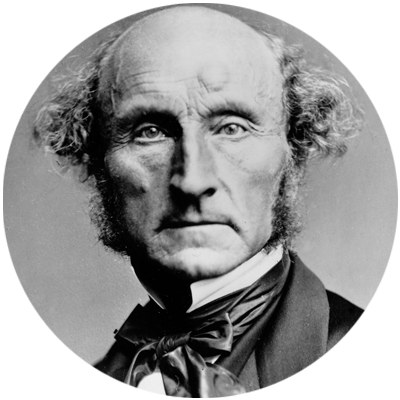 Utilitarianism is the name given to any ethical theory that says something is good if, overall, it brings about utility. This idea, that the goodness of something depends on how much utility it brings about, is often called the utility principle. This approach to ethics, and the term “utility,” is most closely associated with British intellectual John Stuart Mill (1806–1873). In 1861, Mill published in Fraser’s Magazine (a popular literary magazine in England) a multipart essay that expanded upon a system of morality derived from the work of Jeremy Bentham (1748–1832). This moral theory is a consequentialist morality, which means that the overall moral value of an action is determined by the consequences (outcomes) of the action. If we think about a potential action, we work from a prediction of the consequences.
In this excerpt from the essay, Mill explains both what he means by utility and how it functions as a measure of the moral value of an action.
"The creed which accepts as the foundation of morals, Utility, or the Greatest Happiness Principle, holds that actions are right in proportion as they tend to promote happiness, wrong as they tend to produce the reverse of happiness. By happiness is intended pleasure, and the absence of pain; by unhappiness, pain, and the privation of pleasure. To give a clear view of the moral standard set up by the theory, much more requires to be said; in particular, what things it includes in the ideas of pain and pleasure; and to what extent this is left an open question. But these supplementary explanations do not affect the theory of life on which this theory of morality is grounded–namely, that pleasure, and freedom from pain, are the only things desirable as ends; and that all desirable things (which are as numerous in the utilitarian as in any other scheme) are desirable either for the pleasure inherent in themselves, or as means to the promotion of pleasure and the prevention of pain."
This paragraph serves both as an introduction to utilitarian theory and as the complete statement of the approach. Utilitarianism holds that utility is the measure of morality. The greater the amount of utility produced by an action, the more morally praiseworthy (good) the action is. Utility can be understood as a specific understanding of happiness. We can increase happiness by increasing pleasure or decreasing pain. Across all possibilities, what the utilitarian seeks is the greatest utility for the greatest number of people. Thus, it is the happiness of a community that is considered, not the happiness of any single individual.
IN CONTEXT
Let’s look at two simple scenarios that are useful to understand the theory.
- Scenario 1: If I save a drowning person’s life, we can imagine that the person who was saved will be happy, as will his family and friends. At most, we might think that an undertaker would be disappointed. Since there is more happiness than unhappiness, there has been an increase in utility and the action is morally good.
- Scenario 2: Chuck has been having horrible pain in his jaw for some time. After going to a dentist, he discovers that he is in need of a root canal. While the procedure involves numbing, there is a fair amount of discomfort in the process, as well as general pain while he heals. But a few days later, he is pain free for the first time in months. In this instance, we can imagine that Chuck is happy not to be in pain, his friends are happy not to hear about his pain, and (most importantly) his prior pain is diminished. There is more happiness than unhappiness, so there is an increase in utility and the action is morally good.
There is a danger in thinking about utility in too narrow a sense.
EXAMPLE
You may hear “utility” and think of something along the lines of a “utility belt,” or something where “utility” means “useful for a job.”But here, utility just refers to something that’s beneficial to us or aids our well-being. You could say that something has utility if it makes us happy, but happiness is understood broadly to include anything from the comfort of a good chair to the relief of knowing your family is safe. This way of thinking comes quite naturally to us most of the time. We often think that people should act in a way that brings about the better outcome. You can even see this in established laws or policies.
EXAMPLE
Some governments have passed policies to limit sugar in food to decrease obesity rates. Cutting down the level of obesity in a population is seen as a good outcome, so the policy is seen as good.Utilitarianism holds that everyone ought to increase utility, but this doesn’t mean everyone should act the same.
EXAMPLE
If a person has lots of money, they can increase utility by donating to charity. If someone else doesn’t have a lot of money, they could increase utility by volunteering at a homeless shelter. The two people would have different actions, but they would be following the same ethical ideal.With this in mind, you can figure out what kind of ethical theory utilitarianism is.
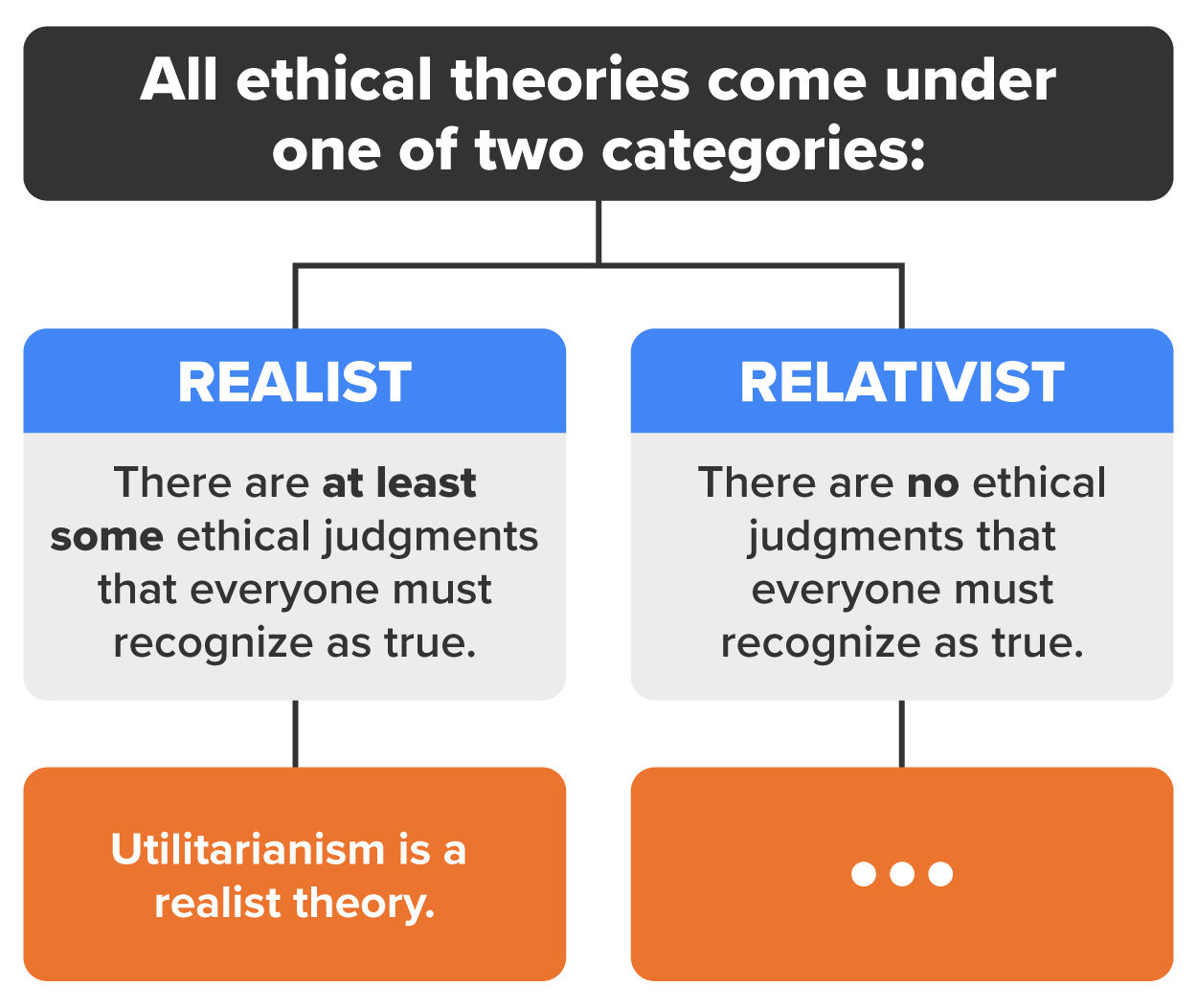
For a utilitarian, anything that affects consequences is ethically relevant. If you wanted to decide which action is best, you would need to figure out which action would have the best possible outcome. This can be difficult because our actions affect people in different ways.
EXAMPLE
If you give money to a homeless person, you can’t be absolutely sure if this will bring about happiness or not. Maybe they use that money to buy a meal (a good consequence), or maybe they waste it on a losing lottery ticket (not a good consequence).People do not respond in the same way as things or objects do. This is because, unlike mere things, humans make decisions rather than being pushed around by various causes. For this reason, we can’t predict the way humans will be affected by actions in the same way that we can predict the way things are affected by actions. Nevertheless, our experience with people can help us predict some of the consequences of our actions fairly well.
EXAMPLE
Although charities sometimes suffer from organizational problems like inefficiency, we know that giving to them will generally lead to good consequences, such as funding research into preventable diseases or raising awareness of a neglected problem.This shows that there is at least a rough guide available for your actions, even if you cannot predict with absolute certainty what the consequences of your actions will be.
So far, we’ve said that utilitarianism determines the good by what brings about utility. But you need to keep in mind that it isn’t simply about the presence or absence of utility. It is also about the degree, or quantity, of utility.
IN CONTEXT
Imagine you’re deciding where to go on vacation. If you decide to go someplace where you can also meet up with some old friends, it would bring about more happiness than if you don’t. Therefore, the utilitarian will say it’s good.
But if you decide to travel to a place that recently suffered a natural disaster and you volunteer to help survivors, this brings about even more utility. Therefore, for the utilitarian, this is a better action.
As you can see, there are different degrees of goodness for the utilitarian. The same goes for badness.
EXAMPLE
Avoiding paying your taxes is bad because it reduces the utility experienced by your fellow nationals as a result of less funding for public services. But if you were a lawyer helping many wealthy people to avoid paying taxes, this is worse. That’s because the reduction in revenue is much more severe.Utilitarians are concerned not only with the amount of utility that is produced but the type of utility as well. As you’ll recall, utility is meant to measure happiness, and by happiness, they mean pleasure and lack of pain. But some pleasures just seem to be of a better quality than others.
"Of two pleasures, if there be one to which all or almost all who have experience of both give a decided preference, irrespective of any feeling of moral obligation to prefer it, that is the more desirable pleasure. If one of the two is, by those who are competently acquainted with both, placed so far above the other that they prefer it, even though knowing it to be attended with a greater amount of discontent, and would not resign it for any quantity of the other pleasure which their nature is capable of, we are justified in ascribing to the preferred enjoyment a superiority in quality, so far outweighing quantity as to render it, in comparison, of small account."
EXAMPLE
While there is a pleasure that comes from eating a candy bar, that is not the same sort of pleasure that one has from achieving a long-standing goal.Perhaps, we might think that the difference is one of amount, but Mill would have us believe that pleasures that come from intellectual endeavors are better than those that come from purely physical aspects. His proof of this is that “few human creatures would consent to be changed into any of the lower animals for a promise of the fullest allowance of a beast’s pleasures.”
Mill understands that there is some sort of proportionality between the qualities of utility, such that a lesser amount of high-quality pleasure would be preferable to a higher amount of low-quality pleasure. Indeed, someone who has the ability to experience the higher quality would be better off in all cases. As he famously states, “It is better to be a human being dissatisfied than a pig satisfied; better to be Socrates dissatisfied than a fool satisfied.”
As a consequentialist theory, utilitarianism is concerned with the happiness of everyone, not just the person acting. Not paying your taxes may make you happy, but it wouldn’t achieve happiness overall. That’s because many people benefit from the services provided by taxation. Likewise, using your family’s savings to buy yourself a yacht may make you happy, but it may not bring happiness to the rest of your family.
Bentham, whose work was foundational to Mill’s explanation of utilitarianism, stated “The greatest happiness of the greatest number is the foundation of morals and legislation.” For Bentham and Mill, it is not just the happiness (utility) of the person acting but the larger impact on the community. In some actions, like in the yacht example above, it is the utility of the family. Other actions, like the tax example above, involve the utility of one’s town, state, or nation.
As you may have guessed, a utilitarian is not just concerned with whether or not something has good consequences. They are also concerned about the potential bad consequences, as most actions have both.
EXAMPLE
Imagine you manage to stop a bully from assaulting their target and they turn their hostility towards you instead. The positive consequence would be that someone escaped violence, but the negative consequence would be that you didn’t.As we have seen, the utilitarian tries to get all the probable consequences in view when evaluating things. They can do so by considering:
We also saw that a utilitarian can calculate which action brings about more utility by contrasting what makes only you happy with what makes many people happy. The example about whether or not you pay taxes showed this.
Lastly, a utilitarian can think about the probability of a consequence.
EXAMPLE
You may be more likely to get a decent job if you finish school. Therefore, the utilitarian will say you ought to go to school to get that probable utility. The utilitarian could also predict other utilities further down the road, such as how you might contribute to society more using the knowledge you gained.Source: THIS TUTORIAL WAS AUTHORED BY SOPHIA LEARNING. PLEASE SEE OUR TERMS OF USE.
REFERENCES
Bentham, J. (2009). The works of Jeremy Bentham (J. Bowring, Ed.; Vol. 10). Liberty Fund. (Original work published 1843). oll.libertyfund.org/titles/bentham-the-works-of-jeremy-bentham-vol-10-memoirs-part-i-and-correspondence#lf0872-10_head_070



