Table of Contents |
You may already have heard of one very common tool firms use to analyze their strategic and competitive situations: SWOT analysis, which is an acronym for strengths, weaknesses, opportunities, and threats. Firms use SWOT analysis to get a general understanding of what they are good or bad at and what factors outside their doors might present chances for success or difficulty. Let’s take a look at SWOT analysis piece by piece.
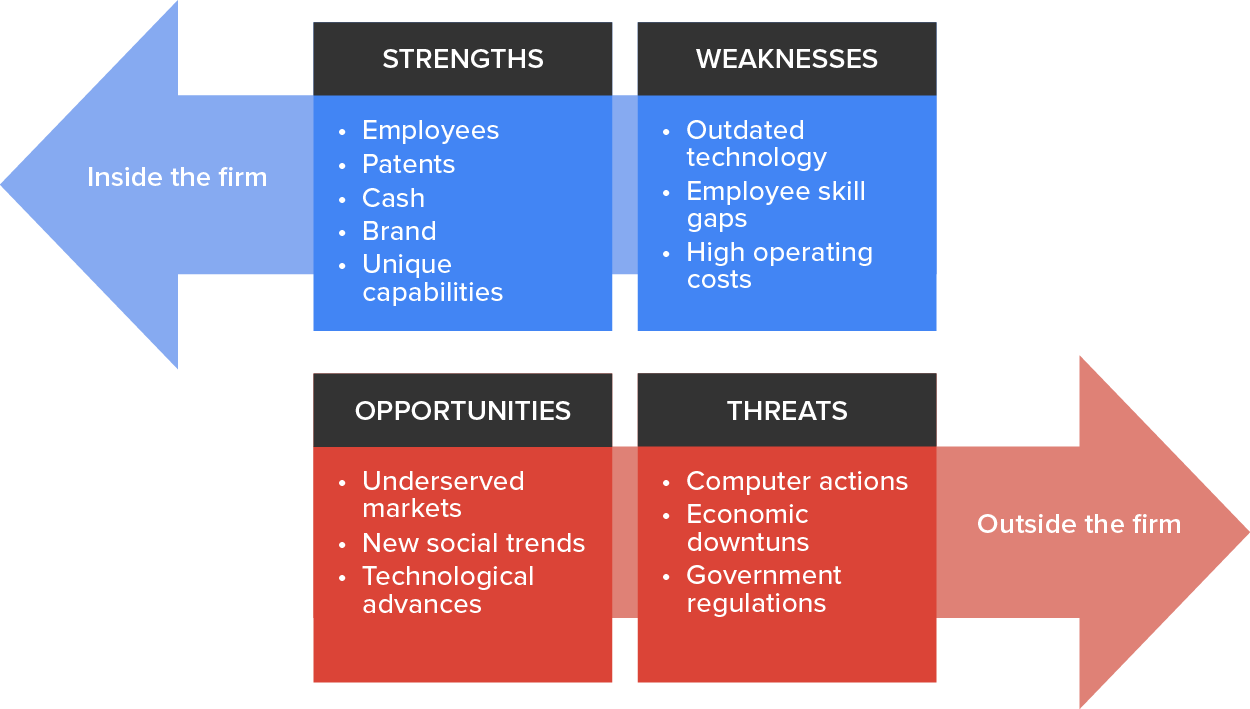
A firm’s strengths are, put simply, what it is good at. Nike is good at marketing sports products, McDonald’s is good at making food quickly and inexpensively, and Ferrari is good at making beautiful fast cars. When a firm analyzes its strengths, it compiles a list of its capabilities and assets. Does the firm have a lot of cash available? That is a strength. Does the firm have highly skilled employees? Another strength. Knowing exactly what it is good at allows a firm to make plans that exploit those strengths. Nike can plan to expand its business by making products for a sport it doesn’t currently serve. Its sports marketing expertise will help it successfully launch that new product line.
A firm’s weaknesses are what it is not good at—things that it does not have the capabilities to perform well. Weaknesses are not necessarily faults; remember that not all firms can be great at all things. When a firm understands its weaknesses, it will avoid trying to do things it does not have the skills or assets to succeed in, or it will find ways to improve its weaknesses before undertaking something new. A firm’s weaknesses are simply gaps in capabilities, and those gaps do not always have to be filled within the firm.
SWOT analysis alerts firms to the gaps in their capabilities so they can work around them, find help in those areas, or develop capabilities to fill the gaps.
For Paychex, these capabilities are a company strength—that’s what it does. Other companies that do not have the resources to develop this capability or may not be interested in doing so can hire Paychex to do the job for them.
Strengths and weaknesses are internal to an organization, but opportunities and threats are always external. An opportunity is a potential situation that a firm is equipped to take advantage of. Think of opportunities in terms of things that happen in the market. Opportunities offer positive potential; however, sometimes a firm is not equipped to take advantage of an opportunity which is why considering the entire SWOT analysis is important before deciding what to do. For example, as cities are becoming more populated, parking is becoming scarcer. Younger consumers who live in cities are starting to question whether it makes sense to own a car at all when public transportation is available and parking is not. Sometimes, however, a person might need a car to travel outside the city or transport a special purchase. Daimler, the manufacturer of Mercedes-Benz and Smart cars, started a car-sharing service in Europe, North America, and China called Car2Go to offer cars to this new market of part-time drivers. By establishing Car2Go, Daimler has found a way to sell the use of its products to people who would not buy them outright.
When a manager assesses the external competitive environment, he/she labels anything that would make it harder for the firm to be successful as a threat. A wide variety of situations and scenarios can threaten a firm’s chances of success, from a downturn in the economy to a competitor launching a better version of a product the firm also offers. A good threat assessment looks thoroughly at the external environment and identifies threats to the firm’s business so it can be prepared to meet them. Opportunities and threats can also be a matter of perspective or interpretation. For example, the Car2Go service that Daimler developed to serve young urban customers who don’t own cars could also be cast as a defensive response to the trend away from car ownership in this customer group. Daimler could have identified decreasing sales among young urban professionals as a threat and developed Car2Go as an alternative way to gain revenue from these otherwise lost customers.
Although a SWOT analysis can identify important factors and situations that affect a firm, it only works as well as the person doing the analysis. It can also be beneficial to complete a SWOT analysis for each of a firm’s top three or four competitors to get a better sense of the organization’s overall competitive position. Generally, strengths and weaknesses will differ, but opportunities and threats will be the same among firms in the same industry and region.
That’s why the remainder of this Challenge will present tools for developing a strategic analysis that is more thorough and systematic in examining both the internal and external environments that firms operate in.
Source: THIS TUTORIAL HAS BEEN ADAPTED FROM OPENSTAX "PRINCIPLES OF MANAGEMENT". ACCESS FOR FREE AT openstax.org/books/principles-management/pages/1-introduction. LICENSE: CREATIVE COMMONS ATTRIBUTION 4.0 INTERNATIONAL. Accessed by June 2021.
REFERENCES
Paychex. (2017). Company history. Retrieved 2017 from www.paychex.com/corporate/history.aspx



