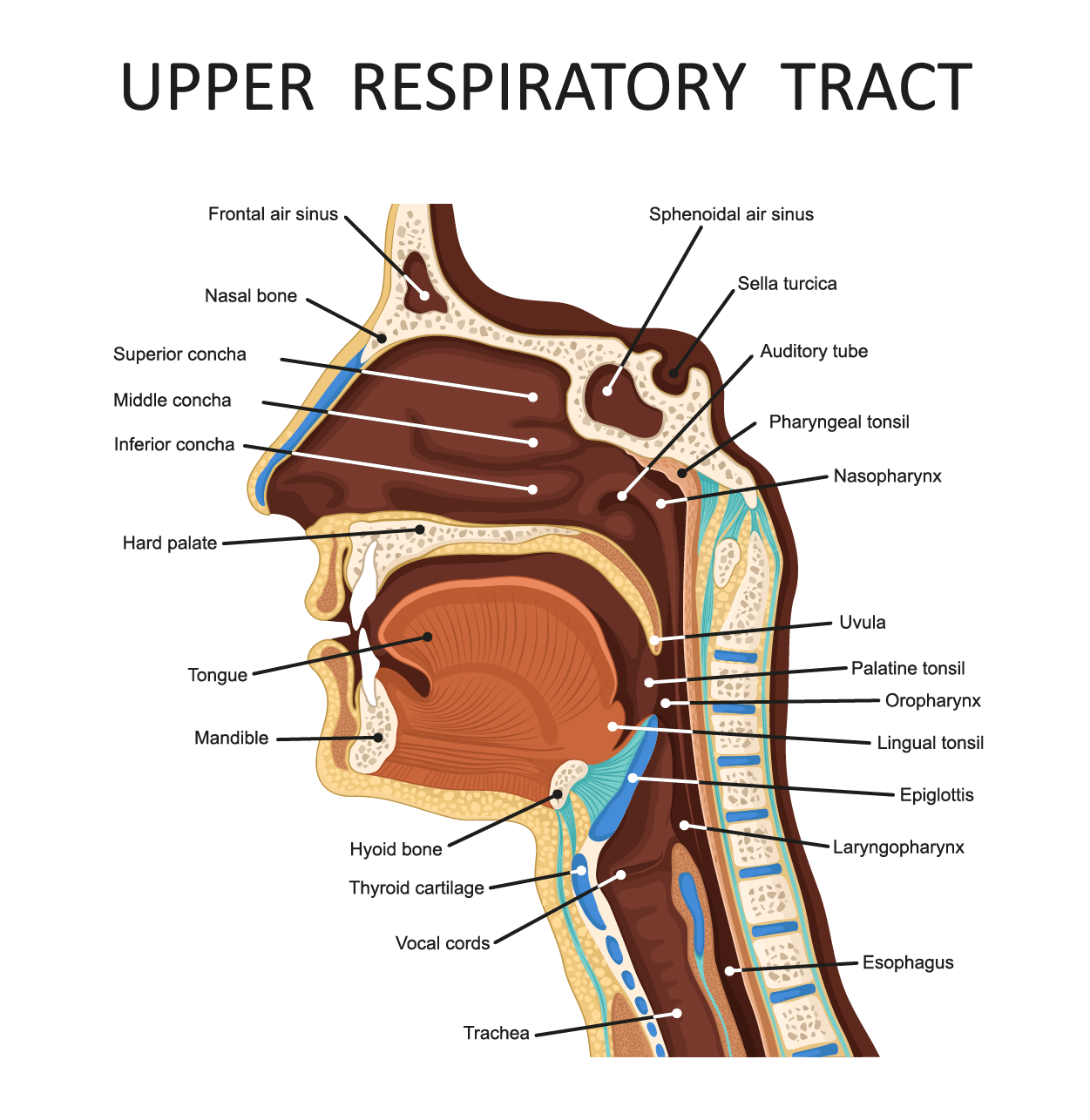
The organs of the upper respiratory tract include the nose and its adjacent structures as well as the pharynx and larynx. The primary roles of the upper respiratory tract include the passing of air breathed in and out of the lungs as well as heating, humidifying, and filtering the air. Moreover, it is involved in actions such as swallowing, speech, and sneezing.
The Upper Respiratory Tract
2. The Nose and Its Adjacent Structures
key concept
The major entrance and exit for the respiratory system is through the nose. When discussing the nose, it is helpful to divide it into two major sections: the external nose and the nasal cavity (or internal nose).
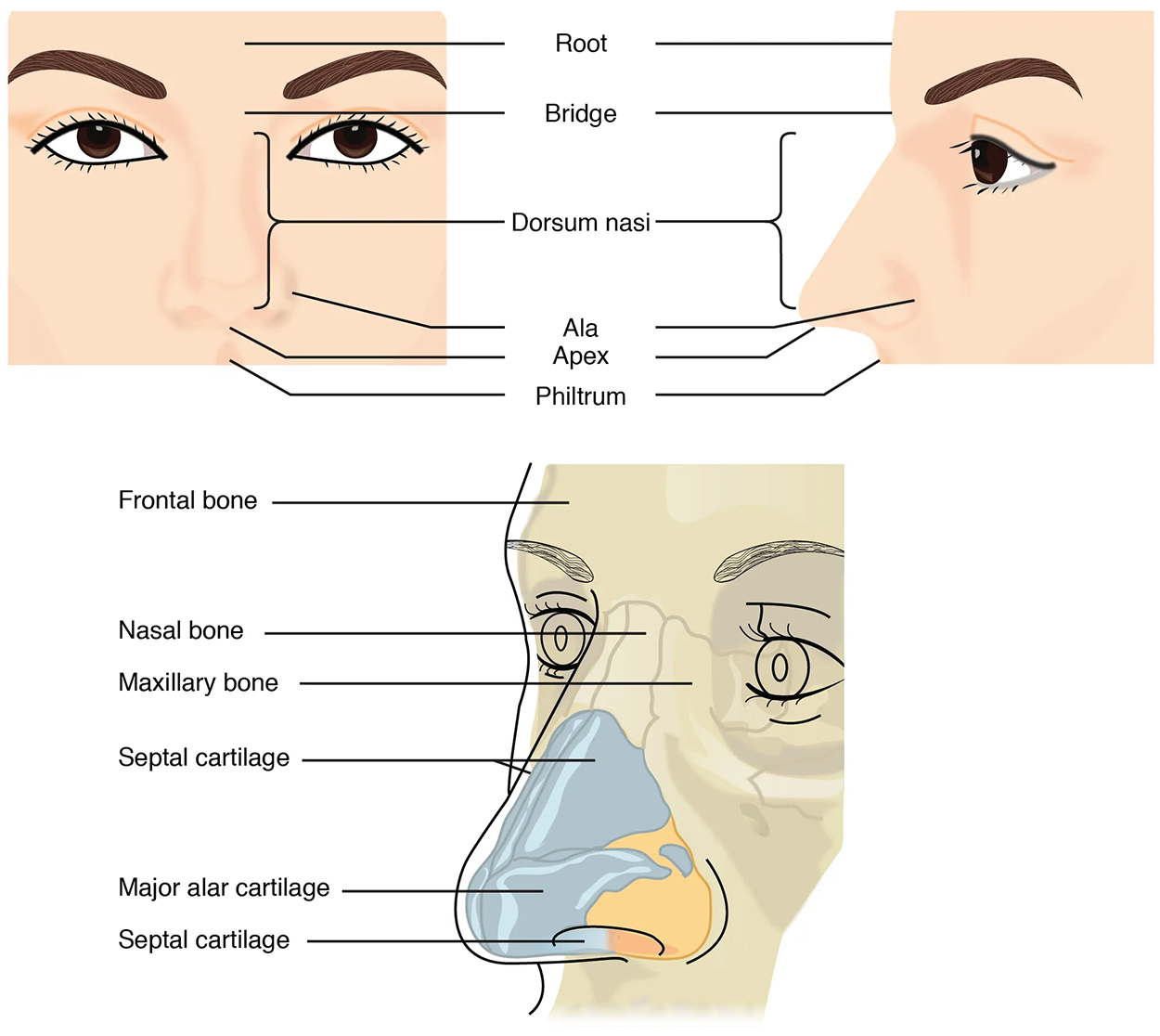
The external nose consists of the surface and skeletal structures that result in the outward appearance of the nose and contribute to its numerous functions. The root (of the nose) is the region of the nose located between the eyebrows. The bridge is the part of the nose that connects the root to the rest of the nose. The dorsum nasi is the length of the nose. The apex is the tip of the nose. On either side of the apex, the nostrils are formed by the alae (singular = ala). An ala is a cartilaginous structure that forms the lateral side of each naris (plural = nares), or nostril opening. The philtrum is the concave surface that connects the apex of the nose to the upper lip.
Nose—This illustration shows features of the external nose (top) and skeletal features of the nose (bottom).
Underneath the thin skin of the nose are its skeletal features (see the lower illustration in the image above). The root and bridge of the nose consist of bone, whereas the protruding portion of the nose is composed of cartilage. As a result, when looking at a skull, the nose is missing. The nasal bone is one of a pair of bones that lies under the root and bridge of the nose.
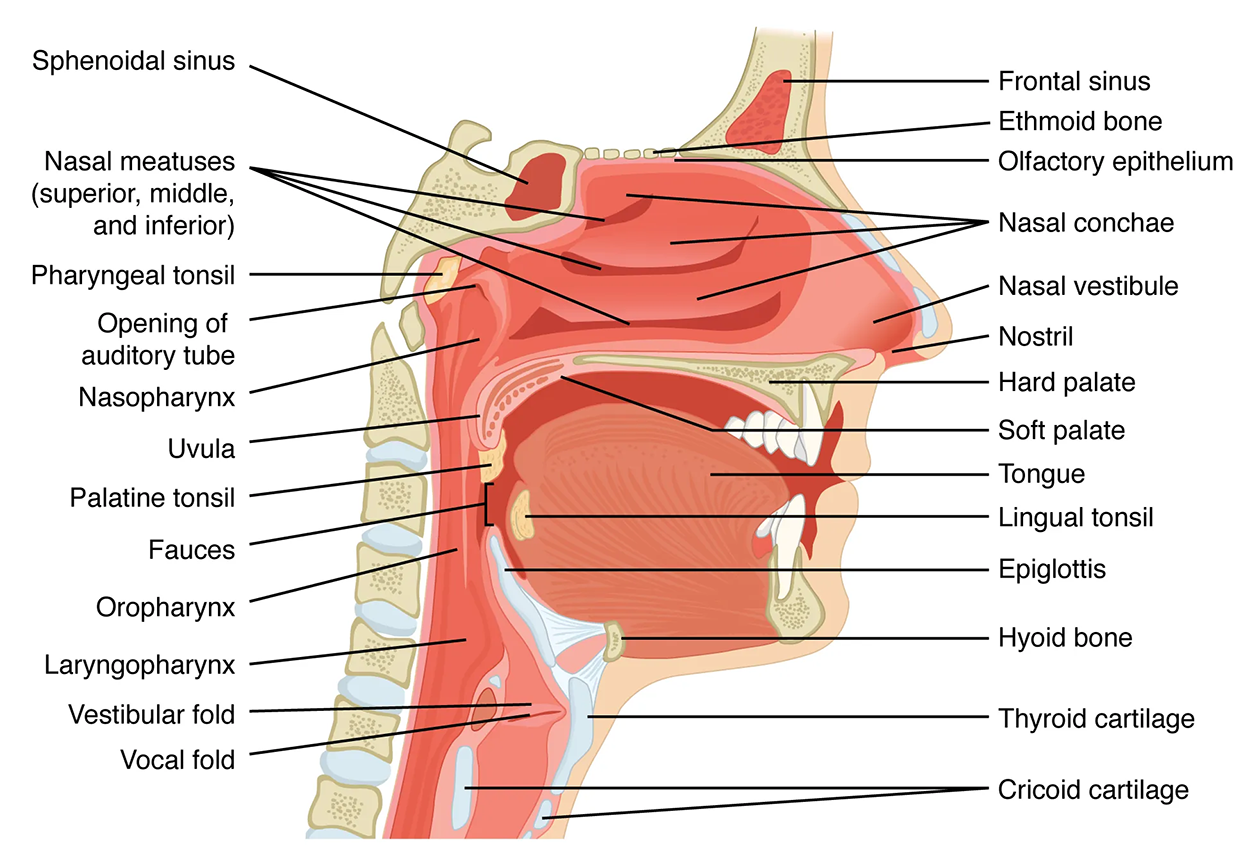
The nares open into the nasal cavity, which is separated into left and right sections by the nasal septum (see the image below). The nasal septum is the wall composed of bone and cartilage that separates the left and right.
Each lateral wall of the nasal cavity has three bony projections, called the superior, middle, and inferior nasal conchae. The inferior conchae are separate bones, whereas the superior conchae and middle conchae are portions of the ethmoid bone. Conchae serve to increase the surface area of the nasal cavity and to disrupt the flow of air as it enters the nose, causing air to bounce along the epithelium, where it is cleaned and warmed. The conchae and meatuses also conserve water and prevent dehydration of the nasal epithelium by trapping water during exhalation.
The Upper Airway
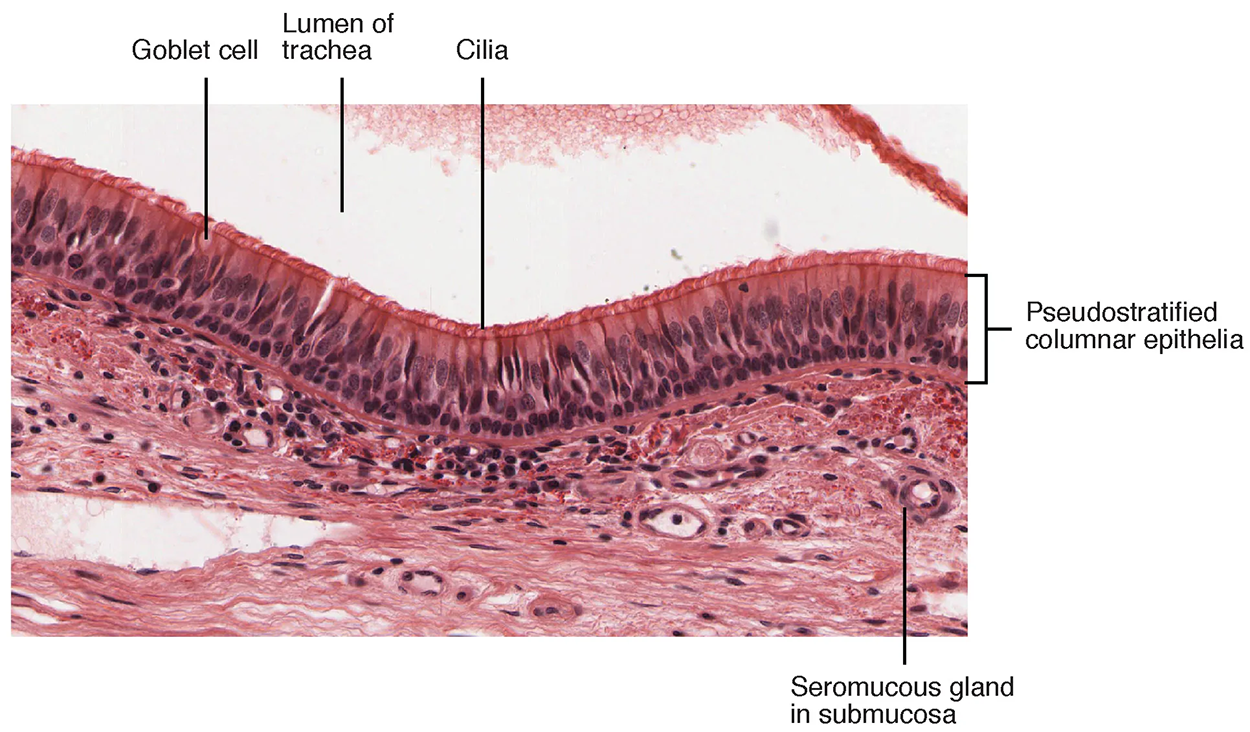
The conchae, meatuses, and paranasal sinuses are lined by respiratory epithelium composed of pseudostratified ciliated columnar epithelium (see the image below). The epithelium contains goblet cells, one of the specialized, columnar epithelial cells that produce mucus to trap debris. The cilia of the respiratory epithelium help remove the mucus and debris from the nasal cavity with a constant beating motion, sweeping materials toward the throat to be swallowed.
did you know
Have you ever had a runny nose in the winter?
Cold air slows the movement of the cilia, resulting in the accumulation of mucus that may in turn lead to a runny nose during cold weather. This moist epithelium functions to warm and humidify incoming air. Capillaries located just beneath the nasal epithelium warm the air by convection. Serous and mucus-producing cells also secrete the lysozyme enzyme and proteins called defensins, which have antibacterial properties. Immune cells that patrol the connective tissue deep to the respiratory epithelium provide additional protection.
The region of the nose that is easily visible to others.
Root (of the Nose)
The region of the nose located between the eyebrows.
Bridge
The portion of the external nose that lies in the area of the nasal bones.
Dorsum Nasi
The intermediate portion of the external nose that connects the bridge to the apex and is supported by the nasal bone.
Naris
The opening of the nostrils. Plural, nares.
Nasal Bone
The bone of the skull that lies under the root and bridge of the nose and is connected to the frontal and maxillary bones.
Nasal Septum
The wall composed of bone and cartilage that separates the left and right nasal cavities.
Nasal Conchae
The curved bony plates that project from the lateral walls of the nasal cavity; include the superior and middle nasal conchae, which are parts of the ethmoid bone, and the independent inferior nasal conchae bone.
Meatus
One of three recesses (superior, middle, and inferior) in the nasal cavity attached to the conchae that increase the surface area of the nasal cavity.
Paranasal Sinus
One of the cavities within the skull that is connected to the conchae that serve to warm and humidify incoming air, produce mucus, and lighten the weight of the skull; consists of frontal, maxillary, sphenoidal, and ethmoidal sinuses.
Respiratory Epithelium
The ciliated lining of much of the conducting zone that is specialized to remove debris and pathogens and produce mucus.
3. The Pharynx
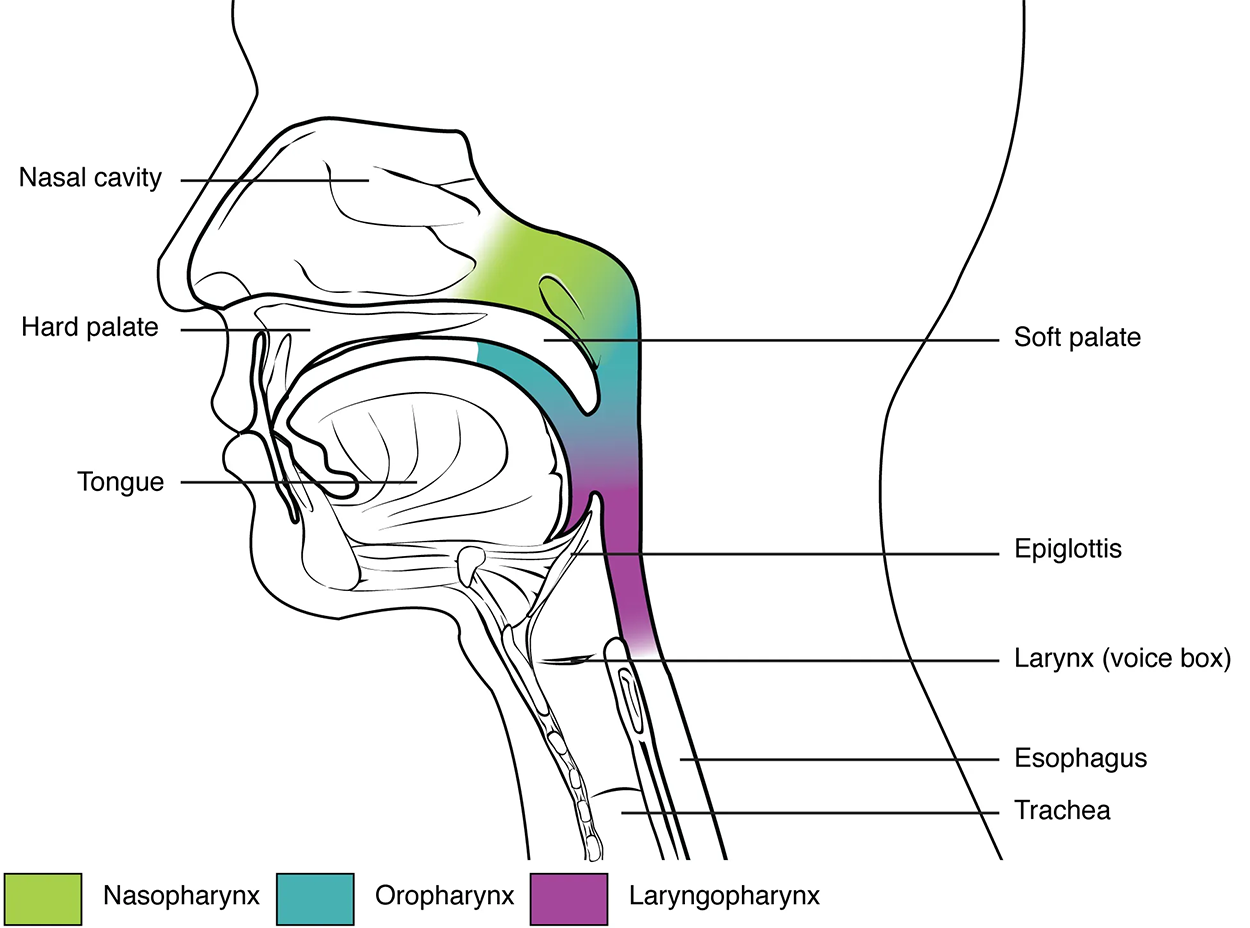
The pharynx is a tube formed by skeletal muscle and lined by mucous membrane that is continuous with that of the nasal cavities. Anatomically, it is divided into three major regions: the nasopharynx, the oropharynx, and the laryngopharynx (see the image below).
Divisions of the Pharynx—The pharynx is divided into three regions: the nasopharynx, the oropharynx, and the laryngopharynx.
The nasopharynx is flanked by the conchae of the nasal cavity, and it serves only as an airway. At the top of the nasopharynx are the pharyngeal tonsils. A pharyngeal tonsil, also called an adenoid, is an aggregate of lymphoid reticular tissue similar to a lymph node that lies at the superior portion of the nasopharynx. The function of the pharyngeal tonsil is not well understood, but it contains a rich supply of lymphocytes and is covered with ciliated epithelium that traps and destroys invading pathogens that enter during inhalation. The pharyngeal tonsils are large in children, but interestingly, tend to regress with age and may even disappear.
The uvula is a small, bulbous, teardrop-shaped structure located at the apex of the soft palate. Both the uvula and soft palate move like a pendulum during swallowing, swinging upward to close off the nasopharynx to prevent ingested materials from entering the nasal cavity. In addition, auditory (Eustachian) tubes that connect to each middle ear cavity open into the nasopharynx. This connection is why colds often lead to ear infections.
The oropharynx is a passageway for both air and food. The oropharynx is bordered by the nasopharynx and the oral cavity. The fauces is the opening at the connection between the oral cavity and the oropharynx. As the nasopharynx becomes the oropharynx, the epithelium changes from pseudostratified ciliated columnar epithelium to stratified squamous epithelium. The oropharynx contains two distinct sets of tonsils, the palatine and lingual tonsils. A palatine tonsil is one of a pair of structures located laterally in the oropharynx in the area of the fauces. The lingual tonsil is located at the base of the tongue. Similar to the pharyngeal tonsils, the palatine and lingual tonsils are composed of lymphoid tissue, and trap and destroy pathogens entering the body through the oral or nasal cavities.
The laryngopharynx is below the oropharynx and posterior to (behind) the larynx. It continues the route for ingested material and air until its inferior end, where the digestive and respiratory systems diverge. The stratified squamous epithelium of the oropharynx is continuous with the laryngopharynx. Anteriorly, the laryngopharynx opens into the larynx, whereas posteriorly, it enters the esophagus.
terms to know
Pharynx
The throat.
Nasopharynx
The upper part of the pharynx that serves as an airway and is flanked by the conchae of the nasal cavity.
Fauces
The opening at the connection between the oral cavity and the oropharynx.
Oropharynx
The part of the pharynx that is continuous with the oral cavity and functions in respiration and digestion.
Laryngopharynx
The part of the pharynx that functions in respiration and digestion.
4. The Larynx
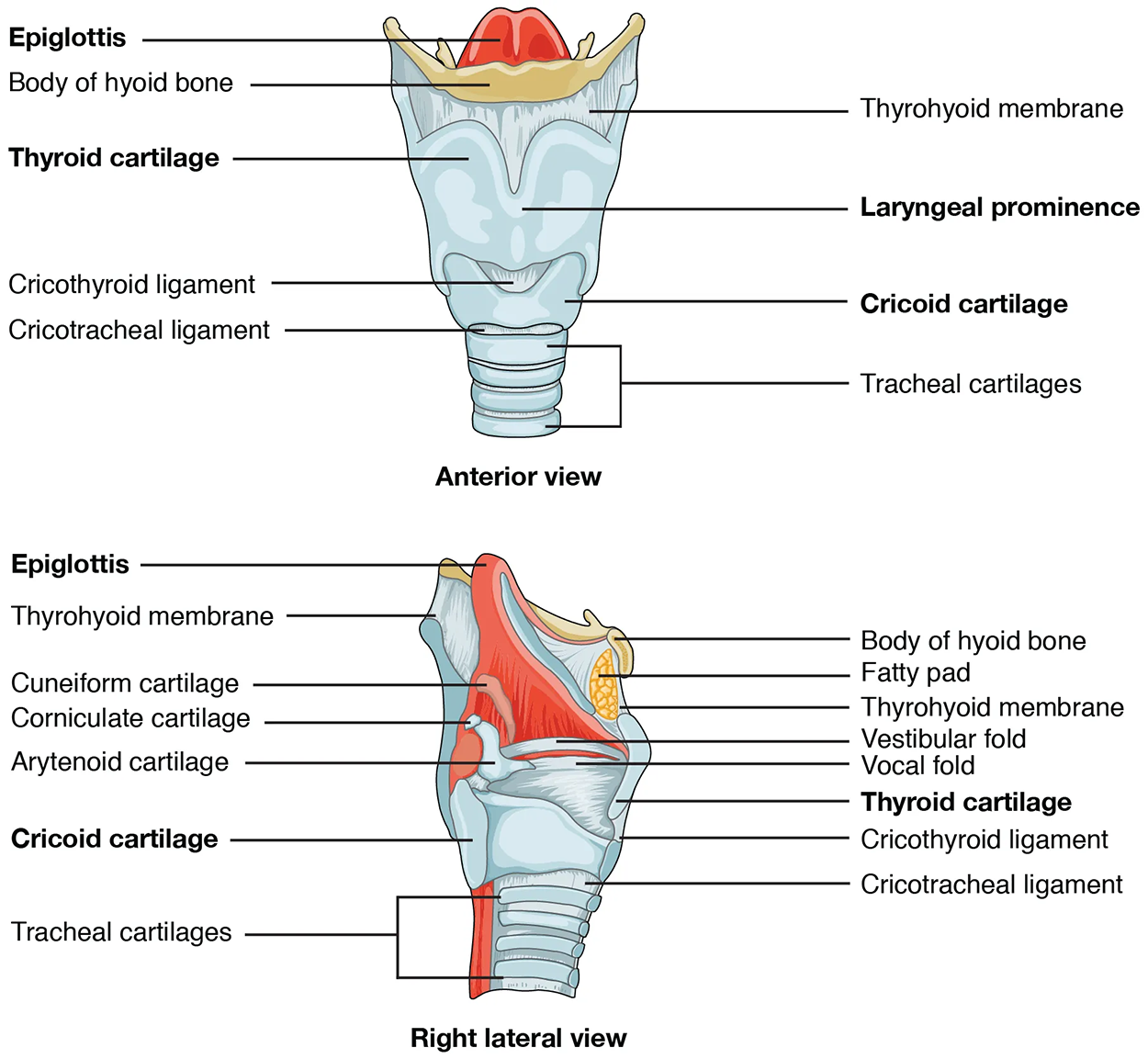
The larynx is a cartilaginous structure inferior to (below) the laryngopharynx that connects the pharynx to the trachea and helps regulate the volume of air that enters and leaves the lungs. The structure of the larynx is formed by several pieces of cartilage. Three large cartilage pieces form the major structure of the larynx:
Thyroid cartilage (anterior)
Epiglottis (superior)
Cricoid cartilage (inferior)
The thyroid cartilage is the largest piece of cartilage that makes up the larynx, and it consists of two identical halves called laminae, which are plates of cartilage. The thyroid cartilage consists of the laryngeal prominence, or “Adam’s apple,” which tends to be more prominent in males. The thick cricoid cartilage forms a ring, with a wide posterior region and a thinner anterior region. Three smaller, paired cartilages—the arytenoids, corniculates, and cuneiforms—attach to the epiglottis and the vocal cords and muscle that help move the vocal cords to produce speech.
Larynx—The larynx extends from the laryngopharynx and the hyoid bone to the trachea.
The epiglottis, attached to the thyroid cartilage, is a very flexible piece of elastic cartilage that covers the opening of the trachea. When in the “closed” position, the unattached end of the epiglottis rests on the glottis.
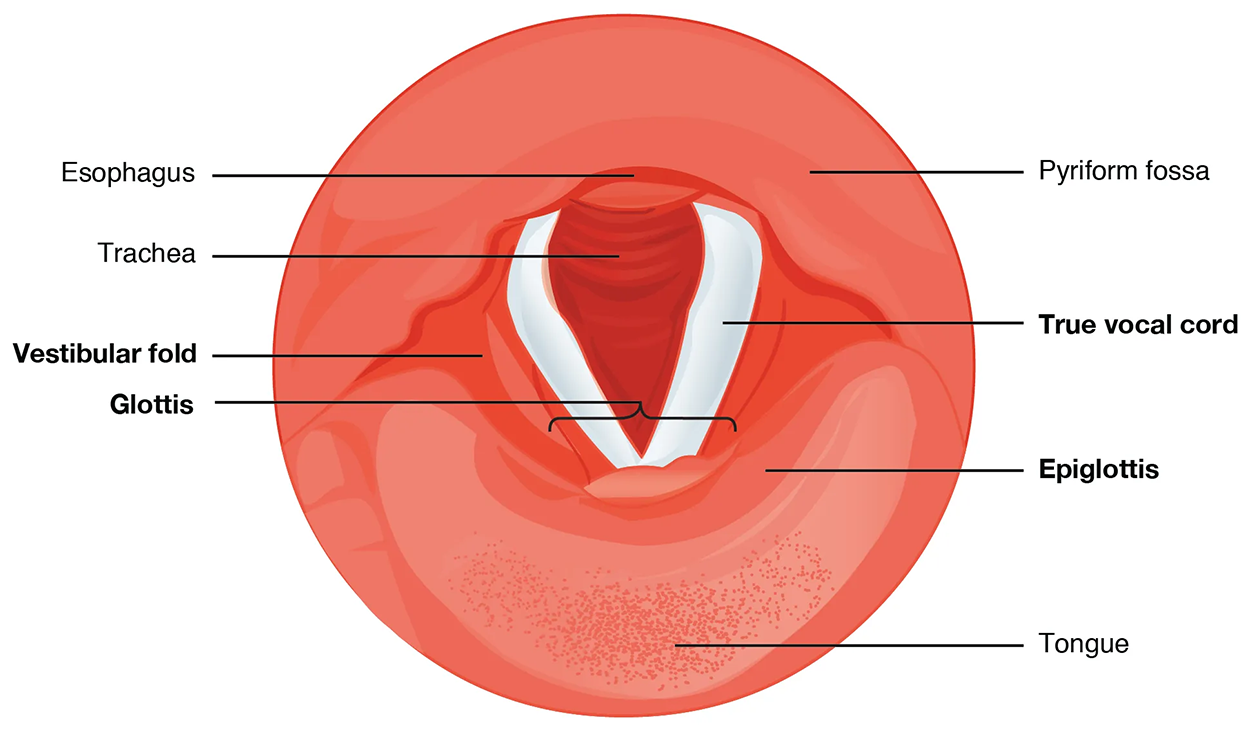
The glottis is composed of the vestibular folds, the true vocal cords, and the space between these folds. A vestibular fold, or false vocal cord, is one of a pair of folded sections of mucous membrane. A true vocal cord is one of the white, membranous folds attached by muscle to the thyroid and arytenoid cartilages of the larynx on their outer edges. The inner edges of the true vocal cords are free, allowing oscillation (movement back and forth) to produce sound.
did you know
The size of the membranous folds of the true vocal cords differs between individuals, producing voices with different pitch ranges. Folds in males tend to be larger than those in females, which creates a deeper voice.
The act of swallowing causes the pharynx and larynx to lift upward, allowing the pharynx to expand and the epiglottis of the larynx to swing downward, closing the opening to the trachea. These movements produce a larger area for food to pass through while preventing food and beverages from entering the trachea.
Vocal Cords—The true vocal cords and vestibular folds of the larynx are viewed inferiorly from the laryngopharynx.
Continuous with the laryngopharynx, the superior (upper) portion of the larynx is lined with stratified squamous epithelium, transitioning into pseudostratified ciliated columnar epithelium that contains goblet cells. Similar to the nasal cavity and nasopharynx, this specialized epithelium produces mucus to trap debris and pathogens as they enter the trachea. The cilia beat the mucus upward towards the laryngopharynx, where it can be swallowed down the esophagus.
IN CONTEXT
How Humans Produce Speech
Human speech is a complex process. First, air is brought from the lungs to the larynx following respiration. Then, phonation occurs when the vocal folds can be held open, which allows the air to pass through; this makes the vocal folds vibrate. When this occurs, the vocal folds trap and release air. When the air is released, it sends air into the pharynx, and that is the beginning of a sound wave. Articulation then occurs when airflow is shaped by the articulators in the mouth and nose. The main articulators include the tongue, lips, upper teeth, upper gum ridge (alveolar ridge), hard palate, soft palate, uvula, pharyngeal wall, and glottis.
A Child Articulates the “O” Sound.
terms to know
Larynx
The cartilaginous structure that produces the voice, prevents food and beverages from entering the trachea, and regulates the volume of air that enters and leaves the lungs.
Thyroid Cartilage
The largest piece of cartilage that makes up the larynx and consists of two identical halves called laminae, which are plates of cartilage.
Laryngeal Prominence
The region where the two halves (the laminae) of the thyroid cartilage join, forming a protrusion known as the “Adam’s apple.”
Cricoid Cartilage
The portion of the larynx which is composed of a ring of cartilage with a wide posterior region and a thinner anterior region; attached to the esophagus.
Epiglottis
The leaf-shaped piece of elastic cartilage that is a portion of the larynx that swings to close the trachea during swallowing.
Glottis
The opening between the vocal folds through which air passes when producing speech.
Vestibular Fold
The part of the folded region of the glottis composed of mucous membrane; supports the epiglottis during swallowing.
True Vocal Cord
One of the pair of folded, white membranes that have a free inner edge that oscillates as air passes through to produce sound.
Phonation
Production of speech sounds when air is pushed through the glottis and causes the vocal folds to vibrate.
Articulation
The part of speech in which air that flows from the lungs is shaped by the articulators in the mouth and nose.
summary
In this lesson, you learned about the structures of the upper respiratory tract. You explored the nose and its adjacent structures and the pharynx, and how they are involved in processes such as passing air in and out of the lungs; heating, humidifying, and filtering air; and swallowing. Then, you examined the structure of the larynx and its role in passing air through the respiratory tract and producing speech.
The part of speech in which air that flows from the lungs is shaped by the articulators in the mouth and nose.
Bridge
The portion of the external nose that lies in the area of the nasal bones.
Cricoid Cartilage
The portion of the larynx which is composed of a ring of cartilage with a wide posterior region and a thinner anterior region; attached to the esophagus.
Dorsum Nasi
The intermediate portion of the external nose that connects the bridge to the apex and is supported by the nasal bone.
Epiglottis
The leaf-shaped piece of elastic cartilage that is a portion of the larynx that swings to close the trachea during swallowing.
External Nose
The region of the nose that is easily visible to others.
Fauces
The opening at the connection between the oral cavity and the oropharynx.
Glottis
The opening between the vocal folds through which air passes when producing speech.
Laryngeal Prominence
The region where the two halves (the laminae) of the thyroid cartilage join, forming a protrusion known as the “Adam’s apple.”
Laryngopharynx
The part of the pharynx that functions in respiration and digestion.
Larynx
The cartilaginous structure that produces the voice, prevents food and beverages from entering the trachea, and regulates the volume of air that enters and leaves the lungs.
Meatus
One of three recesses (superior, middle, and inferior) in the nasal cavity attached to the conchae that increase the surface area of the nasal cavity.
Naris
The opening of the nostrils. Plural, nares.
Nasal Bone
The bone of the skull that lies under the root and bridge of the nose and is connected to the frontal and maxillary bones.
Nasal Conchae
The curved bony plates that project from the lateral walls of the nasal cavity; include the superior and middle nasal conchae, which are parts of the ethmoid bone, and the independent inferior nasal conchae bone.
Nasal Septum
The wall composed of bone and cartilage that separates the left and right nasal cavities.
Nasopharynx
The upper part of the pharynx that serves as an airway and is flanked by the conchae of the nasal cavity.
Oropharynx
The part of the pharynx that is continuous with the oral cavity and functions in respiration and digestion.
Paranasal Sinus
One of the cavities within the skull that is connected to the conchae that serve to warm and humidify incoming air, produce mucus, and lighten the weight of the skull; consists of frontal, maxillary, sphenoidal, and ethmoidal sinuses.
Pharynx
The throat.
Phonation
Production of speech sounds when air is pushed through the glottis and causes the vocal folds to vibrate.
Respiratory Epithelium
The ciliated lining of much of the conducting zone that is specialized to remove debris and pathogens and produce mucus.
Root (of the Nose)
The region of the nose located between the eyebrows.
Thyroid Cartilage
The largest piece of cartilage that makes up the larynx and consists of two identical halves called laminae, which are plates of cartilage.
True Vocal Cord
One of the pair of folded, white membranes that have a free inner edge that oscillates as air passes through to produce sound.
Vestibular Fold
The part of the folded region of the glottis composed of mucous membrane; supports the epiglottis during swallowing.