Table of Contents |
The word consumer is used interchangeably with buyer, but the reality is that not all buyers are consumers. For example, business-to-business (B2B) buyers are typically purchasing agents that do not consume the goods they purchase or if they do, they do so with other user groups. Business-to-consumer (B2C) markets involve selling to individuals for their personal use and they have unique characteristics, offer specific types of goods, and represent a changing market for marketers to understand.
Business-to-consumer marketers conduct extensive research to understand their buyers. As a foundation, marketers need to understand the demographics, psychographics, and geographic characteristics that collectively create a persona or characterization of who is willing and able to purchase their goods. Demographics describe identifiers such as age, sex, income, and education, which suggest the level of purchasing power, product knowledge, and engagement that consumers want to have about the products, services, and experiences they purchase. Psychographics describe identifiers such as lifestyle, hobbies, interests, social network, and perceptions of success, which suggest the level of association that consumers want to have with a particular company or brand. Geographic characteristics describe location and cultural identifiers such as where consumers grew up, what values they hold based on the local and cultural groups and traditions they adopted, the connection between the environment and their lifestyle associated with locational attributes, and regionally popular brands. Behavioral characteristics describe how consumers make decisions, rely on influencers, identify with socioeconomic groups, and align with causes that are important to them.
IN CONTEXT
The key characteristics of consumer markets and factors marketers consider are as follows:
Geographics: country, city, density, language, climate, area, and population.
Demographics: age, gender, income, education, social status, family, life stage, and occupation.
Psychographics: lifestyle, AIO: activity, interest, opinion, concerns, personality, values, and attitudes.
Behavioral: benefits sought, purchase, usage, intent, occasion, buyer stage, user status, life cycle stage, and engagement.
Previous lessons have discussed the importance of marketing research, and one area to note for consumer markets is consumer behavior research. Since marketers want to create relationships, design products, communicate value, and increase share of wallet, understanding consumer behavior is important. While future lessons will discuss factors that influence consumer behavior and decision-making, this section will take a high-level approach to describing some of the areas that marketers need to learn about consumers to design and implement effective marketing.
It’s important for marketers to understand consumers’ needs for product packaging and perception so that they can design graphics and messages that align with buyers’ interests. Online shopping behavior provides data that allows marketers to determine where consumers go to search for information about products and services. Marketers also need to understand consumers’ intentions for brand loyalty or the degree to which they insist on purchasing a specific product or service and the likelihood of customer retention or maintaining buyers for the long term. Price sensitivity describes the changes in intended purchase behavior based on increases or decreases in pricing and value, which is used in promotion analysis to predict how likely consumers are to change their purchase intention based on special offers or experiences. The consumer decision-making process or the stages buyers go through when they intend to purchase a product is also important for marketers to understand.
An increasing number of consumers are concerned with environmental and sustainability concerns, which relate to how a company manages its use of resources to limit its impact on the natural ecosystem and society at large. Marketers need to understand what customer satisfaction means to buyers in terms of loyalty programs, special offers, and overall experience so that complaint behavior or actions buyers engage in when they are not satisfied, are anticipated and services are designed to accommodate those actions. Consumer impulse buying behavior usually results in unplanned purchasing, and understanding what product categories are most likely to be impulse purchases helps marketers design packaging, messaging, and promotional offers to engage buyers in this type of purchasing. This behavior is also the reason that there are special aisles for weekly specials, gum and candy, and seasonal items in grocery stores.
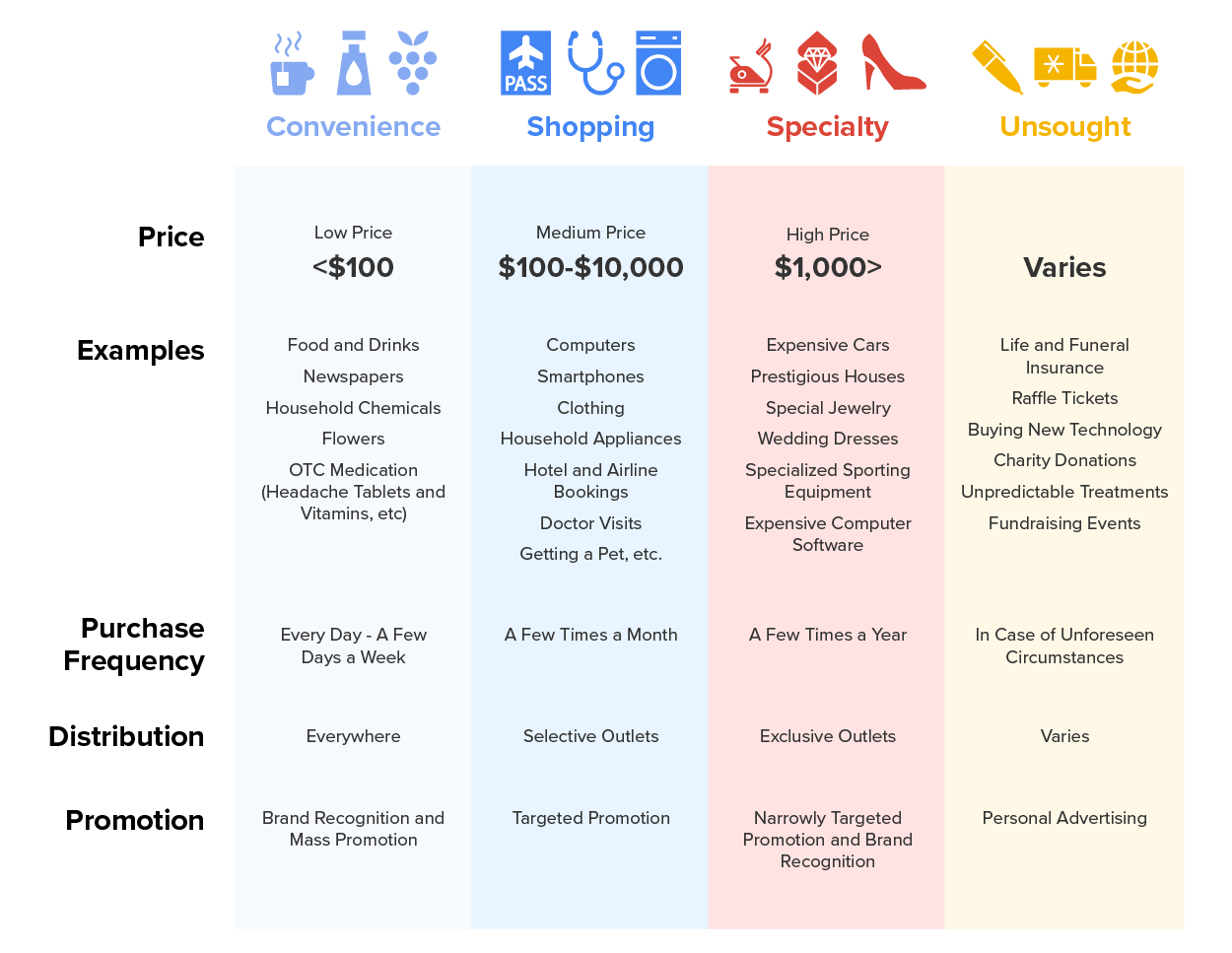
There are four primary types of goods sold in consumer markets:
A recent study by global consulting firm McKinsey & Company cited five forces that will change the consumer market for goods by 2030: the changing consumer makeup of society, environmental and political changes that will impact consumer behavior, changes in how and what consumers purchase, the increasing advance of technology and its role in consumption, and changing models of consumer behavior.
IN CONTEXT
Some key takeaways for marketers include the increasing role of Millennials as agents of change in consumption, the decreasing size of households and increasing role of the individual consumer, the role of increasing costs in producing goods that are sustainable and are concerned with consumer interconnectedness, and an overall emphasis on a sharing economy where consumers focus less on owning goods and are more interested in sharing experiences.
Consumers will increase their acceptance and use of artificial intelligence in creation, expect more virtual reality experiences from marketers, and will continue to rely on social media for their lives and purchases. Direct-to-consumer models will increase the need for marketers to learn more about consumer markets to increase one-to-one relationships and customized offerings to buyers. Channel partnerships, while remaining important for future consumer markets, will demand a focus from marketers to ensure that consumers have seamless, integrated experiences from e-business to physical retail to other forms of distribution.
| Five Dominant Forces—and an Underlying Set of Trends—Will Drive Change in the Consumer Landscape Over the Next 15 Years. | ||||
|---|---|---|---|---|
| Changing face of the consumer | Evolving geopolitical dynamics | New patterns of personal consumption | Technological advancements | Structural industry shifts |
|
|
|
|
|
Source: THIS TUTORIAL HAS BEEN ADAPTED FROM OPEN STAX’S PRINCIPLES OF MARKETING COURSE. ACCESS FOR FREE AT https://openstax.org/details/books/principles-marketing. LICENSE: CREATIVE COMMONS ATTRIBUTION 4.0 INTERNATIONAL.
REFERENCES
Benson-Armer, R., Noble, S., & Thiel, A. (2015). The Consumer Sector in 2030: Trends and Questions to Consider. Retrieved from www.mckinsey.com/industries/consumer-packaged-goods/our-insights/the-consumer-sector-in-2030-trends-and-questions-to-consider
Gill, N. (2019). Conducting a Market Size Up. Retrieved from medium.com/investbeta/conducting-a-market-size-up-8922d5e94d16
Jain, N. (2023). What is Consumer Behavior Research? Definition, Examples, Methods, and Questions. Retrieved from ideascale.com/blog/what-is-consumer-behavior-research/
Ulitovskyi, A. (2019). 4 Types of Consumer Products: Definition & Marketing. Retrieved from unmiss.com/consumer-products



