The first type of good to discuss comprise normal goods, a category which includes most goods. Normal goods are goods for which demand increases as income increases. As we make more money, we generally buy more of most things.
Luxury goods are a type of normal good that offers better quality and features, which is consumed when income rises.
Therefore, when our income goes up, we buy more luxury goods.
EXAMPLE
For example, luxury goods could include expensive restaurant meals, yachts, fur coats or designer jeans.On the opposite end of the spectrum are the type of goods known as inferior goods, or goods for which demand decreases as income increases.
EXAMPLE
For instance, if you lost your job, you might have to buy more generic brands. In this case, the generic brands would be considered an inferior good, because you would buy store brand cereal instead of a name brand if you made less money.Here is a summary sheet.
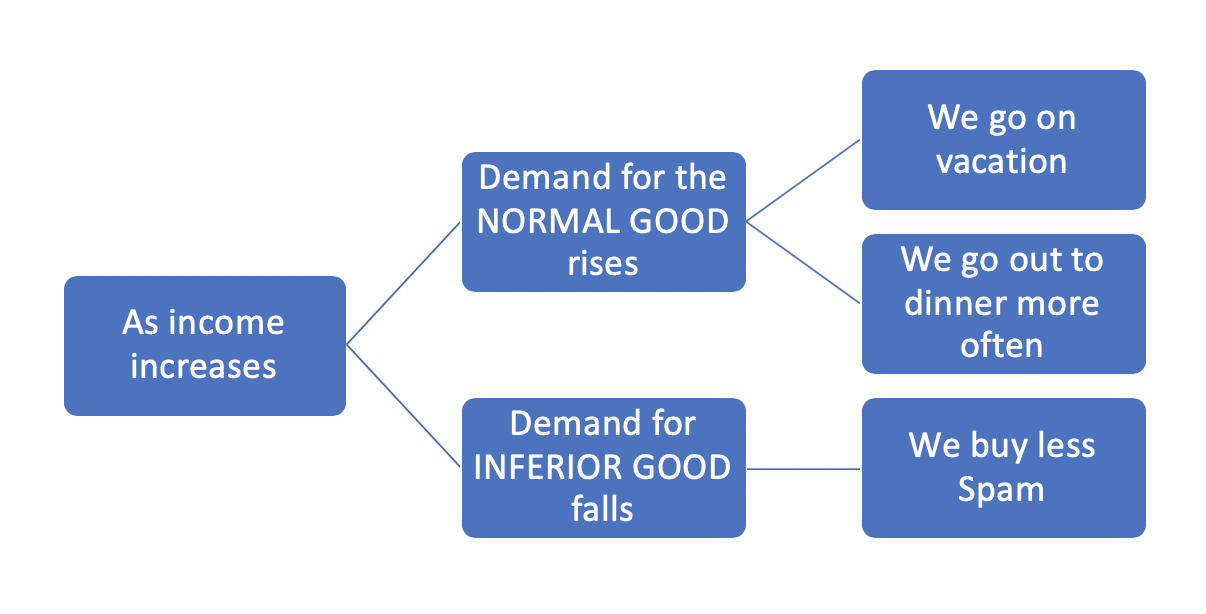
As income goes up, demand for normal goods--most goods--goes up, including luxury goods.
As income increases, however, the demand for an inferior good falls, meaning, for instance, we buy less Spam if we make more money, because we can afford "real" meat.
Now let's discuss two types of goods that are less common.
The first one is called a Giffen good, which is a good for which the demand increases with price and falls as price decreases.
Giffen goods are a type of inferior good that arise because there are no close substitutes for the good itself. Economists debate how common these goods are.
EXAMPLE
An example of a Giffen good is a cheap, stable food in an economy, such as rice in China. If the price of rice in China goes up, the poor will still buy it and may actually buy more since it will still be cheaper than more expensive food items.Now, a Veblen good involves the concept of conspicuous consumption. These are goods for which consumption increases as income increases because consumers wish to establish stature and prestige.
In fact, people are more likely to buy Veblen goods as they get more expensive, simply to show their wealth.
EXAMPLE
Examples of Veblen goods include items like designer purses or expensive cars.Here is a summary sheet illustrating the difference between Giffen and Veblen goods.
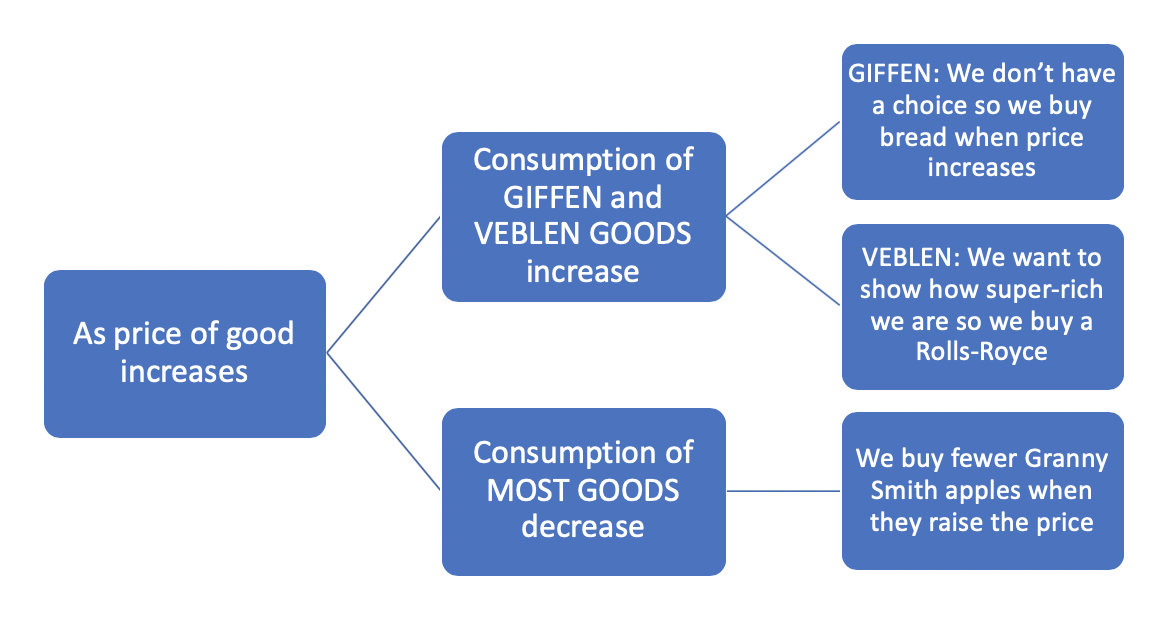
As the price of goods increases, consumption of most goods falls.
However, as the price of goods increases, consumption of Giffen and Veblen goods increases, though for varying reasons.
With Giffen goods, such as bread, consumers buy it because they don't have a choice; there is no substitute for it and it is still cheaper than other items.
With Veblen goods, certain consumers want to show how wealthy they are, so they purchase that Rolls Royce even though it is ridiculously expensive.
Source: Adapted from Sophia instructor Kate Eskra.



