Table of Contents |
A democracy is a political system in which people govern themselves. While democratic governments vest authority in the people, the way in which this is accomplished can look different. There are different types of democratic government.
In a direct democracy, people, particularly those franchised with the right to vote, participate directly in making government decisions. For example, in ancient Athens (likely the most famous example of a direct democracy) male citizens were allowed to attend meetings of the Assembly. They debated and voted for or against all proposed laws.
Although neither the federal government nor any of the U.S. state governments function as a direct democracy, some elements of direct democracy do exist in the United States. While residents of the different states vote for people to represent them and to make laws on their behalf in the state legislatures and in Congress, people may still directly vote on certain issues. For example, referendums allow citizens to vote on proposed laws and changes to constitutions directly during state or local elections, instead of leaving the matter in the hands of the state legislature. At New England town meetings, all residents are allowed to debate and vote on decisions affecting the town (Figure 1).

Many states also have mechanisms of direct democracy through which the people make important decisions through a popular vote. Some state legislatures may put a referendum into motion. They place a proposed law on the ballot, and the people in the state vote on whether or not to pass the law.
Whereas referendums call for a vote on proposed laws, also called statutes, some states allow citizens to vote on changes to their state constitutions. These changes are called amendments. Some states have both referendums and votes on amendments, some have neither, and some have one or the other. In Texas, for example, all amendments to the state constitution have to pass in this way.
The people themselves can gather enough signatures to place a proposed law on the ballot. This is called an initiative. Figure 2 shows the states that have initiatives and referendums.
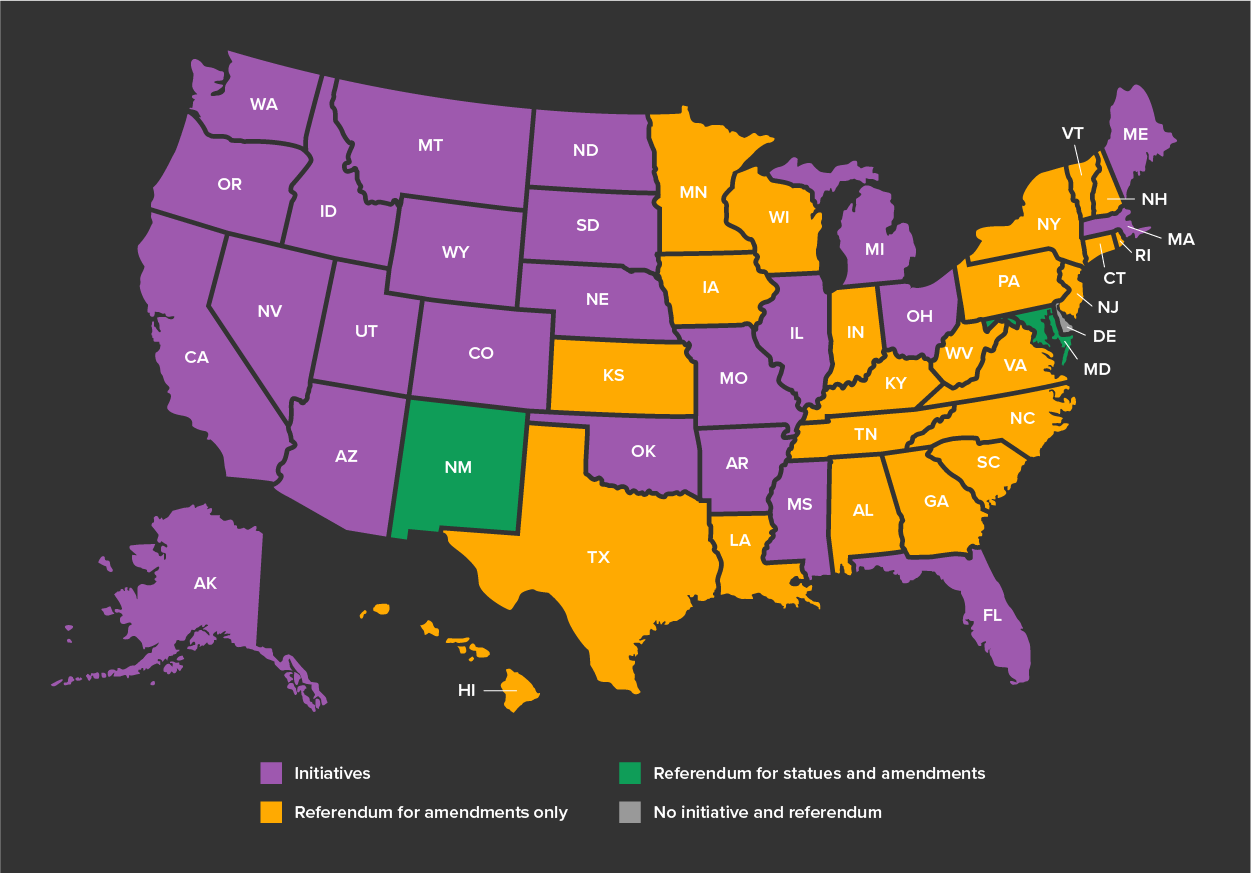
Source: National Conference of State Legislatures
State and local governments also have recalls through which they can hold an election to remove an elected official, such as a governor or a member of a school board, from office.
IN CONTEXT
In response to the passage of the Affordable Care Act (ACA) and its requirement that states expand their Medicaid program, the National Federation of Independent Businesses and several states sued to challenge the constitutionality of required expansion of Medicaid and other provisions of the law. Medicaid is a federal health insurance program for low-income citizens, and expansion of the program under the ACA would allow more citizens to qualify for the program. When the Supreme Court ruled the Medicaid expansion provision of the law unconstitutional, states were no longer required to expand their program but could do so voluntarily. Following the Court’s ruling, several states expanded their programs through their state legislature. However, in some states, particularly those where state governments would not act to expand Medicaid, citizens within the state took action. In 2020, Missouri citizens approved a constitutional amendment that expanded Medicaid in their state through the initiative process. Citizens in Nebraska, Oklahoma, and Utah also expanded their programs using the same method. As of 2025, 41 states had adopted Medicaid expansion, including six states that did so through the initiative process.
A representative democracy, also known as a republic, is an indirect form of democracy in which citizens elect representatives to make decisions and pass laws. For example, most Americans have no direct participation in the passage of federal laws but rather elect the president and members of Congress. The president and congress then each play a role in passing laws. So, Americans indirectly participate in the passage of laws.
Moreover, many Americans express their views about proposed legislation to their elected members of the United States House of Representatives and the United States Senate, and they expect their representative to take their views into consideration. With the power of election and reelection sitting in the hands of the people, elected officials have the incentive to listen to their constituents—the people who elect them.
While committed to democratic ideals, the framers of the United States Constitution had several concerns about direct democracy. They worried about the ability of ordinary citizens to directly vote on public matters, and if the general public would be educated enough to make sound policy decisions. And even if they were, groups of people might band together to form a majority faction and pass laws that only serve their own interests. They might not think about the interests of others, the minority, or the best interests of the whole society. The framers called this the tyranny of the majority, a dynamic that occurs when a majority makes decisions or influences government exclusively for its benefit and to the detriment of a minority population.
For example, James Madison (1787), one of the framers, pointed out that “the most common and durable source of factions has been the various and unequal distribution of property.” Since the people with little property outnumber the people with a lot of property, they can form a majority and make laws that only meet their needs. Similarly, religious majorities could pass laws to forbid the free exercise of the rituals of the religion of a religious minority.
Finally, the framers noticed that ancient Athens and other attempts at direct democracies had not endured over time. When the interests of minority groups are consistently trampled, members of these groups might take up arms to overthrow the government. So, Madison (1787) concluded that direct democracies “have in general been as short in their lives as they have been violent in their deaths (Federalist Paper #10).”
The framers of the U.S. Constitution argued that indirect democracy allowed for the representation of minority interests. Large republics solve the problem of factions because they contain so many factions that they will have trouble uniting into a majority or acting in unison over time. However, state and local governments would introduce forms of direct democracy, such as referendums, initiatives, and recalls.
The United States allows its citizens to participate in government in many ways. The United States also has many different levels and branches of government that any citizen or group might approach. Many people take this as evidence that U.S. citizens, especially as represented by competing groups, are able to influence government actions. We have achieved the framers’ goals. Other people, however, argue that this is not the case. They claim that only a handful of economic and political elites have any influence over government.
Some Americans fear that a set of elite citizens is really in charge of the government in the United States and that others have no influence. This belief is called the elite theory of government. In contrast, the pluralist theory of government says that political power rests with competing interest groups who share influence in government. Pluralist theorists assume that citizens who want to get involved in the system do so because of the great number of access points to government. That is, the U.S. system, with several levels and branches, has many places where people and groups can engage the government.
The foremost supporter of elite theory was C. Wright Mills. In his book, The Power Elite, Mills argued that government was controlled by a combination of business, military, and political elites. Most are highly educated and often graduated from prestigious universities (Figure 3). According to elite theory, the wealthy use their power to control the nation’s economy in such a way that those below them cannot advance economically. Their wealth allows the elite to secure important positions in politics. Then, they use this power to make decisions and allocate resources in ways that benefit their group. Politicians do the bidding of the wealthy instead of attending to the needs of ordinary people, and order is maintained by force.
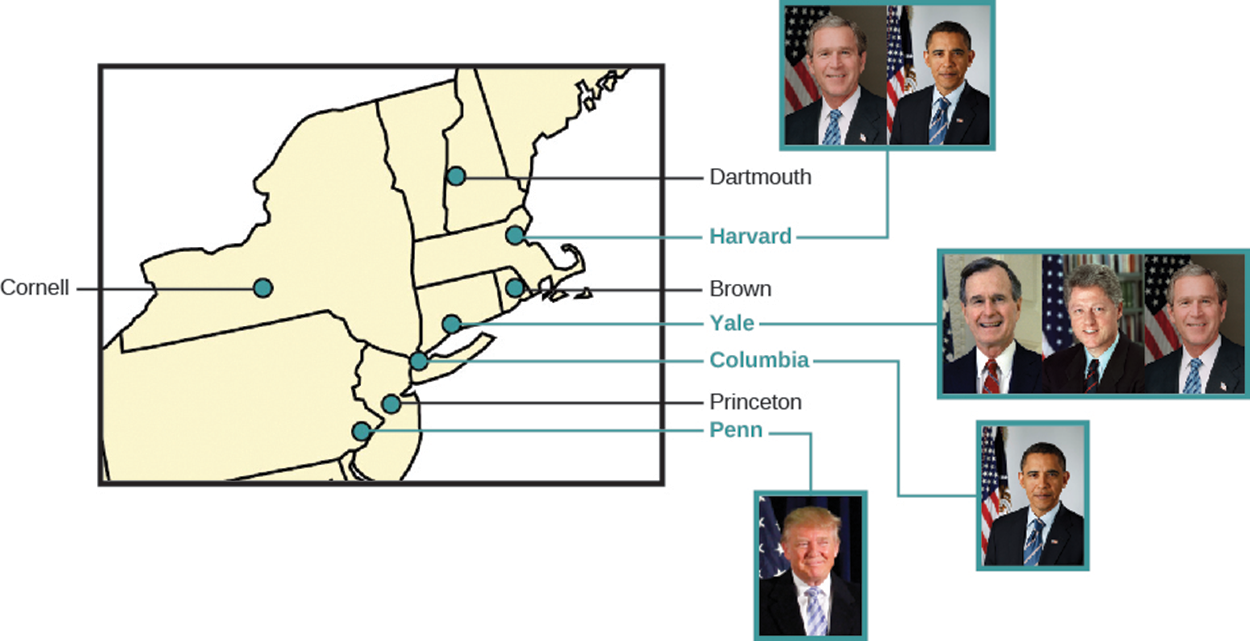
As of 2021, one-third of U.S. presidents had attended Ivy League schools, a much higher percentage than the rest of the U.S. population. Among members of the 117th Congress (2021–2022), 94 percent of House members and 100 percent of Senators have a college degree.
Fewer than 40 percent of U.S. adults have even an associate’s degree. The majority of men and women in Congress also engaged in either state or local politics, were business people, or practiced law before being elected to Congress.
The nation’s laws are also made primarily by well-educated, white, male professionals and businessmen. Approximately 77 percent of members of Congress are Non-Hispanic whites, whereas non-Hispanic whites make up approximately 58 percent of the general population. In addition, 72 percent of members are male. Currently, about half of the members of Congress are millionaires. Their experience, therefore, does not reflect the experience of average Americans.
Pluralists argue that political power—influence over institutions, leaders, and policies—is distributed throughout society. They point out that a variety of organized groups hold power, with some groups having more influence on certain issues than others.
According to pluralist theory, people with shared interests and values will form interest groups or parties. These groups include such entities as environmental advocates, unions, and organizations that represent the interests of various businesses. Each group has particular interests. For example, the American Association of Retired People (AARP) pursues policies that help Americans who are 50 years or older. Some groups have competing interests. For example, United Steelworkers is a union that seeks good conditions, higher wages, and better working conditions for its laborers. These goals might clash with that of companies in the steel industry that seek to make a profit. Both groups influence government policies.
Thousands of interest groups exist in the United States, and many Americans report belonging to at least one group.
As groups compete with one another and find themselves in conflict regarding important issues, government policy begins to take shape. In this way, government policy is shaped by various interests, rather than by those at the top, as we see in elitist theory.
We see pluralism at work when various interest groups demand their interests be protected when a proposed law is debated. For example, proposed changes to national healthcare law may impact various populations differently. As such, these groups may all work and compete against each other for influence to ensure that they are helped and not harmed by changes to the law. The passage of the Patient Protection and Affordable Care Act (also known as ACA) demonstrated the diversity of interests in health care. When the ACA was debated by Congress, the medical community, business owners and employers, labor unions, and advocacy organizations representing women and children were among those communicating their preferences.
Robert Dahl (author of Who Governs?) was one of the first to advance the pluralist theory and argued that politicians seeking an “electoral payoff” are attentive to the concerns of politically active citizens and, through them, become acquainted with the needs of ordinary people. Elected representatives will attempt to give people what they want in exchange for their votes.
Although elitists and pluralists present political influence as a tug-of-war with people at opposite ends of a rope trying to gain control of government, government action and public policy are often influenced by an ongoing series of tradeoffs or compromises. In the end, the goals of both the elite and interest groups likely influence government, often resulting in compromises as elected officials attempt to please all sides.
Since the framing of the U.S. Constitution, tradeoffs have been made between those who favor the supremacy of the national government and those who believe that state governments should be more powerful.
For example, with the rapid spread of COVID-19 in 2020, a debate erupted among Americans about mask requirements, how long schools should be closed, and how much financial support to give businesses and people. President Trump, the head of the national government at the time, would have preferred to have fewer mask restrictions. However, this decision was made at the state and local levels. As a result, governors and mayors made decisions about whether masks should be worn in their areas. The Centers for Disease Control (CDC), an office of the national government, provided advice based on the latest scientific information they could obtain. Some people took to the streets to pressure their local governments to remove mask restrictions or to open up schools. In this way, many people were involved in these decisions, and these decisions were often a result of compromise.
Source: THIS TUTORIAL HAS BEEN ADAPTED FROM OPENSTAX “AMERICAN GOVERNMENT 3E”. ACCESS FOR FREE AT OPENSTAX.ORG/DETAILS/BOOKS/AMERICAN-GOVERNMENT-3E. LICENSE: CREATIVE COMMONS ATTRIBUTION 4.0 INTERNATIONAL.
References
Heatlie v. Padilla. 1 (Superior Court of California, 2020). Retrieved September 8, 2022, from elections.cdn.sos.ca.gov/ccrov/pdf/2020/november/20251ra.pdf
Madison, J. (1787, November 22). Federalist No. 10: The Same Subject Continued: The Union as a Safeguard Against Domestic Faction and Insurrection. New York Daily Advertiser.
Membership of the 117 Congress: A profile. (n.d.). U.S. Congress. Retrieved August 20, 2022, from crsreports.congress.gov/product/pdf/R/R46705



