In this lesson, you will learn about different business structures and how they affect financial management, liability, and decision making. You’ll explore how organizational design influences operations, legal responsibilities, and leadership roles. You’ll also compare the advantages and disadvantages of common business types, from sole proprietorships to corporations and limited liability companies. Specifically, this lesson will cover:
1. Organizational Structures and Their Role in Finance
Business organizations can take on a variety of structural forms, each influencing how decisions are made, how resources are allocated, and how financial responsibilities are managed. These structures are shaped by legal status, internal hierarchy, and operational needs. Understanding these frameworks is essential, as they determine how financial authority is distributed, how budgets are created and monitored, and how risk is managed across departments or divisions.
Pre-bureaucratic structures: These are common in startups and small businesses, where decision making is centralized and informal. Financial decisions in these organizations are typically made by the founder or a small leadership team, allowing for agility but also increasing the risk of oversight or inconsistency.
Bureaucratic structures: These are more formalized and suited for larger organizations. They rely on standardized procedures and clear hierarchies, which can enhance financial control and compliance but may slow down responsiveness to market changes.
Functional structures: These group employees by expertise (e.g., finance, marketing, or operations), allowing for specialization and efficiency. However, this can lead to silos, where financial decisions may not align well with broader strategic goals.
Divisional structures: These organize around products, services, or regions, giving each unit its own financial oversight. This decentralization can improve responsiveness and accountability but may lead to duplication of financial resources.
Matrix structures: These combine both functional and divisional elements, requiring finance professionals to collaborate across departments and product lines. While complex, this model supports dynamic financial planning and resource allocation, especially in large, diversified firms.
IN CONTEXT
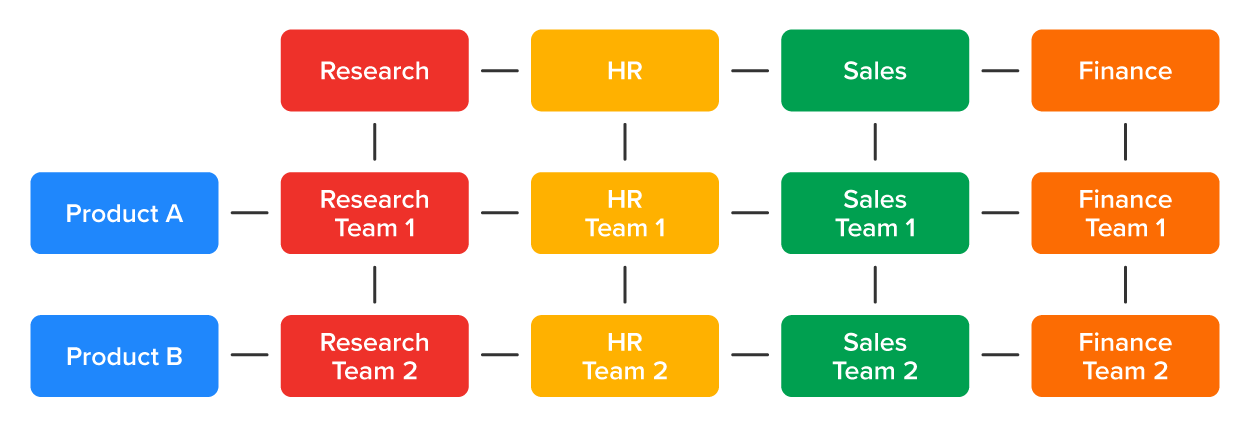
Suppose a company produces two products: Product A and Product B. If it used the matrix structure, this company would organize departments within it by product and function, as shown below.
A matrix structure example
1a. Legal Considerations
In the United States and elsewhere, many business structures require a form of incorporation to register them as legal entities. The owner files articles of incorporation with the secretary of state’s office for the particular jurisdiction. The organization may also hold meetings, select a board of directors, adopt bylaws, and report on a regular basis.
The business entity’s type, geographic span of operations, risk profile, and other factors are issues to consider when deciding what entity type to use, in what jurisdiction to incorporate, how the articles should be drafted, and if a stock form should be used.
term to know
Incorporate
To form into a legal company.
1b. Business Perspective
There are various forms of organizational structures from a business perspective, including the following:
Sole proprietorships
Cooperatives
Partnerships
Limited liability companies
Corporations
All of these structures are for-profit, but there are also nonprofit corporations and other structures. The differences in structures can depend on the number of entrepreneurs or owners involved and the different tax treatments.
One issue dividing these forms is liability. With sole proprietorships and some forms of partnership, owners can be personally liable for business losses, meaning their personal assets are not protected against creditors’ claims. Unlike corporations, these organizational structures are not separate entities from the owners/entrepreneurs.
term to know
Liability
An obligation, debt, or responsibility owed to someone.
1c. Organizational Behavior
Internally, organizations can also be structured differently, in terms of the groupings of organizational relationships and the characteristics of management. Some common structures are functional, divisional, matrix, team, network, and modular structures.
Organizations can also behave differently, independent of their legal and internal structures. For example, hybrid organizations, which may fall under various legal categories, can mix elements, value systems, and the logic of action from the private, public, and voluntary sectors.
2. Business Structures
The functions of most executive management teams are very similar for most businesses, and they will not differ significantly based on how they may be structured or organized. However, a company’s legal structure will have a substantial impact on its operations; therefore, it deserves a significant amount of analysis and discussion.
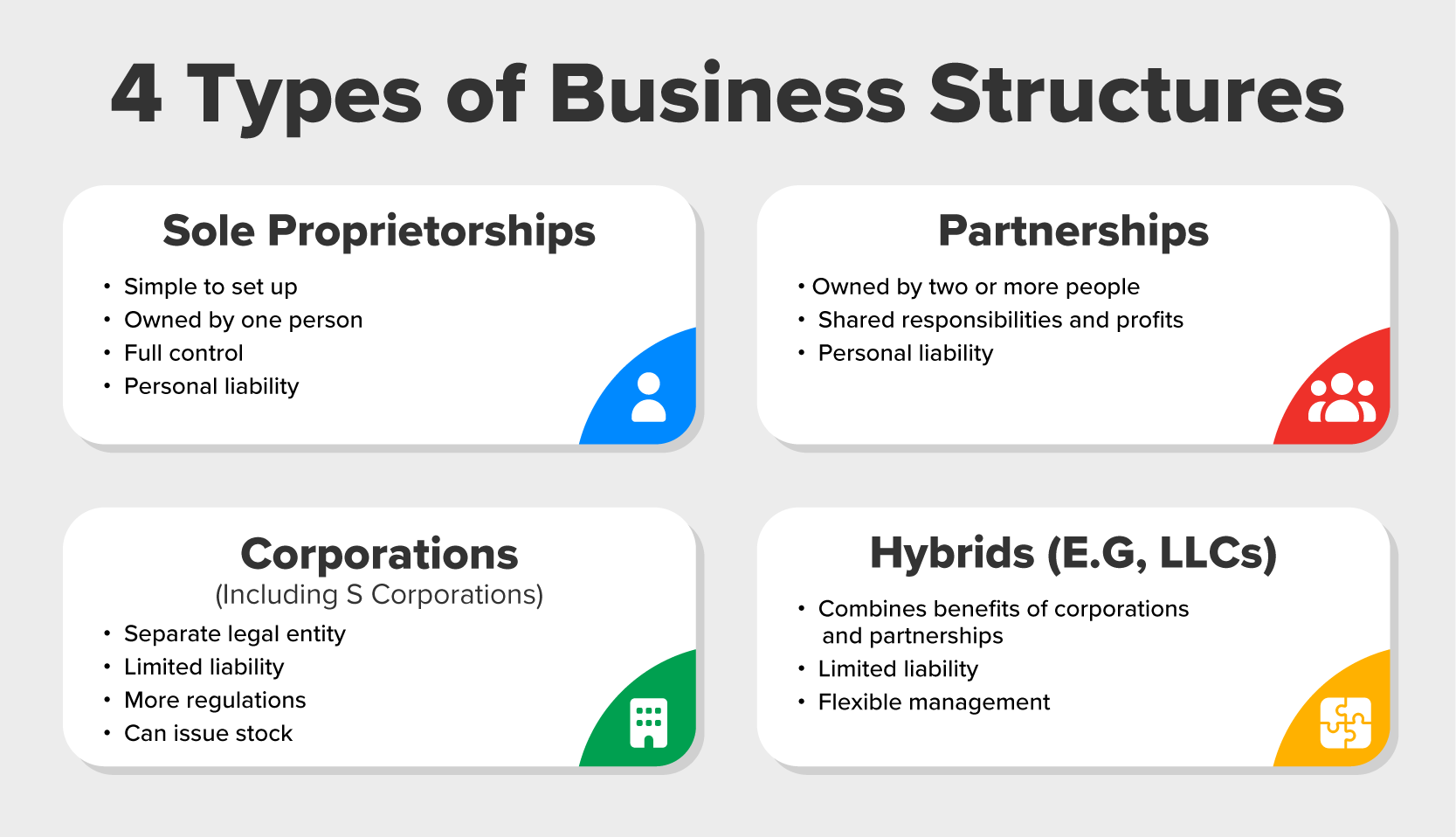
The four most common forms of business organizations are the following:
Sole proprietorships
Partnerships
Corporations, including S corporations
Hybrids, such as limited liability companies (LLCs)
2a. Sole Proprietorship
A sole proprietorship is one type of business structure from a legal status perspective. It is a structure open to businesses run and owned by one entrepreneur, also known as a proprietor. There are both advantages and disadvantages when it comes to using a sole proprietorship as a business structure.
Advantages:
There is an ease in filing incorporation and tax documents.
It does not require formal incorporation, meaning that sole proprietors do not need to formally file articles of incorporation, hold regular meetings, or elect an advising or directing board.
Simplicity is also reflected in the tax treatment, as a sole proprietor files taxes as personal income.
Sole proprietors also have control over aspects of their business without the involvement of elected board members.
Disadvantages:
There is no separation between the entrepreneur and the business. With sole proprietorships, like some forms of partnership, owners can be personally liable for business losses, meaning their personal assets are not protected against the claims of creditors.
It is not a separate entity from the owner/entrepreneur, unlike a corporation. As a result, if the proprietor dies, the business ceases to exist.
Because the enterprise rests exclusively on one person, it often has difficulty raising long-term capital.
big idea
The sole proprietorship structure has the benefit of simplicity and control but the drawback of unlimited liability.
terms to know
Sole Proprietorship
A form of business that is operated and run by a single individual, known as the sole trader, with no legal distinction between the owner and the business entity.
Entrepreneur
A person who organizes and operates a business venture and assumes much of the associated risk.
Proprietor
An owner.
2b. Partnership
A partnership is the next simplest business structure after a sole proprietorship. Because a sole proprietorship can only have one owner, a partnership is the simplest structure open to collaborative ownership. There are both advantages and disadvantages when it comes to using a partnership as a business structure.
Advantages:
There is an ease in filing and tax treatment.
With a general partnership, two or more people can start a business as co-owners with no special formalities, directly controlling the partnership and making binding decisions with a simple majority vote.
Partners are taxed individually on their share of the partnership’s profits.
By default, the profits are shared equally among the partners. However, a partnership agreement will almost invariably expressly provide for the manner in which the profits and losses are to be shared.
Disadvantages:
In some forms of partnership, owners can be personally liable for business losses, meaning their personal assets are not protected against creditors’ claims.
Unlike a corporation, a partnership is not a separate entity from its owners/entrepreneurs. This means that the partnership structure is only as good as the partnership at the relational level. If the mutual consent to form a partnership breaks down, the partnership breaks down as well; partnerships are considered to be an aggregate of their partners rather than a separate entity.
There has been debate in most states as to whether a partnership should remain aggregate or be allowed to become a business entity with a separate continuing legal personality. Types of partnership beyond the general partnership have developed to mitigate some of the disadvantages of the structure. Limited partnerships allow limited liability for some partners who have no management authority, and in some cases (depending on the jurisdiction), limited liability partnerships provide for limited liability for all partners.
big idea
The partnership structure has the benefit of simplicity and control but the drawback of personal liability for the partnership’s activities.
term to know
Partnership
An association of two or more people to conduct a business.
2c. Corporation
A corporation is another type of business structure. There are both advantages and disadvantages when it comes to using a corporation as a business structure.
Advantages:
It protects personal assets. Stockholders, directors, and officers of a corporation are typically not liable for the company’s debts and obligations. They are limited in liability to the amount they have invested in the corporation, which makes financing more attractive from a risk perspective.
Because a corporation is an entity separate from its owners, ownership is easily transferable.
It does not cease to exist with the death of its shareholders, directors, or officers.
In the United States, corporations are generally taxed at a lower rate than individuals.
Disadvantages:
Compared to other business structures, it is less simple to found and maintain.
The incorporator must file articles of incorporation with the secretary of state’s office in the state in which it will be incorporated, as well as hold an organizational meeting to elect a board of directors.
It generally requires the maintenance of at least annual reporting. In many jurisdictions, corporations whose shareholders benefit from limited liability are required to publish annual financial statements and other data so that creditors who do business with the corporation are able to assess the creditworthiness of the corporation and cannot enforce claims against shareholders. Shareholders, therefore, experience some loss of privacy in return for limited liability.
There is the issue of double taxation, wherein the corporation is taxed on its profits, and shareholders are also taxed on their earnings.
big idea
The corporate structure is less simple to found and maintain but has the advantages of limited liability and perpetual life.
IN CONTEXT
It is important to note that after recognizing this problem of double taxation, Congress created the S corporation, which is the best of both worlds. S corporations are merely corporations that elect to pass corporate income, losses, deductions, and credit through to their shareholders for federal tax purposes. The S status combines the legal environment of standard corporations with U.S. federal income taxation similar to that of partnerships.
As with partnerships, the income, deductions, and tax credits of an S corporation flow to shareholders annually, regardless of whether distributions are made. Thus, income is taxed at the shareholder level, not at the corporate level.
Payments to S shareholders by the corporation are distributed tax-free to the extent that the distributed earnings were previously taxed. Also, certain corporate penalty taxes (e.g., accumulated earnings tax and personal holding company tax) and the alternative minimum tax do not apply to an S corporation.
terms to know
Corporation
A legal business entity that is created under the laws of a state.
S Corporation
A closely held corporation that makes a valid election to be taxed under Subchapter S of Chapter 1 of the Internal Revenue Code, which does not require such corporations to pay income taxes and instead taxes owners as individuals.
2d. Limited Liability Company (LLC)
A limited liability company (LLC) is a business structure that combines the limited liability protection of a corporation with the tax benefits and operational flexibility of a partnership. Owners of an LLC, who are called members, are protected from personal liability for business debts and claims. There are both advantages and disadvantages when it comes to using an LLC as a business structure.
Advantages:
There is limited liability protection for members.
The business and owners are not double-taxed. Pass-through taxes are paid on the remaining revenue.
It offers flexibility in management and ownership structure.
Compared to a corporation, it has fewer compliance requirements.
Disadvantages:
There may be a limited lifespan in some states.
Taxes on profits are imposed as self-employment.
As partners enter and exit, there is a complex transfer of ownership process.
It can suffer from a limited ability to attract outside investors compared to corporations.
think about it
You have just developed the next great business idea. How would you evaluate the trade-offs between the limited liability protection offered by an LLC or corporation and the simplicity and tax advantages of a sole proprietorship or partnership? What is most important to you in these structures, and what are some barriers to entry you might face?
term to know
Limited Liability Company (LLC)
A U.S.-specific form of a private limited company; a business structure that can combine the pass-through taxation of a partnership or sole proprietorship with the limited liability of a corporation.
summary
In this lesson, you examined organizational structures and their role in finance, including how different designs (such as pre-bureaucratic, bureaucratic, functional, divisional, and matrix) affect financial control, flexibility, and collaboration. You also explored legal considerations, where incorporation establishes a business as a legal entity with formal responsibilities like filing articles of incorporation and maintaining compliance. In addition, you learned about the business perspective, examining how ownership, taxation, and liability differ among structures such as sole proprietorships, cooperatives, partnerships, corporations, and limited liability companies. You then investigated organizational behavior, recognizing how internal management styles and hybrid models influence company culture and efficiency.
Next, you studied business structures, including the main types: sole proprietorships, which offer simplicity but expose owners to personal liability; partnerships, which allow shared ownership but carry similar risks; corporations, which provide limited liability and perpetual existence but face double taxation and formal reporting; and limited liability companies (LLCs), which combine the tax advantages of partnerships with the liability protection of corporations. Finally, you saw that each structure carries unique trade-offs related to control, taxation, and risk, and that understanding these differences is essential for choosing the right organizational form for any business venture.
A legal business entity that is created under the laws of a state.
Entrepreneur
A person who organizes and operates a business venture and assumes much of the associated risk.
Incorporate
To form into a legal company.
Liability
An obligation, debt, or responsibility owed to someone.
Limited Liability Company (LLC)
A U.S.-specific form of a private limited company; a business structure that can combine the pass-through taxation of a partnership or sole proprietorship with the limited liability of a corporation.
Partnership
An association of two or more people to conduct a business.
Proprietor
An owner.
S Corporation
A closely held corporation that makes a valid election to be taxed under Subchapter S of Chapter 1 of the Internal Revenue Code, which does not require such corporations to pay income taxes and instead taxes owners as individuals.
Sole Proprietorship
A form of business that is operated and run by a single individual, known as the sole trader, with no legal distinction between the owner and the business entity.