Table of Contents |
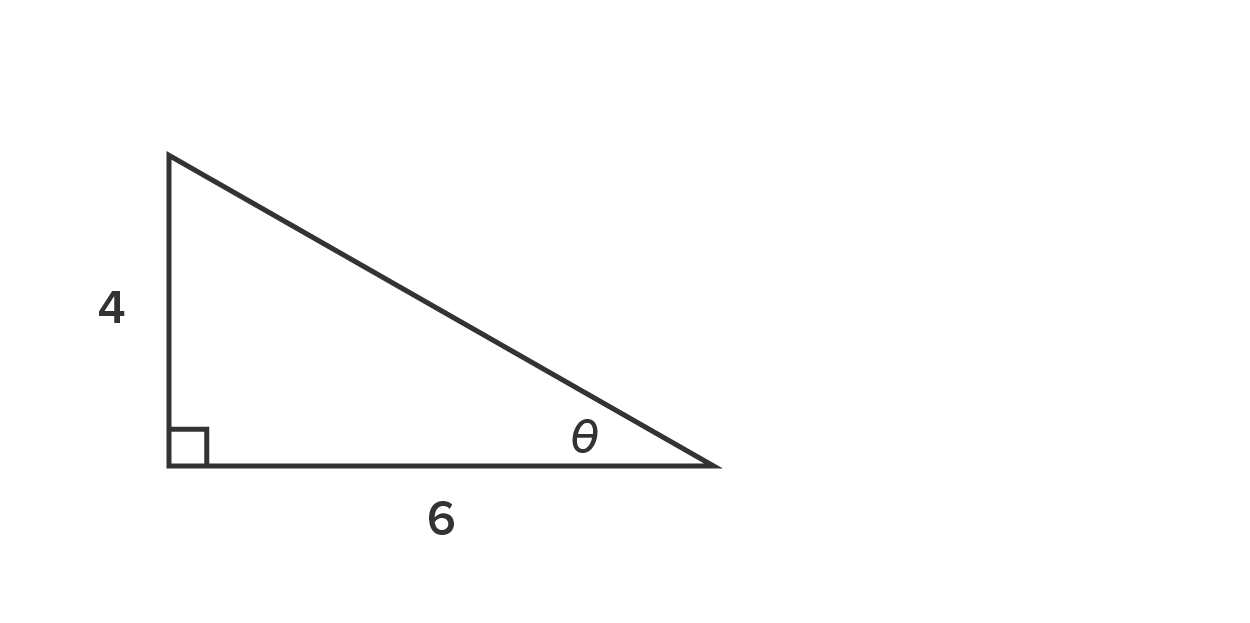
Consider the right triangle.
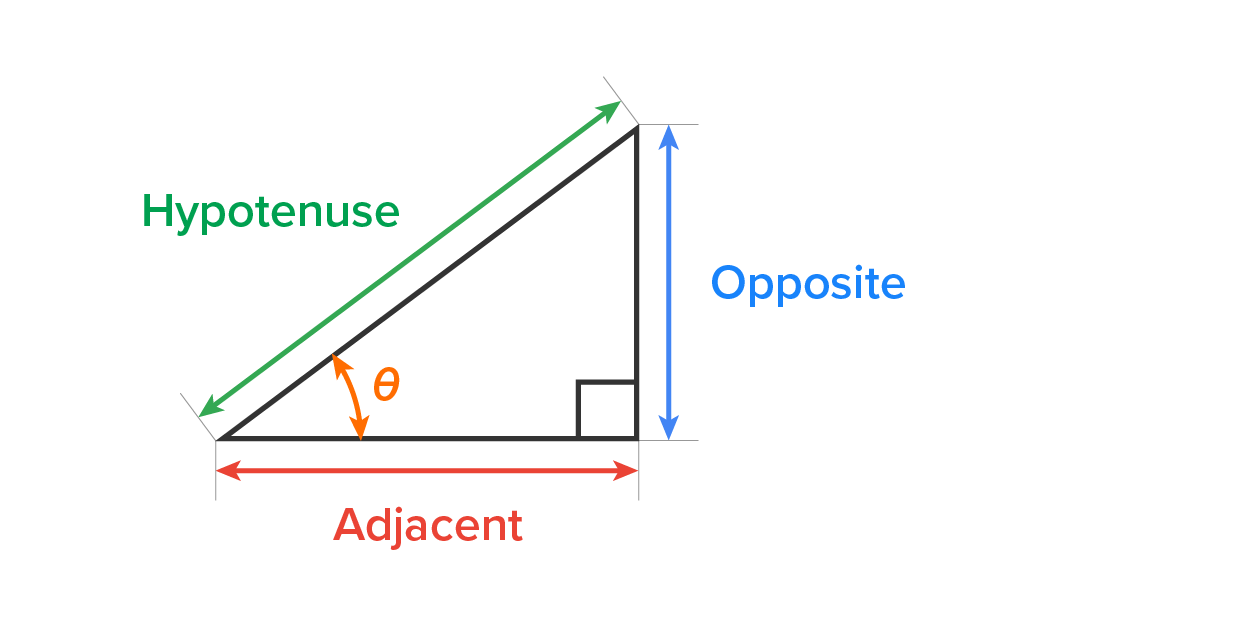
The sides “Opposite” and “Adjacent” are named this way relative to the angle  (theta) marked in the triangle.
Going forward, “Opposite” means the length of the opposite side and “Adjacent” means the length of the adjacent side.
The hypotenuse is the side opposite the right angle, and is consequently the longest side of the right triangle.
Using this convention, there are six possible ratios that can be computed between two distinct sides of a right triangle. We will focus on three of these for now.
A trigonometric function assigns an angle to a ratio. That is, the input is the angle and the output is the ratio. The three basic trigonometric functions we will discuss for now are called the sine function (sin), the cosine function (cos), and the tangent function (tan).
To compute these functions, an angle must be used. Here are their definitions:



At first, we are going to only consider situations where is an acute angle, meaning its measure is more than  and less than
  . When using trigonometric functions, it is important to note that an angle must accompany the name of the function. For example, we write
  , not
, not  . (Think about the square root function: You had to write
  as opposed to
  .)
.)
and less than .EXAMPLE
Using the right triangle, find the sine, cosine, and tangent of angle.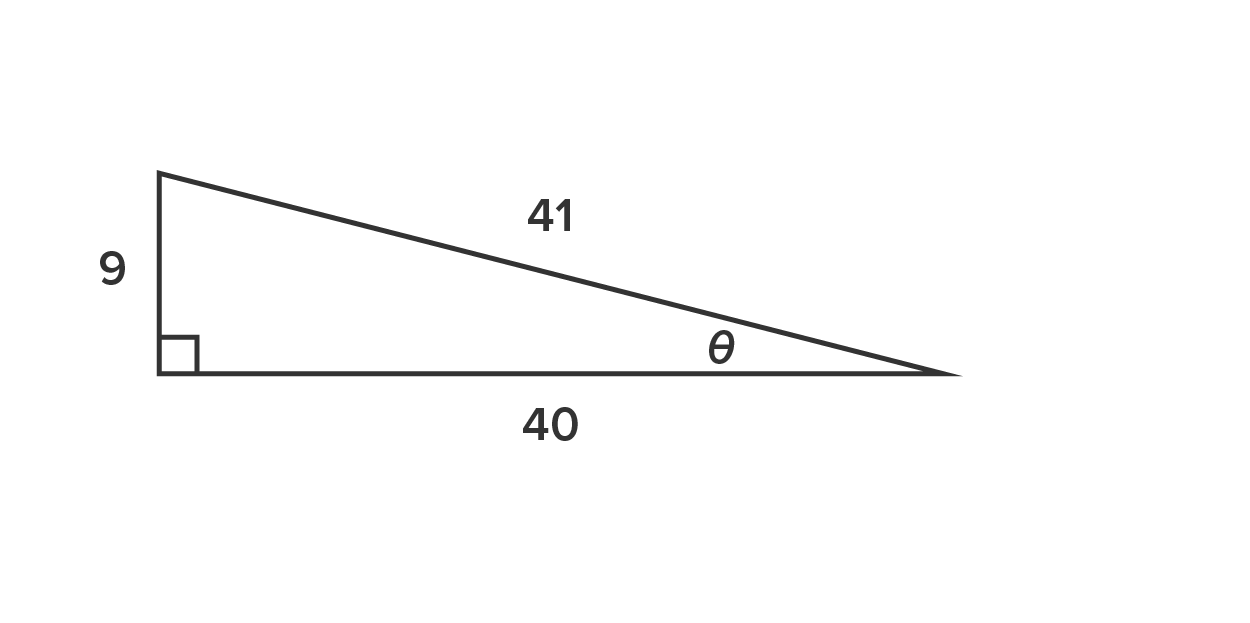

|

|

|
EXAMPLE
Using the right triangle, find the sine, cosine, and tangent of angle.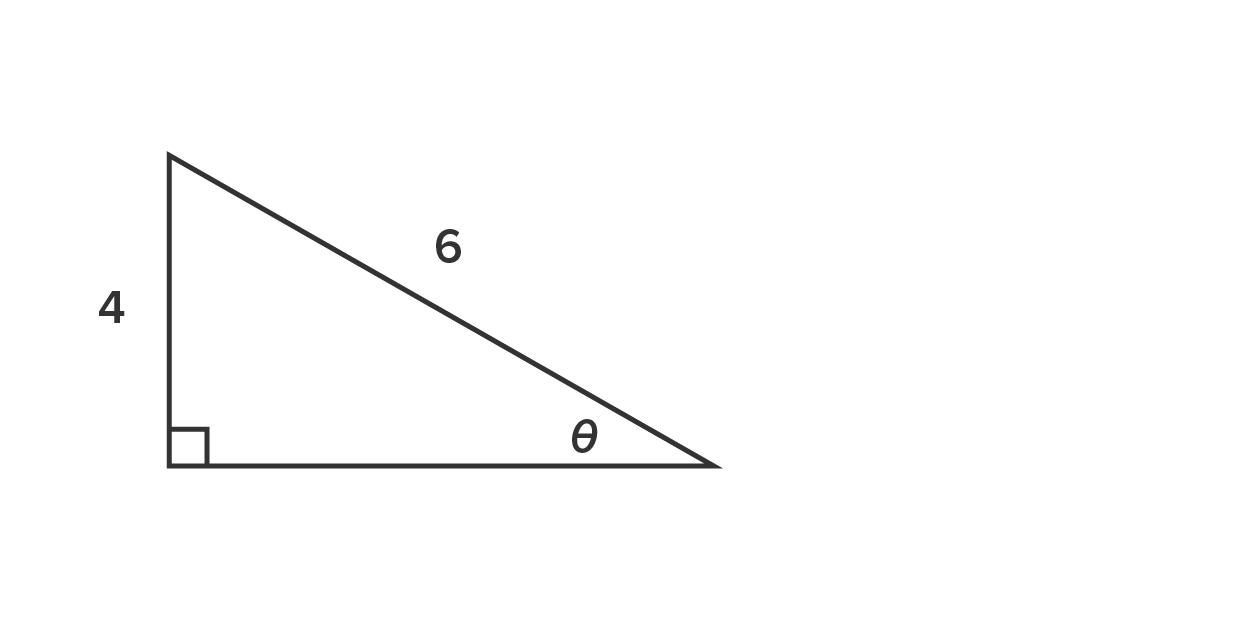

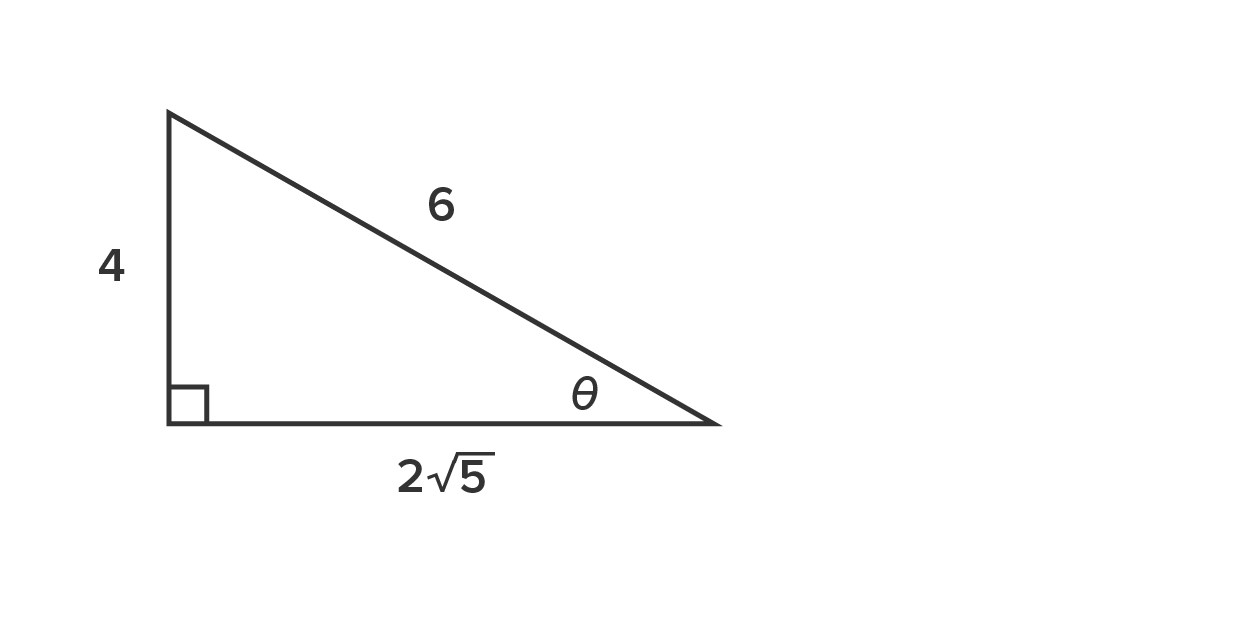

|

|

|
in the above example, the expression  is not considered simplified since there is a radical in the denominator. The process by which an expression like this is simplified is called rationalizing the denominator. In short, to rationalize a fraction with
  in the denominator, multiply by
  .
.

|
Pythagorean Theorem |

|
Substitute  and and 
|

|
Simplify. |

|
Solve for c by applying the square root to both sides, then write in simplest form. |

 Here is why:
|
|
Definition of sine |

|
Opposite side is 4, hypotenuse is 
|

|
Remove common factor of 2. |

|
Rationalize the denominator. |

|
Simplify. |
 Here is why:
|
|
Definition of cosine |

|
Adjacent side is 6, hypotenuse is
|

|
Remove common factor of 2. |

|
Rationalize the denominator. |

|
Simplify. |
Most trigonometric functions require calculator use. On a typical scientific calculator, you will notice the “sin,” “cos,” and “tan” buttons.
Before practicing this, be sure that your calculator is in “degree” mode, which should be the default setting.
EXAMPLE
Suppose we want the sine of the angle This is written
 .
.
Most trigonometric functions produce values that are long decimals, which are irrational numbers. It turns out that the ratios corresponding to  ,
,  , and
, and  are concise enough that they are worth noting (and remembering!). This is why we sometimes refer to these angles as special angles.
The exact values for all the special angles are as follows:

|

|

|

|

|

|

|

|

|
As it turns out, the work we have done with the trigonometric functions can be applied to any angle, not just acute angles. But how are non-acute angles handled?
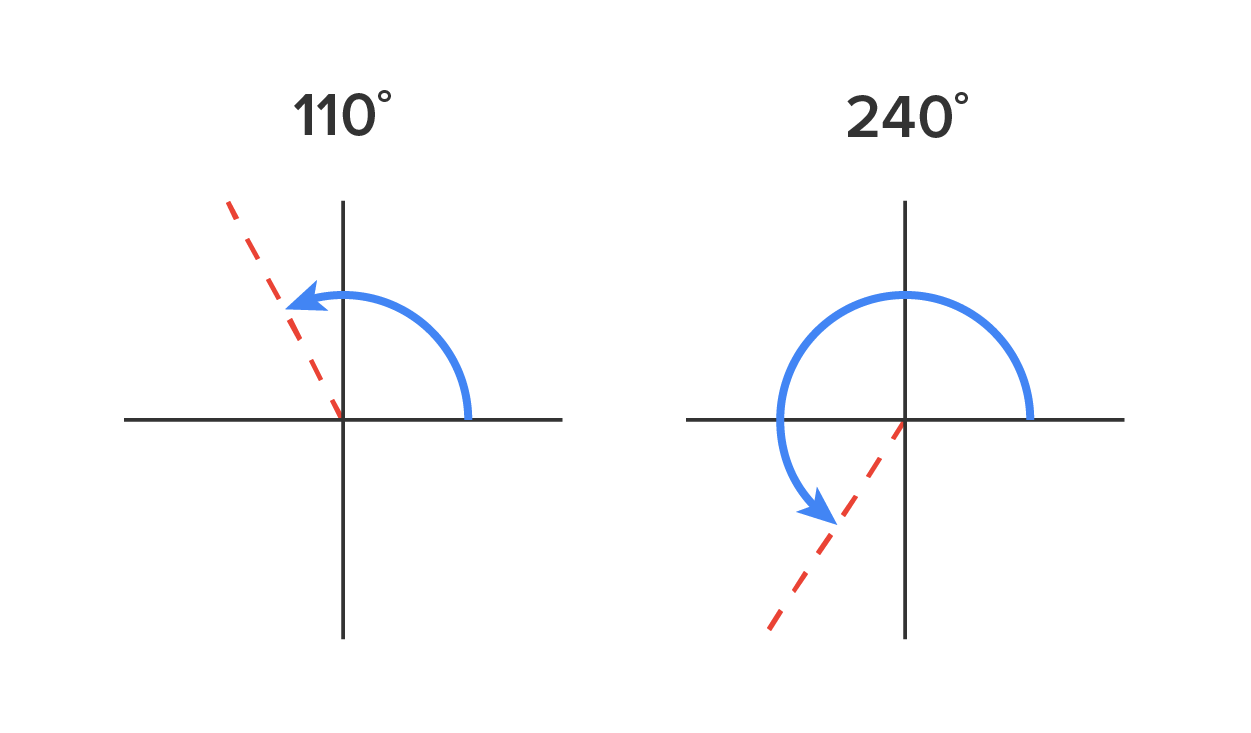
For reference, we draw the x-axis and y-axis. The angle is represented by starting at the positive x-axis (which we call the initial side of an angle), then drawing counterclockwise. To show where the angle stops, a side is created (dashed). This is called the terminal side of the angle.
For example, here are what  and
and  look like:
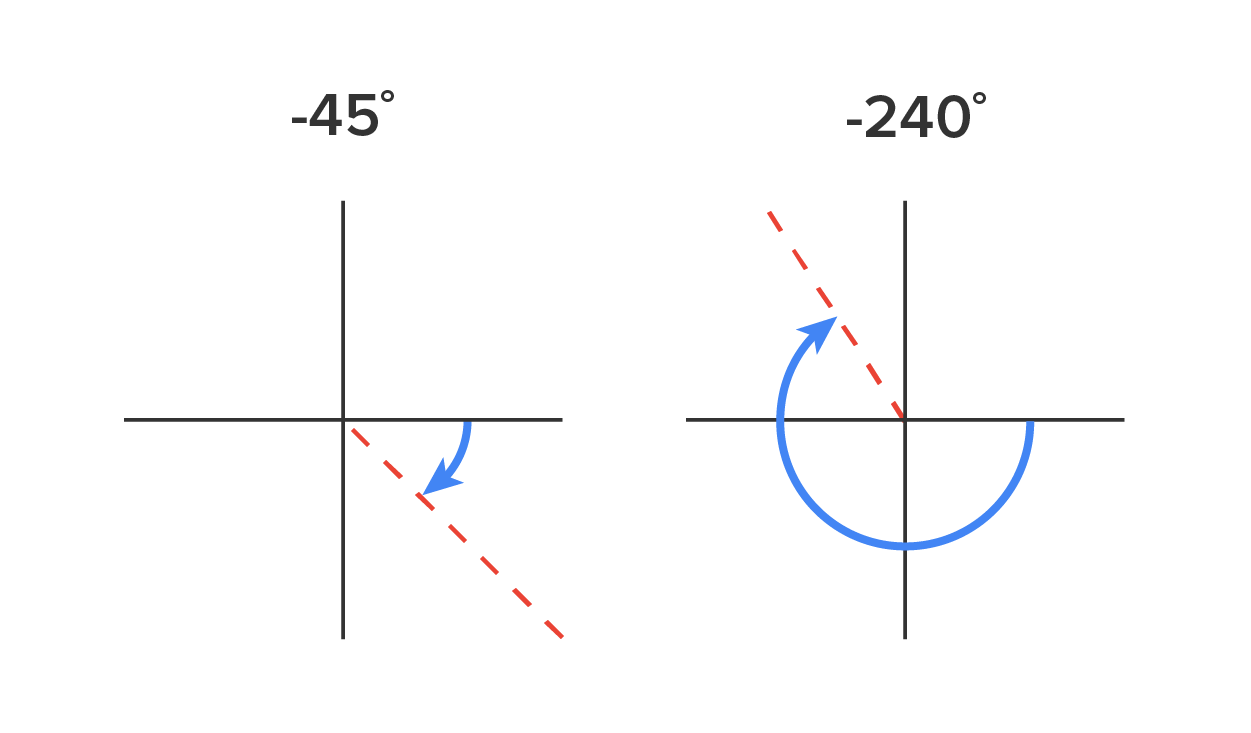
It follows that angles can also be measured clockwise. These angles are negative. Some examples:
Lastly, it is also possible to talk about angles larger than  . These angles go through more than one full revolution.
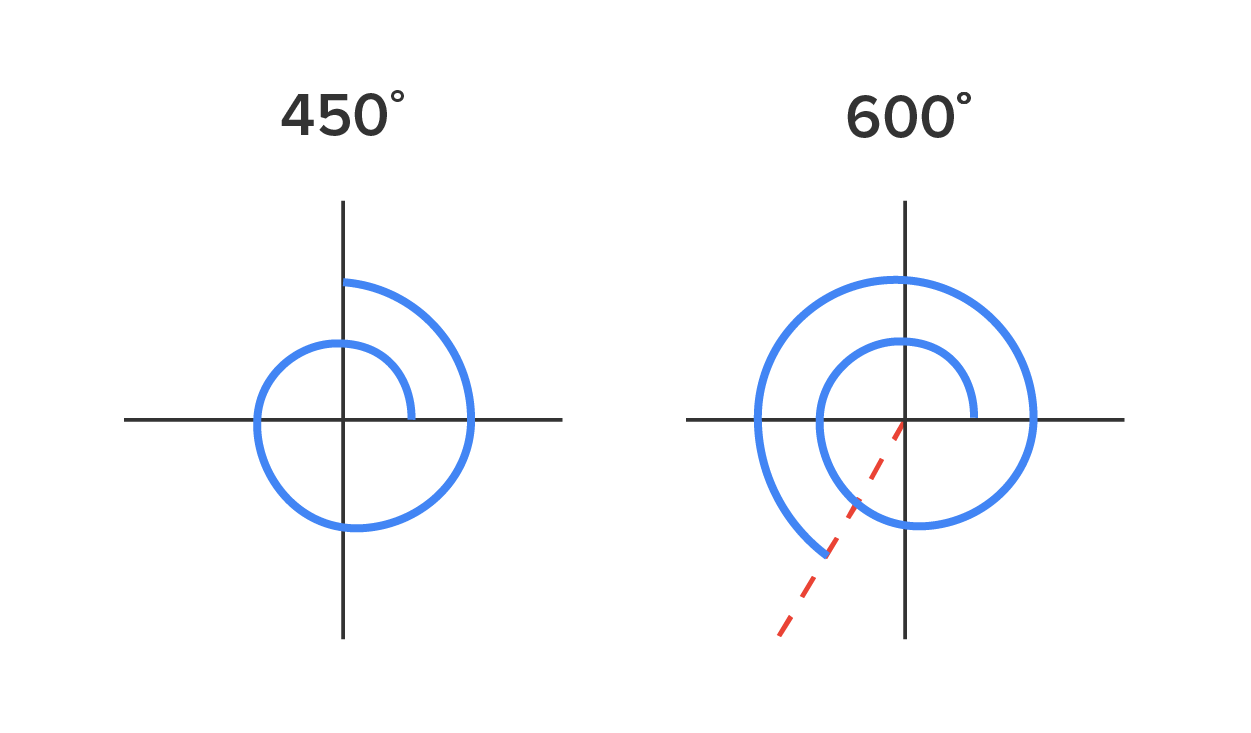
Notice that the  angle above terminates at the same place that a angle terminates. We call these angles coterminal. In general, coterminal angles have measures that differ by some multiple of .
.
 and
and  .
.For your reference, here is the unit circle. It will also be accessible on the course dashboard.
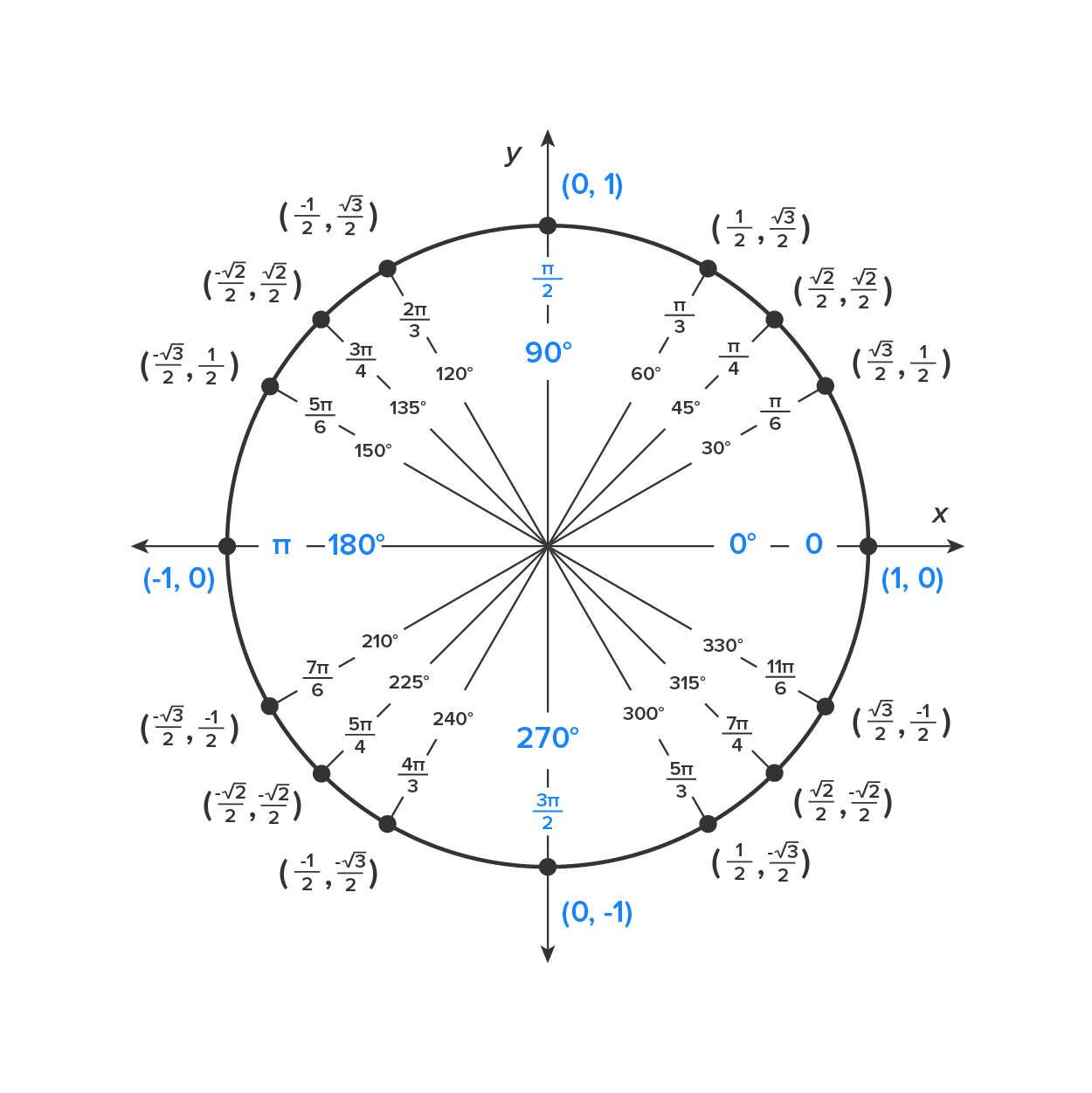
 . This is a very useful identity that can be used to compute .
EXAMPLE
Find the exact value of sin by using the unit circle.
corresponds to the point
by using the unit circle.
corresponds to the point  Since the y-coordinate of the point is 0, it follows that sin
  .
.
EXAMPLE
Find the exact value of tan by using the unit circle.
corresponds to the point
by using the unit circle.
corresponds to the point  . Since
  , it follows that
  .
.
For negative angles and angles larger than , use a coterminal angle between and to evaluate the trigonometric function.
EXAMPLE
Find the exact value of cos .
has the same terminal side as . This means that
.
has the same terminal side as . This means that  .
Since corresponds to the point
.
Since corresponds to the point  ,
,  .
.
EXAMPLE
Find the exact value of tan .
.
 is coterminal with
  . Thus,
  .
Since
.
Since  corresponds to the point
  , it follows that
  or
or  .
.
Another way to measure angles is to use radians. One radian is defined as the central angle in the circle (see figure) so that the length of the circular arc is equal to the radius of the circle. Radians are used as a way of measuring angles because they represent a quantity, while degrees represent a scale.
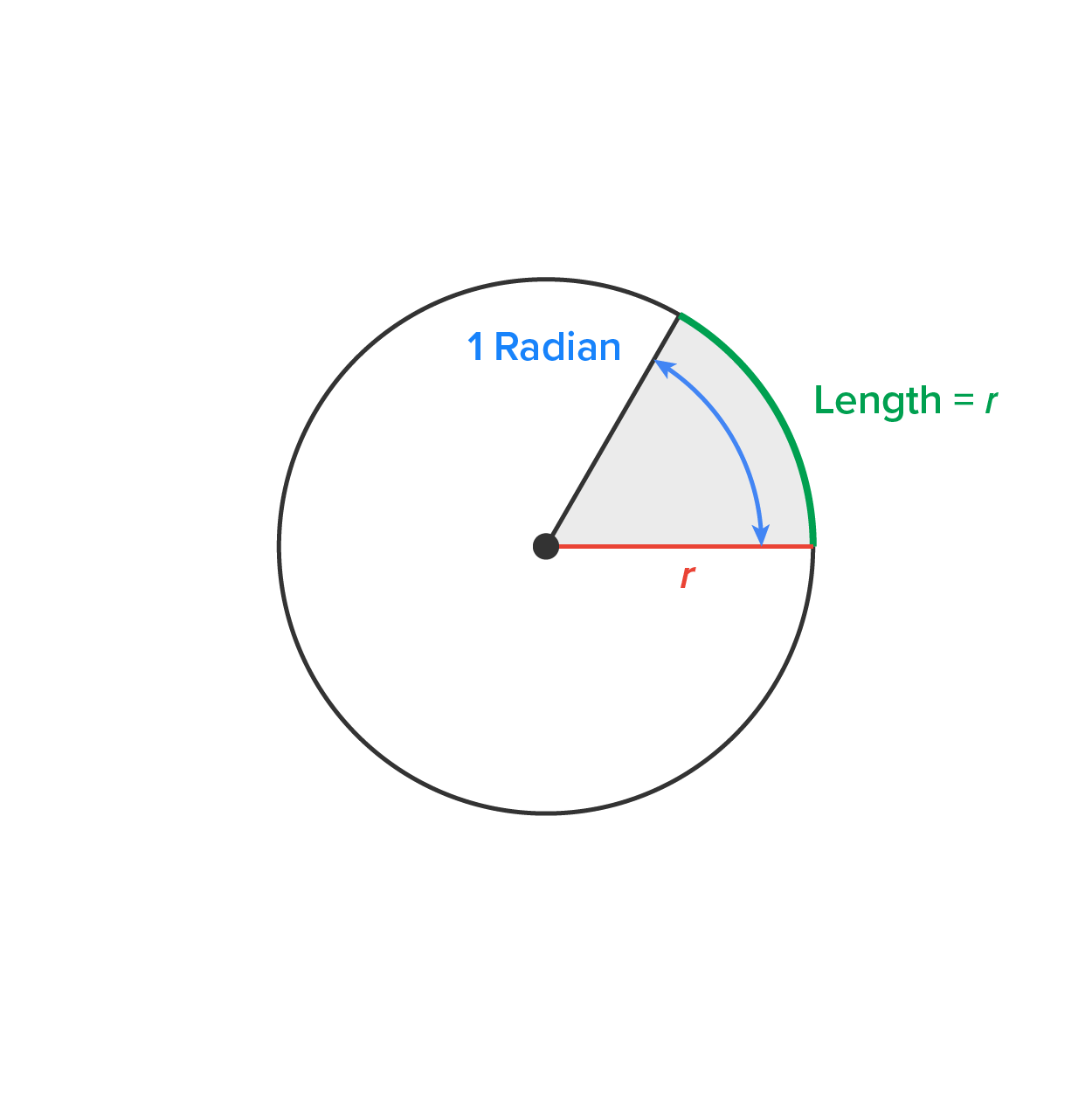
 degrees.
Thinking about the previous figure, consider making one trip around the entire circle, which has length  (circumference). Remembering that each radian contributes a length of r to the circle, it follows that one full trip around the circle is
  radians.
Also recall that one full trip around the circle is .
As a result, we see that  radians. Dividing both sides by 2, we can also say that
  radians. Dividing both sides by
  and 180 respectively, we have two rules to use when converting between radians and degrees:
| Formula | When To Use It | |
|---|---|---|
|
Divide by :
|

|
When given an angle measured in radians, multiply by  to get the angle measurement in degrees. to get the angle measurement in degrees.
|
| Divide by 180: |

|
When given an angle measured in degrees, multiply by  to get the angle measurement in radians. to get the angle measurement in radians.
|


EXAMPLE
Convert to radians.
 radians
EXAMPLE
Convert 2.1 radians to degrees. rather than approximate it. These angles are usually multiples of
  .
.
| Degrees |
|
|
|
|
|

|

|

|
|

|
|
|---|---|---|---|---|---|---|---|---|---|---|---|
| Radians |

|

|

|

|

|

|

|

|
|

|

|
Remember that radian measure is another way to represent an angle, so it may be helpful to convert the angle to degrees first before evaluating. (Recall the special values you were given earlier and the values from the unit circle).
EXAMPLE

|

|

|

|
An equation where the angle is unknown and the ratio is known is called a trigonometric equation.
EXAMPLE

|

|

|
Based on what we know from the unit circle, there are infinite solutions to a trigonometric equation if we include all coterminal angles. In most situations, we want to find all solutions in the first revolution of the circle, namely the interval  or in radians,
  .
.
For now, we will focus on known ratios that correspond to special angles. Other angles/ratios will be investigated in Unit 3.
EXAMPLE
Find all solutions to on the interval .
are and , or in radians, and .
on the interval .
are and , or in radians, and .
 and
and  .
.
EXAMPLE
Solve the equation on the interval .
 .
.
 and . In radians, that means
  and
and  .
.
 on the interval by completing the following steps.
Consider the function 
From the unit circle, here is a table of values that shows how the angles and the ratios are related.
| x | 0 |
|
|
|
|
|
|
|
|
|---|---|---|---|---|---|---|---|---|---|

|
0 |

|

|

|
1 |
|
|
|
0 |
| x |

|

|

|
|

|

|

|
|
|
|
|

|

|

|
-1 |
|
|
|
0 | |
Here is the graph, limited to the points that are listed above.
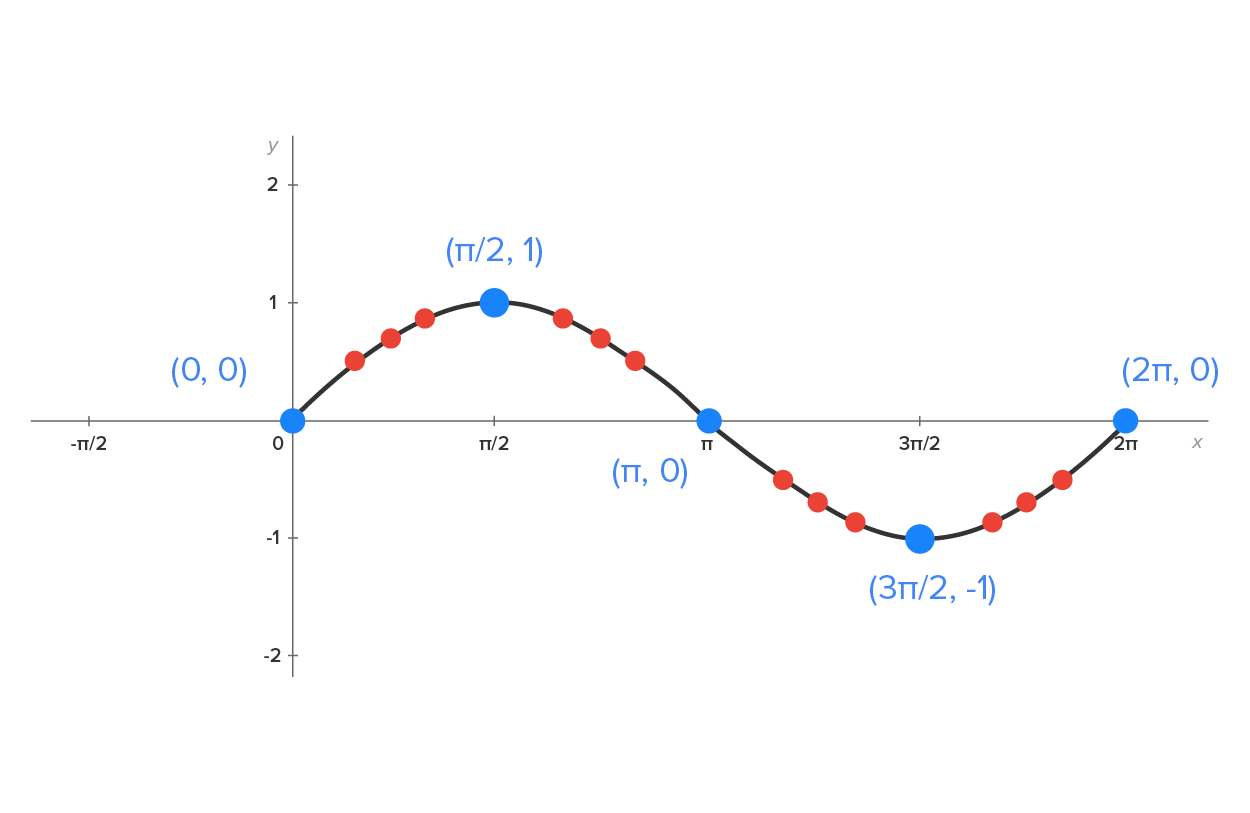
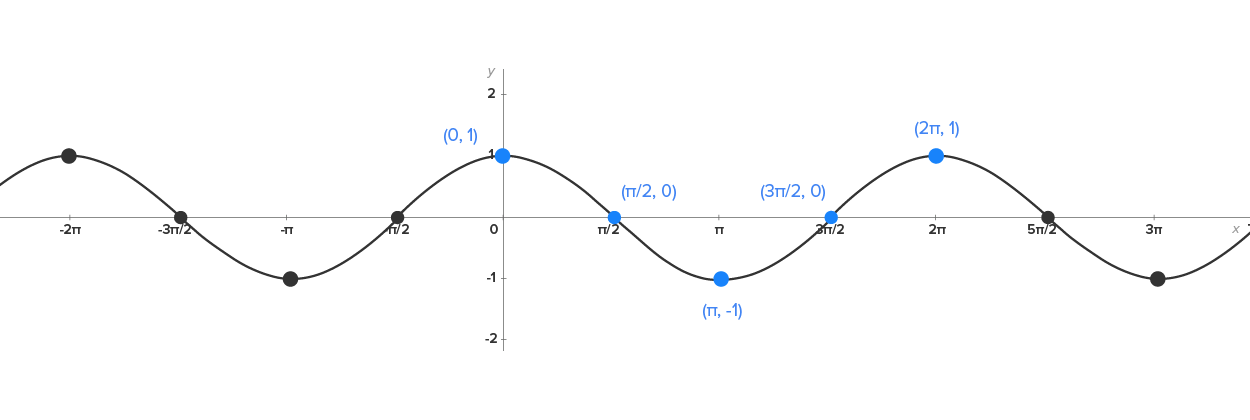
Remember also that coterminal angles produce the same trigonometric values. Thus, we can say that  . Because of this relationship, we say that the sine function has a period of , meaning that the graph repeats itself every units. As a result, the complete graph of
  is as follows:
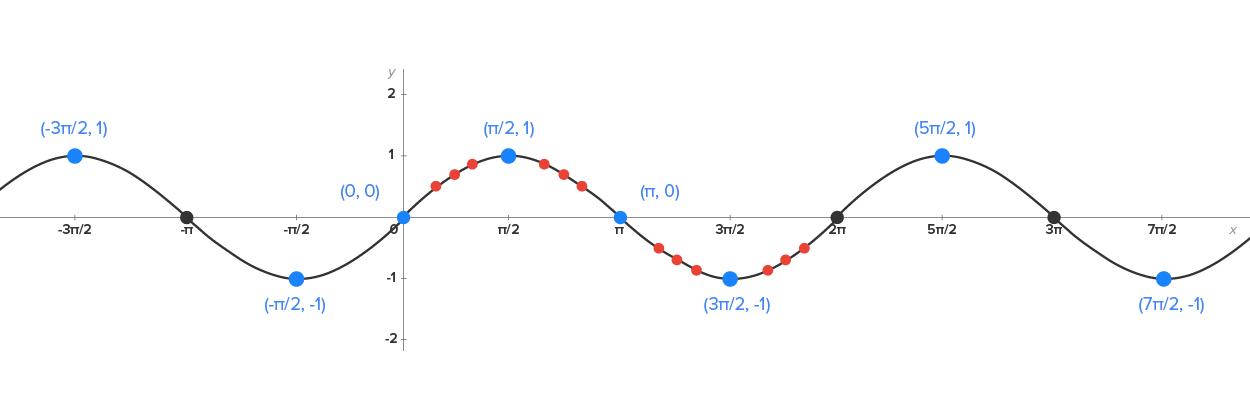
The graph continues in this pattern indefinitely. Since there are no breaks or holes in the graph, the domain of  is the set of all real numbers, also written in interval notation as
  . The range of this function is
  since the graph goes no higher than
  and no lower than
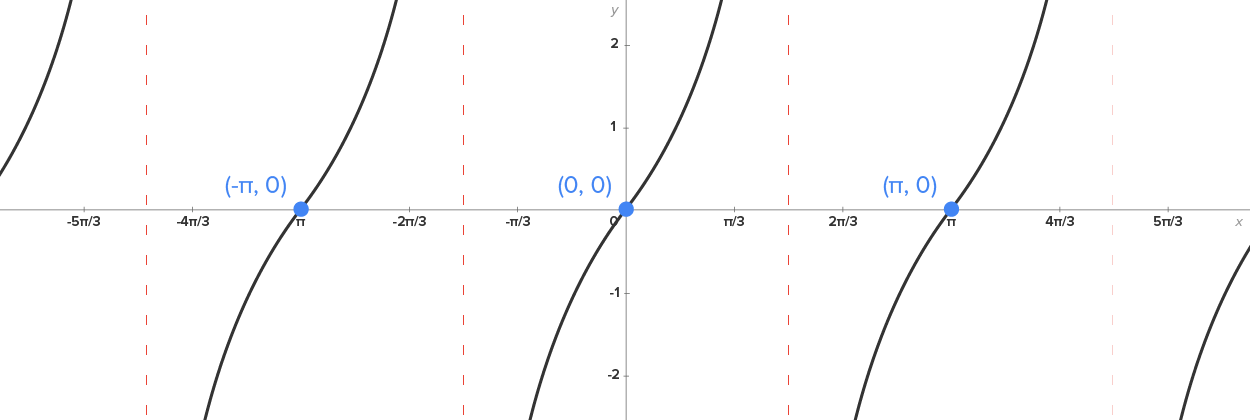
By following a similar process as above, we can obtain the graphs of  and
and  :
:

| |
|---|---|
| Graph |
|
| Domain |
|
| Range |
|
| Period |
|

| |
| Graph |
|
| Domain |
All reals except 
|
| Range |
|
| Period |
|
 . Therefore,
  is undefined whenever
  , which is when x is an odd multiple of .
Recall that an identity is an equation that is true for all possible values of the variable.
EXAMPLE
 is an identity. No matter what is substituted for x, both sides of the equation will have the same value.
The following are the most commonly used trigonometric identities.
| Reciprocal Identities | Tangent/Cotangent Identities |
|---|---|
Secant:  Cosecant:  Cotangent: 
|
 
|
| Cofunction Identities | Pythagorean Identities |
      (Note: If is measured in degrees, replace with .)
|
   (Note: The notation  means means  .) .)
|
| Sum of Angles Identities | Double-Angle Identities |

|

|
| Power-Reducing Identities | |

|
and less than ), evaluating trigonometric functions for 30°, 45°, and 60° (special angles with concise corresponding ratios), defining non-acute angles, the unit circle, and evaluating trigonometric functions for any angle.
Source: THIS TUTORIAL WAS AUTHORED BY SOPHIA LEARNING. PLEASE SEE OUR TERMS OF USE.
An angle whose measure is more than  and less than
  .
.
Angles that have the same terminal side.
The angle required to produce a circular arc whose length is equal to the radius. One radian is  degrees.
An equation in which trigonometric functions are involved and the angle is unknown.
Uses an angle as an input and returns a ratio as the output.









 radians