Table of Contents |
If you recall, the internal environment of a business consists of entrepreneurs, managers, workers, and customers. There are many trends impacting this environment, such as a greater focus on “people-first” company cultures. When we consider a people-first culture, it ultimately goes beyond just good perks and high pay. It means to build a workforce where people can easily communicate, where they feel heard, valued, and supported. Companies attempt to do this in many ways.
EXAMPLE
Many companies have implemented technology to make communication easier and more streamlined, such as the use of Slack or Teams.In addition, employees have more say, and manager roles have slipped more into coaching roles rather than “telling someone what to do” roles. Companies overall are considering how to create transparent policies to encourage work and create better work–life balance for employees. Work–life balance is the concept of managing time, so it allows not only for work time but also for personal time.
EXAMPLE
 In the past, many companies had a culture where checking emails seven days a week was normal. However, this has shifted more to employees not being expected to work during off-times so they may enjoy time away from work. This shift is a result of many people becoming burned out.
There are many ways companies create work–life balance, such as the following:
Companies are also more focused on building inclusive and diverse teams, which goes beyond hiring diverse people and ensures that all individuals feel heard and valued.
EXAMPLE
Companies may create leadership programs specifically for underrepresented groups.Many companies also have, or are considering creating, growth opportunities in their organizations by providing clear promotion paths. This caters to the idea that if someone is investing time in the company, the company should also be investing in the employee’s personal growth.
The goal of most businesses is to make a profit, and they can do this by meeting the competitive challenges that exist in the market today. Companies are turning to many different strategies to remain competitive in the global marketplace. One of the most important strategies is relationship management, which involves building, maintaining, and enhancing interactions with customers and other parties to develop long-term satisfaction through mutually beneficial partnerships.
Relationship management includes both of these:
To meet competitive challenges, companies are leveraging technology, direct-to-consumer buying options, and sustainability.
AI isn’t just for tech giants anymore—it’s popping up everywhere, even in small businesses.
EXAMPLE
Think of how Netflix knows what you want to watch, how your inbox suggests replies, or how Amazon suggests products it thinks you might be interested in, based on past history.Companies are using AI to automate tasks, write marketing copy, answer customer questions with chatbots, and even sort through résumés. While AI does not replace the human factor, it can make traditional business tasks faster and easier, such as writing reports, summarizing data, taking meeting notes, and outlining strategic plans.
The use of technology and AI has made other tasks in business easier.
EXAMPLE
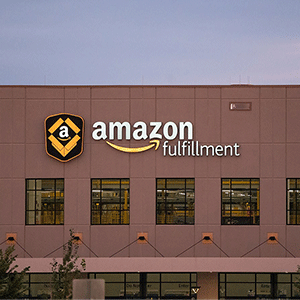 Rather than renting warehouse space and storing massive amounts of goods ready to ship, technology has automated supply chain and purchasing with smart systems that utilize AI, robots, and sensors to track inventory with high precision—which means businesses can focus on other tasks.
Overall, technology continues to improve the experience for customers and businesses. Consider how much easier common tasks like hiring, payroll, and communication are now through the use of technology. The most successful businesses will be the ones that track new technology trends and implement them to save time and money.
Besides technology, other trends related to how businesses sell to consumers should be considered by students of business. First, many companies are focused on direct-to-consumer sales (DTC), which means a company sells its products directly to consumers, without any intermediaries such as retail stores. Companies are selling directly through social media channels such as TikTok and Instagram.
EXAMPLE
The company Warby Parker is a U.S.-based eyewear company. Instead of selling through typical optical shops, it sells its products directly online for competitive prices and allows customers to try on these products at home at no cost.Even very small companies, such as those that may sell on platforms like Etsy, skip the traditional retail sale route to sell directly to consumers.
Another consumer trend to consider is digital payments. Platforms like Venmo, Apple Pay, and Zelle offer consumers more options by which to pay for their purchase—and these options will only continue to grow. In-app payment options, the ability to split a bill at a restaurant, and services like “buy now, pay later” or spreading payments for a bigger ticket item change the way consumers are able to pay for items.
Personalization of products is also a trend to consider in business. Have you ever googled something only to see an ad come up for a similar product moments later? Or perhaps your Spotify list knows exactly what you want to listen to next? The use of technology allows companies to better personalize products and services.
EXAMPLE
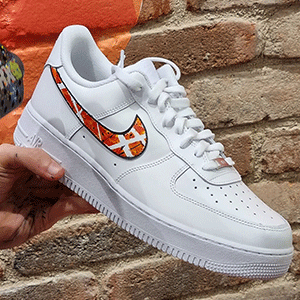 Consider Curology, which allows the consumer to take an online quiz, upload photos of their skin, and get recommended or prescribed a custom skincare formula. Or, consider Nike, which offers a Nike By You line, where you’re able to customize colors and materials.
Of course, technology has helped propel this trend forward, but offering personalized products for reasonable prices is an important trend to recognize in business.
Sustainability is now a business imperative, not just a branding strategy. Investors, regulators, and consumers are demanding greater transparency in how companies impact the environment and society. Environmental, social, and governance (ESG) reporting is becoming standard practice, with new regulations pushing for verified data and real accountability. Companies are adopting circular economy models—recycling, reusing, and minimizing waste—to meet both ecological goals and customer expectations. In addition, these efforts save the companies money as well.
EXAMPLE
 Allbirds, a DTC footwear brand, makes all of its shoes from sustainable materials and labels every product with its carbon footprint.
Greenwashing, however, is when a company pretends to be environmentally friendly just to look good, without actually doing much to help the planet.
EXAMPLE
A fashion brand claims it uses recycled materials, but only 5% of the product is recycled materials.Many companies avoid the concept of greenwashing, attempt to provide real, sustainable strategies, and are held accountable for them.
Source: THIS TUTORIAL WAS AUTHORED BY SOPHIA LEARNING. PLEASE SEE OUR TERMS OF USE



