Use Sophia to knock out your gen-ed requirements quickly and affordably. Learn more
×

Time Value of Money

Author: Sophia

what's covered
In this lesson, you will learn about the time value of money and how to calculate the future value and present value of money. Specifically, this lesson will cover the following:

Table of Contents

1. Time Value of Money

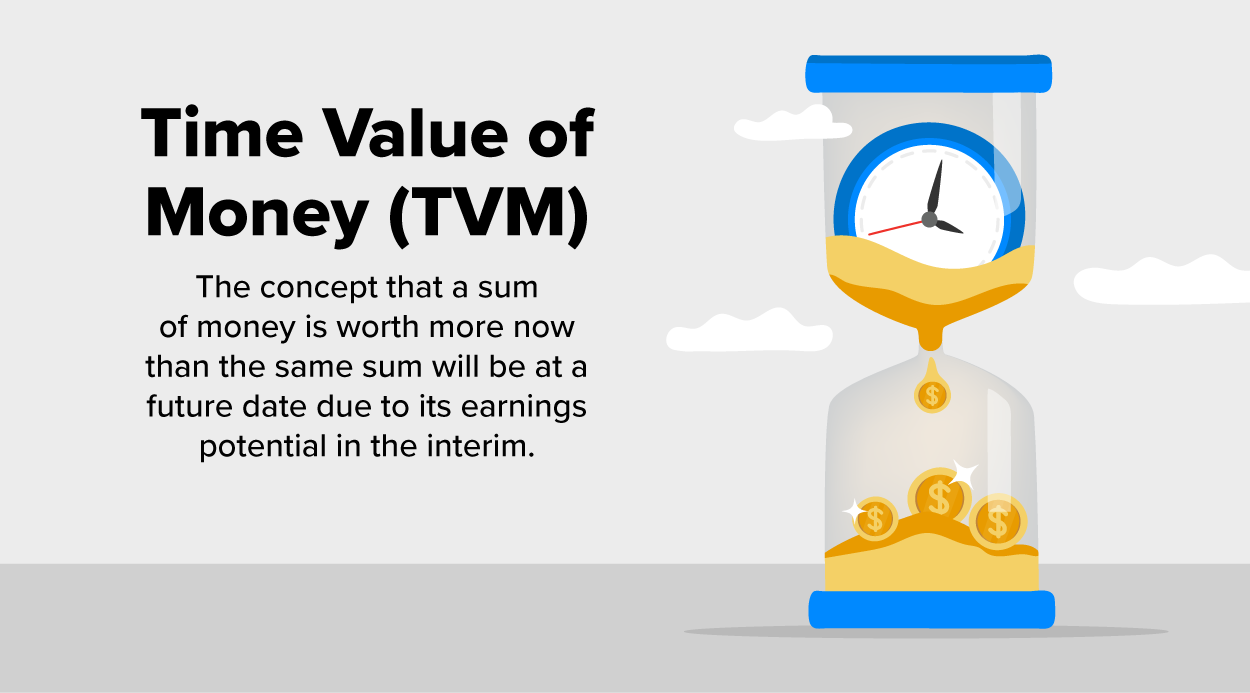
The image presents the concept of the Time Value of Money (TVM) with a title in bold text and an explanation below. The text states that money is worth more today than in the future because of its earning potential. On the right side, there is an hourglass filled with coins, with the upper section containing sand and a clock face, symbolizing the relationship between time and money. The background includes a few clouds, adding to the visual representation of time passing.

Understanding the time value of money (TVM) is crucial for making informed financial decisions. At its core, the concept highlights how money today is worth more than the same amount in the future because of its earning potential. But why does this matter in our everyday lives? Let’s unpack this powerful idea and explore how you can harness it to achieve financial freedom.

Before we dive into the technical aspects, let’s start with a simple story.

Imagine someone offers you $1,000 today or $1,000 5 years from now. Which would you choose? Most of us would instinctively take the money today. Why? Because that $1,000 can be put to work. You could invest it, let it grow, and have more than $1,000 in 5 years.

This simple scenario captures the essence of TVM—money is worth more now because of its potential to grow and because it’s more reliable.

Now, let’s break it down:

  • If you choose the $1,000 today and invest it at a 5% annual return, you could turn it into $1,276 in 5 years. If you wait to receive the $1,000, you’ve lost out on the extra $276 you could have earned. That’s the opportunity cost of waiting.
  • On the flip side, taking the $1,000 today reduces the risk of not getting it in 5 years. Life happens—maybe the promise of $1,000 in the future falls through. Having the money now gives you control and certainty.
This is why understanding both opportunity cost and risk is key to making smart financial decisions. They help you see not just the numbers, but the potential and risks tied to every choice you make with your money.

Why It Matters:

1. Opportunity Cost

Think of opportunity cost as the cost of missing out on something you could have had, simply because you didn’t take action. Let’s say you have $100 right now. You have two choices:

  1. You can invest it right away.
  2. You can wait a year before investing it.
Now, here’s why waiting comes at a cost:

If you invest that $100 today in something like a savings account or an investment earning 5% interest, by next year, your $100 will have grown to $105. That extra $5 is money you earned simply by letting your money sit and grow.

But if you decide to hold on to that $100 and wait a year before investing, you’re giving up the chance to earn that $5. It’s as if someone said, “Hey, here’s $5 for free,” and you said, “Nah, I’m good.”

So, the opportunity cost is not just about losing $5—it’s about what that $5 could have done for you in the long run. Because guess what? If you had invested the $105 (your $100 plus the $5 you earned) in the second year, it would earn even more interest—building a snowball effect.

EXAMPLE

Imagine you’re saving up for something fun, like a vacation. If you keep your money in a jar at home for a year, that’s fine—you’ll still have the same $100. But if you had put that $100 in an account that earned interest, you could have had $105. Now, that $5 might not seem like a big deal, but over time, this difference really adds up. It’s like your money is missing out on working shifts for you.

2. Risk

Imagine this: Someone says, “I’ll give you $100 right now, no strings attached,” and someone else says, “I’ll give you $100 in a year, but trust me, it’ll be there.” Which sounds better? Most people would take the money now because it’s less risky.

Money you have in your hand right now is certain. You can see it, use it, and make it work for you immediately. Money promised in the future? Well, things could happen—a job might fall through, the deal might change, or they might simply forget. That future money is a promise, not a guarantee, and carries with it more risk.

Having cash now also gives you the power of choice. Let’s say you come across an opportunity, like investing in a business, snagging a property deal, or grabbing a once-in-a-lifetime vacation discount. If you have the money ready to go, you can jump on it. But if all you have is a promise of money in the future, you might miss out because you don’t have cash on hand when you need it.

EXAMPLE

Imagine you’re walking through your favorite store and you see a $300 gadget on sale for just $200 today. You’ve got $200 in your wallet, so you grab it, saving $100. But if you were waiting for payday or some money someone promised you in the future, you’d miss the sale and have to pay full price later—or not buy it at all. Having money now means you can act quickly and take advantage of the opportunity and not risk missing the sale.

Now, think about this in terms of a paycheck. When you get paid, that money has potential. Spending it all immediately might feel good at the moment, but it means losing out on its earning power. Instead, saving or investing allows you to harness the power of TVM to grow your wealth over time.

TVM is a powerful tool for prioritizing decisions. For example, should you pay off debt or invest? Should you splurge on something now or save for a bigger goal later? By understanding TVM, you can weigh these choices based on what will grow your wealth the most and make decisions that set you up for long-term success.

reflect
Reflect on a decision where you had to choose between receiving money now versus later. Did you consider TVM? What might you do differently now?

TVM gives you a powerful insight: The sooner you start using your money, the more it can grow. But how do we measure that growth? Think about it like planning a road trip—you need to know where you’re starting, where you want to end up, and how long it will take to get there. That’s exactly what future value helps with. It shows you the destination of your financial journey and helps you understand how today’s decisions can shape tomorrow’s outcomes. Next, we’ll explore how to calculate and use future value to turn your financial goals into reality.

terms to know
Time Value of Money (TVM)
The concept that an amount of money is worth more now than the same sum received at a future date because of the ability to earn a return from this date forward.
Risk
The chance that something won’t go as planned, especially when it comes to your money.
Opportunity Cost
What you give up when you choose one option over another—it’s the value of the missed opportunity.


2. Solving for the Future Value (FV)

Imagine you’re saving for a big goal, like buying your dream car or taking an unforgettable vacation. You’ve put some money aside but you’re curious: How much could it grow over time if you let it sit and earn more?

This is where future value (FV) comes in—it’s like a sneak peek into your money’s future. It tells you how much your savings could grow based on how much they earn, whether from a simple interest rate in a savings account or bigger returns from investing. The key is understanding how the growth rate (what your money earns) and the time you let it grow work together to make your dream savings a reality.

FV is a way to answer questions like, “If I invest $5,000 now, how much will I have in 10 years?” or “How much should I set aside today to reach my savings goal in the future?” By calculating FV, you can visualize the power of your money working for you—and it makes saving and investing feel more achievable. Let’s break down how it works and how you can use it to plan your financial journey.

formula to know
Future Value (FV) Formula
FV space equals PV space straight x space left parenthesis 1 plus straight r right parenthesis to the power of straight t space end exponent

Where:
  • FV is the future value
  • PV is the present value (this is simply the amount of money you’re starting with today, which will grow into the FV based on the interest rate and time. We’ll talk about PV in the next section)
  • r is the annual rate of interest as a decimal (5% is .05)
  • t is the number of years your money is invested
    • Note: The “t” or time value is an exponential value

Using the FV formula above, let’s calculate the FV, or the amount grown by an interest rate over time to a later period, of a savings amount using 10% interest as an example. Although interest rates vary given current economic conditions, we will use 10% since the calculations are simpler.

EXAMPLE

What is the value of an account at the end of 3 years that earns 10% compounded annually on $5,000 deposited today?


Using the FV formula:
FV space equals PV space straight x space left parenthesis 1 plus straight r right parenthesis to the power of straight t space end exponent

Where:
  • PV=$5,000
  • r =annual interest rate, which is 10% or .10
  • t = number of years, which is 3
FV space equals 5 comma 000 space straight x space left parenthesis 1 plus.10 right parenthesis cubed
space space space space space space equals space 5 comma 000 space straight x space left parenthesis 1.1 right parenthesis cubed space space
space space space space space space equals space 5 comma 000 space straight x space left parenthesis 1.331 right parenthesis space
space space space space space space equals space 6 comma 655 space or space $ 6 comma 655

try it
After you figure this out, check if you are correct by selecting the “+” button to reveal the answer.
Your turn! Using the FV formula, calculate the FV you will have for a deposit of $1,500 today, or a present value amount today, that grows for 15 years compounded annually at 10%.
Using the FV formula:
FV space equals PV space straight x space left parenthesis 1 plus straight r right parenthesis to the power of straight t space end exponent

Where:
  • PV = $1,500
  • r = annual interest rate, which is 10% or .10
  • t = number of years, which is 15
FV space equals space 1 comma 500 space straight x space left parenthesis 1 plus.10 right parenthesis space to the power of 15
space space space space space space equals space 1 comma 500 space straight x space left parenthesis 1.1 right parenthesis to the power of 15
space space space space space space equals space 1 comma 500 space straight x space left parenthesis 4.1772 right parenthesis
space space space space space space equals space 6 comma 265.87 space or space $ 6 comma 265.87

Not bad for a $1,500 deposit!

Let’s try some situations that you may want to consider yourself.

EXAMPLE

Take Alex, who is 25 years old and saved $3,000. He would like his savings to grow to $5,000 so he can return to community college part-time when his children attend elementary school in 6 years. What will Alex have in his savings account in 6 years if he figures he can earn 8% in a savings account at his local bank?


Using the FV formula:
FV space equals PV space straight x space left parenthesis 1 plus straight r right parenthesis to the power of straight t space end exponent

Where:
  • PV = $3,000
  • r = annual interest rate, which is 8% or .08
  • t = number of years, which is 6
FV space equals space 3 comma 000 space straight x space left parenthesis 1 plus.08 right parenthesis space to the power of 6
space space space space space space equals space 3 comma 000 space straight x space left parenthesis 1.08 right parenthesis to the power of 6
space space space space space space equals space 3 comma 000 space straight x space left parenthesis 1.58687 right parenthesis
space space space space space space equals space 4 comma 761 space or space $ 4 comma 761

Alex is just shy of his goal of $5,000! Earning a higher rate of return would likely allow him to surpass his goal within 6 years.

try it
Try another example with the FV formula. Again, check if you are correct by selecting the “+” button to reveal the answer.
If you invest $3,000 at a 7% annual rate for 10 years, what will the FV be?
Using the FV formula:
FV space equals PV space straight x space left parenthesis 1 plus straight r right parenthesis to the power of straight t space end exponent

Where:
  • PV = $3,000
  • r = annual interest rate, which is 7% or .07
  • t = number of years, which is 10
FV space equals space 3 comma 000 space cross times space left parenthesis 1 space plus space 0.07 right parenthesis to the power of 10
space space space space space space equals space 3 comma 000 space cross times space left parenthesis 1.07 right parenthesis to the power of 10 space space
space space space space space space equals space 3 comma 000 space cross times space 1.96715
space space space space space space equals space 5 comma 901.45 space or space $ 5 comma 901.45
After 10 years, your $3,000 investment will grow to approximately $5,901.45.
big idea
The FV formula helps you figure out how much your money will grow over time. It’s influenced by two key factors:

  1. Time (t): How long your money is invested or saved
  2. Interest Rate (r): The annual rate at which your money grows
Here’s the connection between these factors and the FV of money:

  • If time (t) or interest rate (r) goes up, your money’s FV increases.

EXAMPLE

Saving for 10 years at 5% earns you more than saving for 5 years at the same rate.

  • If time (t) or interest rate (r) goes down, your money’s FV decreases.

EXAMPLE

Saving for 5 years at 3% earns you less than saving for 5 years at 6%.

The longer your money has to grow and the higher the interest rate, the more it’s worth in the future. Simple as that!

learn more
Practice using the FV calculator found here: www.calculator.net/future-value-calculator.html

Note: This website uses “Number of Periods (N)” for time (t), and Periodic Deposit (PMT) would be 0 if you are not planning on adding more deposits periodically.

Knowing how to calculate FV helps you set realistic savings goals and understand what your investments can achieve over time. It’s a tool to keep your financial plans grounded in reality while still inspiring action. Now that you know how to solve for FV, let’s learn how to solve for present value.

terms to know
Future Value (FV)
An amount grown by an interest rate over time to a later period.
Growth Rate
The percentage change in a value over a specific period of time, showing how quickly it is increasing or decreasing.


3. Solving for the Present Value (PV)

Imagine you know exactly how much money you’ll need in the future for a specific goal—whether it’s a dream vacation, a child’s college education, or even a down payment on a house. The big question becomes, how much do you need to save today to reach that goal? This is where present value (PV) comes into play.

PV is like reverse engineering your financial future. Instead of wondering whether you will have enough money later, you can confidently say, “Here’s what I need to set aside now to meet that goal.” It’s a powerful tool for planning and taking control of your finances.

PV determines how much a future sum of money is worth today. It’s like working backward to figure out what you need now to reach a goal later.

key concept
Today’s value of $1,000 that you will receive in the future is the PV—what it’s worth in today’s terms. This is simply the FV (what you’ll get later, i.e., $1,000) minus the interest you would earn if you had that money now and invested it. Sometimes, you might prefer to have the money today instead of saving and investing it, especially if you need it for something important now, like paying off debt, covering an emergency, or taking advantage of an opportunity that won’t wait.

Imagine you want to buy a house and need $25,000 for a down payment in 5 years. Instead of saving bit by bit, you plan to invest a lump sum today that will grow over time. How much would you need to invest now to reach your $25,000 goal, assuming you could earn a 3% interest rate?

To calculate the PV, we adjust the formula for FV, which is as follows:

FV space equals PV space straight x space left parenthesis 1 plus straight r right parenthesis to the power of straight t space end exponent

Now, to solve for PV, we rearrange the formula:

formula to know
Present Value (PV) Formula
PV space equals fraction numerator FV over denominator space left parenthesis 1 plus straight r right parenthesis to the power of straight t end fraction

Where:
  • FV is the future value (your goal of $25,000)
  • PV is the present value (what you need to invest today)
  • r is the annual rate of interest as a decimal (3% is .03)
  • t is the number of years your money is invested
    • Note: The “t” or time value is an exponential value

Using this formula, let’s say our annual rate of interest is 3%.

Using the PV formula:

PV space equals FV over left parenthesis 1 plus straight r right parenthesis to the power of straight t
space space space space space space space equals space fraction numerator 25 comma 000 over denominator left parenthesis 1 plus 0.03 right parenthesis to the power of 5 end fraction
space space space space space space space equals fraction numerator 25 comma 000 over denominator left parenthesis 1.03 right parenthesis to the power of 5 end fraction
space space space space space space space equals fraction numerator 25 comma 000 over denominator 1.159274 space end fraction
space space space space space space space equals space 21 comma 565.22 space or space $ 21 comma 565.22

To reach $25,000 in 5 years at a 3% annual interest rate, you’d need to invest $21,565.22 today.

try it
Try calculating a PV. Check if you are correct by selecting the “+” button to reveal the answer.

PV helps you determine how much to save today to fund future expenses—such as a car, a home, or retirement.

PV is the ultimate planning tool. It reminds you that starting now, even with smaller amounts, can make big dreams attainable.

term to know
Present Value (PV)
The value of the money received in cash today.

summary
In this lesson, you learned about the time value of money. You also learned to solve the future value (FV) and present value (PV) of money and learned about the relationships these formulas have with the time value of money.

Source: THIS TUTORIAL WAS AUTHORED BY SOPHIA LEARNING. PLEASE SEE OUR TERMS OF USE.
Terms to Know
Future Value (FV)

An amount grown by an interest rate over time to a later period.

Growth Rate

The percentage change in a value over a specific period of time, showing how quickly it is increasing or decreasing.

Opportunity Cost

What you give up when you choose one option over another—it’s the value of the missed opportunity.

Present Value (PV)

The value of the money received in cash today.

Risk

The chance that something won’t go as planned, especially when it comes to your money.

Time Value of Money (TVM)

The concept that an amount of money is worth more now than the same sum received at a future date because of the ability to earn a return from this date forward.

Formulas to Know
Future Value (FV) Formula

FV space equals PV space straight x space left parenthesis 1 plus straight r right parenthesis to the power of straight t space end exponent

Where:

FV is the future value
PV is the present value (this is simply the amount of money you’re starting with today, which will grow into the FV based on the interest rate and time)
r is the annual rate of interest as a decimal (5% is .05)
t is the number of years your money is invested
  Note: The “t” or time value is an exponential value
Present Value (PV) Formula

PV space equals fraction numerator FV over denominator space left parenthesis 1 plus straight r right parenthesis to the power of straight t end fraction

Where:

FV is the future value
PV is the present value
r is the annual rate of interest as a decimal (5% is .05)
t is the number of years your money is invested
  Note: The “t” or time value is an exponential value


