Table of Contents |
The field of criminology referred to as environmental criminology can also be broadly described as spatial criminology (Hipp & Williams, 2020). Spatial criminology concerns the relationship between physical spaces and crime. C. Ray Jeffery first coined the term “environmental criminology” in 1979. This new school of thought incorporated elements of the classical school of criminology, such as the deterrence of crime before it occurs. However, it also focused on the environment within which crime occurs (Andresen et al., 2010).
The environment broadly consists of the following:
Oscar Newman (1972), whose view on this topic is similar to that of C. Ray Jeffery, discussed what are known as defensible spaces. Defensible spaces are designed to help prevent crime. They use the layout and features of places to increase their safety, often by making it easier for people to watch out for each other and harder for criminals to hide or commit crimes without being noticed (Andresen et al., 2010). There is a large volume of literature that investigates the role of the environment in crime, which ranges from changes in social conditions to the constraints imposed by the built environment to the choice of structure that constrains the environment (Jeffery, 1979). With that said, most of what we call environmental criminology today seeks to understand crime through the perspective of our ever-changing environment.
Essentially, environmental criminology is an umbrella term used to encompass a variety of theoretical approaches (Felson, 2017). At the most basic level, those who study environmental criminology are focused on the criminal event and not the individual criminal (Sidebottom & Wortley, 2016); that is, they are interested in the spatial distribution of crime, victimization, or offenders in society. Exploring the physical and social characteristics of these spaces can help in understanding the distribution of crime (Snaphaan & Hardyns, 2019).
EXAMPLE
The number of police officers patrolling a location is an important source of information for an environmental criminologist. The social composition of a neighborhood and the physical layout of a street are also important factors to consider (Bruinsma et al., 2018).We will continue to examine the theoretical approaches that form the backbone of environmental criminology.
There are three main theories that comprise the broader field of environmental criminology:
One of the main theories associated with environmental criminology is routine activity theory, which you were briefly introduced to in a previous lesson. Routine activity theory predicts how changes in social and economic conditions influence crime and victimization. It was first introduced in 1979 by Lawrence Cohen and Marcus Felson, who defined routine activities as “any recurrent and prevalent activities which provide for basic population and individual needs, whatever their biological or cultural origins” (Cohen & Felson, 1979). Essentially, the activities we engage in are all associated with our routine activities, are commonplace, and involve multiple people moving through space and time (Felson, 2017).
EXAMPLE
These activities can range from extracurricular to work-related to school-related activities—like going to work, attending school, seeing one’s friends, or running errands.Routine activity theory is closely associated with human ecology (Andresen, 2010), which is significant because it considers the importance of time. In the context of time, human ecologists state that ecology is defined as “understanding how a population survives in an ever-changing environment” (Andresen, 2010). So, where we work, where we live, and where we mingle are where we spend our time; however, also knowing when we are at those specific places and locations is crucial. As such, routine activity theory acknowledges the important interplay between space and time in everyday activities, including criminal activity.
Routine activity theory focuses on crimes that involve the following:
| Routine Activity Theory: The Three Essential Elements of Crime | |
|---|---|
| Motivated offender |
This is an individual who is capable of and willing to commit a criminal activity. This is an individual who has the intent to commit a crime against another individual or property. The motivated offender has everything they need to commit a crime, physically and mentally. |
| Suitable Target |
This is any type of individual or property that the motivated offender can damage or threaten in the easiest way possible. There are four different attributes of what makes a target suitable (VIVA):
|
| Absence of a suitable guardian |
This refers to a person or object that is effective in deterring an offense: The presence of guardianship in space and time can prevent or stop crime. This includes adults and formal authorities, such as private security guards and police; it could also include security cameras. |
Adapted from “The Place of Environmental Criminology Within Criminological Thought,” by M. A. Andresen, in M. A. Anderson, P. J. Brantingham, & J. B. Kinney (Eds.), Classics in Environmental Criminology (pp. 21–44), 2010, Routledge. Copyright 2010 by Simon Fraser University Publications.
For a visual illustration, see the Crime Triangle.
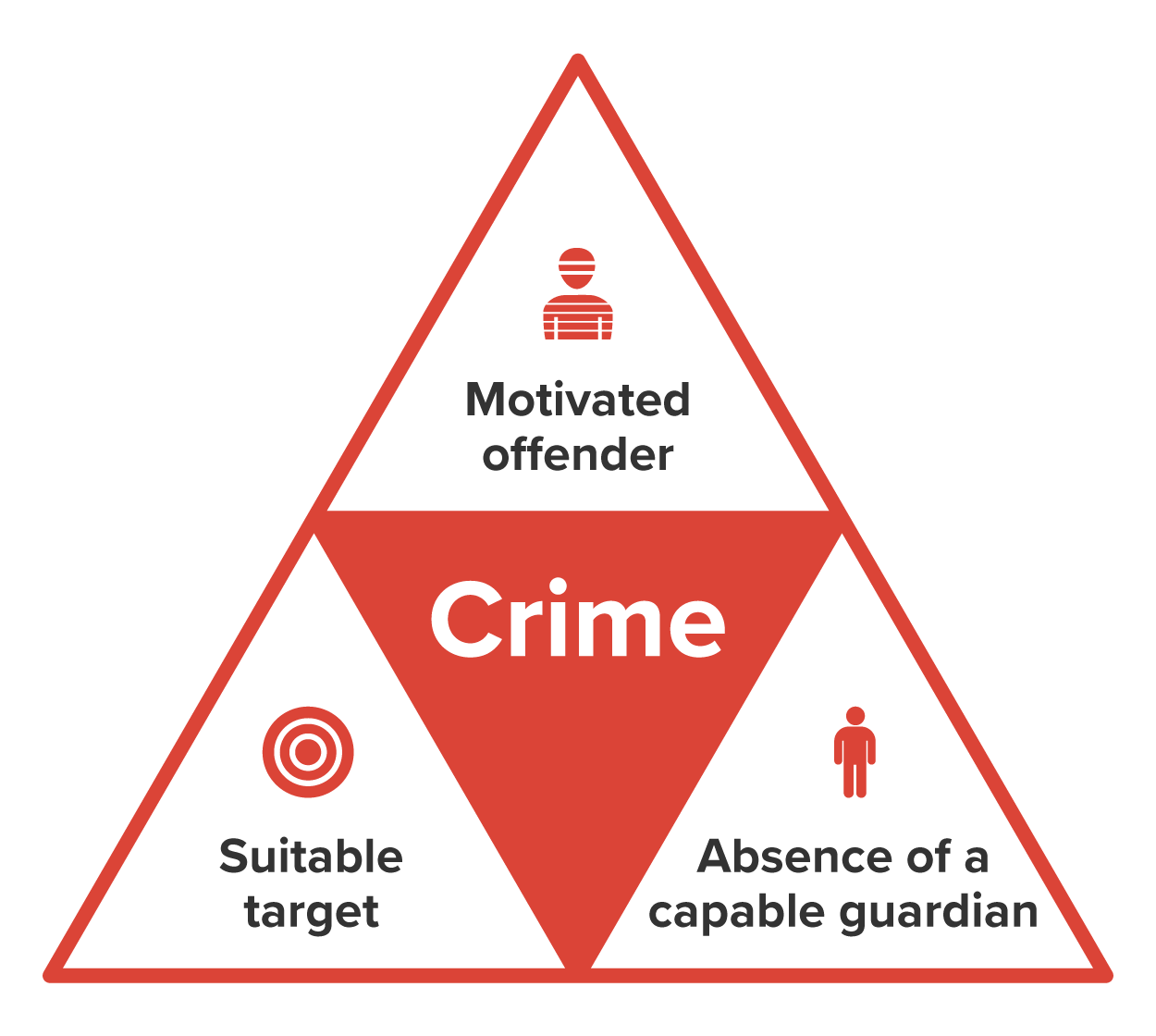
Routine activity theory has traditionally been used to explain residential breaking and entering, burglary, domestic violence, and physical assault. This theory provides significant insight into the causes of crime as it pertains to a particular place (e.g., drug dealing locations) and among victims (e.g., domestic violence survivors). The theory explains why crime is often concentrated in specific locations and contributes to the understanding of the uneven spatial and temporal distribution of crimes.
The second theoretical framework associated with environmental criminology is geometric theory. The geometric theory of crime explains patterns of crime based on the geographic dimension of human activity patterns. The focus here is not on the motivation for crime but rather on the perceived opportunities for crime that exist within the urban spatial structure.
In the geometric theory of crime, the term used for the environment is environmental backcloth—a term coined by Brantingham and Brantingham (1981) that represents the built environment, social and cultural norms, institutions, and the legal environment. It also recognizes the changing nature of our environment. To better understand the geometry of crime, Brantingham and Brantingham (1993) classified four elements of cities:
| Considerations of the Complexity of Crime and the Physical Environment | |
|---|---|
| Nodes |
Consist of places within the city that a person travels to and from. May be business, entertainment, or industrial districts in the context of large urban centers. Represent the places in which we spend most of our time: home, work, recreational sites, entertainment venues, or shopping areas. |
| Paths | The channels that we use to move from node to node, often limited by streets, walkways, and public transit. |
| Districts | Regions within the city that have commonalities and identifying features. |
| Edges | The boundaries between districts that may be physical and distinct (such as literally crossing railroad tracks) or subtle (such as the gradual change as one passes from one neighborhood to the next). |
We can use nodes and paths to generate maps to examine where we spend our time and the pathways between those spaces (Brantingham & Brantingham, 1981). Essentially, these maps represent our activity space, which becomes our awareness space. We become familiar with and attached to different places, so we feel more comfortable in some spaces than others (Andresen, 2010).
Understanding awareness space is important because we use it to manage risk by avoiding or limiting time in places where we are uncomfortable. Similarly, criminals favor their own activity spaces to commit crimes and identify targets. They search areas for criminal opportunities that intersect with their activity space.
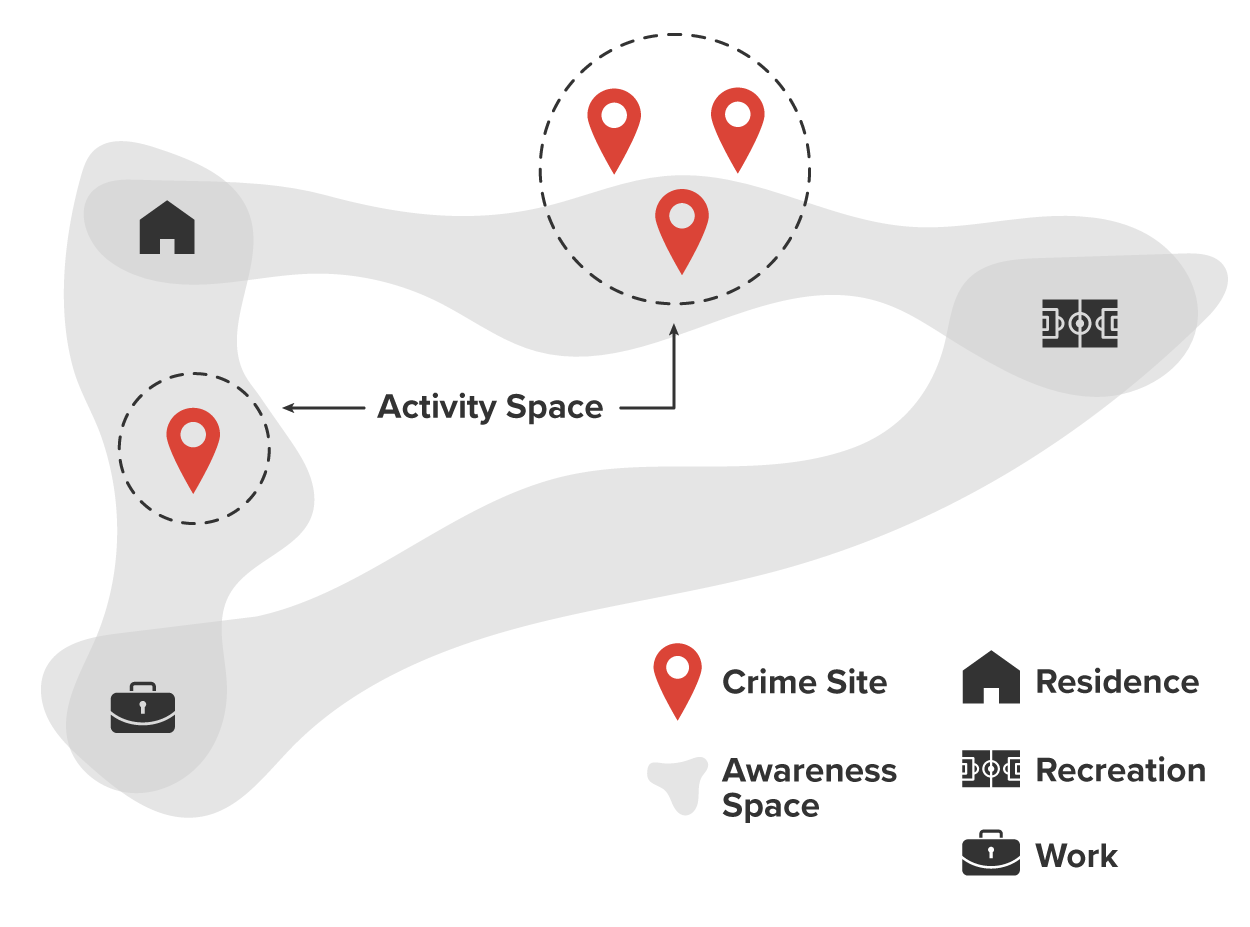
Understanding how someone moves through an environment can provide an understanding of how potential offenders move through that same environment. Subsequently, when our activity spaces overlap with those of potential offenders, we can become victims of crime (Andresen, 2010). This overlap can occur throughout the day as potential victims share nodes and pathways with potential offenders.
Motivated offenders can blend into the environment and are able to search for targets, such as in the following cases:
The third theoretical framework that we’ll discuss is rational choice theory, which we briefly touched upon in an earlier lesson. This theory was first introduced in 1987 by Ronald Clarke and Derek Cornish. The fundamental concept within rational choice theory is rationality, which refers to the role of reasoning in human behavior. This theory views crime as the outcome of someone thinking through the possible rewards and downsides of a criminal act. It suggests that a potential offender must make four primary choices:
EXAMPLE
If a person commits a property crime like motor vehicle theft, this does not mean the same person will commit sexual assault.When considering how rational choice theory fits into environmental criminology, it’s important to note that environmental criminology is closely connected with situational crime prevention. Situational crime prevention attempts to reduce the opportunity for specific crimes by manipulating the immediate environment.
EXAMPLE
To prevent stealing, some stores have installed electronic access control inserts. This is a practical strategy that focuses on deterring criminal events.Additionally, environmental criminology theories assume that because offenders behave rationally, we can predict their actions, prevent further crime, and reduce criminal activity. Thus, rational choice relates to environmental criminology in terms of the interplay between individual reasoning and environmental cues, and situational crime prevention manipulates the environment to act on the rational calculations of potential offenders.
Source: THIS TUTORIAL HAS BEEN ADAPTED FROM KWANTLEN POLYTECHNIC UNIVERSITY’S “INTRODUCTION TO CRIMINOLOGY.” ACCESS FOR FREE AT: kpu.pressbooks.pub/introcrim/ . LICENSE: CREATIVE COMMONS ATTRIBUTION 4.0 INTERNATIONAL.
REFERENCES
Andresen, M. A. (2010). The place of environmental criminology within criminological thought. In M. A. Anderson, P. J. Brantingham, & J. B. Kinney (Eds.), Classics in environmental criminology (pp. 21–44). Routledge.
Andresen, M. A., Brantingham, P. J., & Kinney, J. B. (Eds.). (2010). Classics in environmental criminology. Routledge.
Brantingham, P. J., & Brantingham, P. L. (Eds.). (1981). Environmental criminology (pp. 27–54). Sage Publications.
Brantingham, P. L., & Brantingham, P. J. (1993). Nodes, paths and edges: Considerations on the complexity of crime and the physical environment. Journal of Environmental Psychology, 13(1), 3–28. doi.org/10.1016/S0272-4944(05)80212-9
Bruinsma, G. J., Bruinsma, G., & Johnson, S. D. (Eds.). (2018). The Oxford handbook of environmental criminology. Oxford University Press.
Cohen, L. E., & Felson, M. (1979). Social change and crime rate trends: A routine activity approach. American Sociological Review, 44(4), 588–608. doi.org/10.2307/2094589
Cornish, D. B., & Clarke, R. V. (1987). Understanding crime displacement: An application of rational choice theory. Criminology, 25(4), 933–948. doi.org/10.1111/j.1745-9125.1987.tb00826.x
Felson, M. (2017). Criminology’s first paradigm. In N. Tilley & A. Sidebottom (Eds.), Handbook of crime prevention and community safety (2nd ed., pp. 22–31). Routledge.
Hipp, J. R., & Williams, S. A. (2020). Advances in spatial criminology: The spatial scale of crime. Annual Review of Criminology, 3, 75–95. doi.org/10.1146/annurev-criminol-011419-041423
Jeffery, C. R. (Ed.). (1979). Biology and crime. Sage Publications.
Newman, O. (1972). Defensible space. Macmillan.
Sidebottom, A., & Wortley, R. (2016). Environmental criminology. In A. R. Piquero (Ed.), The Handbook of Criminological Theory (pp. 156–181). Wiley Blackwell.
Snaphaan, T., & Hardyns, W. (2019). Environmental criminology in the big data era. European Journal of Criminology, 18(5), 713–734. doi.org/10.1177/1477370819877753



