Table of Contents |
Now that we’ve completed the scope management plan, we can now look at the work breakdown structure (WBS). It is a process where the project deliverables are broken into smaller, manageable work components. In the WBS, the estimated time needed to complete each work component is provided, giving the project manager a clear picture of the project schedule.
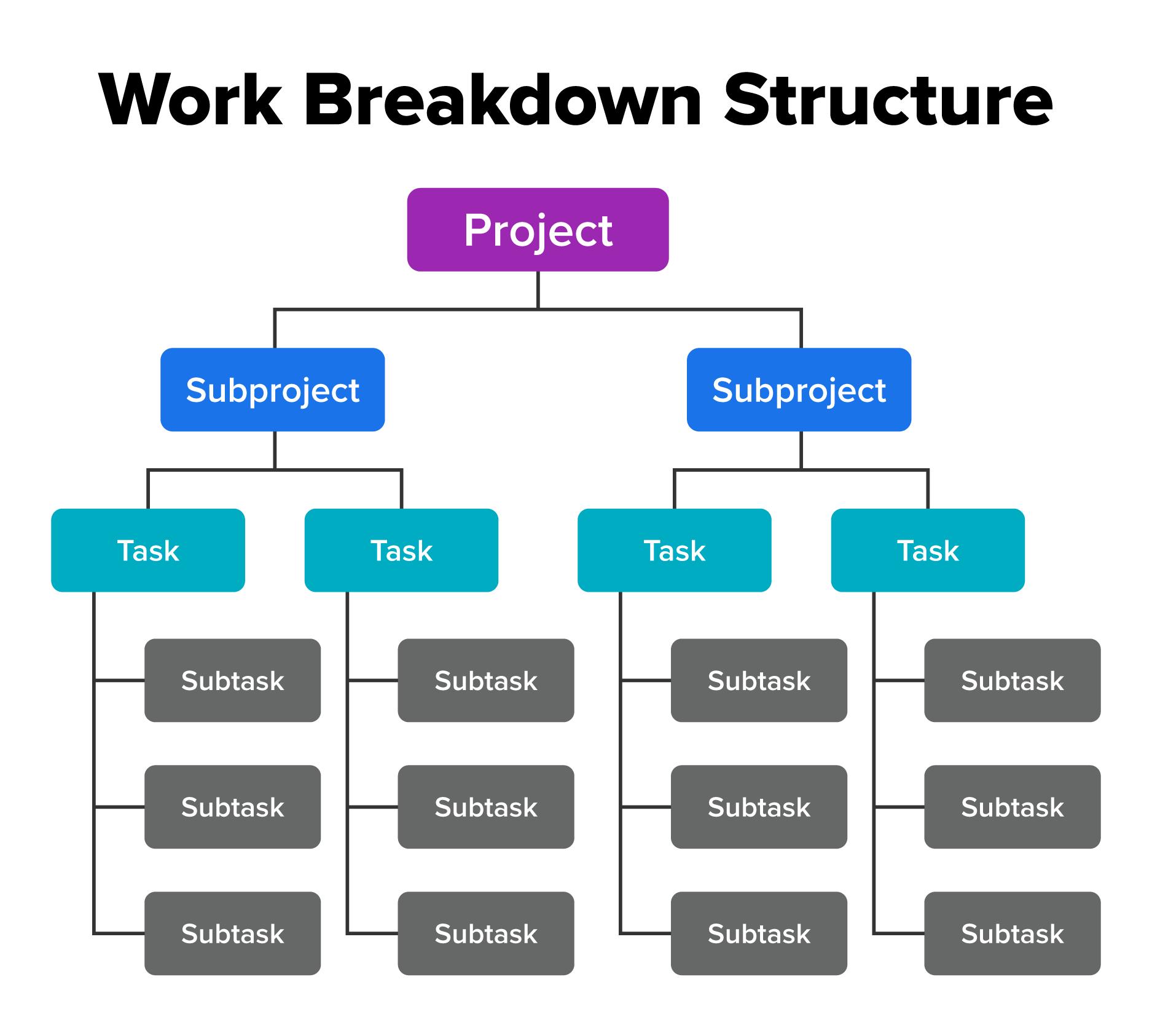
The WBS aligns with the scope of the project and breaks the work down into components that can be scheduled, estimated, and easily monitored and controlled. The idea behind the WBS is simple: you subdivide a complicated task into smaller tasks until you reach a level that cannot be further subdivided.
IN CONTEXT
Suppose we consider earning a bachelor’s degree as a project. You wouldn’t look at it as simply earning the degree as the end goal. You would break down earning the bachelor’s degree into two specific components, such as what classes need to be taken and when they can be taken. You might even have a spreadsheet or a document that lists when certain courses should be taken (some classes depend on the completion of others first). This is the same idea of a WBS. It breaks everything that needs to be done into smaller pieces, which makes it a lot more manageable, while allowing you to order the tasks into a logical sequence of events.
As you probably already know, creating the WBS and the schedule management plan is part of the project planning phase and the second step in our list of components.
| Planning Phase Component | Addresses | Document | Document Purpose |
|---|---|---|---|
| Scope and scope management | The process of defining exactly what work is required (and what is not) to deliver the project’s objectives | Scope Management Plan | Outlines how the project scope will be defined, validated, and controlled to prevent scope creep |
| Work breakdown structure (WBS) and Scheduling | Breaking the project deliverables into smaller, manageable components and estimating the time needed to complete each activity | WBS and Schedule | The WBS breaking the project scope into manageable components, serving as the foundation for planning, estimating, and assigning work |
| Identify resources needed | Determining the people, equipment, and materials required to complete project activities | Resource Management Plan | Created to document the type, quantity, and timing of resources so they can be acquired and managed effectively |
| Determine costs | Estimating the costs associated with the resources needed for the project activities | Project Budget and Procurement Management Plan | The project budget documents the costs of the project. The Procurement Management Plan documents goods and resources needed to be obtained for the project |
| Communication | Determining how project information will be shared among stakeholders (remember, you identified stakeholders during the initiation phase!) | Communication Management Plan | Created to ensure the right information is delivered to the right people at the right time using the right methods |
| Risk assessment and management | Identifying potential events that could impact the project, analyzing their likelihood and impact, and planning responses | Risk Management Plan | Created to record identified risks, their characteristics, and planned responses so they can be monitored and managed throughout the project |
WBS describes the products or services to be delivered by the project and how they are decomposed and related. It is a deliverable-oriented decomposition of a project into smaller components. It defines and groups a project’s discrete work elements in a way that helps organize and define the total work scope of the project.
IN CONTEXT
Agile Connection
In a Waterfall approach, the WBS becomes a fixed baseline, and any changes to it require formal approval. This approach ensures a structured and predictable roadmap, but it can be rigid when adapting to changes.
In contrast, Agile projects treat the WBS in a more flexible way. Instead of a static, hierarchical chart, Agile uses a flexible backlog that functions as a dynamic and evolving version of a WBS. A flexible backlog in Agile is basically a living to-do list for the project. Instead of mapping out every single task from the beginning like you would in Waterfall, the backlog holds all the features, ideas, and user stories the team might work on (remember when we created requirements in the last lesson? This is essentially the requirements).
The backlog is feature based rather than task based, containing epics, user stories, and features that represent customer value. Work is progressively broken down and refined as the project advances, with detailed planning happening only for the current sprint or iteration. This rolling WBS adapts continuously, allowing teams to respond quickly to changing requirements and prioritize value delivery over rigid task tracking.
Ultimately, Waterfall relies on a traditional WBS that is detailed upfront and fixed, while Agile uses a flexible backlog that evolves throughout the project. Both serve the purpose of organizing and breaking down work, but Waterfall emphasizes structure and predictability, whereas Agile emphasizes adaptability and customer value.
A WBS also provides the necessary framework for detailed cost estimating and control and guidance for schedule development and control, which you’ll use in future planning.
WBS is a hierarchical decomposition of the project into phases and deliverables.
Hierarchical decomposition is a method to break down large projects into hierarchical subcomponents to simplify and better understand what needs to be done to complete a project. It is a tree structure, which shows a subdivision of effort required to achieve an objective (e.g., a program, project, or contract). In a project or contract, the WBS is developed by starting with the end objective and successively subdividing it into manageable components in terms of size, duration, and responsibility (e.g., systems, subsystems, components, tasks, subtasks, and work packages), which include all steps necessary to achieve the objective.
The WBS creation involves the following:
EXAMPLE
If you want to clean a room, you might begin by picking up clothes, toys, and other things that have been dropped on the floor. You could use a vacuum cleaner to get dirt out of the carpet. You might take down the curtains, take them to the cleaners, and then dust the furniture. All of these tasks are subtasks performed to clean the room. As for vacuuming the room, you might have to get the vacuum cleaner out of the closet, connect the hose, empty the bag, and put the machine back in the closet. These are smaller tasks to be performed to accomplish the subtask called vacuuming.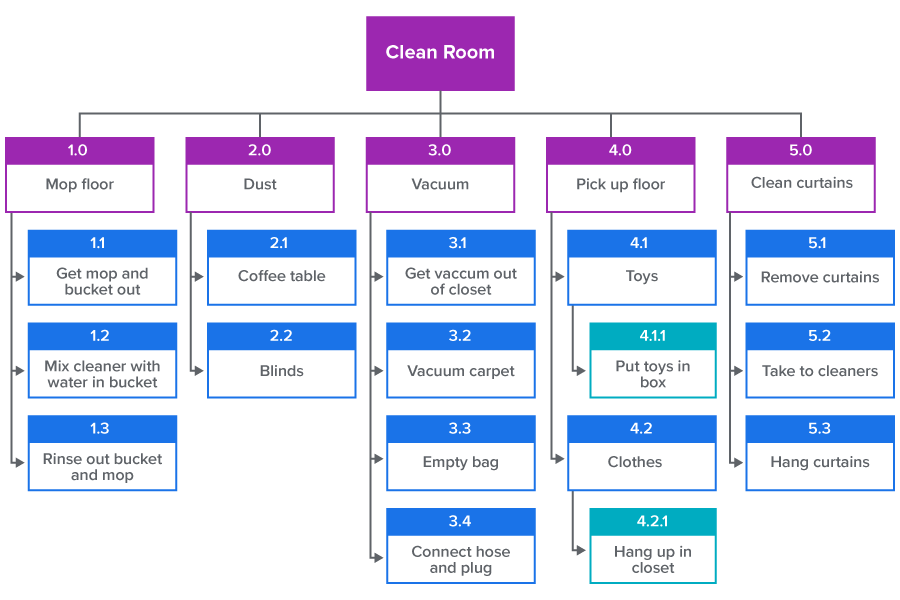
Now that you’ve learned more about WBS, in the next lesson, we will address how to actually create one.
Source: THIS CONTENT HAS BEEN ADAPTED FROM PRESSBOOKS "NSCC PROJECT MANAGEMENT” BY ADRIENNE WATT. ACCESS FOR FREE AT https://pressbooks.atlanticoer-relatlantique.ca/projectmanagement/ LICENSE: CREATIVE COMMONS ATTRIBUTION 4.0 INTERNATIONAL



