Table of Contents |
According to political scientist V.O. Key, modern political parties consist of three components: the party in the electorate (the voters); the party organization (which helps to coordinate everything the party does in its quest for office); and the party in office (the office holders). To understand how these various elements work together, we begin by thinking about a key first step in influencing policy in any democracy: winning elections.
A key fact about the U.S. political party system is that it’s still reliant on votes. If voters do not show up to vote for a party’s candidates on Election Day, the party has no chance of gaining office and implementing its preferred policies. It only makes sense, then, that parties have found it in their interest to build a permanent and stable presence among the voters. By fostering a sense of loyalty, a party can insulate itself from changes in the system, and improve its odds of winning elections.
The party-in-the-electorate are those members of the voting public who consider themselves to be part of a political party or those who consistently prefer the candidates of one party over the other.
What it means to be part of a party depends on where a voter lives and how much they choose to participate in politics. At its most basic level, being a member of the party-in-the-electorate simply means that a voter is more likely to voice support for a party. These voters are often called party identifiers, since they usually represent themselves in public as being members of a party, and they may attend some party events or functions.
Party identifiers are also more likely to provide financial support for the candidates of their party during election season. This does not mean self-identified Republicans support all the party’s positions or candidates, but it does mean that, on the whole, they feel their wants or needs are more likely to be met if the Republican Party is successful.
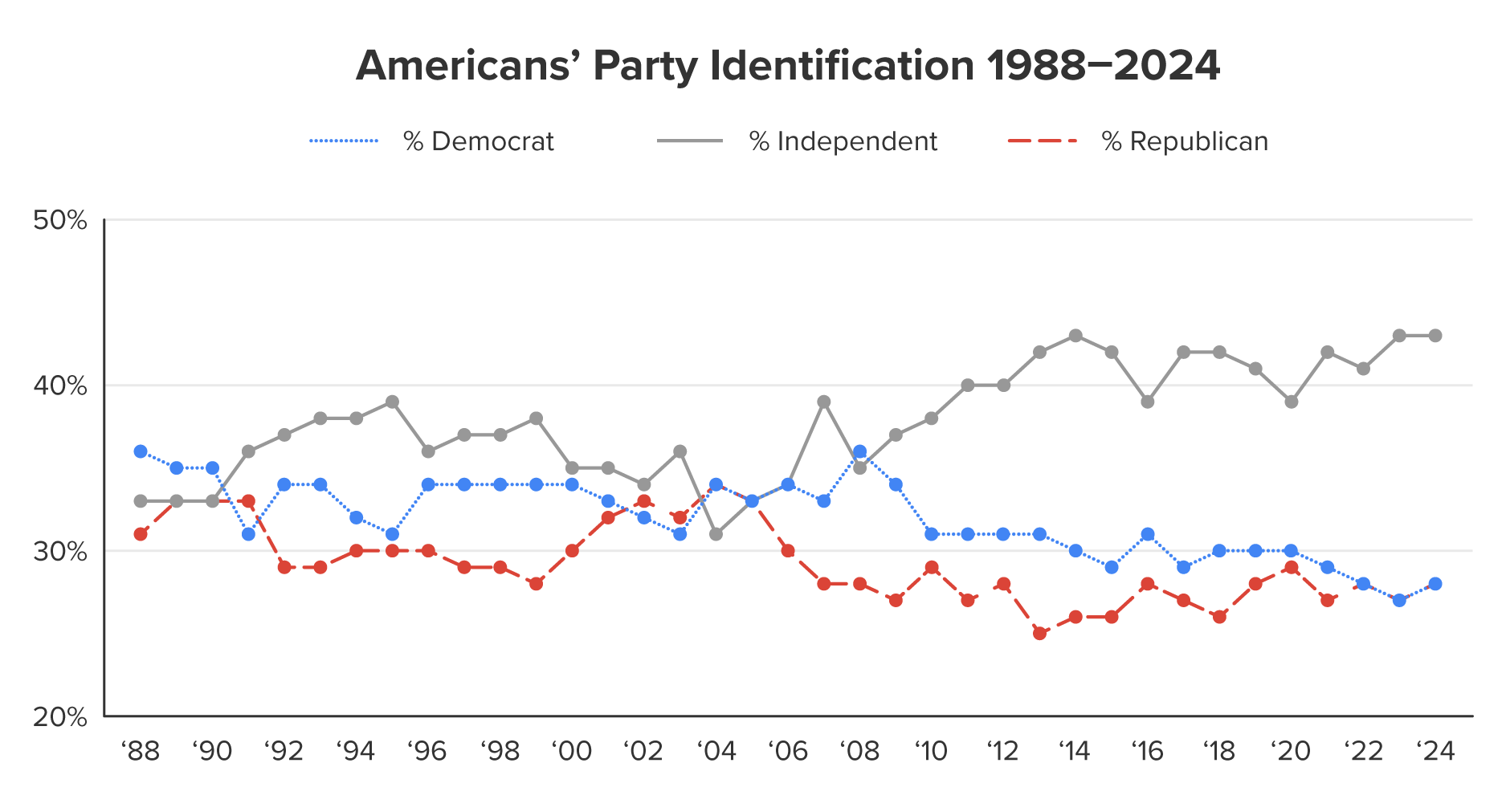
Party identifiers make up the majority of the voting public. However, the number of independents, or voters who do not identify with one party or another, has increased significantly over the past three decades, growing from approximately one-third to almost one-half the population. Figure 1 shows the percentage of Americans identifying as Republican, Democratic, or Independent.
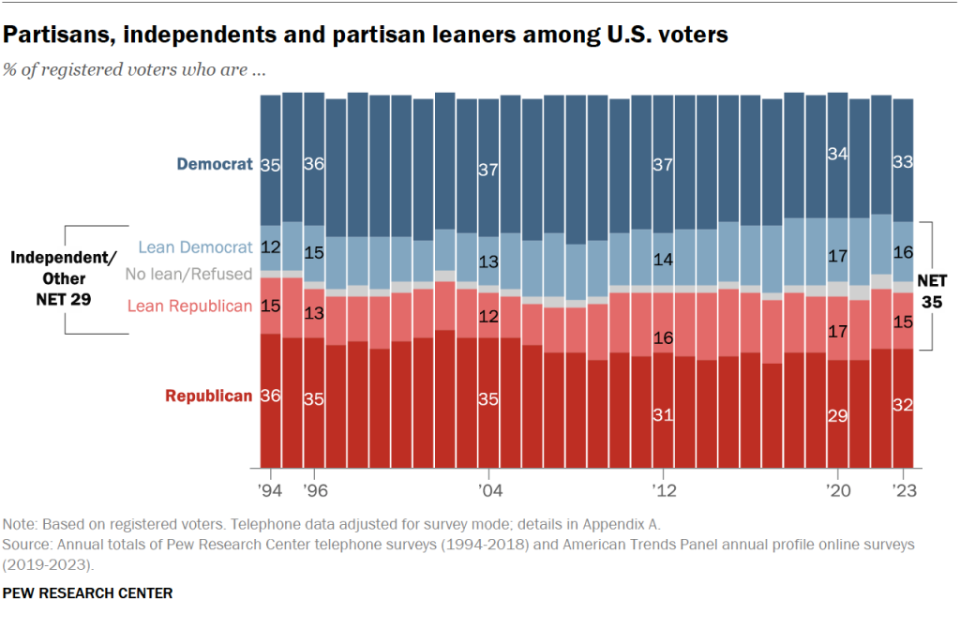
Even among independents, the majority lean in the direction of one party or the other, suggesting they behave as if they identified with a party during elections, even if they preferred not to pick a side (Figure 2). They may switch loyalties more frequently, however, and often vote for candidates from both parties.
Strictly speaking, party identification is not quite the same thing as party membership. People may call themselves Republicans or Democrats without being registered as a member of the party, and the Republican and Democratic parties do not require individuals to join their formal organization in the way that parties in some other countries do. Many states require voters to declare a party affiliation before participating in primaries, but primary participation is irregular and infrequent, and a voter may change identities long before changing party registration. Despite it all, the actual act of registering to vote and selecting a party reinforces party loyalty.
A significant subset of American voters views their party identification as something far beyond simply a shortcut to voting. These individuals are more energized by the political process and have chosen to become more active in the life of political parties. They are part of what is known as the party organization. The party organization is the formal structure of the political party, and its active members are responsible for coordinating party behavior and supporting party candidates. It is a vital component of any successful party because it bears most of the responsibility for building and maintaining the party's “brand.” It also plays a key role in helping select, and elect, candidates for public office.
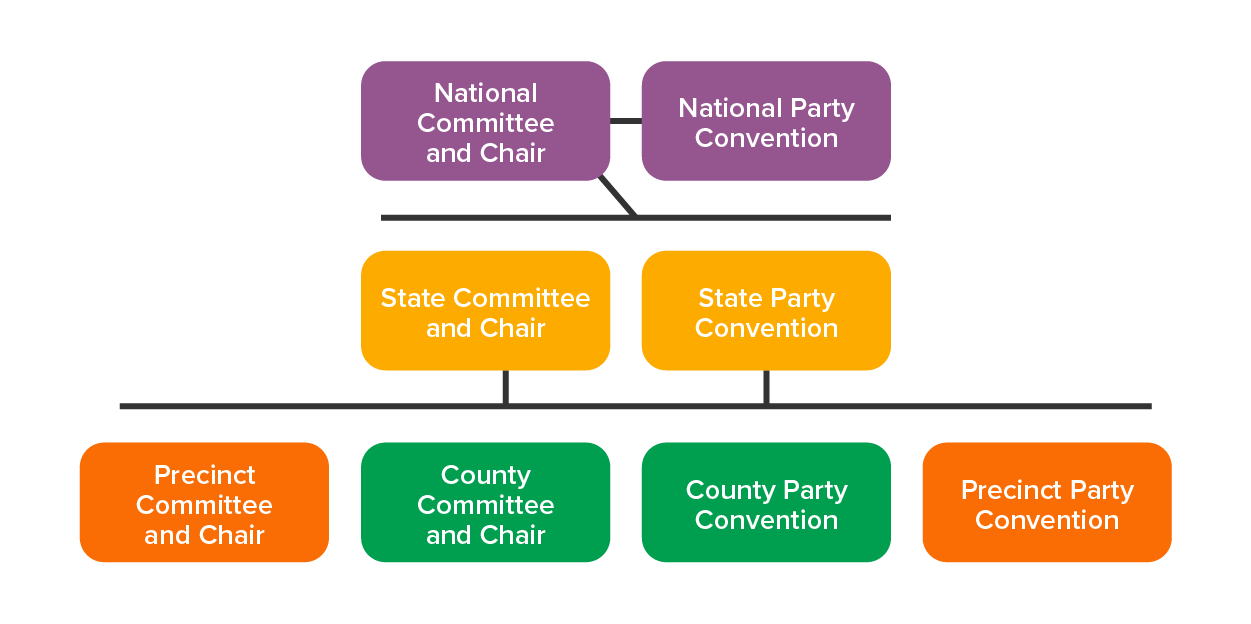
Since winning elections is the first goal of the political party, it makes sense that the formal party organization mirrors the local-state-federal structure of the U.S. political system. While the lowest level of party organization is technically the precinct and is usually organized around neighborhoods, many of the operational responsibilities for local elections fall upon the county-level organization.
The county-level organization does much of the work of the party system, especially around election time. This level of organization frequently takes on many of the most basic responsibilities of a democratic system, including identifying and mobilizing potential voters and donors, identifying and training potential candidates for public office, and recruiting new members for the party. County organizations are also often responsible for finding rank-and-file members to serve as volunteers on Election Day, either as officials responsible for operating the polls or as monitors responsible for ensuring that elections are conducted honestly and fairly. They may also hold regular meetings to provide members the opportunity to meet potential candidates and coordinate strategy (Figure 3). Of course, all this is voluntary and relies on dedicated party members willing to pitch in to run the party.
Most of the county organizations’ formal efforts are devoted to supporting party candidates running for county and city offices. But a fair amount of political power is held by individuals in statewide office or in state-level legislative or judicial bodies. While the county-level offices may be active in these local competitions, most of the coordination for them takes place in the state-level organizations.
Like their more local counterparts, state-level organizations are responsible for key party functions, such as statewide candidate recruitment and campaign mobilization. Most of their efforts focus on electing high-ranking officials such as the governor or occupants of other statewide offices (e.g., the state’s treasurer or attorney general), as well as candidates to represent the state and its residents in the U.S. Senate and the U.S. House of Representatives. The greater prominence of state- and national-level offices requires state organizations to take on several key responsibilities in the life of the party.
First, state-level organizations usually accept greater fundraising responsibilities than their local counterparts. Statewide races and races for national office have become increasingly expensive in recent years.
EXAMPLE
The average cost of a successful House campaign was $2.4 million in 2020; for Senate races, it was $27.2 million.While individual candidates are responsible for funding and running their own races, it is typically up to the state-level organization to coordinate giving across multiple races and to develop the staffing expertise that these candidates will draw upon at election time.
State organizations are also responsible for creating a sense of unity among members of the party statewide. Building unity can be very important as the party transitions from sometimes-contentious nomination battles to the all-important general election.
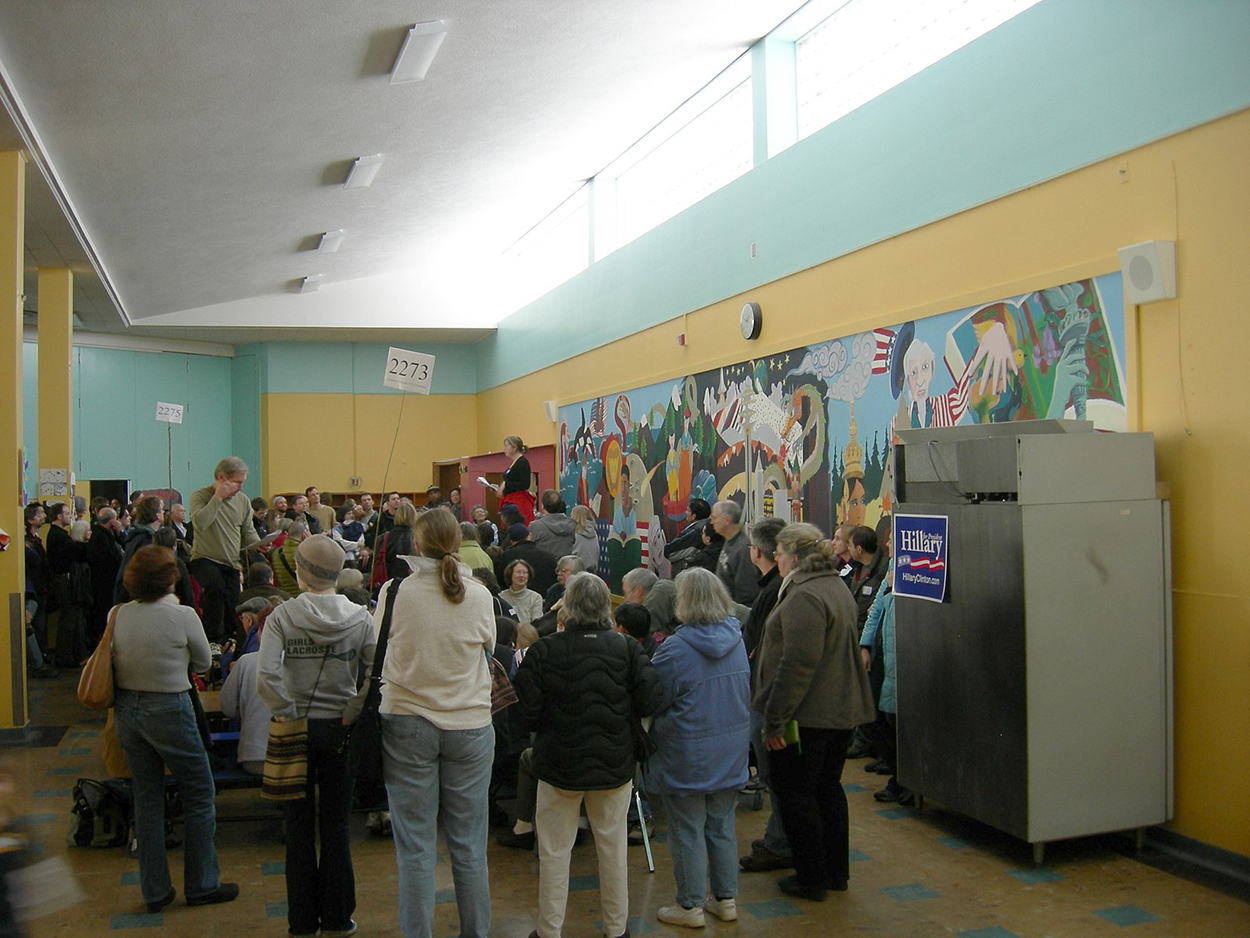
The state organization uses several key tools to get its members working together towards a common goal. First, it helps the party’s candidates prepare for state primary elections or caucuses, which allow voters to choose a nominee to run for public office at either the state or national level. Caucuses are a form of town hall meeting at which voters in a precinct get together to voice their preferences, rather than voting individually throughout the day (Figure 4).
The state organization is also responsible for drafting a state platform that serves as a policy guide for the politicians who are eventually selected for public office. These platforms are usually the result of a negotiation between the various coalitions within the party and are designed to ensure that everyone in the party will receive some benefits if their candidates win the election.
Finally, state organizations hold a statewide convention, where delegates from the various county organizations come together to discuss the needs of their respective areas. The state conventions are also responsible for selecting delegates to the national convention.
The local and state-level party organizations are the workhorses of the political process. They take on most of the responsibility for party activities and are easily the most active participants in the party formation and electoral processes. They are also largely invisible to most voters. The average citizen knows very little of the local party’s behavior unless there is a phone call or a knock on the door in the days or weeks before an election. The same is largely true of the activities of the state-level party. Typically, the only people who notice are those who are already actively engaged in politics or are being targeted for donations.
But most people are aware of the presence and activity of the national party organizations, for several reasons. Many Americans, especially young people, are more interested in the topics discussed at the national level than at the state or local level. According to John Green of the Ray C. Bliss Institute of Applied Politics, “Local elections tend to be about things like sewers, and roads and police protection—which are not as dramatic an issue as same-sex marriage or global warming or international affairs.” Presidential elections and the behavior of the U.S. Congress are also far more likely to make news broadcasts than the activities of county commissioners, and the national-level party organization is mostly responsible for coordinating the activities of participants at this level.
Another reason for the prominence of the national organization is that it usually coordinates the grandest spectacles in the life of a political party. Most voters are never aware of the numerous county-level meetings or coordinating activities. But the national conventions, organized and sponsored by the national-level party, can dominate the national discussion for several weeks in late summer, a time when the major media outlets are often searching for news. High-ranking politicians, party elites, celebrities, such as actor/director Clint Eastwood (Figure 5), and the individuals considered to be the future leaders of the party, are brought before the public so the party can make its best case for being the one to direct the future of the country. National party conventions culminate in the formal nomination of the party nominees for the offices of president and vice president, and they mark the official beginning of the presidential competition between the two parties.

Both parties have come to recognize the value of the convention as a medium through which they can communicate to the average viewer. To ensure that they are viewed in the best possible light, the parties have worked hard to turn the public face of the convention into a highly sanitized, highly orchestrated media event. Speakers are often required to have their speeches screened to ensure that they do not deviate from the party line, or risk embarrassing the eventual nominee, whose name has often been known by all for several months. And while protests still happen, party organizations have become increasingly adept at keeping protesters away from the convention sites, arguing that safety and security are more important than First Amendment rights to speech and peaceable assembly.
EXAMPLE
In 2016 supporters of presidential candidate Senator Bernie Sanders protested outside of the Democratic National Convention after Hillary Clinton received the party’s nomination for president. Upset over party rules that they believed unfairly advantaged Clinton over Sanders, they placed tape over their mouths and organized a silent sit-in, and later burned American flags and chanted “F--k Hillary.”EXAMPLE
Between 1976 and 1996, ABC and CBS cut their coverage of the nominating conventions from more than fifty hours to only five. NBC cut its coverage to fewer than five hours.This is not to say the national conventions are no longer important, or that the national party organizations are becoming less relevant. The conventions, and the organizations that run them, still contribute heavily to a wide range of key decisions in the life of both parties. The national party platform is formally adopted at the convention, as are the key elements of the strategy for the national campaign. And even though the media is paying less attention, key insiders and major donors often use the convention as a way of gauging the strength of the party, and its ability to effectively organize and coordinate its members. They are also paying close attention to the rising stars who are given time at the convention’s podium, to see which are able to connect with the party faithful.
EXAMPLE
Most observers credit then-Senator Barack Obama’s speech at the 2004 Democratic National Convention with greatly boosting his national prominence.One of the first challenges facing the party-in-government, or the party identifiers who have been elected or appointed to hold public office, is to achieve their policy goals. Members of each party meet in closed sessions and discuss what items to place on the legislative agenda, as well as which party members should serve on the committees that draft proposed laws. Republican meetings are called party conferences, and Democratic meetings are called party caucuses.
Party members also elect the leaders of their respective parties in the House and the Senate, and their party whips. Leaders serve as party managers and are the highest-ranking members of the party in each chamber of Congress. The party whip ensures that members are present when a piece of legislation is to be voted on and directs them on how to vote. Both the Republicans and the Democrats have a leader and a whip in the House, and a leader and a whip in the Senate. The leader and whip of the party that holds the majority of seats in each house are known as the majority leader and the majority whip. The leader and whip of the party with fewer seats are called the minority leader and the minority whip.
The party that controls the majority of seats in the House of Representatives also elects someone to serve as Speaker of the House. People elected to Congress as independents (that is, not members of either the Republican or Democratic parties) must choose a party to conference or caucus with.
EXAMPLE
Senator Bernie Sanders of Vermont, who originally ran for Senate as an independent candidate, caucuses with the Democrats and ran for the presidency as a Democrat. He returned to the Senate in 2017 as an independent.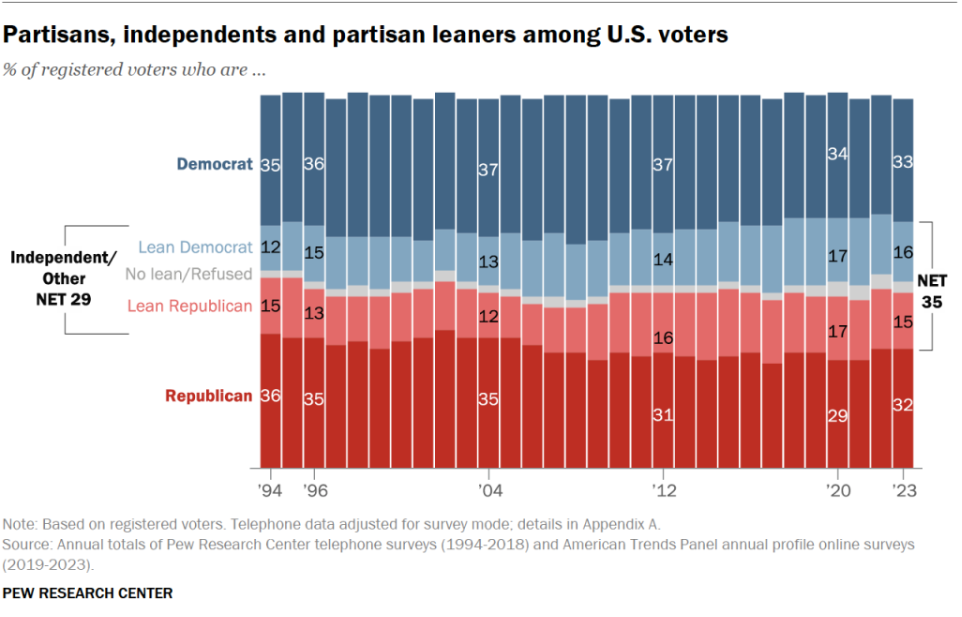
Source: THIS TUTORIAL HAS BEEN ADAPTED FROM OPENSTAX “AMERICAN GOVERNMENT 3E”. ACCESS FOR FREE AT OPENSTAX.ORG/DETAILS/BOOKS/AMERICAN-GOVERNMENT-3E. LICENSE: CREATIVE COMMONS ATTRIBUTION 4.0 INTERNATIONAL.
REFERENCES
Jones, J. M. (2021, April 7). Quarterly Gap in Party Affiliation Largest Since 2012. Gallup.
news.gallup.com/poll/343976/quarterly-gap-party-affiliation-largest-2012.aspx
Pew Research Center. (2019, March 14). Political Independents: Who They Are, What They Think.
www.pewresearch.org/politics/2019/03/14/political-independents-who-they-are-what-they-think/
Nelson, S. (2016, July 27). American Flags Burn Outside DNC After Anti-Hillary March. U.S. News & World Report.
URL:
www.usnews.com/news/articles/2016-07-27/american-flags-burn-outside-dnc-after-anti-hillary-march



