In this lesson, you will learn the anatomical organization of the sarcomere and the way in which it provides movement. Specifically, this lesson will cover:
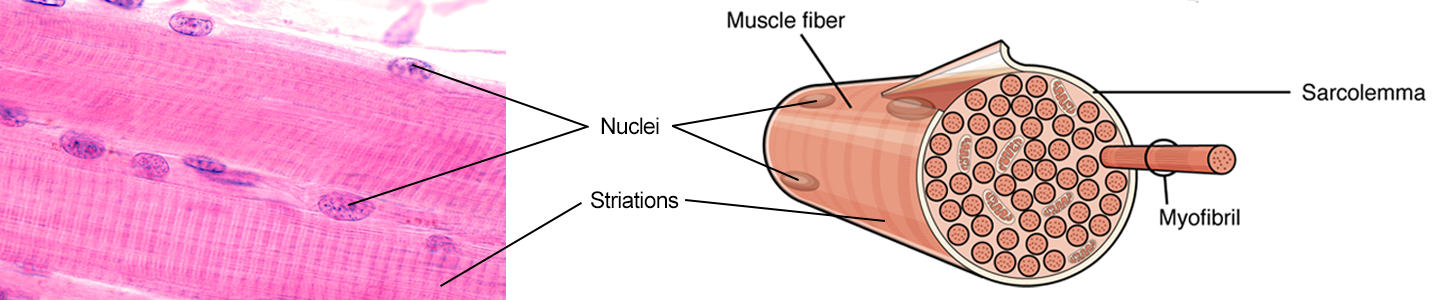
Skeletal muscle cells appear striated (striped) from the outside. This striation is due to the arrangement of the myofilaments which are composed of alternating thin and thick filaments. When a light is placed behind the cell, as in histology, thin filaments allow more light through while thick filaments block more light. This creates alternating bands of light and dark along the skeletal muscle fiber.
Skeletal Muscle Fiber - Skeletal muscle fibers, shown in histology (left) and diagram (right) are striated on their surface due to the presence of a unique contractile organelle called a myofibril.
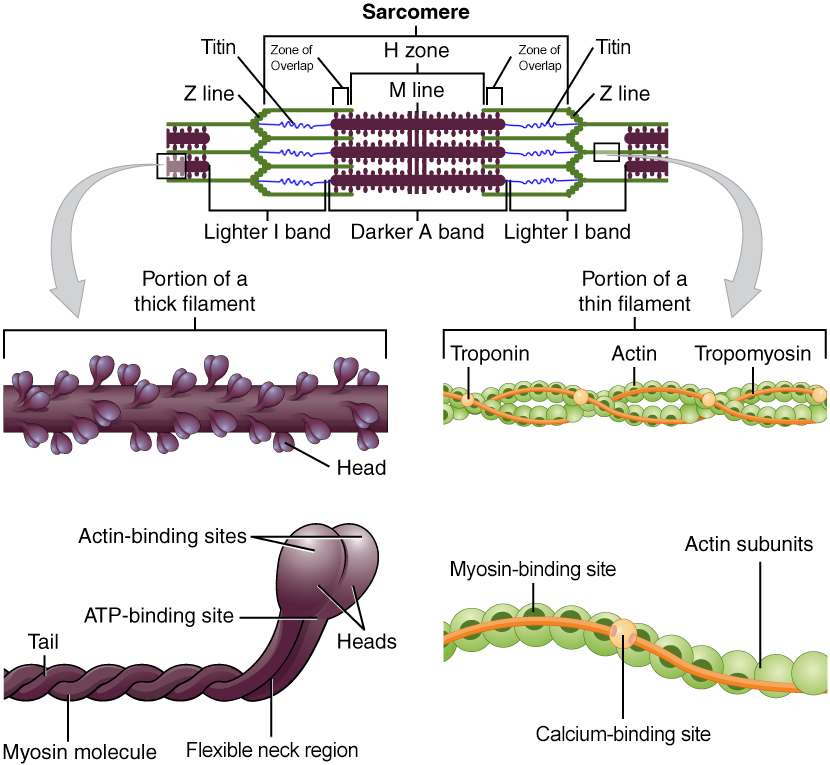
A thick filament is a myofilament composed of a protein called myosin. Myosin looks like two golf clubs that were twisted together and contains three regions, the head, neck, and tail. The long, twisted portion (the shaft of the golf club) is called the myosin tails. The two bulbous ends are called the myosin heads and each contain an actin-binding site and an ATP-binding site. The flexible region that is bent and connects the head to the tails is called the myosin neck or hinge. A thick filament contains many myosin proteins bunched together with their heads sticking out at all angles. At the end of this large group, the thick filament is connected to what you will later learn is called the Z-line by an elastic protein called titin.
A thin filament is a myofilament composed of a complex of three proteins. The primary protein is actin. Individual actin subunits are roughly spherical and bond together like beads on a string to form two filamentous forms of actin that are twisted around one another. Each actin subunit contains a myosin-binding site. However, when a muscle is at rest, this myosin-binding site is blocked by a long, thin protein called tropomyosin (tropo, to change). Tropomyosin is held in place by a third protein called troponin which contains a calcium-binding site.
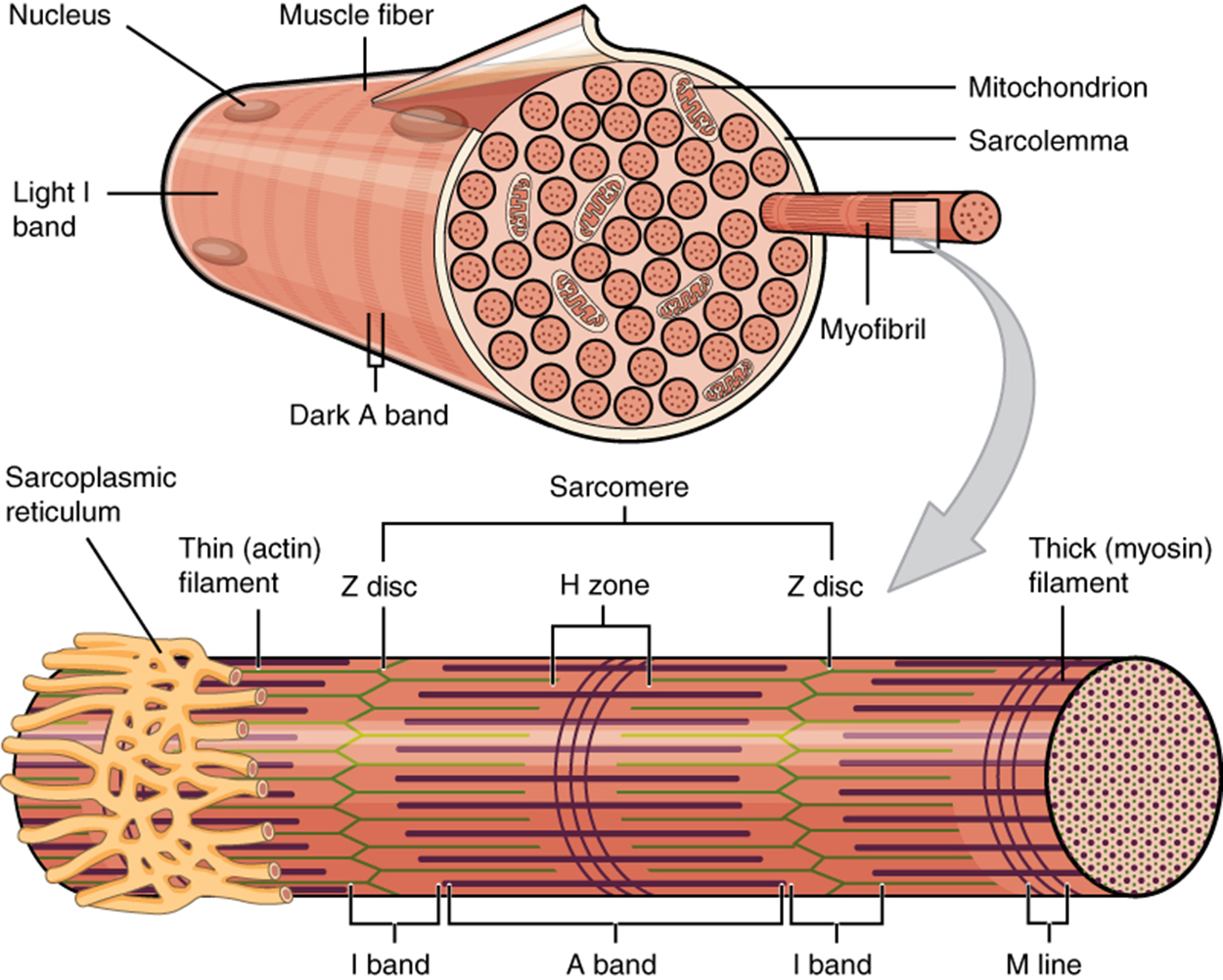
Muscle Fiber - A skeletal muscle fiber is surrounded by a plasma membrane called the sarcolemma, which contains sarcoplasm, the cytoplasm of muscle cells. A muscle fiber is composed of many fibrils, which give the cell its striated appearance.
As you can see below, the thick and thin filaments are combined in a highly organized alternating pattern to form a myofibril. This organization has various structures and regions.
The Z-line is the zig-zag point of attachment for thin filaments.
The M-line is the point of attachment for thick filaments.
The I-band is the region of a sarcomere that contains thin filaments only.
The H-zone is the region of a sarcomere that contains thick filaments only.
The A-band is the region of a sarcomere where thick filaments exist. Keep in mind that thin filaments may or may not also be in the A-band depending on the contracted state of the muscle.
The zone of overlap is the region where thin and thick filaments overlap.
A sarcomere is the repeating unit of a muscle fiber and runs from Z-line to Z-line.
hint
There are a couple of tricks that may help you remember what all the structures and regions of a sarcomere are.
The Z-line is at either END of the sarcomere, just like the letter Z is at the end of the alphabet.
The M-line is in the M-iddle or M-idline of the sarcomere.
The alternating I- and A-bands create the striations—alternating bands of light and dark—on a muscle fiber.
The I-band is the l-I-ght band of the striation. The letter “I” is also THIN-ner than the letter “A” and is made of thin filaments.
The A-band is the d-A-rk band of the striation. The letter “A” is also THICK-er than the letter “I” and is made of thick filaments.
The H-Zone and zone of overlap are located right next to one another.
The Sarcomere - The sarcomere, the region from one Z-line to the next Z-line, is the functional unit of a skeletal muscle fiber.
watch
View the following video for more information on this topic.
terms to know
Thick Filament
A myofilament composed of myosin.
Myosin
The protein that forms the thick filament.
Myosin Tail
The long, twisted portion of a myosin molecule.
Myosin Head
The bulbous region of a myosin molecule.
Myosin Neck
The flexible hinge that connects the myosin head and tail together.
Titin
An elastic protein connecting the thick filament to the Z-line.
Thin Filament
A myofilament composed of actin, tropomyosin, and troponin.
Actin
The primary protein that forms the thin filament.
Tropomyosin
A long, thin regulatory protein that covers the myosin binding site of actin when a muscle is at rest.
Troponin
A regulatory protein that binds tropomyosin to actin.
Z-line
The point of attachment for thin filaments.
M-line
The point of attachment for thick filaments.
I-band
The region of a sarcomere that contains thin filaments only.
H-zone
The region of a sarcomere that contains thick filaments only.
A-band
The region of a sarcomere where thick filaments exist.
Zone of Overlap
The region where thin and thick filaments overlap.
Sarcomere
The repeating unit of a muscle fiber that runs from Z-line to Z-line.
2. The Sliding Filament Model
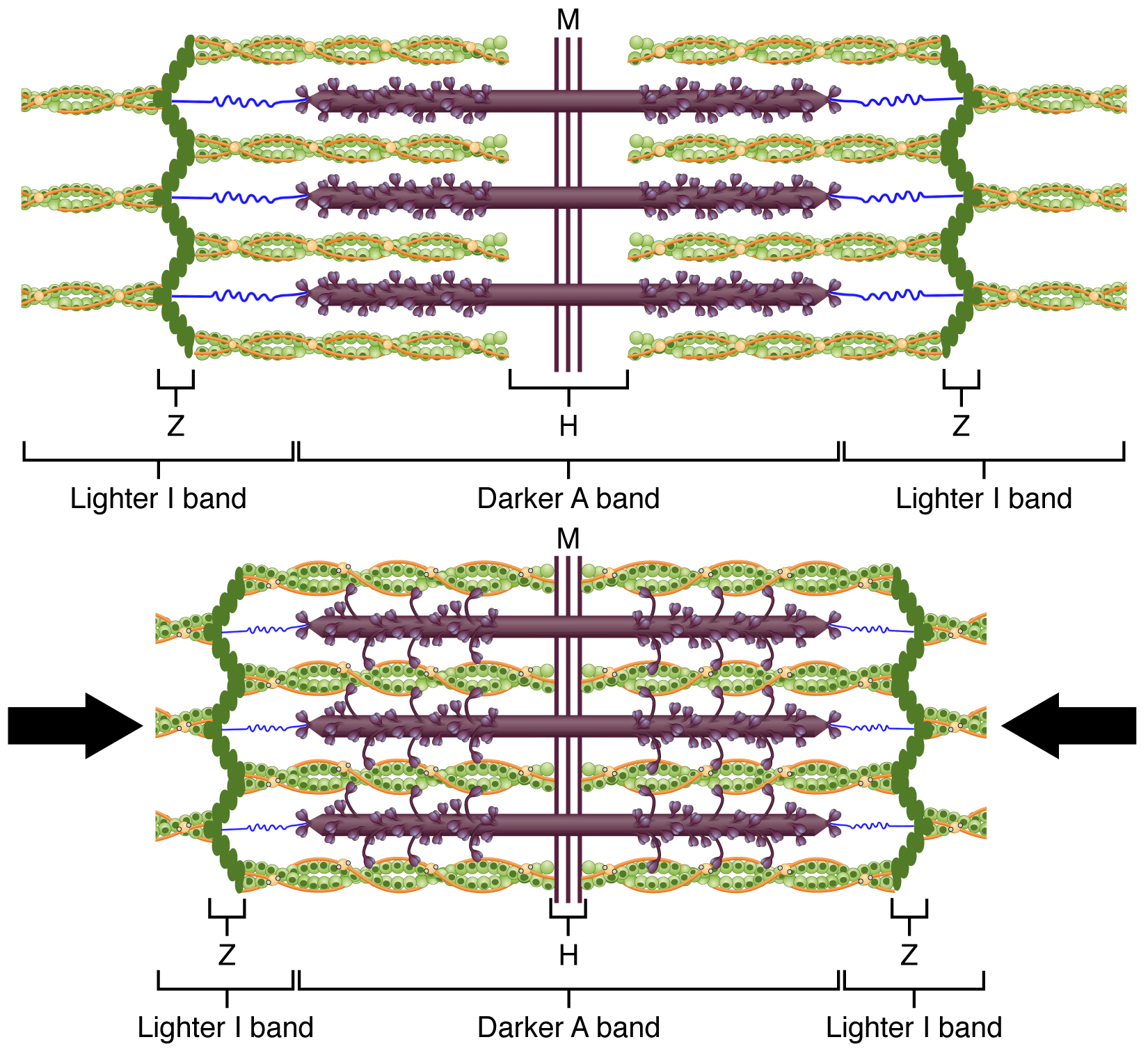
When excited (signaled) by a motor neuron, a skeletal muscle fiber contracts. As a muscle shortens, thin filaments are pulled and then slide past the thick filaments within the fiber’s sarcomeres. This process is known as the sliding filament model (also referred to as the sliding filament theory).
The Sliding Filament Model of Muscle Contraction - When a sarcomere contracts, the Z lines move closer together and the I band becomes smaller. The A band stays the same width. At full contraction, the thin and thick filaments overlap completely.
try it
As the sarcomere shortens or lengthens, the muscle shortens or lengthens. Recall that the sarcomere contains various regions and structures defined by their position relative to one another.
Directions: Consider the following questions. As a muscle shortens or lengthens, try and predict how each region changes. Click to reveal the answer.
A molecular model of a muscle contraction which explains how thin and thick filaments slide relative to one another to cause a muscle to shorten or lengthen.
summary
In this lesson, you learned about the anatomical organization of the sarcomere, the contractile unit of muscle cells. Then you learned about how sarcomere changes relate to whole muscle changes in the sliding filament model.
The region of a sarcomere where thick filaments exist.
Actin
The primary protein that forms the thin filament.
H-zone
The region of a sarcomere that contains thick filaments only.
I-band
The region of a sarcomere that contains thin filaments only.
M-line
The point of attachment for thick filaments.
Myosin
The protein that forms the thick filament.
Myosin Head
The bulbous region of a myosin molecule.
Myosin Neck
The flexible hinge that connects the myosin head and tail together.
Myosin Tail
The long, twisted portion of a myosin molecule.
Sarcomere
The repeating unit of a muscle fiber that runs from Z-line to Z-line.
Sliding Filament Model
A molecular model of a muscle contraction which explains how thin and thick filaments slide relative to one another to cause a muscle to shorten or lengthen.
Thick Filament
A myofilament composed of myosin.
Thin Filament
A myofilament composed of actin, tropomyosin, and troponin.
Titin
An elastic protein connecting the thick filament to the Z-line.
Tropomyosin
A long, thin regulatory protein that covers the myosin binding site of actin when a muscle is at rest.
Troponin
A regulatory protein that binds tropomyosin to actin.
Z-line
The point of attachment for thin filaments.
Zone of Overlap
The region where thin and thick filaments overlap.