Use Sophia to knock out your gen-ed requirements quickly and affordably. Learn more
×

The Skeleton

Author: Sophia

what's covered
In this lesson, you will learn about the divisions of the skeletal system. Specifically, this lesson will cover:

Table of Contents

1. The Skeleton

Your skeleton includes all of the bones of your body, providing the internal supporting structure of the body. The skeleton is divided into the axial and appendicular skeletons. The adult axial skeleton consists of 80 bones that form the head and body trunk. Attached to this are the limbs, whose 126 bones constitute the appendicular skeleton.

Because of our upright stance, different functional demands are placed upon the upper and lower limbs. Thus, the bones of the lower limbs are adapted for weight-bearing support and stability, as well as for body locomotion via walking or running. In contrast, our upper limbs are not required for these functions. Instead, our upper limbs are highly mobile and can be utilized for a wide variety of activities. The large range of upper limb movements, coupled with the ability to easily manipulate objects with our hands and opposable thumbs, has allowed humans to construct the modern world in which we live.

You will learn more about the axial and appendicular skeletons throughout this lesson.

term to know
Skeleton
The bones of the body.


2. The Axial Skeleton

The axial skeleton forms the vertical, central axis of the body and includes all bones of the head, neck, chest, and back. It serves to protect the brain, spinal cord, heart, and lungs. It also serves as the attachment site for muscles that move the head, neck, and back, and for muscles that act across the shoulder and hip joints to move their corresponding limbs.

term to know
Axial Skeleton
The central, vertical axis of bones of the body, including the skull, vertebral column, and thoracic cage.

2a. The Skull

The cranium (skull) is the skeletal structure of the head that supports the face and protects the brain. The bones of the cranium are collectively referred to as the craniofacial bones. These can be subdivided into cranial and facial bones. Cranial bones form the brain casing, surrounding and protecting the brain. Facial bones underlie the facial structure, including the eye sockets, nose, upper and lower jaws, and more.
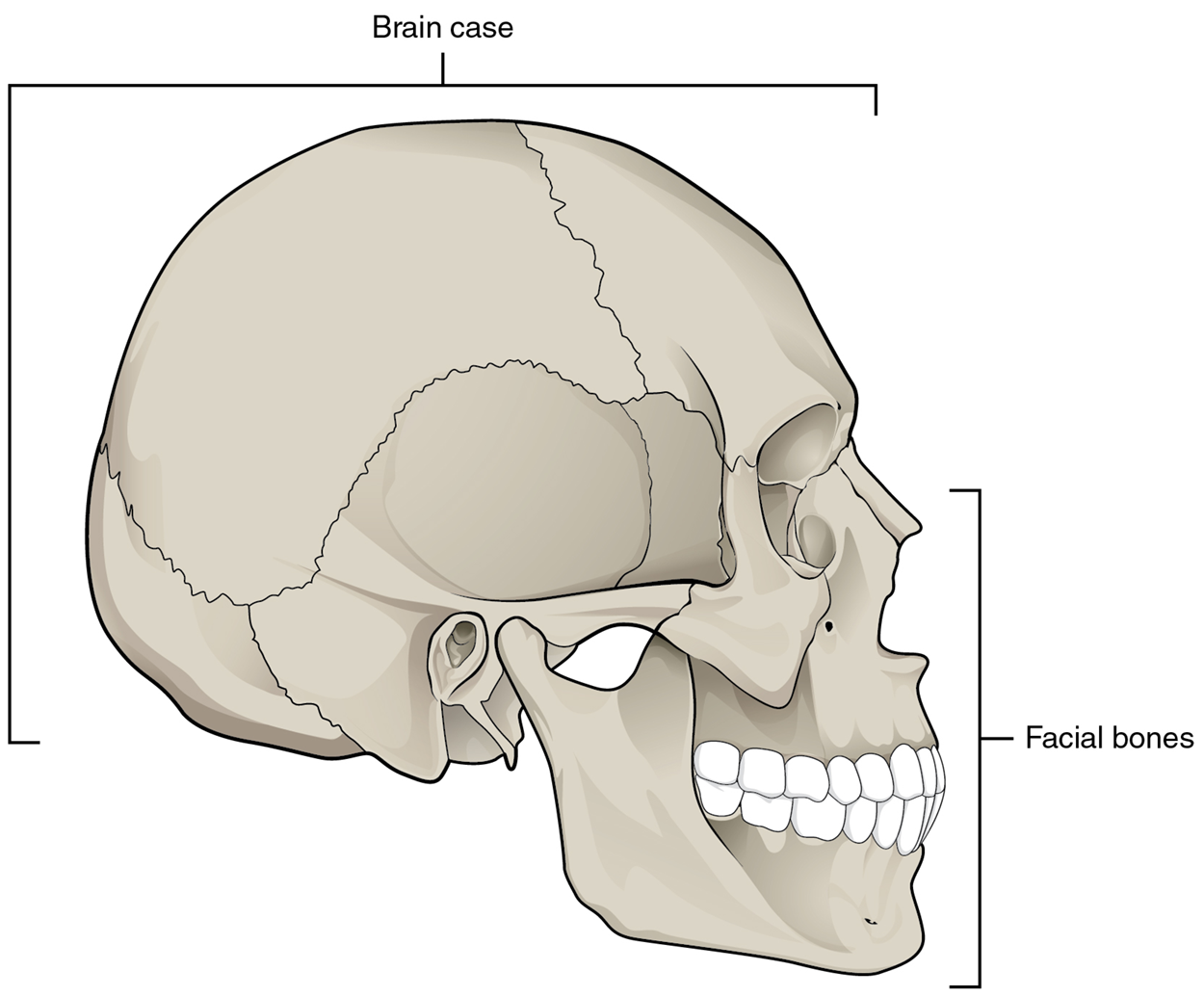
Parts of the Skull—The skull consists of the rounded brain case that houses the brain and the facial bones that form the upper and lower jaws, nose, orbits, and other facial structures.

The craniofacial bones form multiple spaces within the cranium, some large and some small. For example:
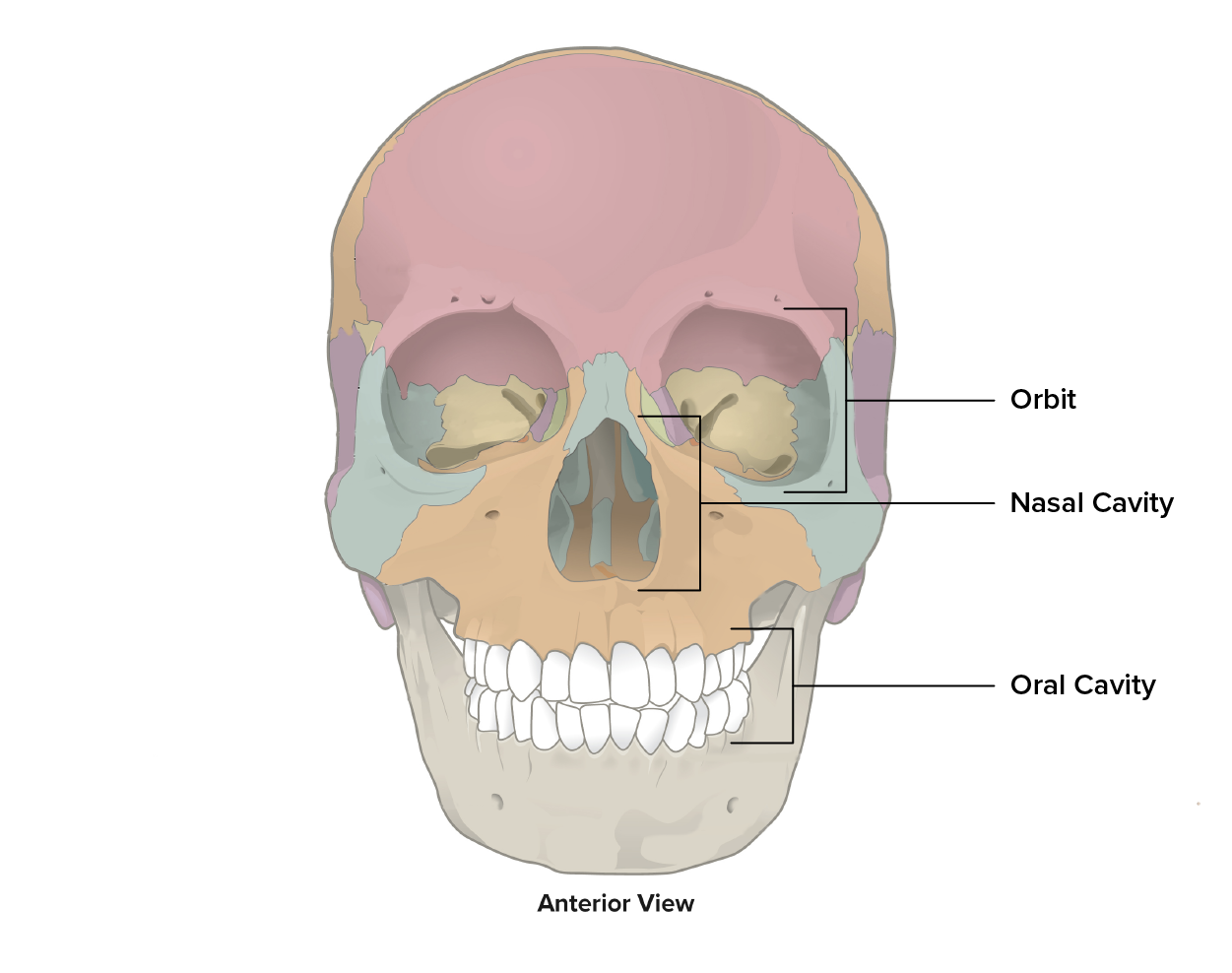
  • The orbit is also known as the eye socket or the bony opening of the eye. The orbital region of anatomy relates to the eye.
  • The nasal cavity is the space enclosed by the nose which is split into right and left halves by the bony nasal septum.
  • The oral cavity is also known as the mouth.
  • Recall that the cranial bones form the cranial cavity, which protects the brain.
Skull Spaces—The craniofacial bones form multiple spaces within the skull, including the cranial cavity, oral cavity, nasal cavity, and orbit.

terms to know
Cranium
The skeletal structure of the head that supports the face and protects the brain.
Cranial Bones
The bones of the skull that form the brain casing.
Facial Bones
The bones of the skull that underlie facial structure.
Orbit
The bony opening of the eye.
Nasal Cavity
A large space in the skull behind the nose.
Oral Cavity
A large space in the skull behind the jaws, also known as the mouth.

2b. The Vertebral Column

The vertebral column is also known as the spinal column or spine. It consists of a sequence of vertebrae (singular, vertebra), each of which is separated and united by an intervertebral disc formed by connective tissue. Together, the vertebrae and intervertebral discs form the vertebral column. It is a flexible column that supports the head, neck, and body and allows for their movements. It also protects the spinal cord, which passes down the back through openings in the vertebrae.
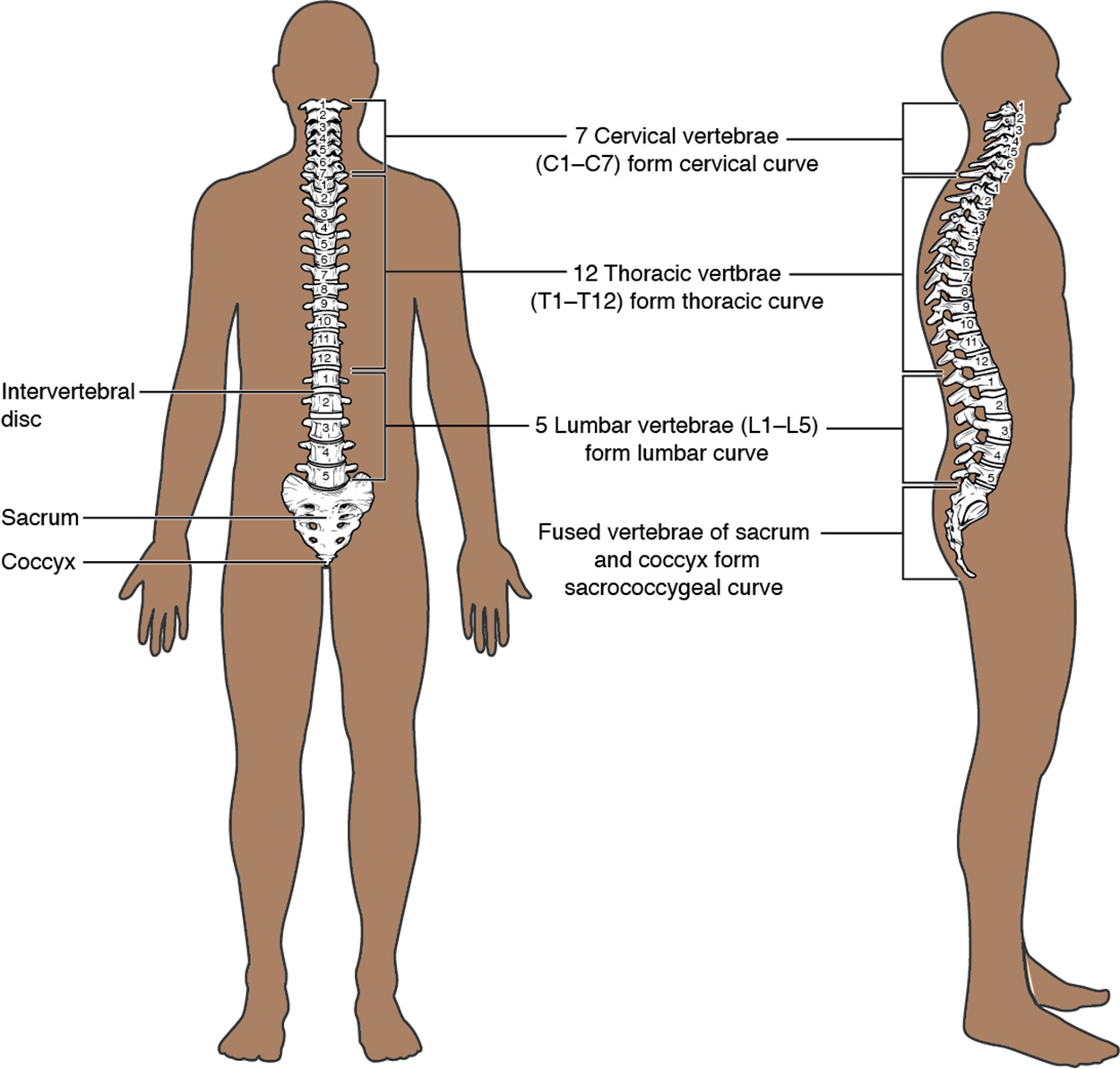
Vertebral Column—The adult vertebral column consists of 24 vertebrae, plus the sacrum and coccyx. The vertebrae are divided into three regions: cervical C1–C7 vertebrae, thoracic T1–T12 vertebrae, and lumbar L1–L5 vertebrae. The vertebral column is curved, with two primary curvatures (thoracic and sacrococcygeal curves) and two secondary curvatures (cervical and lumbar curves).

The vertebral column originally develops as a series of 33 vertebrae. However, as humans develop, certain vertebrae fuse together, leaving the adult human with 24 vertebrae, plus the sacrum and coccyx. The vertebral column is subdivided into five regions, with the vertebrae in each area named for that region and numbered in descending order.

  • In the cervical region (neck), there are seven cervical vertebrae (C1–C7).
    • The first and second cervical vertebrae (C1 and C2) are modified with a distinctive appearance. The C1 vertebra is also called the atlas, because this is the vertebra that supports the skull on top of the vertebral column (in Greek mythology, Atlas was the god who supported the heavens on his shoulders). The C2 vertebra is called the axis, because it serves as the axis for rotation when turning the head toward the right or left.
  • In the thoracic region (chest), there are the 12 thoracic vertebrae (T1–T12).
  • In the lumbar region (lower back), there are five lumbar vertebrae (L1–L5).
  • In the sacral region, there is a single sacrum, which is also part of the pelvis. The sacrum is formed by the fusion of five sacral vertebrae.
  • At the inferior end of the vertebral column is the coccyx, or tailbone, which is formed from the fusion of four small coccygeal vertebrae. However, the sacral and coccygeal fusions do not start until age 20 and are not completed until middle age.
did you know
An interesting anatomical fact is that almost all mammals have seven cervical vertebrae, regardless of body size. This means that there are large variations in the size of cervical vertebrae, ranging from the very small cervical vertebrae of a shrew to the greatly elongated vertebrae in the neck of a giraffe. In a full-grown giraffe, each cervical vertebra is 11 inches tall.

terms to know
Vertebral Column
A sequence of vertebrae that form the spine.
Intervertebral Disc
A connective tissue structure that separates and unites adjacent vertebrae.
Sacrum
A single fused bone in the sacral region, inferior to the lumbar vertebra.
Coccyx
A single fused bone at the most inferior end of the vertebral column; the tailbone.

2c. The Thoracic Cage

The thoracic cage, also referred to as the rib cage, forms the bony structure of the thorax, or chest. It consists of the 12 pairs of ribs and the associated cartilages. The ribs are attached posteriorly (toward the back) to the thoracic vertebrae. Anteriorly, most ribs are attached to the sternum, which is the elongated bony structure that anchors the anterior (front) thoracic cage. The thoracic cage protects the heart and lungs.
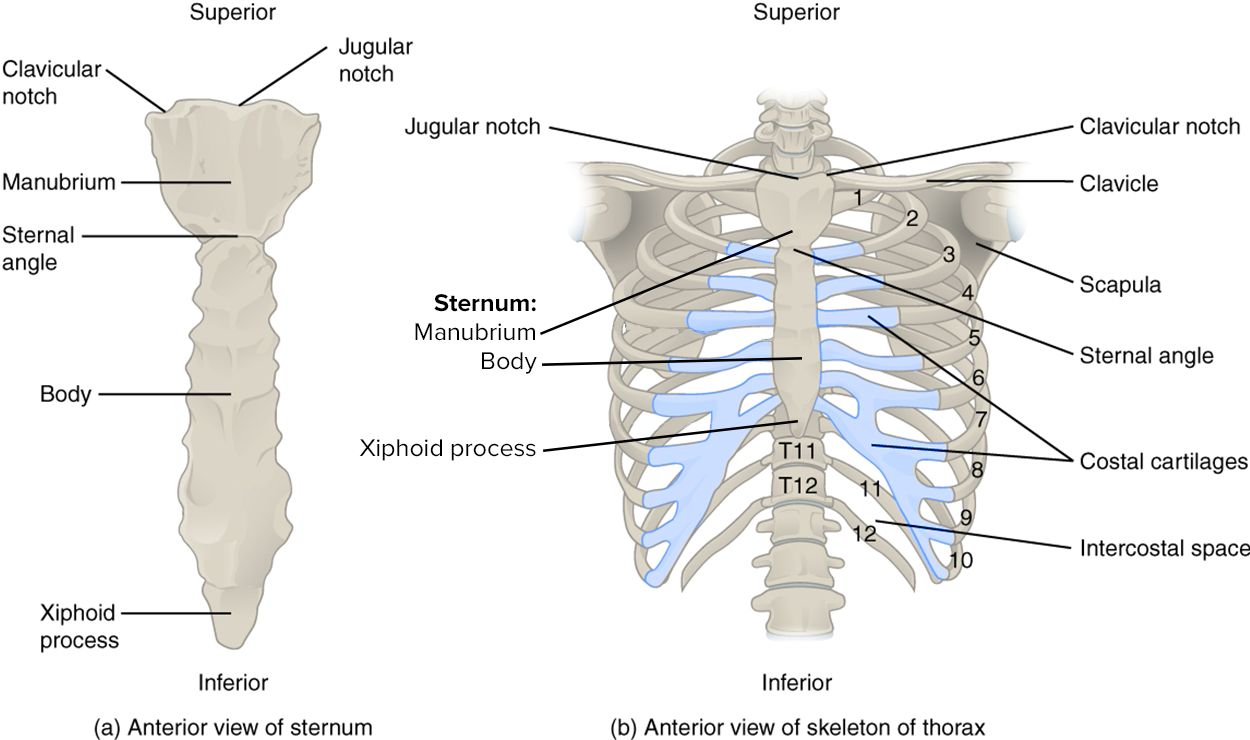
Thoracic Cage—The thoracic cage is formed by the (a) sternum and (b) 12 pairs of ribs with their costal cartilages. The ribs are anchored posteriorly to the 12 thoracic vertebrae. The sternum consists of the manubrium, body, and xiphoid process. The ribs are classified as true ribs (1–7) and false ribs (8–12). The last two pairs of false ribs are also known as floating ribs (11–12). In anatomical terms, “superior” describes a position above or higher than another part of the body proper (or toward the head), whereas “inferior” describes a position below or lower than another part of the body proper (or away from the head).

terms to know
Thoracic Cage
The bones that form the thorax.
Thorax
The chest.
Rib
A curved, flat bone that contributes to the wall of the thorax.
Sternum
The elongated bony structure that anchors the anterior thoracic cage.


3. The Appendicular Skeleton

As you learned above, the appendicular skeleton includes all bones of the upper and lower limbs, plus the bones that attach each limb to the axial skeleton. These bones are divided into two groups: the bones that are located within the limbs themselves, and the girdle bones that attach the limbs to the axial skeleton. The bones of the shoulder region form the pectoral girdle, which anchors the upper limb to the thoracic cage of the axial skeleton. The lower limb is attached to the vertebral column by the pelvic girdle.

term to know
Appendicular Skeleton
All bones of the upper and lower limbs, plus the girdle bones that attach each limb to the axial skeleton.

3a. The Pectoral Girdle

The bones that attach each upper limb to the axial skeleton form the pectoral girdle (shoulder girdle). This consists of two bones, the scapula and clavicle. The clavicle (collarbone) is an S-shaped bone located on the anterior (front) side of the shoulder. You can easily palpate (feel with your fingers) the entire length of your clavicle.

The scapula (shoulder blade) lies on the posterior (back) of the shoulder. It is supported by the clavicle and articulates with the humerus (arm bone) to form the shoulder joint. The scapula is a flat, triangular-shaped bone with a prominent ridge running across its posterior surface. This ridge extends out laterally, where it forms the bony tip of the shoulder and joins with the clavicle. By following along the clavicle, you can palpate out to the bony tip of the shoulder, and from there, you can move back across your posterior shoulder to follow the ridge of the scapula.
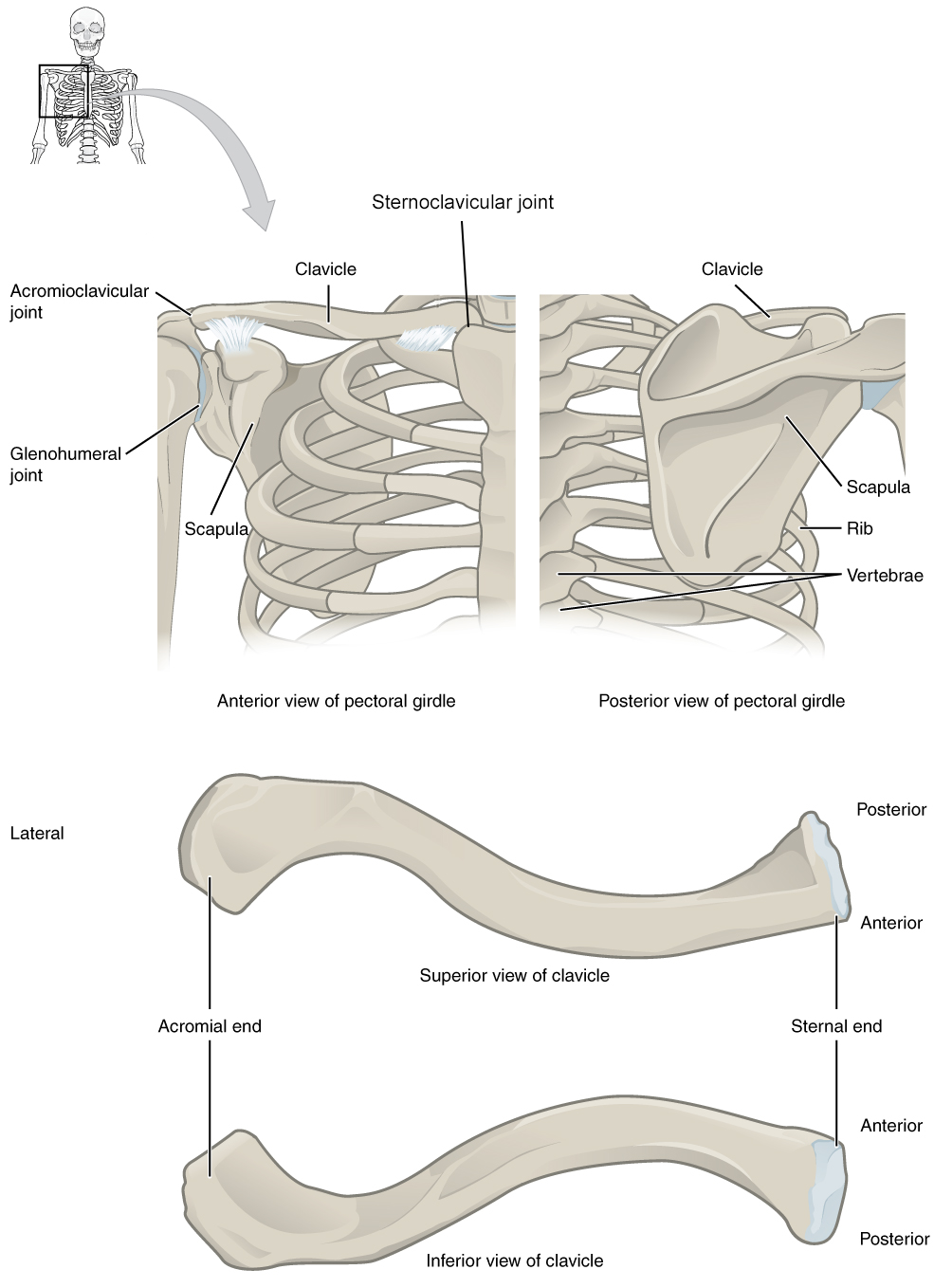
Pectoral Girdle—The pectoral girdle consists of the clavicle and the scapula, which serve to attach the upper limb to the sternum of the axial skeleton.

try it
Move your shoulder around and feel how the clavicle and scapula move together as a unit. Both of these bones serve as important attachment sites for muscles that aid with movements of the shoulder and arm.

The right and left pectoral girdles are not joined to each other, allowing each to operate independently. In addition, the clavicle of each pectoral girdle is anchored to the axial skeleton by a single, highly mobile joint. This allows for the extensive mobility of the entire pectoral girdle, which in turn enhances movements of the shoulder and upper limb.

terms to know
Pectoral Girdle
The bones that attach each upper limb to the axial skeleton.
Clavicle
The collarbone; an S-shaped long bone located on the anterior side of the shoulder.
Scapula
The shoulder blade; a triangle-shaped flat bone on the posterior aspect of the shoulder.

3b. The Upper Limb

The upper limb is divided into three regions:

  • Arm
  • Forearm
  • Hand
key concept
While you may be used to referring to your entire upper limb as your “arm,” in anatomy, the arm is the region between the shoulder and elbow joints. The forearm (fore, in front of) is the region between the elbow and wrist joints. The hand is the region beyond the wrist.

There are 30 bones in each upper limb. The humerus is the single bone of the arm, and the ulna and the radius are the paired bones of the forearm. The base of the hand contains eight bones, each called a carpal bone, and the palm of the hand is formed by five bones, each called a metacarpal bone. The fingers and thumb contain a total of 14 bones, each of which is a phalanx bone of the hand.
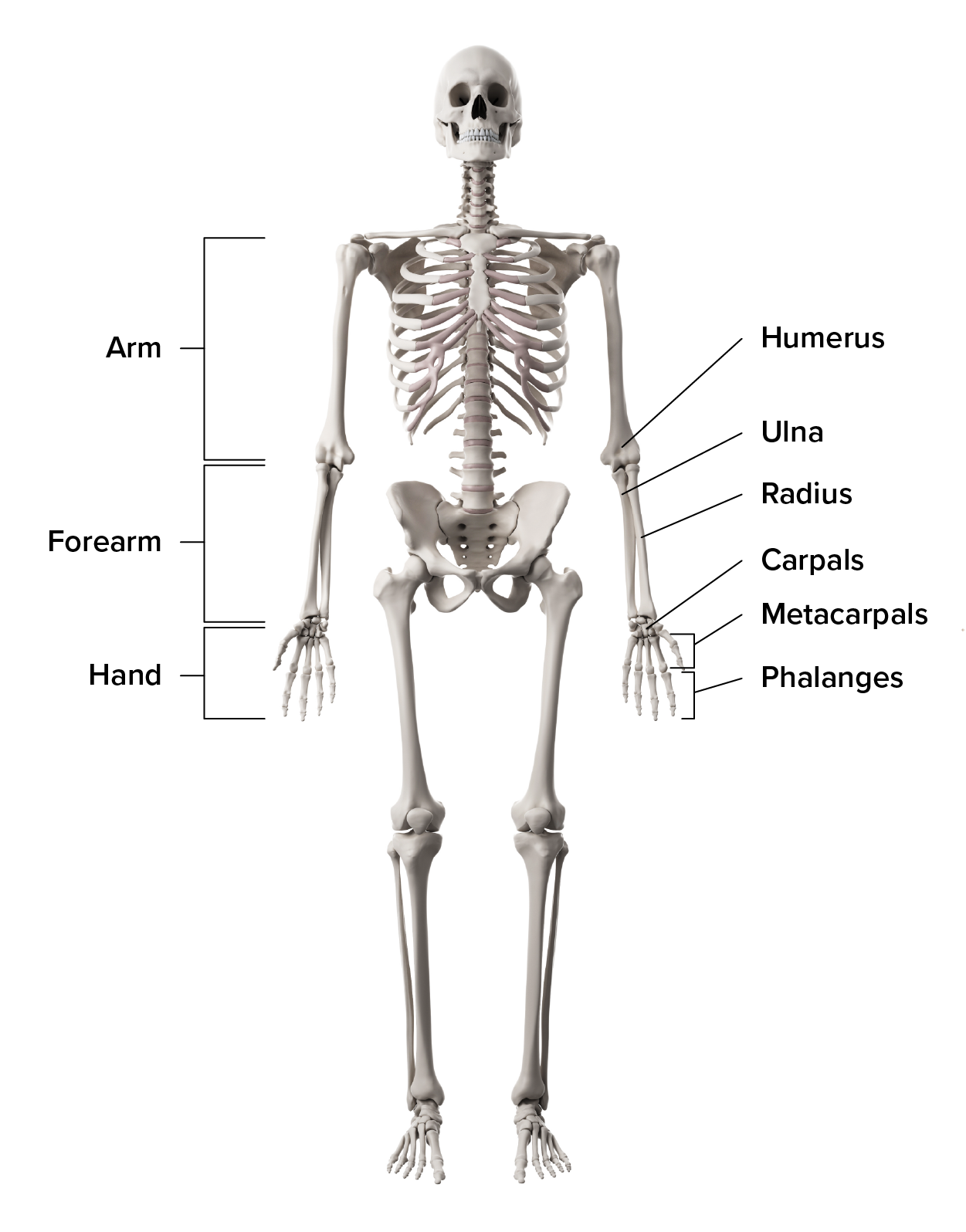
The Upper Limb—The upper limb is divided into the arm and forearm and is composed of 30 bones.

terms to know
Arm
The region of the upper limb from the shoulder to the elbow.
Forearm
The region of the upper limb from the elbow to the wrist.
Hand
The region of the upper limb beyond the wrist.

3c. The Pelvic Girdle

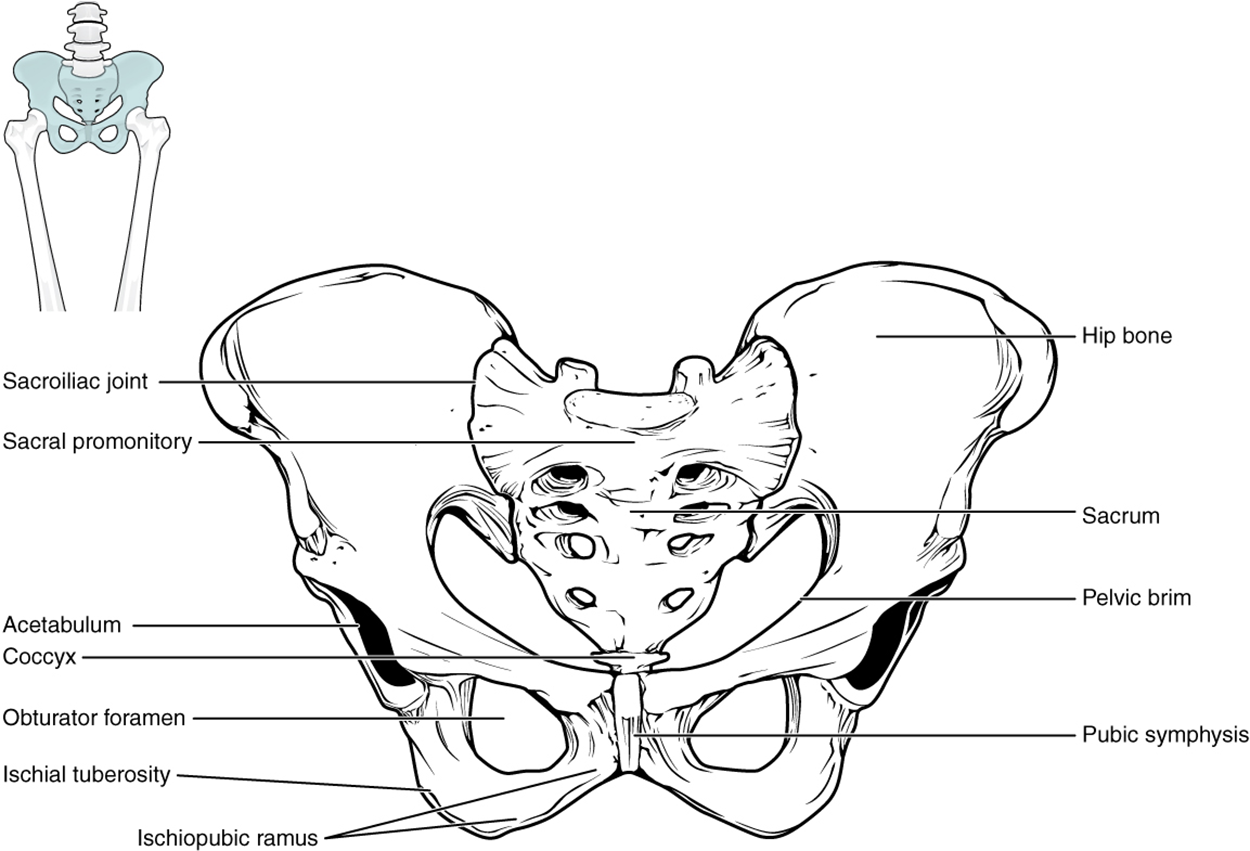
The pelvic girdle (hip girdle) is the attachment point for each lower limb. This structure is formed by right and left coxal bones (also known as the hip bones; coxal, hip). Each coxal bone is firmly joined to the axial skeleton via its attachment to the sacrum of the vertebral column. The right and left hip bones also converge anteriorly to attach to each other. The bony pelvis is the pelvic girdle (the two coxal bones), the sacrum, and the coccyx.
key concept
Unlike the bones of the pectoral girdle, which are highly mobile to enhance the range of upper limb movements, the bones of the pelvis are strongly united to each other to form a largely immobile, weight-bearing structure. This is important for stability because it enables the weight of the body to be easily transferred laterally from the vertebral column, through the pelvic girdle and hip joints, and into either lower limb whenever the other limb is not bearing weight. Thus, the immobility of the pelvis provides a strong foundation for the upper body as it rests on top of the mobile lower limbs.

Pelvis—The pelvic girdle is formed by a single hip bone. The hip bone attaches the lower limb to the axial skeleton through its articulation with the sacrum. The right and left hip bones, plus the sacrum and the coccyx, together form the pelvis.

The bones of the male and female pelvis have several clear differences that make the pelvis one anatomical piece of the body that allows for accurate sex determination. These differences relate to function and body size.

In general, the bones of the male pelvis are thicker and heavier, adapted for support of the male’s heavier physical build and stronger muscles. The greater sciatic notch of the male hip bone is narrower and deeper than the broader notch of females.

The female pelvis is adapted for childbirth, which is evidenced by it being wider than the male pelvis. The female sacrum is wider, shorter, and less curved, causing it to project less into the pelvic cavity. This creates a more rounded or oval-shaped pelvic inlet compared with males. The lesser pelvic cavity of females is also wider and shallower than the narrower, deeper, and tapering (becoming thinner) lesser pelvis of males.
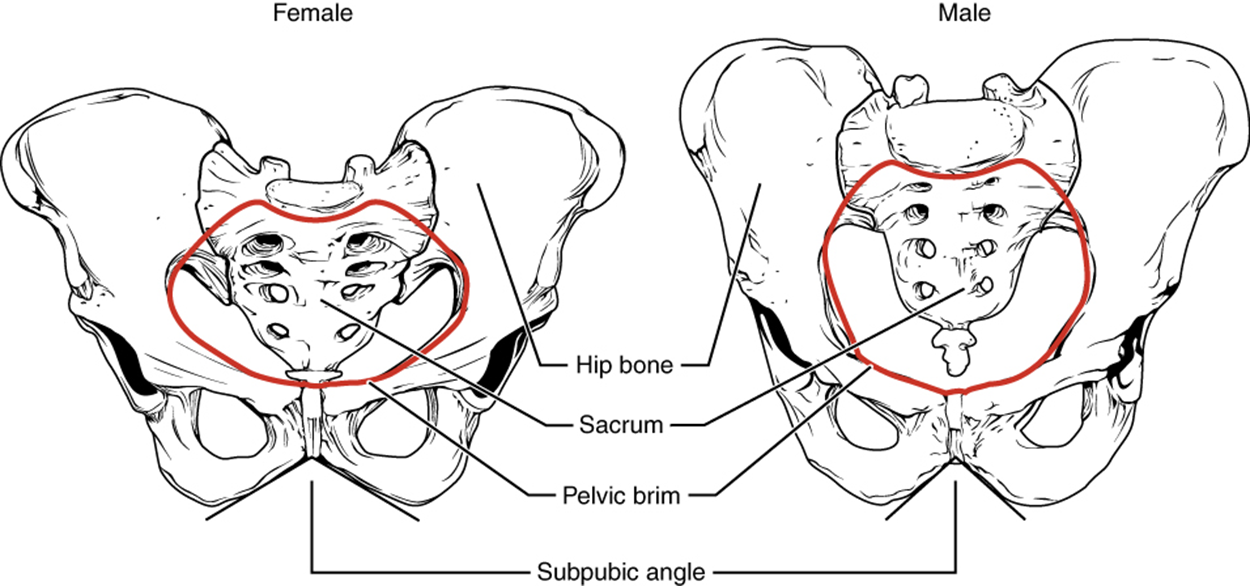
Male and Female Pelvis—The female pelvis is adapted for childbirth and is broader, with a larger subpubic angle, a rounder pelvic brim, and a wider and shallower lesser pelvic cavity than the male pelvis.

Because of the obvious differences between female and male hip bones, this is the one bone of the body that allows for the most accurate sex determination.

terms to know
Pelvic Girdle
The attachment point for the lower limbs; the coxal bones.
Coxal Bone
The hip bone.
Pelvis
The coxal bones, sacrum, and coccyx.

3d. The Lower Limb

Like the upper limb, the lower limb is divided into three regions: the thigh, leg, and foot. While you may be used to referring to the entire lower limb as your “leg,” in anatomy, the term “leg” only refers to the portion of the lower limb between the knee and ankle. The thigh is the region of the lower limb located between the hip and knee joints. The leg is the region between the knee and ankle joints. Distal to (beyond) the ankle is the foot.

The lower limb contains 30 bones. The femur is the single bone of the thigh. The patella, or kneecap, is the bone found at the knee joint. The tibia and fibula are the paired bones of the leg. The bones of the foot are divided into three groups. The posterior portion of the foot is formed by a group of seven tarsal bones, whereas the midfoot contains five elongated metatarsal bones. The toes contain 14 small bones, each of which is a phalanx bone of the foot.

terms to know
Thigh
The region of the lower limb from the hip to the knee.
Leg
The region of the lower limb from the knee to the ankle.
Foot
The region of the lower limb beyond the ankle.

summary
In this lesson, you learned about the divisions of the skeleton. You explored the axial skeleton, which is made up of 80 bones that form the head and the trunk of the body. You learned that the axial skeleton includes the skull, the vertebral column, and the thoracic cage. You then examined the appendicular skeleton, which includes 126 bones that are located within the limbs or attach the limbs to the axial skeleton. You specifically learned that the appendicular skeleton includes the pectoral girdle, the upper limb, the pelvic girdle, and the lower limb.

SOURCE: THIS TUTORIAL HAS BEEN ADAPTED FROM OPENSTAX “ANATOMY AND PHYSIOLOGY 2E”. ACCESS FOR FREE AT OPENSTAX.ORG/BOOKS/ANATOMY-AND-PHYSIOLOGY-2E/PAGES/1-INTRODUCTION. LICENSE: CREATIVE COMMONS ATTRIBUTION 4.0 INTERNATIONAL.


Terms to Know
Appendicular Skeleton

All bones of the upper and lower limbs, plus the girdle bones that attach each limb to the axial skeleton.

Arm

The region of the upper limb from the shoulder to the elbow.

Axial Skeleton

The central, vertical axis of bones of the body, including the skull, vertebral column, and thoracic cage.

Clavicle

The collarbone; an S-shaped long bone located on the anterior side of the shoulder.

Coccyx

A single fused bone at the most inferior end of the vertebral column; the tailbone.

Coxal Bone

The hip bone.

Cranial Bones

The bones of the skull that form the brain casing.

Cranium

The skeletal structure of the head that supports the face and protects the brain.

Facial Bones

The bones of the skull that underlie facial structure.

Foot

The region of the lower limb beyond the ankle.

Forearm

The region of the upper limb from the elbow to the wrist.

Hand

The region of the upper limb beyond the wrist.

Intervertebral Disc

A connective tissue structure that separates and unites adjacent vertebrae.

Leg

The region of the lower limb from the knee to the ankle.

Nasal Cavity

A large space in the skull behind the nose.

Oral Cavity

A large space in the skull behind the jaws, also known as the mouth.

Orbit

The bony opening of the eye.

Pectoral Girdle

The bones that attach each upper limb to the axial skeleton.

Pelvic Girdle

The attachment point for the lower limbs; the coxal bones.

Pelvis

The coxal bones, sacrum, and coccyx.

Rib

A curved, flat bone that contributes to the wall of the thorax.

Sacrum

A single fused bone in the sacral region, inferior to the lumbar vertebra.

Scapula

The shoulder blade; a triangle-shaped flat bone on the posterior aspect of the shoulder.

Skeleton

The bones of the body.

Sternum

The elongated bony structure that anchors the anterior thoracic cage.

Thigh

The region of the lower limb from the hip to the knee.

Thoracic Cage

The bones that form the thorax.

Thorax

The chest.

Vertebral Column

A sequence of vertebrae that form the spine.
