Table of Contents |
In a rapidly changing world marked by economic fluctuations and shifts in the nature of work, government safety net programs play a critical role in maintaining economic stability and protecting the well-being of all citizens. These programs work by providing food, medical care, cash payments, and more to individuals and families facing job loss, illness, or other life-altering events. If your financial plan is compromised, or disaster strikes, it’s important to understand how the government can help.
Agility: Skill Tip |
The U.S. government has implemented a number of programs to assist those living below the poverty line and also those with incomes just above the poverty line, who are referred to as being near-poor. Such programs help tens of millions of Americans each year and are called the safety net, in recognition that they offer some protection for those who find themselves without jobs or income. In 2019, 99.1 million people participated in one of the 10 major U.S. safety net programs, representing 30% of the U.S. population. More than one in four working-age adults (27%) and nearly one of every two children (49%) participated in a safety net program that year (U.S. Department of Health and Human Services, 2019).
Table: Select Safety Net Program Summaries, 2021
| Program | Number of Beneficiaries | Cost | Description |
|---|---|---|---|
| Medicaid | 61.9 million beneficiaries | $748 billion | Healthcare/Health Insurance |
| Earned Income Tax Credit (EITC) | 31 million beneficiaries | $59 billion | Tax credit for low-income workers |
| Supplemental Nutrition Assistance Program (SNAP) | 41.2 million beneficiaries | $111 billion | Food assistance |
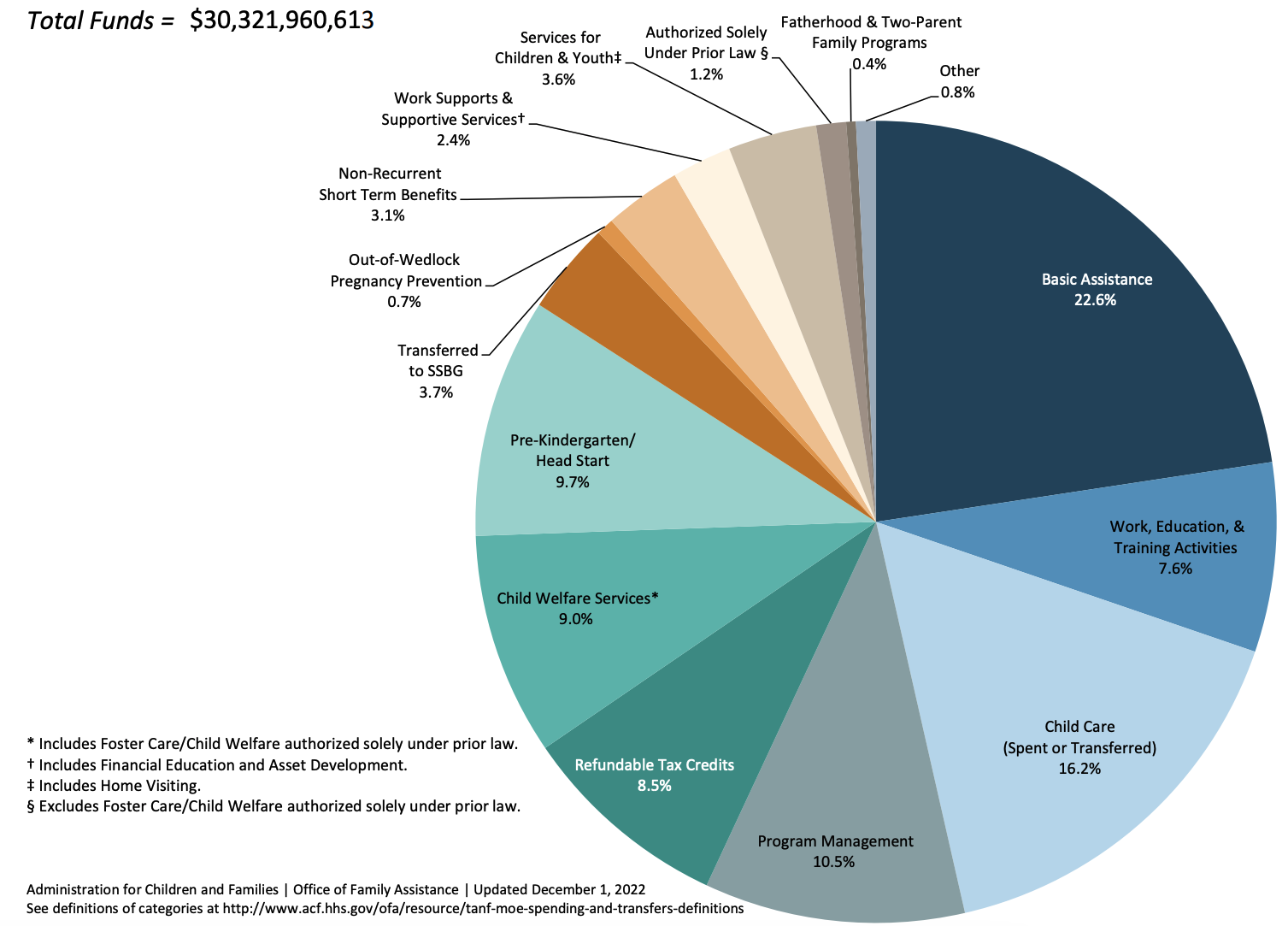
| Temporary Assistance for Needy Families (TANF) | 1.9 million beneficiaries | $30.3 billion | Direct payments |
In addition to the safety net programs discussed in this tutorial, other government programs exist, including government-subsidized school lunches and breakfasts for children from low-income families; the Special Supplemental Nutrition Program for Women, Infants, and Children (WIC), which provides food assistance for pregnant women and newborns; the Low Income Home Energy Assistance Program, which provides help with home heating bills; housing assistance, which helps pay the rent; and Supplemental Security Income, which provides cash support for those with disabilities and people who are aging and have low income.
Safety net programs helped nearly 100 million Americans at a cost of over $1 trillion dollars, but millions more eligible Americans did not take advantage of benefits (CBO, 2022).
Unemployment Insurance (UI) is a critical safety net program administered by states that provides temporary financial assistance and support to individuals who have lost their jobs through no fault of their own. UI is particularly crucial during an economic downturn, when losing a job is more common and finding another job may be more difficult. To qualify for UI benefits, you must meet specific eligibility criteria set by your state.
Generally, the main requirements include:
The length and value of the unemployment benefit are based on your previous income and history of work. State programs vary in the details of how the benefit is calculated, but the national average weekly payment in 2020 was $378. Unemployment benefits generally may be extended for up to 26 weeks, although Congress often extends benefits during severe economic downturns, such as occurred during the COVID-19 pandemic (CNBC, 2020).
From the Great Depression of the 1930s until 1996, the United States’ most visible antipoverty program was Aid to Families with Dependent Children (AFDC), which provided cash payments to mothers with children whose income was below the poverty line. This program was often just called “welfare.” In 1996, Congress passed the Personal Responsibility and Work Opportunity Reconciliation Act, more commonly called the “Welfare Reform Act.” The new law replaced AFDC with Temporary Assistance for Needy Families (TANF).
Under TANF, the federal government grants a fixed amount of money to each state. The state can then use the money for almost any program with an antipoverty component. For example, the state might give direct cash assistance to poor families, or fund programs to reduce teenage pregnancy, or even to raise the high school graduation rate. However, the federal government included two key requirements:
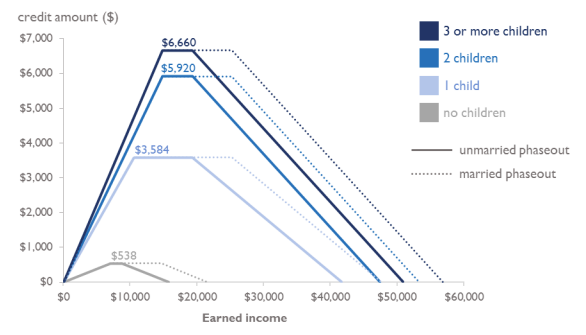
The Earned Income Tax Credit (EITC), first passed in 1975, is a method of assisting working adults with low incomes through the tax system. The EITC is the second largest non-healthcare assistance program for low-income groups (after SNAP, described below), and it helped 31 million households in 2021 to take advantage of it at an estimated cost of $59 billion. The amount of the tax break increases with the amount of income earned, up to a point. The Earned Income Tax Credit has often been popular with both economists and the general public because of the way it effectively increases the wages received for low-income workers.
The EITC is designed to encourage employment among low-income workers. A key part of the program is that benefits phase out slowly. For instance, a single-person head of household with three children in 2023 will receive a benefit up to an adjusted gross income of $56,838. The figure below summarizes how benefits first increase and then decrease with income depending on your household configuration:
Often called “food stamps,” the Supplemental Nutrition Assistance Program (SNAP) is a federally funded program, started in 1964, in which participants receive a card like a debit card, reloaded monthly, that they can use to buy food. About two-thirds of beneficiaries are families with children, and over one-third are in households with elderly or people with disabilities. The amount of food aid for which a household is eligible varies by income, number of children, and other factors, but in general, households are expected to spend about 30% of their own net income on food. If 30% of their net income is not enough to purchase a nutritionally adequate diet, then those households are eligible for SNAP. SNAP requires most families to reapply for the benefit every 6–12 months and has work requirements for some recipients.
Table: SNAP Benefits by Household Size, 2023
| Household Size | Maximum Monthly Benefit | Estimated Average Monthly Benefit |
|---|---|---|
| 1 | $281 | $195 |
| 2 | $516 | $359 |
| 3 | $740 | $577 |
| 4 | $939 | $684 |
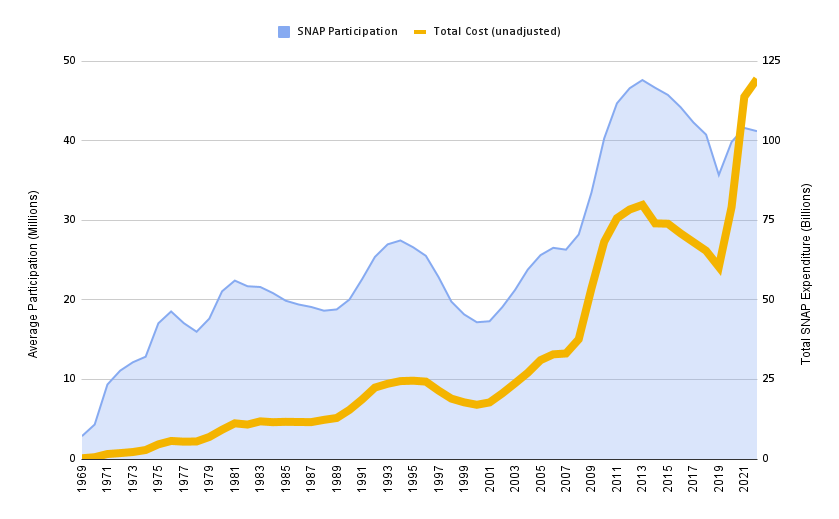
As seen in the figure below, SNAP participation and expenditures rise sharply during economic downturns, such as the 2008 financial crisis and the COVID-19 pandemic. In 2020, Congress authorized extra SNAP benefits for recipients and suspended work requirements. These changes quickly increased participation to 43 million recipients, or 13% of the population.
Medicaid was created by Congress in 1965 and is a joint health insurance program entered into by both the states and the federal government. Whereas Medicare provides health insurance for all Americans over the age of 65, Medicaid was created to provide healthcare coverage for people with limited incomes. The federal government helps fund Medicaid, but each state is responsible for administering the program and determining the level of benefits. Medicaid provides medical insurance for people with low incomes, including those below the poverty line, with a focus on families with children, the elderly, and people with disabilities. About one-third of Medicaid spending is for low-income mothers with children. An increasing share of the program funding in recent years has gone to pay for nursing homes for elderly Americans with low incomes. The program ensures that a basic level of benefits is provided to Medicaid participants, but because each state sets eligibility requirements and provides varying levels of service, the program differs from state to state.
In the past, a common problem was that many low-paying jobs paid just enough that a family could lose eligibility for Medicaid, yet the job did not offer health insurance benefits. A parent considering such a job might choose not to work rather than lose health insurance for themselves and their children. In this way, health insurance could discourage workers from taking actions that might improve their long-term financial situation. Many states recognized this problem in the 1980s and 1990s and expanded their Medicaid coverage to include not just the poor, but the near-poor. In 2010, the Affordable Care Act went further, expanding federal funds to states to broaden Medicaid coverage to include all adults, not just those with children, earning up to 138% of the federally determined poverty line. Children qualify for benefits with even higher household incomes, often as high as 200–300%. As of 2023, 40 states and Washington, DC, have adopted Medicaid expansion through the Affordable Care Act, while 10 states have not.
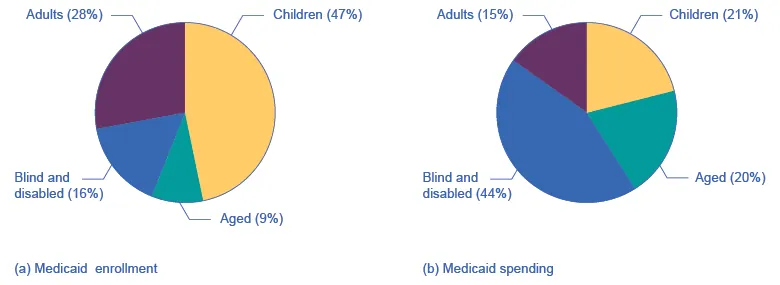
As of 2022, approximately 72 million people participated in Medicaid. Of those enrolled, almost half are children. Healthcare expenditures, however, are highest for the aged population, which comprises approximately 25% of participants. As indicated in the charts below, the largest number of households that enroll in Medicaid are those with children. Adults with low incomes are the next largest group enrolled in Medicaid at 28%. Americans who are blind and disabled comprise 16% of those enrolled, and seniors, 9%.
Source: THIS TUTORIAL HAS BEEN ADAPTED FROM OPENSTAX “Principles of Economics 2e” ACCESS FOR FREE AT openstax.org/books/principles-economics-2e/pages/15-3-the-safety-net. LICENSE: CREATIVE COMMONS ATTRIBUTION 4.0 INTERNATIONAL.
REFERENCES
Barnes, M., Bauer, L., Edelberg, W., Estep, S., Greenstein, R., & Macklin, M. (2021, June 23). The social insurance system in the US: Policies to protect workers and families. Brookings Institution. www.brookings.edu/articles/the-social-insurance-system-in-the-u-s-policies-to-protect-workers-and-families/
Congressional Budget Office. (2023, March). The Federal Budget in Fiscal Year 2022: An Infographic. www.cbo.gov/publication/58888
Desilver, D. (2023, July 19). What the data says about food stamps in the U.S. Pew Research Center. www.pewresearch.org/short-reads/2023/07/19/what-the-data-says-about-food-stamps-in-the-u-s/
Iacurci, G. (2020, April 9). How much unemployment will I get? That depends on your state. CNBC. www.cnbc.com/2020/04/09/how-much-unemployment-will-i-get-that-depends-on-your-state.html
Macartney, S. & Ghertner, R. (April, 2023). Participation in the U.S. Social Safety Net: Multiple Programs, 2019. U.S. Department of Health and Human Services. www.aspe.hhs.gov/reports/multiple-programs-2019
U.S. Department of Agriculture. (2022, August 9). SNAP - Fiscal Year 2023 Cost-of-Living Adjustments. www.fns.usda.gov/snap/fy-2023-cola
U.S. Department of Health and Human Services. (2023, January). U.S. Federal Poverty Guidelines Used to Determine Financial Eligibility for Certain Programs. www.aspe.hhs.gov/topics/poverty-economic-mobility/poverty-guidelines



