In this lesson, you will learn about the impact of public opinion on the government and on American democracy. Does public opinion matter to elected officials? Should it? You will explore how the institutions of government, the media, and public opinion play a role in both elections and policymaking. Specifically, this lesson covers:
Today, public opinion polls are a common feature of the American political landscape. Elected officials, the media, watchdog groups and other organizations, and even governments use polling for the purpose of better understanding the public, especially certain constituencies.
Elected officials and political candidates use public opinion to develop their campaign platforms, to inform the decisions they make once in office, and to better understand the issues their constituents most care about. Elected officials may also use public opinion to gauge their ability to be reelected to office or assess whether their constituents approve of the decisions they have made in office.
Public opinion polling is prevalent even outside election season. Is there some other reason for them? Some believe the increased collection of public opinion is due to growing support of delegate representation, that is, the idea that the politician is in office to be the voice of the people.
EXAMPLE
If voters want the legislator to vote for legalizing marijuana, the legislator should vote to legalize marijuana.
Legislators or candidates who believe in delegate representation may poll the public before an important vote comes up for debate, in order to learn what the public wants them to do.
Others believe polling has increased because politicians, like the president, operate in permanent campaign mode. To continue donating money, supporters must be convinced that the politician is listening to them. Even if the elected official does not act in a manner consistent with the polls, they can mollify supporters by explaining the reasons behind their vote.
Regardless of why polls are taken, studies have not clearly shown whether the branches of government consistently act on them. Some branches appear to pay closer attention to public opinion than other branches, but events, time periods, and politics may change the way an individual candidate or a branch of government ultimately reacts.
2. Impact of Polling on Elections
Elections are the events on which opinion polls have the greatest measured effect. From the very start of election season, the media uses public opinion polls to decide which candidates are ahead of the others, and are therefore of interest to voters and worthy of an interview.
IN CONTEXT
From the moment President Obama was inaugurated for his second term, speculation began about who would run in the 2016 presidential election. Within a year, potential candidates were being ranked and compared by a number of newspapers. The speculation included favorability polls on Hillary Clinton, which measured how positively voters felt about her as a candidate.
During the presidential primary season, we see examples of the bandwagon effect, in which the media pays more attention to candidates who poll well during the first few primaries.
IN CONTEXT
Bill Clinton was nicknamed the “Comeback Kid” in 1992 after he placed second in the New Hampshire primary despite accusations of committing adultery with Gennifer Flowers. The media’s attention on Clinton due to his positive polling gave him the momentum to make it through the rest of the primary season, in which he ultimately won the Democratic nomination and the presidency.
Polling is also at the heart of horse race coverage, in which, just like an announcer at the racetrack, the media calls out a candidate’s every move throughout the presidential campaign. It includes near-constant reporting on polls (some of which have questionable validity), accompanied by commentary from election experts or spokespeople for the candidates. Sound bites, tweets, and videos of campaign stops are frequently integrated into this largely surface-level reporting.
Horse race coverage can be neutral, positive, or negative, depending upon what polls or facts are covered.
EXAMPLE
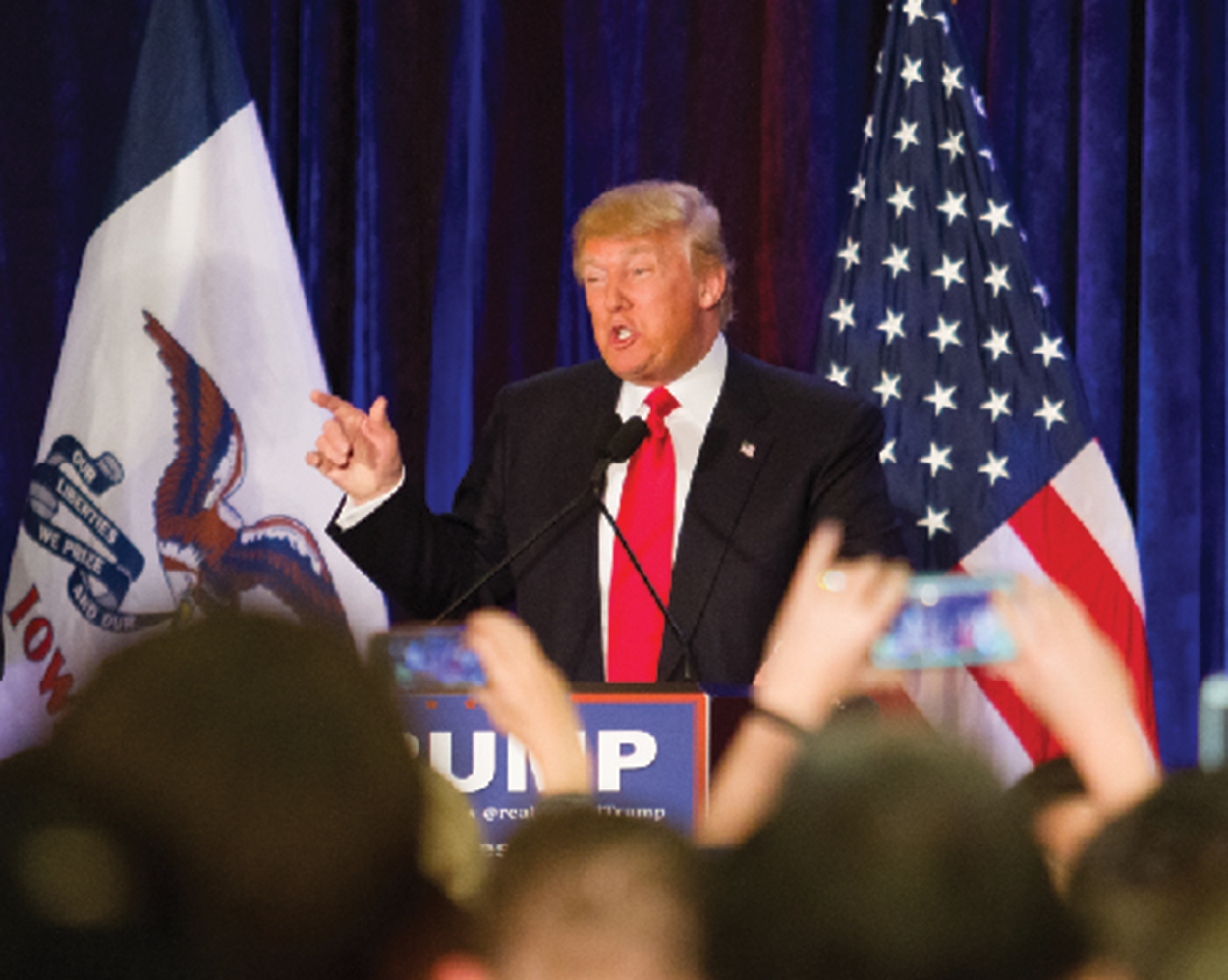
In 2016, Republican presidential candidate Donald Trump became the center of the media’s horse race coverage. As the field winnowed from over twenty candidates down to three, the media incessantly compared everyone else in the field to Trump (Figure 1).
(Figure 1) Presidential candidate Donald Trump campaigning in Iowa. credit: Max Goldberg
Horse race coverage is often criticized for its lack of depth. The stories skip over the candidates’ issue positions, voting histories, and other facts that would help voters make an informed decision. Yet, horse race coverage is popular, because the public is always interested in who will win, and it often makes up a third or more of news stories about the election.
Exit polls, taken on the day of the election, can affect elections as well. Announced results of these surveys can deter voters from going to the polls later in the day if they believe the election has already been decided.
Public opinion polls also affect how much money candidates receive in campaign donations. Donors assume public opinion polls are accurate enough to determine who the top two to three primary candidates will be, and they give money to those who project to do well. Candidates who poll at the bottom will have a hard time collecting donations, increasing the odds that they will continue to do poorly.
terms to know
Bandwagon Effect
Increased media coverage of candidates who are believed to be doing well based on polling results.
Horse Race Coverage
Day-to-day media coverage of candidate performance in an election season based on results of polls.
3. The Influence of Public Opinion on Government
The relationship between public opinion polls and government action is murkier than that between polls and elections. Like the news media and campaign staffers, members of the three branches of government are aware of public opinion. But do politicians use public opinion polls to guide their decisions and actions? The short answer is sometimes.
Some political scientists theorize that policymakers use public opinion data to identify a range of acceptable decision-making options known as the “zone of acquiescence.” If public mood changes, the politicians may change positions to match the public mood. The more savvy politicians look carefully to recognize when shifts occur. When the public is more or less liberal, the politicians may make slight adjustments to their behavior to match. Politicians who frequently seek to win office, like House members, pay attention to both the long- and short-term changes in opinion. By doing this, they are less likely to lose on Election Day. Political Scientist V.O. Key, Jr. theorized that policymakers also make inferences about future opinions, such as that which may be held at election time, a dynamic termed latent opinion.
The particular ways Congress, the president, and justices use public opinion, however, are far more complex.
3a. Presidents and Public Opinion
Unlike members of Congress who are part of an institution of 535 individuals, the president is both a person and the head of an institution. The media pays close attention to any president’s actions, and the public is generally well-informed and aware of the office and its current occupant. Perhaps this is why, historically, presidents have carefully tracked public opinion.
EXAMPLE
As early as Franklin D. Roosevelt’s administration in the 1930s, presidents have regularly polled the public, and since Richard Nixon’s term (1969–1974), they have admitted to using polling as part of their decision-making process.
Presidents are aware of public opinion and often use their bully pulpit to try to move public opinion toward their own personal positions rather than moving themselves toward the public’s opinion. If presidents have enough public support, they use their level of public approval indirectly as a way to get their agenda passed.
In some instances, presidents may appear to directly consider public opinion before acting or making decisions.
IN CONTEXT
As a candidate for president in 2020, Joseph Biden expressed support of measures that would cancel student loan debt cancellation. Once the elected president and amidst growing pressure to cancel student loan debt, President Biden expressed doubt about his ability to unilaterally cancel student loan debt. However, public sentiment regarding the issue didn’t wane. Initially, President Biden responded by using his executive authority to cancel student loan debt for certain types of students. In August of 2022, he announced he was ordering the cancellation of $10,000 and $20,000 in student loan debt for a large number of Americans. While the plan was later halted by the federal courts, President Biden’s action on the matter appeared to be directly related to the growing pressure from the public and progressive policymakers.
Presidents do not consistently listen to public opinion, however.
EXAMPLE
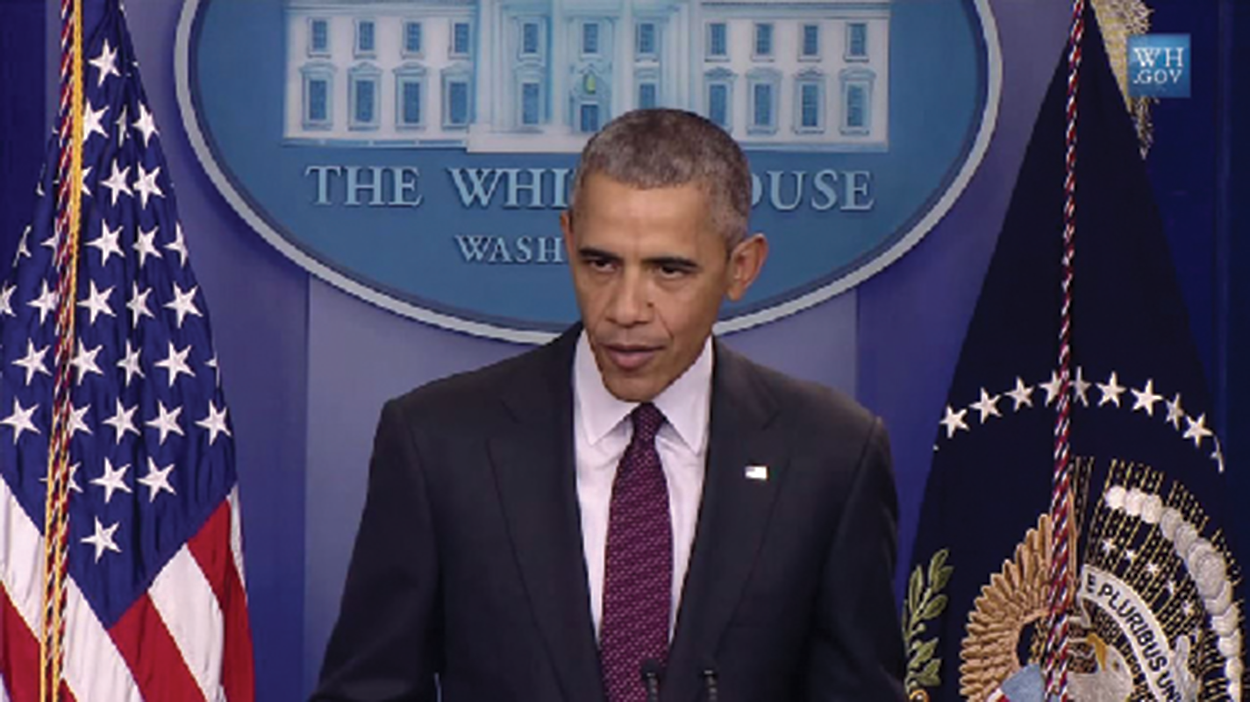
After taking office in 2009, President Obama enjoyed public popularity (Figure 2). As a result, he could make decisions such as not ordering the closing of Guantanamo Bay prison, even though his promise to do so had gained him support during the 2008 election.
(Figure 2) In the wake of a shooting at Umpqua Community College in Oregon in October 2015, President Obama sought to use his popularity to ask Americans to act by calling for a change in gun control laws credit: The White House
3b. Congress
While presidents have at most only two terms to serve and work, members of Congress can serve as long as the public returns them to office. We might think that for this reason, public opinion is of the most importance to House of Representatives members who, with a two-year term, have a more difficult time recovering from decisions that anger local voters. And because most representatives continually fundraise, unpopular decisions can hurt their campaign donations. Yet these elections are also affected by the president on the ticket, presidential popularity during a midterm election, and the perks of incumbency, such as name recognition and media coverage. Interestingly, public opinion is more likely to impact a senator’s chance of reelection.
However, we see policy shifts in both chambers of Congress that often match the policy preferences of the public.
Beyond voter polls, members of Congress are also very interested in polls that reveal the wishes of interest groups and businesses.
EXAMPLE
If the AARP, one of the largest and most active groups of voters in the United States, is unhappy with a bill, members of the relevant congressional committees will very likely take that response into consideration. If the pharmaceutical or oil industry is unhappy with a new patent or tax policy, its members’ opinions will have some effect on representatives’ decisions, since these industries contribute heavily to election campaigns.
3c. The Supreme Court
There is some disagreement about whether the Supreme Court follows public opinion or shapes it. The lifetime tenure of the justices was designed to remove everyday politics from their decisions, protect them from swings in political partisanship, and allow them to choose whether and when to listen to public opinion. More often than not, the public is unaware of the Supreme Court’s decisions and opinions. When the justices accept controversial cases, the media tunes in and asks questions, raising public awareness and affecting opinion. But do the justices pay attention to the polls when they make decisions?
Studies that look at the connection between the Supreme Court and public opinion are contradictory. Early on, it was believed that justices were like other citizens: individuals with beliefs and attitudes who were affected by political shifts. Later studies argued that Supreme Court justices rule in ways that maintain support for the institution. Instead of looking at the short term and making decisions day-to-day, justices are strategic in their planning and make decisions for the long term.
If the majority of Americans agree on a policy or issue before the court, the court’s decision is likely to agree with public opinion. The court is often, but not always, more likely to rule with the majority opinion than against it.
IN CONTEXT
In Town of Greece v. Galloway (2014), a majority of the justices decided that ceremonial prayer before a town meeting was not a violation of the Establishment Clause, which establishes a separation between church and state. The fact that 78 percent of U.S. adults recently reported that religion is fair to very important to their lives, and 61 percent supported prayer in school, may partially explain the Court’s decision.
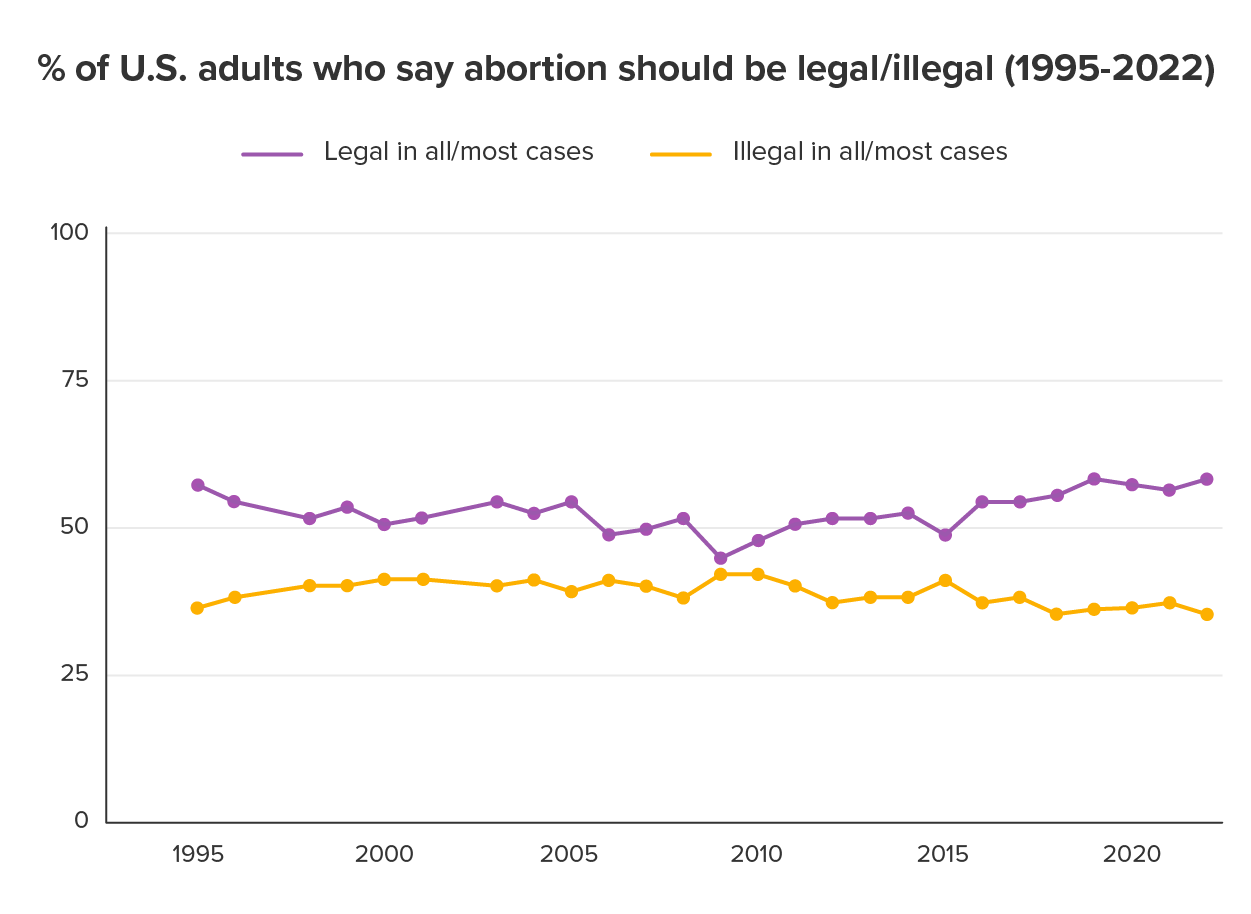
However, despite a consistent majority public opinion in favor of abortion access (Figure 3), the Supreme Court in Dobbs v. Jackson Women's Health Organization (2022) overturned Roe v. Wade and thus no longer requires states to allow women to receive abortions.
(Figure 3) Public opinion on the legality of abortions
Overall, it is clear that public opinion has a less powerful effect on the courts than on the other branches of government. Perhaps this is due to the lack of elections and the lifetime tenure of justices, or perhaps we have not determined the best way to measure the effects of public opinion on the Court.
term to know
Latent Opinion
Unexpressed opinions that may emerge at a later point, at election time for instance.
4. Should Public Opinion Matter?
We’ve now seen that public opinion does impact the government, but should it? You may have watched a late-night talk show host interviewing random people on the street asking them to name the president or the vice president or to explain a recent political crisis. The audience laughs at how little the people on the street know and understand. Studies have underscored the reality of the public’s general lack of political knowledge.
EXAMPLE
According to the 2022 Annenberg Constitution Day Survey of adults in the United States, 47 percent of adults could correctly identify all three branches of government. The study also found that 46 percent of adults could articulate the role of the Supreme Court in exercising judicial review.
The public is not perfectly informed about politics. However, many political studies, from the American Voter in 1960 to the American Voter Revisited in the 2000s, have found that voters behave rationally despite having limited information. Individual citizens do not take the time to become fully informed about all aspects of politics, yet their collective behavior and the opinions they hold as a group make sense.
In The Rational Public, a study that examined 50 years of public opinion. Benjamin Page and Robert Shapiro found that despite some fluctuations in opinion, and even some outright attempts at manipulation, public opinion in the United States has remained relatively stable. Citizens rely on heuristics, shortcuts, or rules of thumb (cues), to make rational decisions. Political party membership is one of the most common heuristics in voting. Many voters join a political party whose platform aligns most closely with their political beliefs, and voting for a candidate from that party simply makes sense.
EXAMPLE
A Republican candidate will likely espouse conservative beliefs, such as smaller government and lower taxes, that are often more appealing to a Republican voter.
Studies have shown that up to half of voters make decisions using their political party identification, or party ID, especially in races where information about candidates is scarce.
Another heuristic that voters use is the opinions of people they trust, and with whom their interests and values align, whether these are media figures, religious leaders, or simply better-informed friends or colleagues.
Furthermore, in the book The Wisdom of Crowds: Why the Many Are Smarter Than the Few and How Collective Wisdom Shapes Business, Economies, Societies and Nations, journalist James Surowiecki argues that group decisions are often more informed and accurate than those of any individual expert. Large groups aggregate knowledge from many different sources.
Yet, even the framers of the U.S. Constitution were concerned about public knowledge and devised our system of government to guard against hasty, uninformed decisions by the general public. Elected officials are also sometimes privy to information that general citizens are not, especially in areas that require expert knowledge or access to national security reports. So, not surprisingly, politicians sometimes realize public opinion may not always guide them toward the right choices.
However, overall, many studies find that the aggregate information voters do have, such as party membership and political ideology, allows them to make rational decisions and hold politicians accountable during an election year.
summary
In this lesson, you learned why polling affects government. Specifically, you explored the impact of polling on elections, as the media covers campaigns as horseraces, speculating on who will finish first. You also explored the influence of public opinion on government and how it differs from branch to branch. Finally, in answer to the question of should public opinion matter, you explored the way voters use information shortcuts to analyze the potential outcomes of policies even when they aren’t informed about policy details.
Surowiecki, James. (2004) The Wisdom of Crowds: Why the Many Are Smarter Than the Few and How Collective Wisdom Shapes Business, Economies, Societies and Nations. New York: Doubleday; Anchor.
Terms to Know
Bandwagon Effect
Increased media coverage of candidates who are said to be doing well based on polling results.
Horse Race Coverage
Day-to-day media coverage of candidate performance in an election season based on results of polls
Latent Opinion
Unexpressed opinions that may emerge at a later point, at election time for instance.