Table of Contents |
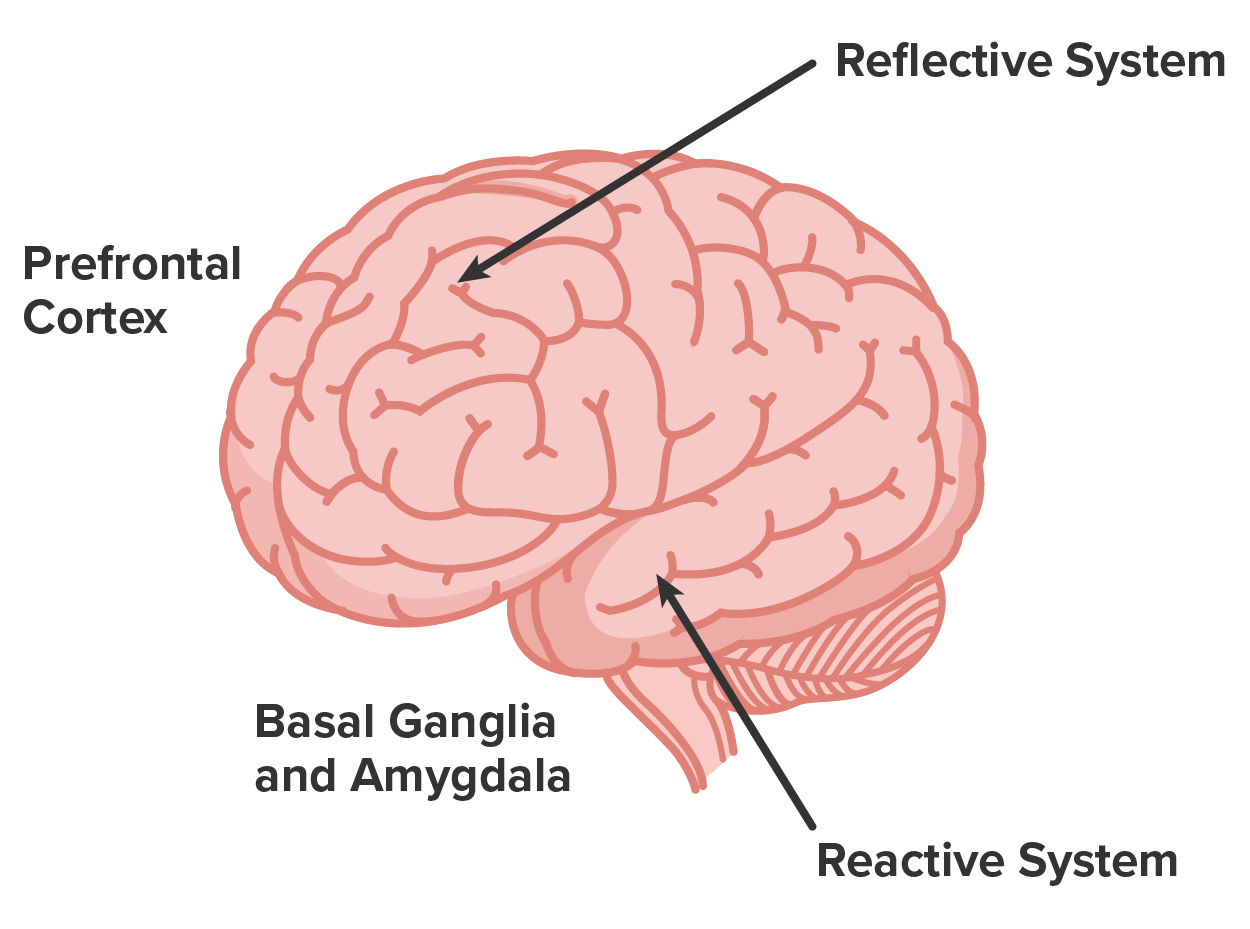
The human brain processes information for decision making using one of two routes: a reflective system and a reactive (or reflexive) system. The reflective system is logical, analytical, deliberate, and methodical, while the reactive system is quick, impulsive, and intuitive, relying on emotions or habits to provide cues for what to do next. Research in neuropsychology suggests that the brain can only use one system at a time for processing information and that the two systems are directed by different parts of the brain. The prefrontal cortex is more involved in the reflective system, and the basal ganglia and amygdala (more primitive parts of the brain, from an evolutionary perspective) are more involved in the reactive system.
We tend to assume that the logical, analytical route leads to superior decisions, but whether this is accurate depends on the situation. The quick, intuitive route can be lifesaving; when we suddenly feel intense fear, a fight-or-flight response kicks in that leads to immediate action without methodically weighing all possible options and their consequences. Additionally, experienced managers can often make decisions very quickly because experience or expertise has taught them what to do in a given situation. These managers might not be able to explain the logic behind their decision and will instead say they just went with their “gut” or did what “felt” right. Because the manager has faced a similar situation in the past and has figured out how to deal with it, the brain shifts immediately to the quick, intuitive decision-making system.
The quick route is not always the best decision-making path to take, however. When faced with novel and complex situations, it is better to process available information logically, analytically, and methodically. As a manager, you need to think about whether a situation requires not a fast, “gut” reaction, but some serious thought prior to making a decision. It is especially important to pay attention to your emotions because strong emotions can make it difficult to process information rationally. Successful managers recognize the effects of emotions and know to wait and address a volatile situation after their emotions have calmed down. Intense emotions—whether positive or negative—tend to pull us toward the quick, reactive route of decision making. Have you ever made a large “impulse” purchase that you were excited about, only to regret it later? This speaks to the power our emotions exert on our decision making. Big decisions should generally not be made impulsively, but reflectively.
Being aware of the role emotions play in decision making does not mean that we should ignore them. Emotions can serve as powerful signals about what we should do, especially in situations with ethical implications. Thinking through how we feel about the possible options, and why we feel that way, can greatly enhance our decision making. Effective decision making, then, relies on both logic and emotions. For this reason, the concept of emotional intelligence has become popular as a characteristic of effective managers.
Empathy, the ability and willingness to consider how your decisions affect others, is an emotional state that guides good decision making. Social skills facilitate good management and are essentially about empathy, considering how your behavior affects people. These qualities are most effective when the manager has an ability to regulate emotions, displaying them appropriately, and is aware of how emotions may be distorting their views or guiding their decisions. Sometimes it might be necessary to wait on a decision, such as when you’re angry, tired, anxious, or suffering from a loss (Desko, 2019). You should abstain entirely from a decision if there’s a conflict of interest, such as a close friend being considered for a promotion.
Managers who are aware of their own emotions can think through what their emotions mean in a given situation and use that information to guide their decision making. Managers who are aware of the emotions of others can also utilize that information to help groups function more effectively and engage in better group decision making. While emotional intelligence seems to come easily to some people, it is something that we can develop and improve on with practice.
Because managers have limited time and must use that time wisely to be effective, it is important for them to distinguish between decisions that can have structure and routine applied to them (called programmed decisions) and decisions that are novel and require thought and attention (nonprogrammed decisions).
Programmed decisions are those that are repeated over time and for which an existing set of rules can be developed to guide the process. These decisions might be simple, or they could be fairly complex, but the criteria that go into making the decision are all known or can at least be estimated with a reasonable degree of accuracy. For example, deciding how many raw materials to order should be a programmed decision based on anticipated production, existing stock, and anticipated length of time for the delivery of the final product.
EXAMPLE
A retail store manager is developing the weekly work schedule for part-time employees. The manager must consider how busy the store is likely to be, taking into account seasonal fluctuations in business. Then, they must consider the availability of the workers by taking into account requests for vacation and for other obligations that employees might have (such as school). Establishing the schedule might be complex, but it is still a programmed decision: It is made on a regular basis based on well-understood criteria, so structure can be applied to the process.For programmed decisions, managers often develop heuristics, or mental shortcuts, to help reach a decision. Heuristics are efficient—they save time for the decision maker by generating an adequate solution quickly. Heuristics don’t necessarily yield the optimal solution—deeper cognitive processing may be required for that. However, they generally yield a good solution. Heuristics are often used for programmed decisions because experience in making the decision over and over helps the decision maker know what to expect and how to react. Programmed decision making can also be taught fairly easily to another person. The rules and criteria, and how they relate to outcomes, can be clearly laid out so that a good decision can be reached by the new decision maker. Programmed decisions are also sometimes referred to as routine or low-involvement decisions because they don’t require in-depth mental processing to reach a decision.
EXAMPLE
The retail store manager may not know how busy the store will be the week of a big sale but might routinely increase staff by 30% every time there is a big sale (because this has been fairly effective in the past).| Unprogrammed Decisions | Programmed Decisions |
|---|---|
|
|
Some researchers say that “quick” decisions often yield better results because making a snap judgment or decision actually ensures our subconscious makes a decision based on nonverbal cues rather than cognitive thought. Often, though, in order for this method to work, we must have a clear objective before we make this quick decision, whether or not that be conscious or unconscious. Whether or not we make decisions quickly, most decisions we make are either high-involvement or low-involvement, programmed or unprogrammed. We will look at nonprogrammed decisions in the next section.
In contrast, nonprogrammed decisions are new, unstructured decisions that are generally based on criteria that are not well-defined. With nonprogrammed decisions, information is more likely to be ambiguous or incomplete, and the decision maker may need to exercise some thoughtful judgment and creative thinking to reach a good solution. These are also sometimes referred to as nonroutine decisions or as high-involvement decisions because they require greater involvement and thought on the part of the decision maker. For example, consider a manager trying to decide whether or not to adopt a new technology. There will always be unknowns in situations of this nature. Will the new technology really be better than the existing technology? Will it become widely accepted over time, or will some other technology become the standard? The best the manager can do in this situation is to gather as much relevant information as possible and make an educated guess as to whether the new technology will be worthwhile. Clearly, nonprogrammed decisions present the greater challenge.
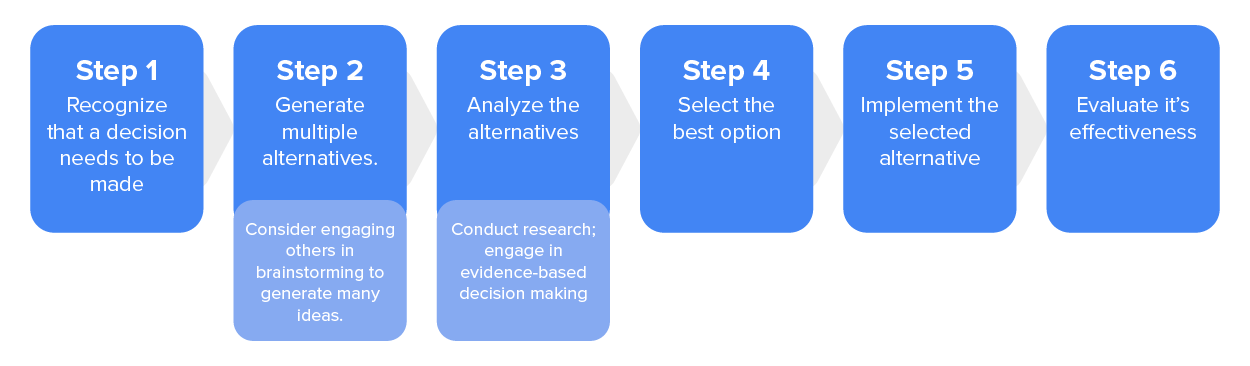
While decisions makers can use mental shortcuts with programmed decisions, they should use a systematic process with nonprogrammed decisions. The decision-making process is illustrated below.
While these steps may seem straightforward, individuals often skip steps or spend too little time on some steps. In fact, sometimes people will refuse to acknowledge a problem (Step 1) because they aren’t sure how to address it.
You may notice similarities between the two systems of decision making in our brains and the two types of decisions (programmed and nonprogrammed). Nonprogrammed decisions will generally need to be processed via the reflective system in our brains in order for us to reach a good decision. But with programmed decisions, heuristics can allow decision makers to switch to the quick, reactive system and then move along quickly to other issues.
Source: THIS TUTORIAL HAS BEEN ADAPTED FROM OPENSTAX "ORGANIZATIONAL BEHAVIOR". ACCESS FOR FREE AT OPENSTAX.ORG/BOOKS/ORGANIZATIONAL-BEHAVIOR/PAGES/1-INTRODUCTION. LICENSE: CREATIVE COMMONS ATTRIBUTION 4.0 INTERNATIONAL.
REFERENCES
Desko, J. (2019). 6 Times When You Should NOT Make A Decision. Center Consulting. www.centerconsulting.org/blog/6-times-when-you-should-not-make-a-decision
Gladwell, M. (2019). Blink: The Power of Thinking Without Thinking. Back Bay Books.