Table of Contents |
We are all consumers, and we have all been the target of promotional campaigns. To connect with consumers of a target market, companies conduct extensive market research so that they may better understand the consumer. When companies understand the consumer, they can better structure a message to appeal to the consumer and also find the best channels for reaching the customer.
While we should be flattered that these companies are thinking of us and trying to figure out how to reach us and what messages they should send, many consumers are busy trying to figure out how to shut out the messages.
IN CONTEXT
When you sit down to watch television, you are typically exposed to ads that a company believes you will respond to based on the research it has done about the audience watching the show you tuned in to watch. During your time scrolling through your news feed on Facebook, you are being served ads that correspond to your Internet search history and even products you may have mentioned while your phone was on and your news feed open. Digital advertising relies heavily on data related to your search history and site visits.
As recipients of these marketing messages, many consumers believe that marketing is only advertising or sales. However, advertising and sales are simply two options in a marketer’s arsenal of communication tools used to connect with the target market. Developing a marketing communications strategy is something marketers should only do after they have developed the rest of the marketing mix.
The promotion mix is the set of strategies marketers use to communicate with their customers. With combined strategies, the promotion mix creates a powerful method of connecting with the customer and conveying all the other marketing mix elements for a holistic marketing approach. The promotion mix allows marketers to reach customers in many different ways, ensuring that the message is seen, heard, and understood. After determining and defining the target market, creating a good product, selecting a pricing strategy and optimal price, and deciding on the distribution method, the marketer is ready to communicate with the customer.
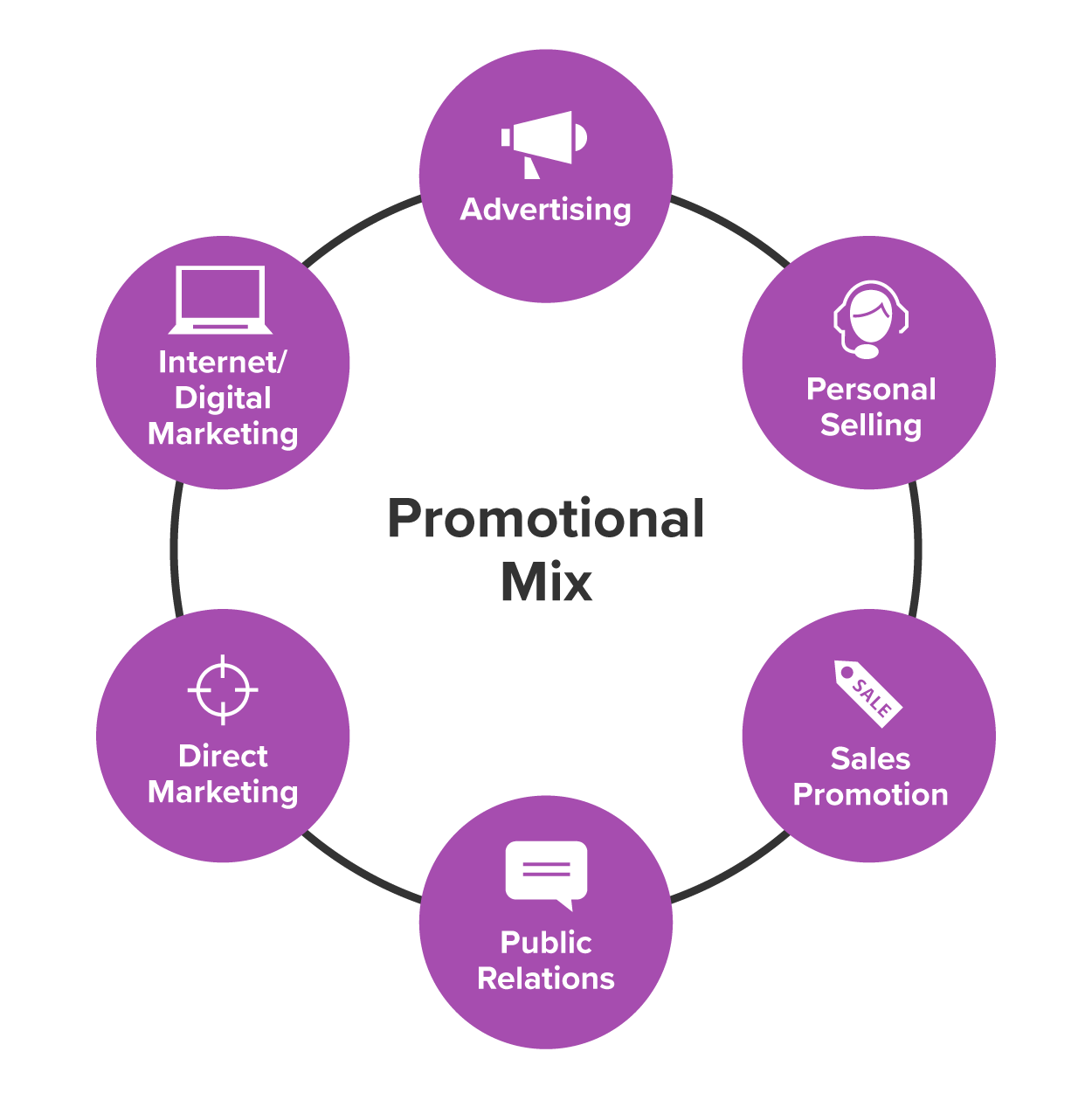
Of all the marketing mix variables, the promotion mix can be further divided into different message channels that allow for connection and communication with the customer. When the promotion connects with the customer, it is the moment when all the marketing activities come together. When the messaging and method of delivery reach the customer and create the desired result, the marketing has achieved its purpose.
IN CONTEXT
The strategies in the promotion mix provide the marketer with an arsenal of methods to achieve their marketing objectives, such as increasing sales or introducing a new product. Marketers must combine the various communication elements to connect with the customer and meet the communication objective. When analyzed individually, each of the promotional mix elements is powerful. They each have a part to play in the overall success of a company. When combined and carefully executed, they create powerful brands with legions of loyal fans and followers—the consumers.
In fact, marketers have a wide variety of strategies to use from the overall promotional mix. Most companies choose to use a combination of the promotional mix methods to create an integrated marketing communication message that reaches the customer in many different ways. When the messaging is integrated, the consumer receives the same message no matter which method of promotion is chosen. If the consumer is watching the news and hears a story about the company or product, public relations has impacted them. If they scroll through their social media accounts at the end of the day and they see an ad for the same product, advertising has impacted them. When they sort through their emails and have a message from the company, they have received a direct marketing communication.
The best products are nothing until the consumer knows about them. Without good promotion, the best products are just secrets. We all have things we want to say, and on any given day we make phone calls, create Instagram posts, upload TikTok videos, send emails, shoot off text messages, and talk face-to-face with people. And just like us, marketers also have things to say. Usually, they want to tell consumers about their new brand extension of Reese’s, a trade-in allowance for a new Toyota Camry that just hit the car lot or even a buy-one-get-one-free promotion for your Starbucks latte.
Advertising is a multibillion-dollar industry.
Advertising is paid nonpersonal communication from an identified source that allows for creative messaging about all aspects of a product, service, idea, person, or place. Consumers are able to quickly point to advertising as a form of promotion. It is perhaps the element of the promotional mix that we are most familiar with and the one we have been most exposed to throughout every phase of our lives.
IN CONTEXT
From our very first commercial showing how much fun it is to build with LEGO to imagery of a toddler walking the Disney streets with a costumed princess and Cinderella’s castle in the foreground, we know what advertising looks like. While advertising can take many forms, it is important to note that advertising consists of carefully designed messaging from the company to the consumer. Advertising is meant to produce a response in the viewer. Advertising is all about what the company wants to tell us.
Advertising can be the pop-up window while we are doing a Google search. It can be the Chick-fil-A billboard we pass every day on our way to work. Advertising can be the trailer we watch before our movie starts. And advertising can be the fun Doritos spots we look forward to during the annual Super Bowl.
While advertising can be a costly means of communication with the customer, it is relatively inexpensive based on the number of people reached. When NBC priced the 2021 Super Bowl at $6 million for a 30-second spot, with a record 96 million viewers, the price averaged out to around $0.06 per person reached.
Personal selling is one of the most expensive forms of promotion because it is a one-on-one, person-to-person form of communicating with the customer. The role of the salesperson is to inform and persuade the customer. This is usually done in what is termed an exchange situation. The salesperson is exchanging knowledge and something of value, while the customer is exchanging money for the item of value. Personal selling is ideal for products that can be customized, are complex, and have a relatively high price point. More details about personal selling are presented in the section on Personal Selling and Its Role in the Promotion Mix.
Most consumers love a sales promotion. A sales promotion is a method for a marketer to induce sales in the short term. Sales promotion is not a long-term strategy but is geared toward specific calls to action, typically aimed at getting the consumer to buy something immediately or enter a sweepstakes or contest. It creates a feeling of excitement and often includes a bit of a gaming experience in the purchase decision. Marketers value the benefits of sales promotions because the results are immediate and they have a wide variety of options when using this promotional mix element. More details about sales promotion are presented in the section on Sales Promotion and Its Role in the Promotion Mix.
Public relations is a nonpaid, nonpersonal form of promotion. Because it is nonpaid, it has a high degree of credibility and is beneficial because a typically credible, non-biased third party is the messenger. While there are many tactics that marketers might use for public relations, some of the most commonly used include press releases, press conferences, events, and annual reports.
More details about public relations are presented in the section on Public Relations and Its Role in the Promotion Mix.
Direct marketing allows for direct communication with the customer. Messages can be tailored to specific market segments and even personalized toward individual consumers. Early tactics of direct marketing included telephone and mail; however, technology has allowed for new methods of connecting with the customer to include text messaging and email marketing.
The Internet is used for digital marketing, which includes websites and digital ads as well as the two-way communication of social media. Marketers have at their disposal a variety of methods to reach their customers and brand products. Some of the tools include websites, landing pages, social media pages, widgets, and customer relationship management (CRM) systems.
Digital marketing is geared toward very specific market segments and is primarily interactive. Think of digital marketing as the mechanism that produces the immediate interaction with the customer and produces some type of feedback. Digital is considered two-way communication between the company and the customer.
EXAMPLE
During the early stages of launching the SPANX brand, Sara Blakely primarily used digital marketing with a heavy emphasis on social media. She involved her women friends who were in her target market demographic and had them post about the brand through their social media.When a consumer completes a Google search for shoes and then jumps to Facebook to scroll their feed and is served shoe ads from Nordstrom, Macy’s, and Steve Madden, they have been targeted by these shoe companies. The targeting, immediacy, and changeability of the messaging make digital a quick and efficient method of reaching consumers. Digital promotional tools are extremely effective and can cut through the clutter and reach the consumers when they are in the demand phase of the buying process and have signaled an intent to purchase.
IN CONTEXT
According to a 2020 chief marketing officer (CMO) survey from Gartner, two-thirds of promotional budgets are being spent on digital. Because of the tremendous amount of data that is collected and provided in report-based analysis, referred to as data analytics, marketers are able to assess the effectiveness immediately. Messages can be tested for effectiveness and quickly changed if they are not producing results. It is very difficult to get the same quick feedback with any of the other forms of promotion. Through careful tracking and robust customer relationship management (CRM) systems, marketers are quickly able to promote products, increase brand awareness, and move consumers down the sales funnel to instantly purchase through online e-commerce sites.
Utilizing mobile app technology, marketers are able to push promotions to customers while segmenting them by their behaviors and simultaneously filling their CRM with insights and analytics that can help drive promotions and sales.
Source: THIS TUTORIAL HAS BEEN ADAPTED FROM OPEN STAX’S PRINCIPLES OF MARKETING COURSE. ACCESS FOR FREE AT https://openstax.org/details/books/principles-marketing. LICENSE: CREATIVE COMMONS ATTRIBUTION 4.0 INTERNATIONAL.



