Table of Contents |
The product life cycle maps the stages a product goes through, tracking its sales and profitability. A product goes through four stages: introduction, growth, maturity, and decline.
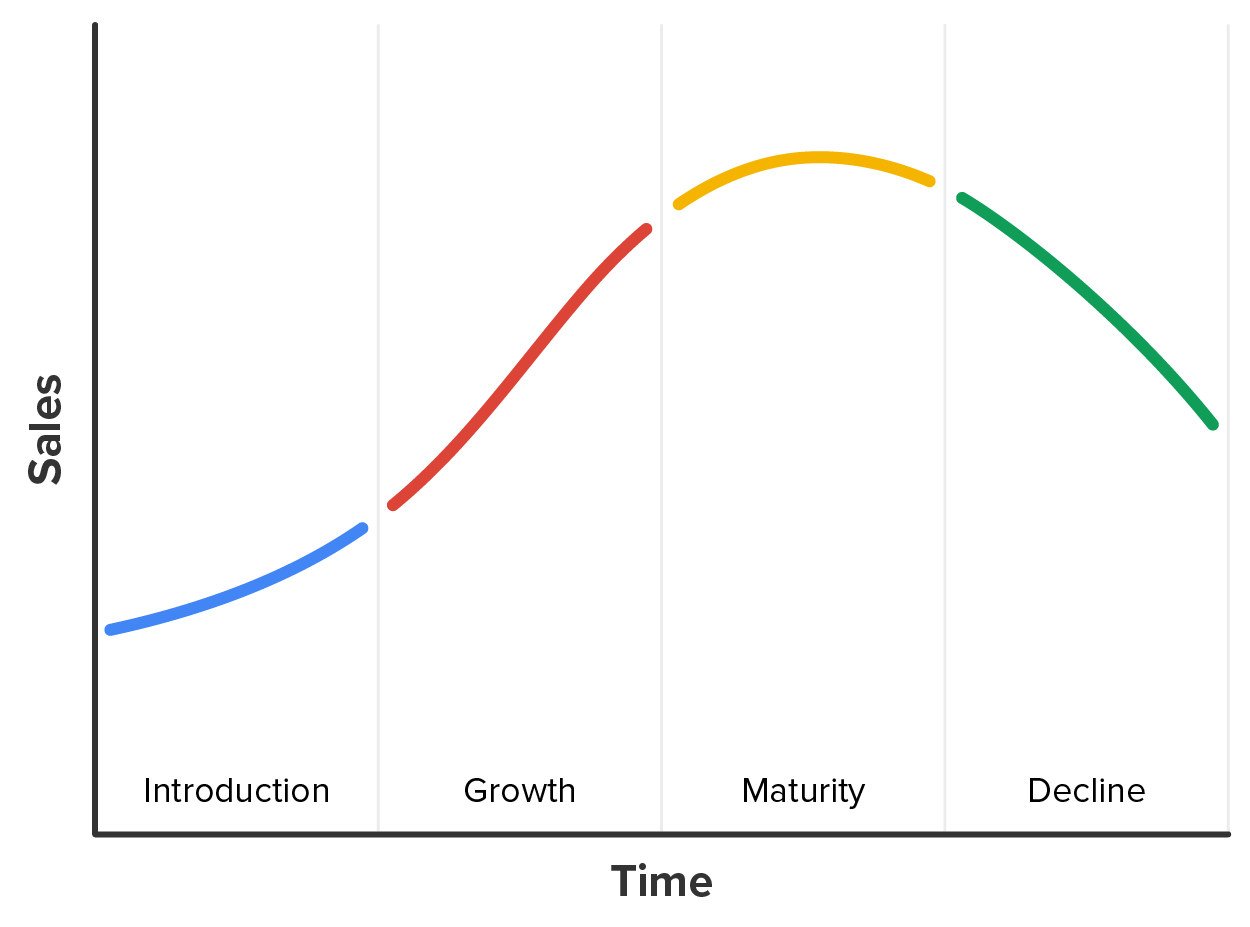
The product life cycle begins in the introduction stage, when consumer awareness is building and sales are starting to grow. The marketing investment is high as brands invest heavily in advertising and sales promotion to encourage trial. Profitability is low due to the costs of launching and scaling a new product.
The introduction stage is characterized by awareness-building to encourage trial. There is a significant investment in marketing activities at this stage to make the shift from early adopters to a broader audience, and pricing is a means of enticing trial.
A rapid skimming strategy sets a high price along with extensive advertising and sales promotion to establish the product in the marketplace. This strategy allows a product to gain share quickly and fend off potential competitors. Technology innovations typically use a rapid skimming strategy to attract early adopters who are willing to pay a higher price.
In contrast, a slow skimming strategy may be utilized when there is not an anticipated influx of competitors. The slow skimming strategy sets high prices with low advertising and sales promotion investment.
EXAMPLE
We may see a rapid skimming strategy for the new model of a truck or SUV in the automobile market because competition is high and the barrier to entry is low. On the other hand, the Tesla brand used a slow skimming strategy in its initial launch with a high-priced offering making it exclusive.A rapid penetration pricing strategy is appropriate when volume sales will increase market share quickly and a lower-priced strategy is employed. Rapid penetration pricing strategies encourage customers to try a product and switch to a new brand. This strategy works well with product categories with many competitors and price-sensitive customers.
EXAMPLE
Old Navy used a rapid penetration pricing strategy when it opened its stores in 1994 with an $8 jeans promotion under the assumption that if customers tried its jeans, they would be hooked and become brand advocates.In contrast, a slow penetration pricing strategy establishes low prices and low promotion to capture share more slowly in a market that typically does not readily react to promotion. Products that do not have a lot of brand equity and are necessities do not respond to promotion readily and are appropriate for a slow penetration pricing strategy.
EXAMPLE
If a store brand of butter were to establish an everyday low price without the use of promotion, it would be adopting a slow penetration pricing strategy.Once a product catches on in the marketplace, it enters the growth stage of the product life cycle. The growth stage is characterized by increasing sales and the potential for copycat brands to enter the market once they see revenue and profitability. In addition, products require less marketing and distribution investments during the growth stage, making them more profitable. However, a brand can decide to invest in product improvements and distribution, which may decrease profitability in the short term in exchange for long-term gain. When hoverboards were new to the market, they experienced explosive growth that quickly tapered off. The growth stage is characterized by growing sales and increasing competition in the marketplace. Investment in product and place is essential at the growth stage to maximize market share and scale quickly.
Once a product becomes mainstream in the growth stage, expanding distribution channels can increase market share. While expanded distribution adds expense, it also brings the product to more customers in various settings. For example, Chicago-based Home Run Inn Pizza was so famous in the restaurant format that it expanded to grocery stores to increase share.
The product enters the maturity stage when sales growth slows and profitability levels taper off. The maturity stage is typically the longest stage of the product life cycle, with products remaining in this stage for years or even decades. Profitability may remain if the brand has a solid competitive advantage or decline if too many competitors enter the market. Marketing investment can increase at this stage if the brand has a rival, and product modification can alter the product to meet consumers’ needs. Yet often a brand will retain a low level of marketing during the maturity stage to remind consumers of its benefits. Kraft Macaroni & Cheese is an example of a product that has a solid place in the market and has stabilized as a mature product.
Stability characterizes the maturity stage: profits, customers, and pricing. While this sounds like good news, brands must defend their market share from increasing product replication and product innovation from competitors.
Products in the maturity stage may engage in market modification, an extension of the product to new customers.
EXAMPLE
Cheerios adopted a market modification strategy when it positioned its cereal to the aging baby boomer demographic as a heart-healthy breakfast. This strategy opened a new market for Cheerios to increase its market share.Products in the maturity stage may also engage in product modification, altering products to fit the market. Modifications may be made to the function of the product, the quality of the product, and/or the style of the product.
EXAMPLE
Chobani modified its yogurt product in 2015 by altering the container, allowing the customer to flip toppings into yogurt, and changing the functionality of the yogurt and topping product.Eventually, most products enter the decline stage. The decline stage is characterized by a significant decrease in sales and profitability. Sometimes the decline occurs because the market has changed: technology has evolved, consumer tastes have shifted, or the need that the product satisfies is no longer relevant. Other times, the product is pushed out by rising costs or competitors. Many companies report their earnings quarterly and do not want to keep an unprofitable brand in their portfolio. As a result, companies typically try to divest a product in the decline stage. Another company may pick up the brand, invest in it, and bring the product back to a growth or maturity stage. Apple’s iPod entered the decline stage when the popular iPhone was introduced, bringing a host of features plus music.
IN CONTEXT
It is important to note that products do not always travel through the product life cycle at a linear rate, nor do they all travel through all product life cycle stages. For example, a product can be introduced and never gain traction, so it goes directly from introduction to decline. Or a product might gain popularity rapidly during the growth stage and then meet a quick decline. This phenomenon occurs when products are fads.
The decline stage of the product life cycle is characterized by declining sales and profitability. The product is at the end of its life cycle and is no longer sustainable or a good investment. Brands reduce to a core set of activities and set out to divest the brand asset.
A brand might divest (no longer sell the product by selling the product to another firm or by eliminating it from the offering) a product to protect the rest of its portfolio, either by selling the brand or discontinuing it. For example, the Coca-Cola brand divested New Coke in 2002 after 17 years on the market in various forms. The product was taken off the shelves because it was unsuccessful in the marketplace.
A brand might also choose to harvest an unsuccessful product. Harvesting involves reducing all unnecessary expenses to retain any remaining revenue. In addition, harvesting allows the brand to invest cash in its more profitable products. Typically, products do not reemerge after harvesting and more often are divested over time. Technology products, such as smartphones, are often harvested as their up-to-date replacements hit the market. Refurbished products may be sold at a discount or used for parts for new models.
Source: THIS TUTORIAL HAS BEEN ADAPTED FROM OPEN STAX’S PRINCIPLES OF MARKETING COURSE. ACCESS FOR FREE AT https://openstax.org/details/books/principles-marketing. LICENSE: CREATIVE COMMONS ATTRIBUTION 4.0 INTERNATIONAL.



