Table of Contents |
The Pantheon in Rome, not to be confused with the Parthenon, which is in Greece, was constructed during the reign of the emperor Hadrian between 117 CE and 125 CE.
The Pantheon’s technical innovation is what makes it arguably the most important example of Roman architecture. Built during the years 117 to 125 CE, the Pantheon was constructed out of concrete and stone.
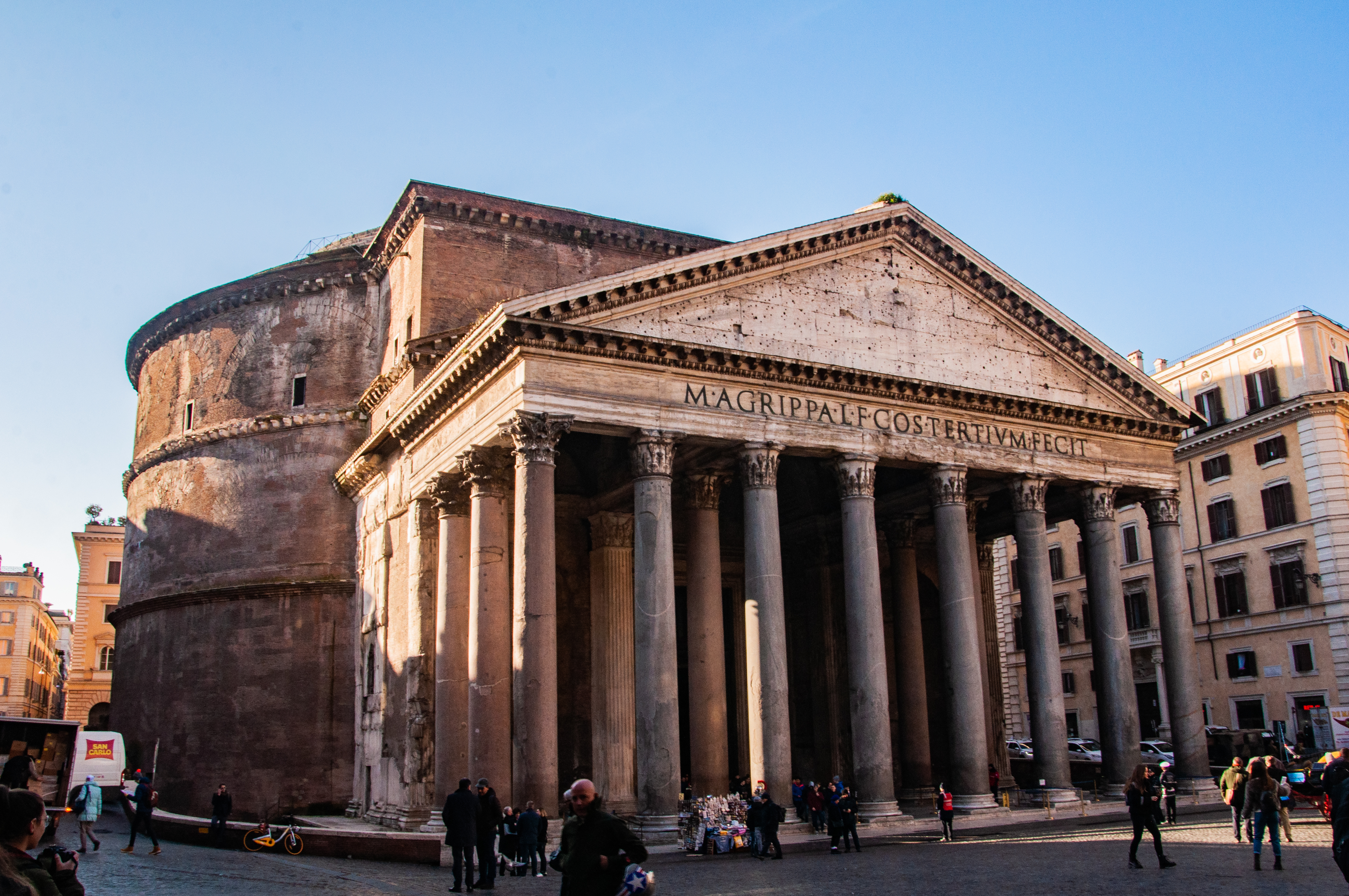
Pantheon means "all gods." This structure was originally constructed in honor of the Roman god or gods. The Romans adopted many Greek gods as a result of contact with their culture. There were multiple Greek colonies on and near the Italian peninsula, and in 146 BCE, the Romans conquered the Greeks at the battle of Corinth. The Romans often incorporated the religious practices of the regions they conquered into their own culture. The Pantheon represented on one level an attempt to centralize the worship of many deities spread throughout the empire. Today it is a Catholic church.
EXAMPLE
The Roman god Jupiter is equivalent to the Greek god Zeus, and the Roman god Mars is equivalent to the Greek god Ares.The design of the Pantheon is an interesting combination that includes:
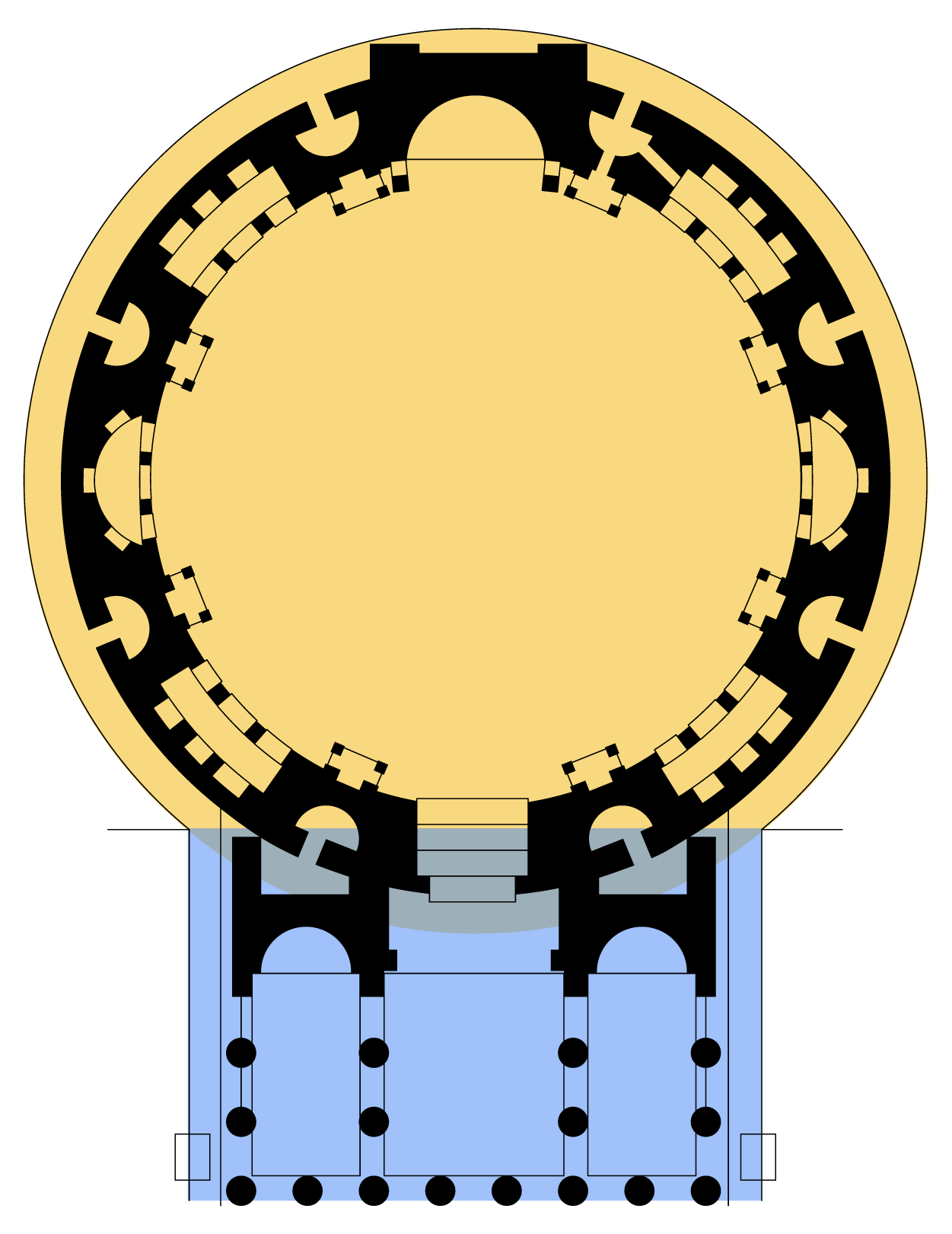
While the combination of these elements might seem like quite an architectural and design feat, these designs complement each other well. The rotunda allows the building to open skywards, while the Greek-style temple provides an aesthetically pleasing front view. In fact, from the front of the temple, the dome isn’t even visible.
Here is view of the Pantheon where you can clearly see the two architectural styles together as well as the use of the Corinthian-style columns.
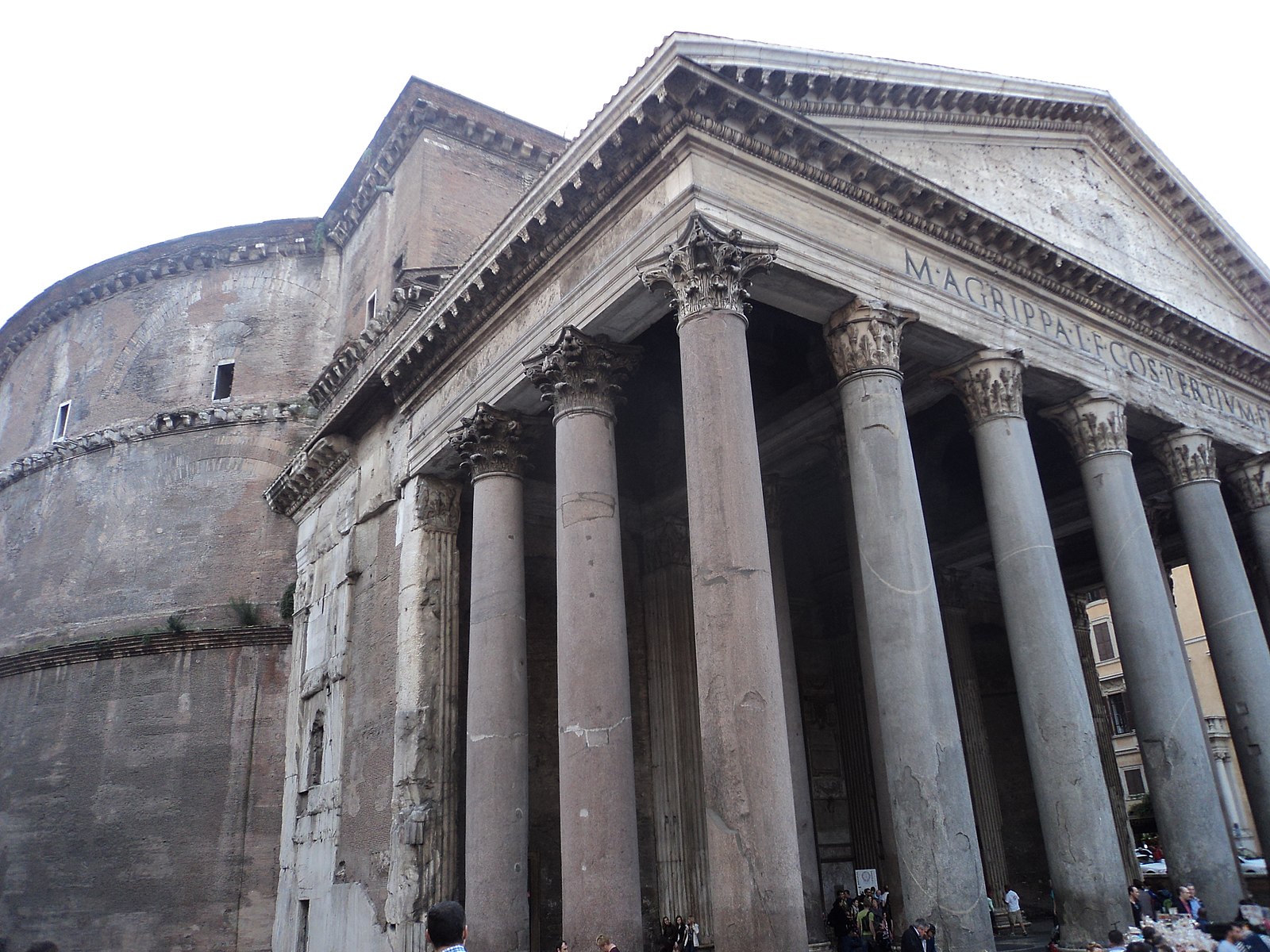
Corinthian-style columns, the most ornate type of column, are used on the exterior and interior of the building. Notice that these columns are not fluted. The Greeks often fluted their columns to hide the fact that they were made out of drums, and since these columns are made out of concrete, they didn't need any fluting; they could just be smooth.
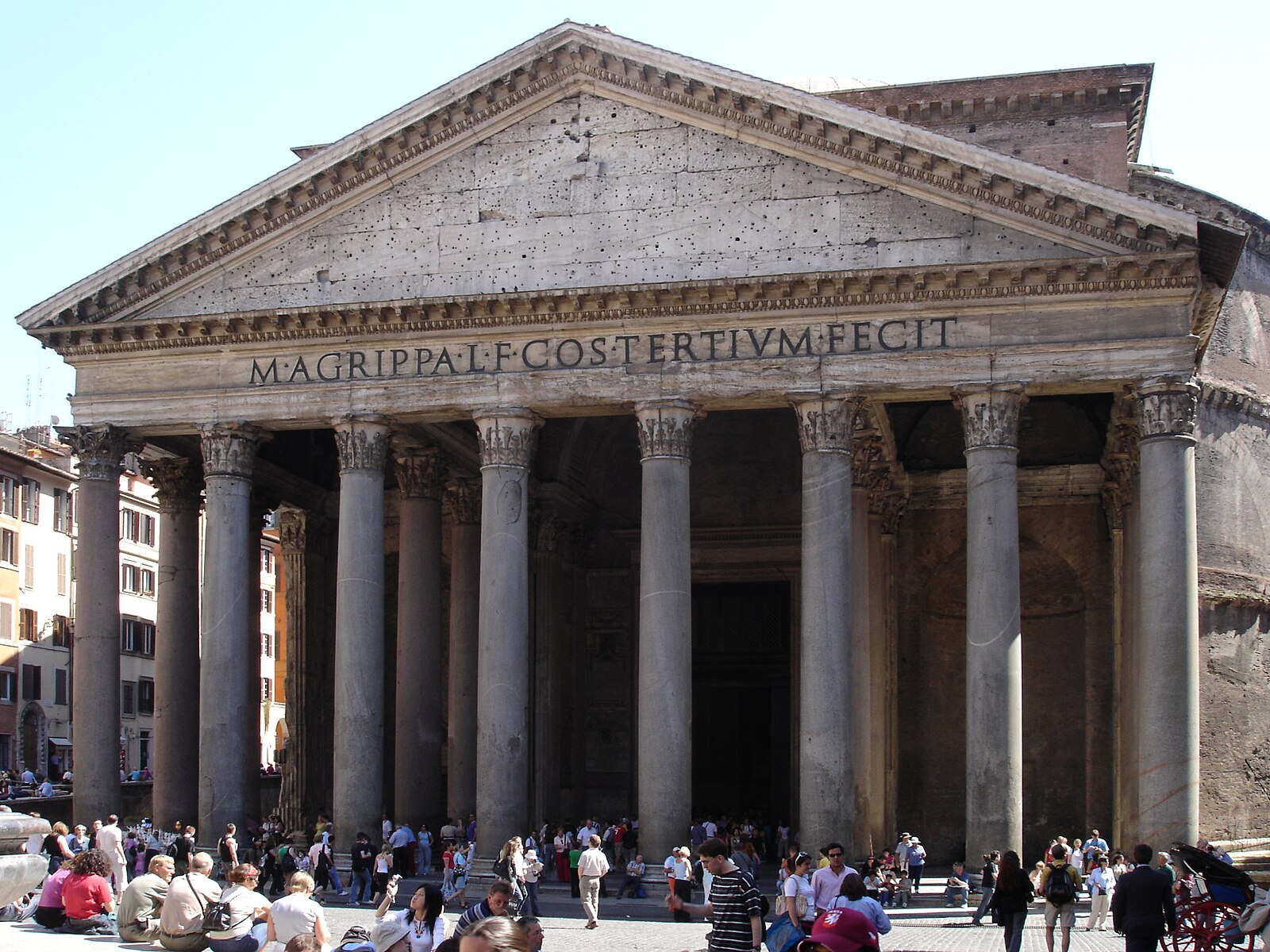
Over the front entrance is an inscription dedicated by the emperor Hadrian to Marcus Agrippa, who was the man responsible for the construction of another Roman temple, the Maison Carrée in present-day France.
Here is a view of the front entrance of the Pantheon that shows the inscription.
The interior of the Pantheon used Corinthian columns, and there are also alcoves, or niches, embedded within the circular walls of the rotunda. Originally, each would have held a separate sculpture and functioned as a shrine dedicated to an individual deity. Eventually, after the fall of Rome and the rise of Christianity, the Pantheon, like many classical temples, was converted into a Christian church.
Here is a view of the interior of the Pantheon.
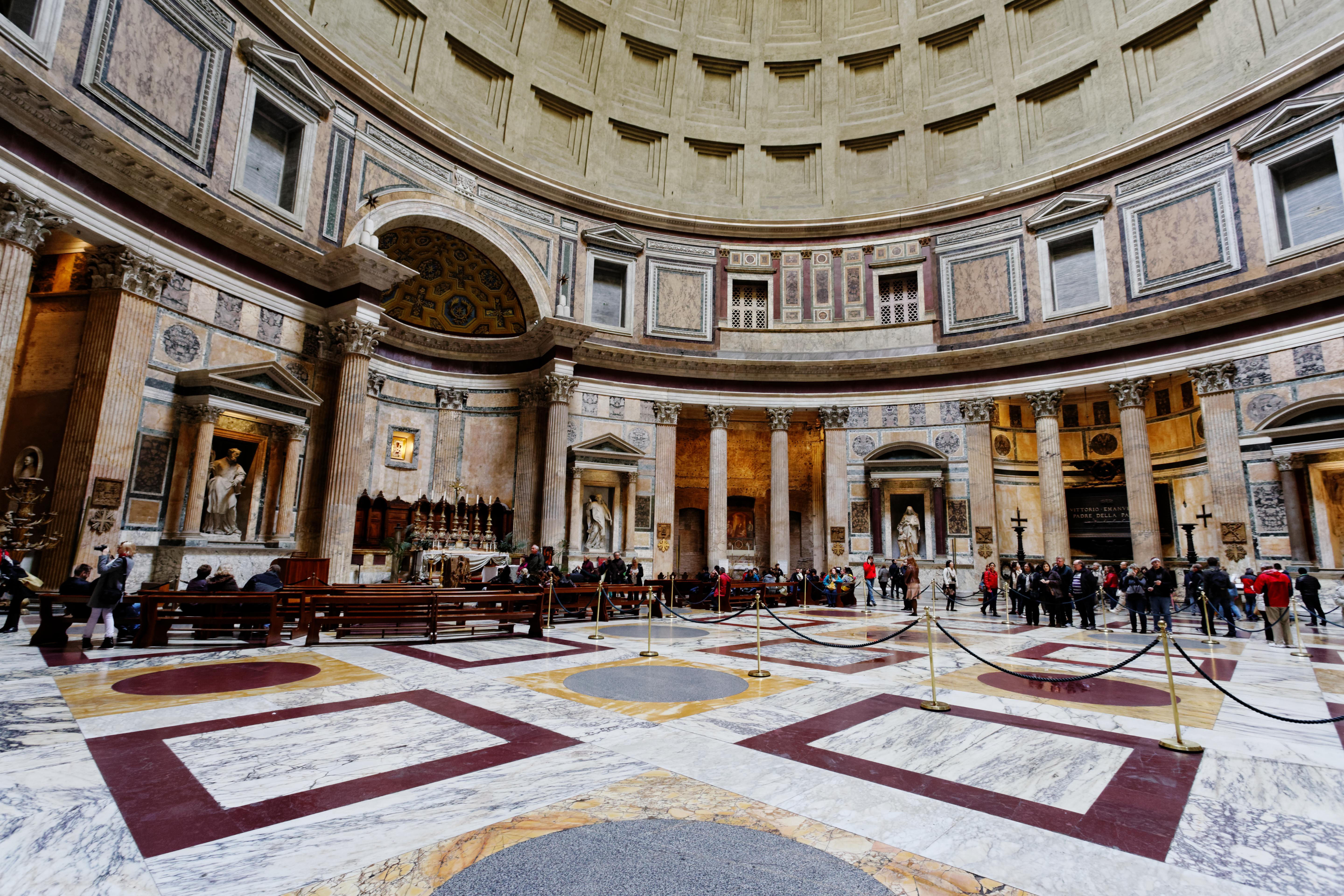
The dome, however, is the most impressive and technologically innovative element of the Pantheon. Its construction would not have been possible without concrete.
If you can imagine taking a rounded arch and spinning it around its vertical axis, you would end up with a dome. It’s a self-supporting structure, but depending on the materials used, a substantial amount of weight can be created. A dome the size of the Pantheon’s made from cut stone would not have been possible. The lower layers of the Pantheon’s dome were made with harder, denser stone near the bottom, with additional layers using progressively lighter stone. The dome was also thicker at the bottom and got thinner towards the top. The topmost layer was made of concrete using pumice, a lightweight volcanic stone. These innovations made the Pantheon the first dome in human history and the largest dome ever made of unreinforced concrete.
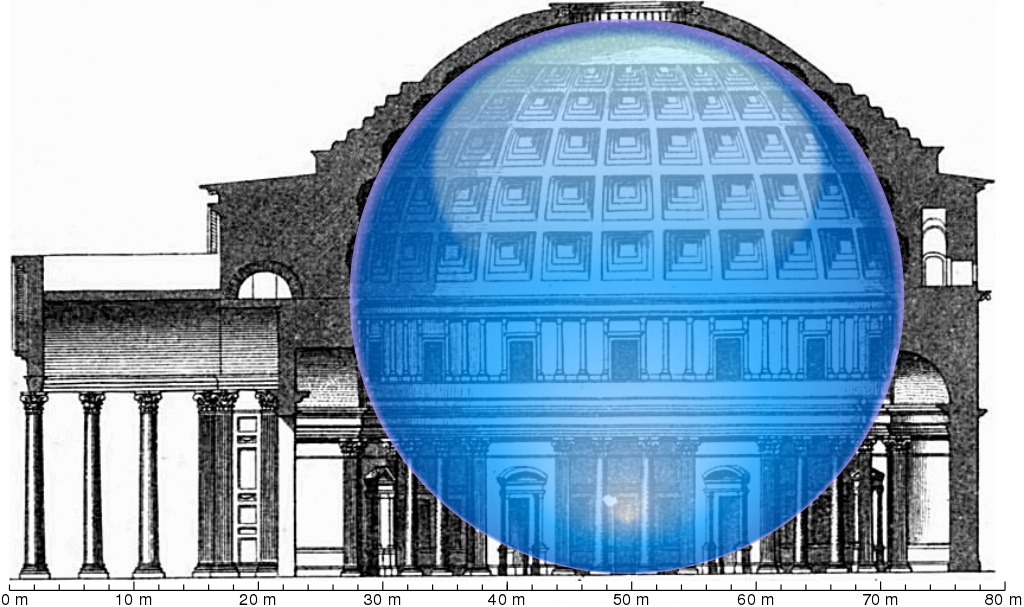
One of the main concepts behind the Pantheon’s design was that a sphere could fit inside its interior space. This sphere is 43.3 meters in diameter. The dome would be the orb of the heavens, and the interior space represented the orb of the earth.
Here is a diagram showing how a sphere could fit inside the Pantheon. This image also shows how the thickness of the dome diminishes near the top.
The rectangular pattern or recesses that you see in the painting below are called coffers. They would have originally been painted blue to imitate the sky, which is really the whole point of having the dome. It also helped to create a sense of openness and depth in the ceiling. The center hole, or oculus, would have illuminated the interior of the Pantheon, blending with the sky motif of the ceiling, and provided a recognizable symbolism of the eye of Jupiter, the Roman equivalent of Zeus. The coffers and the oculus have a practical function, in addition to their aesthetic function. They make the interior space of the dome look aesthetically pleasing, but they also lighten the weight of the dome by reducing its volume. Rosettes would have originally been located inside the coffers and were shaped like stars and gilded bronze, and so that would have given this sense of looking at the dome of the heavens.
The image below is an 18th-century painting by the artist Giovanni Panini, which provides a nice view of the interior design of the dome.
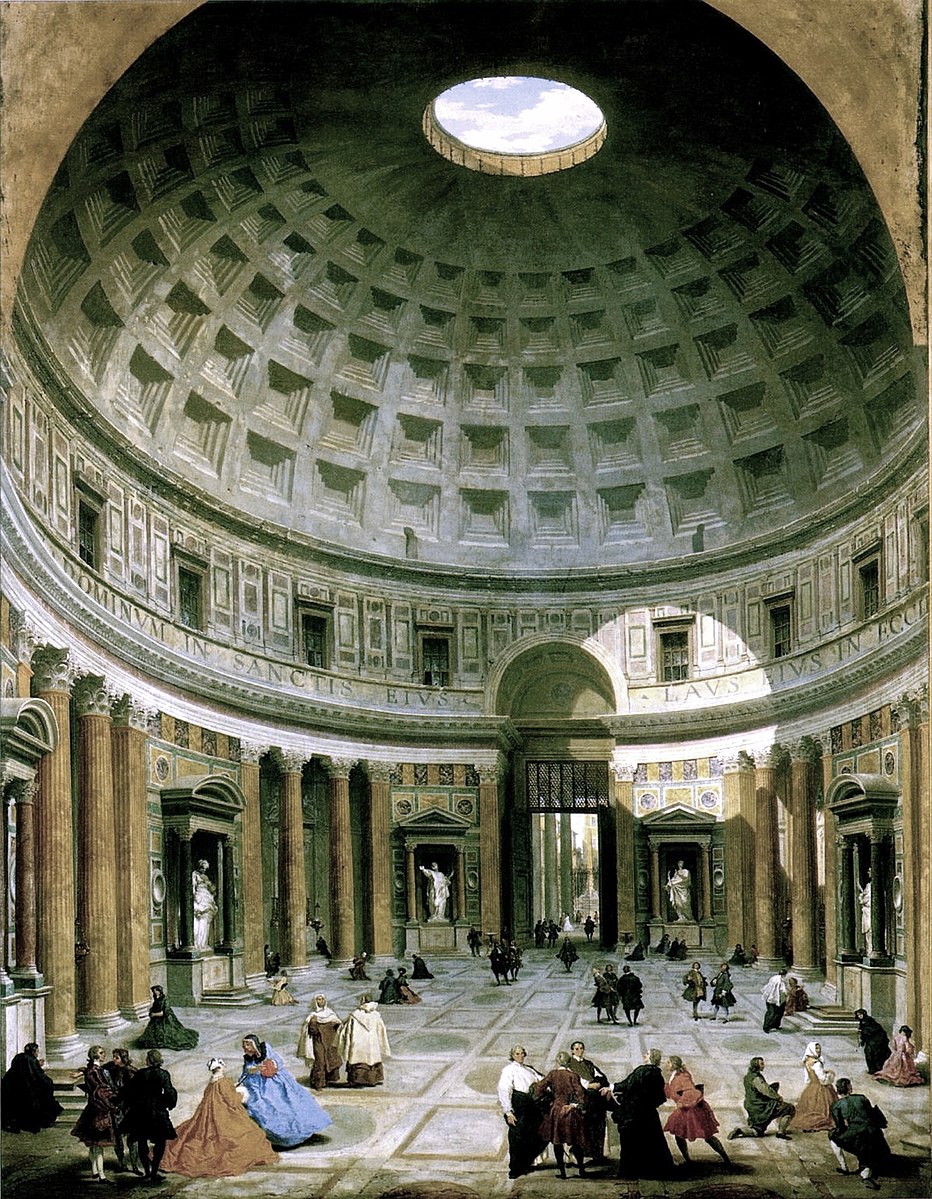
Interior of the Pantheon
Washington, D.C.
c. 1734
Oil on canvas
If you look closely, you can see a series of ridges or a series of solid circular rings that gradually creep inwards. These supported the weight of the dome and channeled it down through the exterior walls.
Source: THIS TUTORIAL WAS AUTHORED BY IAN MCCONNELL FOR SOPHIA LEARNING. PLEASE SEE OUR TERMS OF USE.



