Table of Contents |
You walk into your house after a long day of work. As soon as you open the door, you feel a blast of heat through the open door. You wonder: “What is wrong?” Immediately, your brain starts thinking of scenarios. Did you forget to program the air conditioner to come on before you got home? Is your air conditioner broken? Is your power out? Is there a fire?
What you have just done is an example of the scientific method (which you will learn more about later in this lesson and in the following tutorial). You observed something, and then, you asked a bunch of questions. Now, what are you going to do? Check the power? Check the air conditioner? Check your smoke alarms? Look for signs of a fire? All of this is part of that scientific method. This is the process that scientists use to understand the natural world.
Before we can understand the scientific method, we need to understand science and how scientists think or approach a problem. Science is a process that humans use to understand their surroundings and how they work through testable experiments, which are tests set up to explain a phenomenon. It is a way of knowing how the natural world and our universe work. Science tries to do this by testing and explaining physical laws about the way the universe works.
Critical thinking is the process of rationally and skeptically evaluating facts without any biases to make a judgment on those facts. Critical thinking is a crucial skill for all people, not just scientists. A person is critically thinking when they analyze a source of information, assess its validity, and improve their own understanding of the topic in the process. Critical thinkers are skeptical, and open-minded and will change positions when evidence and reason lead them to do so.
A dogma is a principle or set of principles set by an authority that is considered true with certainty and without question. Dogmatism can be problematic when individuals ignore evidence that does not support their beliefs or values. This can result in confirmatory bias, in which individuals ignore evidence that goes against their beliefs and favor information that confirms or supports their beliefs.
Although skepticism might have a bad connotation in day-to-day conversation, it does not have that same connotation in the sciences. To be skeptical is to not accept facts as they are presented but to have doubts or reservations until the facts can be verified. It does not mean you think a person is a liar or that they are trying to fool or trick you. It just means that you should always question facts that are presented to you without proof of their veracity until you can verify those facts.
When you're evaluating information and trying to figure out if that information is credible, you need to look at a few key points. Credible information should always be:
Information that is based on observation or experience rather than theory or pure logic is called empirical evidence. There is no single route to answering a question or explaining an observation, but there is an aspect common to every approach—each uses knowledge based on experiments that can be reproduced to verify the results. Some routes involve a hypothesis, a tentative explanation of observations that acts as a guide for gathering and checking information.
The laws of science summarize a vast number of experimental observations and describe or predict some facet of the natural world. Scientific theories are well-substantiated, comprehensive, testable explanations of particular aspects of nature. Theories are accepted because they provide satisfactory explanations, but they can be modified if new data becomes available.
A scientific hypothesis is testable. Testable means that you can construct a method to determine whether the hypothesis is supported. A testable hypothesis must be measured against natural laws. For example, if I proposed that the lab is cold because a witch put a spell on the air conditioner unit, that would not be testable. I could not test whether a spell is on the unit.
A scientific hypothesis is also falsifiable. Falsifiable refers to the ability of a hypothesis to be disproven. Falsifiable is often described as having a true or false outcome. However, in reality, not all hypothesis test results in absolute truth; most of the time, the hypothesis is either supported or not supported (falsified).
The path of discovery that leads from question and observation to law or hypothesis to theory, combined with experimental verification of the hypothesis and any necessary modification of the theory, is called the scientific method. The scientific method is a set of guidelines, created by Sir Francis Bacon in 1580, that scientists use to help explain a phenomenon and arrive at reliable results.
The image below shows a schematic of the scientific method and how this process informs theories and laws:
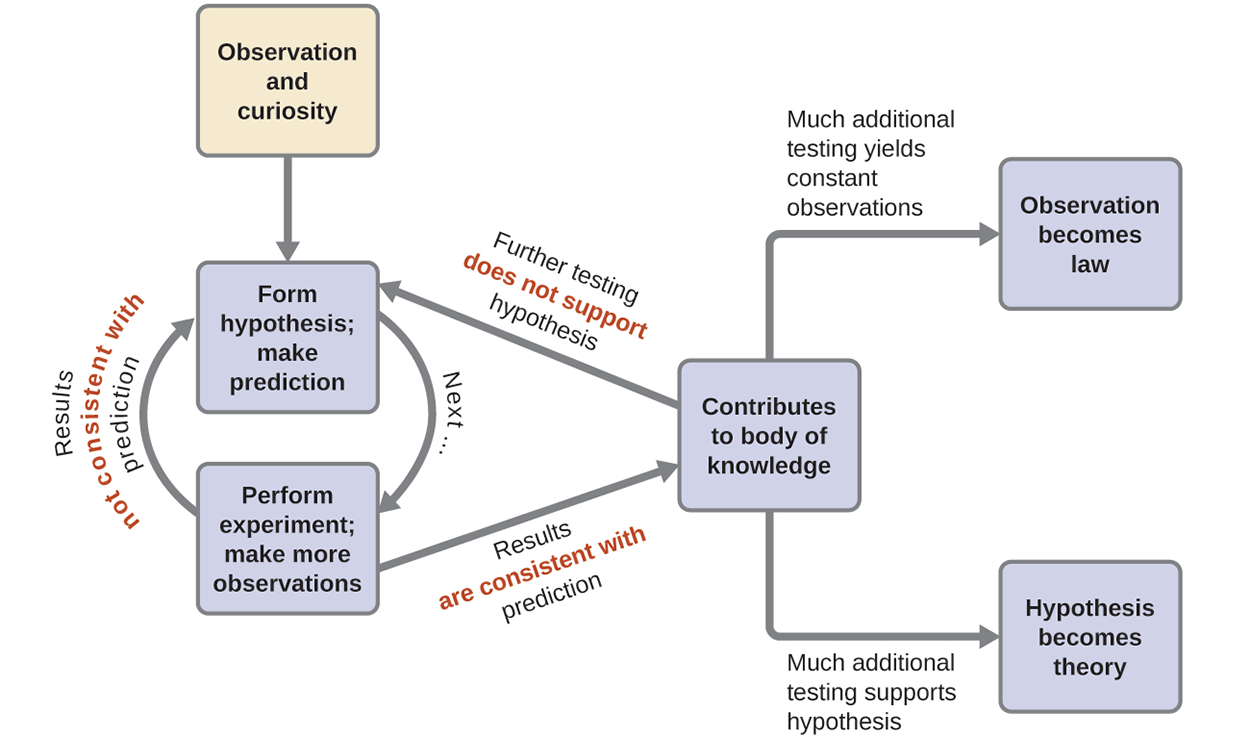
Scientific theories often use the scientific method to explain a phenomenon, but experiments need to be tested many times, and under many conditions, and get the same results. Repeating experiments over and over and getting the same results every time means that you know that when you call something a scientific theory, you believe it to be true because it has been tested so many times.
EXAMPLE
An example of a scientific theory is the theory of natural selection. Darwin came up with this theory after he tested his research over and over and over again, on many different organisms, so many times that he could actually believe it to be true.It is easy to confuse a hypothesis and a theory. Although they are both related to the scientific method, they are very different things. Recall that a hypothesis is a tentative explanation of observations that acts as a guide for gathering and checking information. Scientific theories are widely accepted explanations of natural phenomena that have been extensively tested.
A hypothesis can be thought of as a potential theory. When you are writing an essay for an English class, you should start with a thesis statement. However, you do not have an essay just because you have a thesis statement. You need to defend your thesis statement with research on the topic. Once you have done your research, then you write your essay. So, a thesis statement is like a potential essay just as a hypothesis is like a potential theory.
When people say they have a theory about something, they almost always mean they have a hypothesis about something. To the everyday person, a theory is a thought they have that has not been proven. To a scientist, a theory has been proven at the highest level possible using scientific research. A theory is as strong a proof of something as any law of nature.
As with hypotheses and theories, it is also easy to confuse law and theory. Physical laws are things that apply universally in nature. They are fixed and do not change. A law summarizes a vast number of experimental observations and describes or predicts some facet of the natural world. Scientific theories are widely accepted, well-tested explanations of natural phenomena. Scientific theories can be adjusted or changed if new facts or explanations are discovered.
This does not mean a law is more important or more proven than a theory. Theories and laws are both the highest level of proof in the scientific world, they just relate to different things. A law is the description (often mathematical) of an observation. A law does not explain why something happens or what caused it to happen. A theory is an explanation of observation and explains what happens and what causes it to happen.



