Table of Contents |
In the broadest definition, leadership is a situation where one person influences one or more other people in pursuit of the same goals. However, there are different ways to view this influence. Some consider leadership as a behavior, such as initiating structure so group members know how to complete a task. Others consider leadership to be a personality trait, qualities of persuasion and charisma, and the skill of winning compliance. Still others see leadership as a relationship. In this view, a good leader develops a vision for the group, communicates that vision, and orchestrates the group’s energy and activity toward achieving a goal. In this view, a leader has cultivated a relationship where followers entrust their energy and commitment. In any view of leadership, effective leaders help individuals and groups achieve their goals.
Although they are often conflated, leaders and managers have different roles. Leaders focus on vision and energizing their group. Managers focus on the group’s maintenance needs (the needs for individuals to fit and work together by having shared norms) and task needs (the needs for the group to make progress toward attaining the goal that brought them together).
Effective leadership often necessitates the ability to manage: to set goals; plan, devise, and implement strategy; make decisions and solve problems; and organize and control. Similarly, effective managers may need to be good leaders, providing motivation and vision to their staff. However, managerial skills and leadership skills are not interchangeable. An effective leader may have no official managerial role, and a manager may be effective without being influential or inspiring. In fact, such a manager may be preferred in some roles.
EXAMPLE
In the film industry, a director is a leader in every sense of the word: communicating a creative vision and inspiring the best performances from their creative crew. However, the production manager is responsible for the many operations in a film, such as scoping out film locations, securing permits, hiring a technical crew, and so forth. For the production to be successful, the director (or leader) and production manager will each have distinct and complementary roles.Managers and leaders can be further differentiated in terms of the processes through which they come to their position. Managers are generally appointed to their role. By contrast, a leader relies on the followers’ acceptance of their leadership role. Succinctly put, a manager is hired, but leadership must be earned by winning the trust and confidence of the group.
Furthermore, managers and leaders often differ in terms of the types and sources of power they exercise. Managers derive their power from the organization. The organizational structure determines who they supervise and how much authority they have, as well as the rewards and punishments they can deliver. Leaders derive their power from followers’ perceptions, whether it is respect for their knowledge and expertise, influence from their personality and charisma, or the relationship that has evolved over time. From the perspective of those who are under the leader’s or manager’s influence, the motivation to comply is different. People follow the demands of a manager because the manager can promote them or punish them, assign them to attractive tasks or drudgery. The followers of a leader comply because they want to. Simply put, managers use extrinsic motivators, and leaders use intrinsic motivators. Grace Hopper, retired U.S. Navy admiral and computer pioneer, put it succinctly (Russell, 2017).
However, it is important to remember that while leadership and management are different concepts, they are not mutually exclusive. Managers often succeed or fail because of their ability or inability to lead.
EXAMPLE
Jestina is an effective manager for Quenchbliss, conscientiously tending to duties like balancing a budget and staffing a distribution center, but she is also a leader because people trust her and follow her vision. In essence, a good manager is also a good leader, but not all leaders are good managers.EXAMPLE
Suppose people follow a different manager at Quenchbliss because of his personality, but he does not help to keep people complete their tasks or manage the budget effectively. In this case, he is a good leader but not a good manager. Effective leadership often calls for the ability to manage, too.As mentioned, one view of leadership is a relationship built over time between a leader and a group of followers who depend on each other to attain a mutually desired goal. One model for considering this process is the Leadership Process Model, proposed by Jon Pierce and Randall Dunham and later revised by Pierce and John Newstrom. They propose a four-part model; each component interacts with and influences the other components, and whatever consequences are created influence future interactions. As any of the components change, so does the leadership.
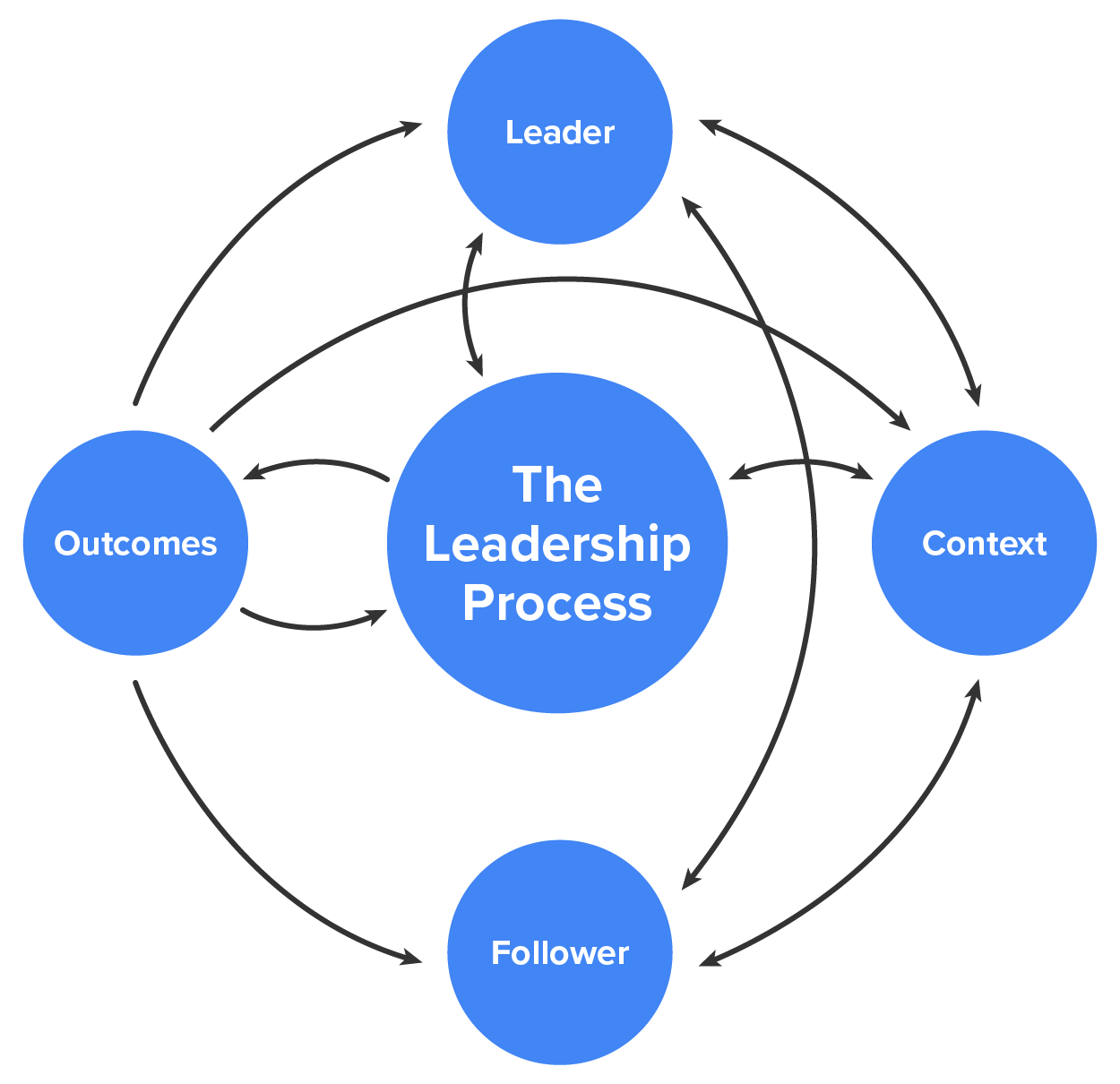
Leaders are those who take charge of or guide the activities of others. They are often seen as the focus or orchestrater of group activity, the people who set the tone of the group so that it can move forward to attain its goals. While managers usually also take on the task-related needs of the group, they may appoint someone else to do so. Either way, they make sure that the needs are met. The leader is the ultimate person responsible and accountable for what happens under their charge.
The follower is not a passive player in the leadership process. Edwin Hollander, after many years of studying leadership, suggested that the follower is the most critical factor to any leadership. It is, after all, the follower who either rejects or accepts leadership, and their willingness to do so depends on their own goals and needs. Thus, the leader is equally influenced by the followers.
The follower’s personality and readiness to follow also determines the style of leadership that will be most effective. For example, individuals with an internal locus of control are much more responsive to participative styles of leadership than individuals with an external locus of control. Individuals with an authoritarian personality are highly receptive to directive acts of leadership. It is the followers’ expectations, as well as their performance-based needs, that determine what a leader must do in order to be effective.
The strength of the follower’s self-concept has also been linked to the leadership relationship. High-self-esteem individuals tend to have a strong sense of self-efficacy, that is, a generalized belief they can be successful in difficult situations. They therefore tend to be strongly motivated to perform and persist in the face of adversity. The high-self-esteem follower tends to be responsive to participative styles of leadership. Low-self-esteem individuals, who doubt their competence and worthiness and their ability to succeed in difficult situations, function better with supportive forms of leadership. This helps them deal with the stress, frustration, and anxiety that often emerge with difficult tasks. Followers without a readiness to follow, limited by their inability to perform and lack of motivation and commitment, usually need more directive forms of leadership.
Follower behavior plays a major role in determining what behaviors leaders engage in. For example, followers who perform at high levels tend to cause their leaders to be considerate in their treatment and to play a less directive role. Followers who are poor performers, on the other hand, tend to cause their leaders to be more directive and controlling in their leadership style.
Context refers to the situation that surrounds the leader and the followers. Some of the variables that might influence the leadership process are:
A number of outcomes or consequences of the leadership process unfold between leader, follower, and context. In the starkest terms, outcomes are the “bottom line,” such as revenue generated, products developed, or people served. This is usually how leaders are evaluated. A politician needs more votes than their opponents. A CEO needs to show improved profits. A school principal needs to show improved educational outcomes, such as scores on standardized tests. Because of this, it is often where most of a leader’s attention and energy is spent. However, to focus entirely on outcomes means not giving the attention to followers and context that is needed to achieve those outcomes. A leader who tries to turn a profit at the cost of goodwill from staff, or by creating an unpleasant working environment, will likely not achieve the outcomes anyway.
Many organizations are moving past the “bottom line” to look at factors such as low turnover and high employee retention, which reflects the dynamic between leadership and members of the organization, and the organizational context, like employee trust in leaders and perceptions of ethical conduct. As the model shows, these are all interrelated. Attention to strong relationships with staff and to the context for those relationships are also signs of good leadership; they contribute to quality outcomes.
IN CONTEXT: QUENCHBLISS
Let’s look at this model using Jestina and her soda distribution team as an example.
In terms of the leader, Jestina as the leader has a lot of charisma, and people naturally follow her. She also has extensive knowledge of the industry, so people respect her. As a result, Jestina has built extensive trust with her team. Of course, these aspects influence and interact with each other in a positive way. But what if Jestina was not well-liked or respected? In this case, we’d see issues in the model in terms of followers, outcomes, and context.
In terms of followers, suppose the followers all have a strong sense of self-efficacy and are all very motivated. This has a positive impact on the other three areas of the model in terms of how they view Jestina as the leader, the context, and the outcomes, because they are more likely to work toward common goals because they are motivated. Suppose the reverse were true, and Jestina had a team made up of low-self-esteem individuals rather than individuals with self-efficacy. This doesn’t mean the team won’t succeed, but it would mean Jestina would need to spend more time supporting the team.
Jestina has set very clear goals for her team, and there is a clear understanding of what roles in the organization contribute to success. Because of the clearness of this, the context of the leadership process is clear, which will likely lead to positive outcomes. If Jestina didn’t have clear goals set, or if the team disagreed about the goals, this aspect would be missing from the leadership process, making the team less effective.
Outcomes, as mentioned earlier, are often the “bottom line,” but suppose Jestina focuses also on lowering turnover, relationship building, and employee development, along with the bottom line. This, combined with leader, follower, and context, make it a productive work environment. If Jestina, however, only focused on the bottom line and not on her people, this element would be missing, which could create diminished productivity.
Source: THIS TUTORIAL HAS BEEN ADAPTED FROM OPENSTAX "ORGANIZATIONAL BEHAVIOR". ACCESS FOR FREE AT OPENSTAX.ORG/BOOKS/ORGANIZATIONAL-BEHAVIOR/PAGES/1-INTRODUCTION. LICENSE: CREATIVE COMMONS ATTRIBUTION 4.0 INTERNATIONAL.



