Use Sophia to knock out your gen-ed requirements quickly and affordably. Learn more
×

The Mean Value Theorem for Integrals

Author: Sophia

what's covered
In this lesson, you will connect the mean value theorem to integrals. Specifically, this lesson will cover:

Table of Contents

1. The Mean Value Theorem for Integrals

Similar to the mean value theorem for derivatives, we can establish a theorem for integrals. If f open parentheses x close parentheses is continuous on open square brackets a comma space b close square brackets comma then at some point c in open square brackets a comma space b close square brackets colon

f open parentheses c close parentheses equals fraction numerator 1 over denominator b minus a end fraction integral subscript a superscript b f open parentheses x close parentheses d x

In other words, there is at least one value of c in the interval open square brackets a comma space b close square brackets such that f open parentheses c close parentheses equals the average value of f open parentheses x close parentheses on open square brackets a comma space b close square brackets.

term to know
The Mean Value Theorem for Integrals
If f open parentheses x close parentheses is continuous on open square brackets a comma space b close square brackets comma then at some point c in open square brackets a comma space b close square brackets colon
f open parentheses c close parentheses equals fraction numerator 1 over denominator b minus a end fraction integral subscript a superscript b f open parentheses x close parentheses d x


2. Finding the Value of c Guaranteed by the Mean Value Theorem for Integrals

Let’s look at a few examples to help illustrate the mean value theorem for integrals.

EXAMPLE

Consider the function f open parentheses x close parentheses equals x squared on the interval open square brackets 0 comma space 3 close square brackets.

The average value of f open parentheses x close parentheses on open square brackets 0 comma space 3 close square brackets is 1 third integral subscript 0 superscript 3 x squared d x. Evaluating, we have:

1 third integral subscript 0 superscript 3 x squared d x equals 1 third times open 1 third x cubed close vertical bar subscript 0 superscript 3 equals 1 over 9 open parentheses 3 close parentheses cubed minus fraction numerator begin display style 1 end style over denominator begin display style 9 end style end fraction open parentheses 0 close parentheses cubed equals 3

To find the value of c, set f open parentheses c close parentheses equals 3. This means c squared equals 3 comma which means c equals plus-or-minus square root of 3. Since short dash square root of 3 is not in the interval open square brackets 0 comma space 3 close square brackets, the value of c guaranteed by the theorem is c equals square root of 3.

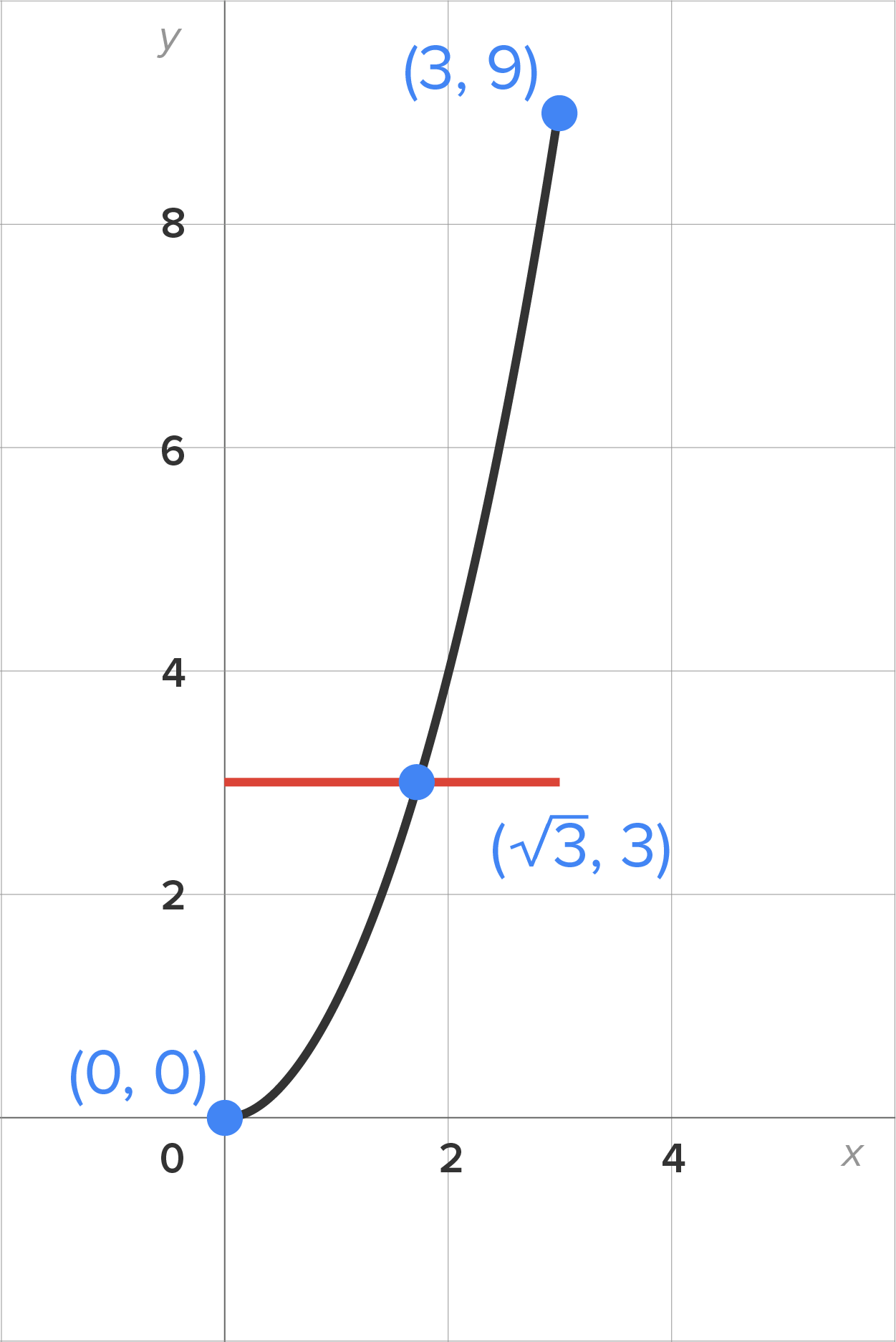
Here is the graph of f open parentheses x close parentheses equals x squared on the interval open square brackets 0 comma space 3 close square brackets along with the line y equals 3 (the average value). Note that they intersect at the point open parentheses square root of 3 comma space 3 close parentheses.

A graph with an x-axis ranging from 0 to 4 and a y-axis ranging from 0 to 8 at intervals of 2. A curve opens upward, starts from the marked point at (0, 0), and extends upward in the first quadrant up to the marked point at (3, 9) by passing through the marked point at (√3, 3). A horizontal line starts from the point (0, 3) on the y-axis and extends up to the point (3, 3) by passing through the marked point (√3, 3) on the curve

watch
Check out this video to see the example to find the average value and the value of c guaranteed by the mean value theorem for f open parentheses x close parentheses equals 2 x squared minus x on open square brackets short dash 1 comma space 3 close square brackets.

try it
Consider the function f open parentheses x close parentheses equals 16 over x cubed.
Find the average value of f  (x  ) on the interval [1, 2].
The average value is found by calculating fraction numerator 1 over denominator 2 minus 1 end fraction integral subscript 1 superscript 2 16 over x cubed d x equals integral subscript 1 superscript 2 16 over x cubed d x.

Now, evaluate the integral:

equals integral 16 x to the power of short dash 3 end exponent d x Rewrite in terms of negative exponents so the power rule can be used.
open equals short dash 8 x to the power of short dash 2 end exponent close vertical bar subscript 1 superscript 2 Find the antiderivative:
integral 16 x to the power of short dash 3 end exponent d x equals 16 open parentheses fraction numerator 1 over denominator short dash 2 end fraction close parentheses x to the power of short dash 2 end exponent equals short dash 8 x to the power of short dash 2 end exponent
equals open parentheses short dash 8 open parentheses 2 close parentheses to the power of short dash 2 end exponent close parentheses minus open parentheses short dash 8 open parentheses 1 close parentheses to the power of short dash 2 end exponent close parentheses Substitute x equals 2 and x equals 1 comma then subtract.
equals short dash 8 open parentheses 1 fourth close parentheses plus 8 open parentheses 1 close parentheses Evaluate the exponential terms: 2 to the power of short dash 2 end exponent equals 1 fourth and 1 to the power of short dash 1 end exponent equals 1.
equals 6 Simplify.

Therefore, the average value of f open parentheses x close parentheses on open square brackets 1 comma space 2 close square brackets is equal to 6.
Find the value of c guaranteed by the mean value theorem for integrals.
Since the average value is 6, we seek the value of c so that f open parentheses c close parentheses equals 6.

This means we need to solve the equation 16 over c cubed equals 6.

16 equals 6 c cubed Multiply both sides by c cubed.
8 over 3 equals c cubed Divide both sides by 6, then reduce the fraction.
cube root of 8 over 3 end root equals c Apply the cube root to both sides.

The approximate value of c is 1.39, which is between x equals 1 and x equals 2. Therefore, this is the value of c that is guaranteed by the mean value theorem for integrals.

hint
Remember to check that each value of c is in the interval open square brackets a comma space b close square brackets.
  • Those that are in open square brackets a comma space b close square brackets are guaranteed by the mean value theorem for integrals.
  • Those that are not in the interval are not guaranteed by the theorem.

summary
In this lesson, you learned that through the mean value theorem for integrals, you are able to guarantee that there is some input value (c) of a function f open parentheses x close parentheses on open square brackets a comma space b close square brackets in which f open parentheses x close parentheses is equal to its average value on open square brackets a comma space b close square brackets. Next, you practiced finding the value of c guaranteed by the mean value theorem for integrals.

Source: THIS TUTORIAL HAS BEEN ADAPTED FROM CHAPTER 4 OF "CONTEMPORARY CALCULUS" BY DALE HOFFMAN. ACCESS FOR FREE AT WWW.CONTEMPORARYCALCULUS.COM. LICENSE: CREATIVE COMMONS ATTRIBUTION 3.0 UNITED STATES.

Terms to Know
The Mean Value Theorem for Integrals

If f open parentheses x close parentheses is continuous on open square brackets a comma space b close square brackets comma then at some point c in open square brackets a comma space b close square brackets colon

f open parentheses c close parentheses equals fraction numerator 1 over denominator b minus a end fraction integral subscript a superscript b f open parentheses x close parentheses d x