As you learned in a previous lesson, spermatogenesis occurs in the seminiferous tubules that form the bulk of each testis. The process begins at puberty, after which time sperm are produced constantly throughout a male's life.
did you know
One production cycle, from spermatogonia through formed sperm, takes approximately 64 days. A new cycle starts approximately every 16 days, although this timing is not synchronous across the seminiferous tubules. Sperm counts—the total number of sperm a person produces—slowly decline after age 35, and some studies suggest that smoking can lower sperm counts irrespective of age.
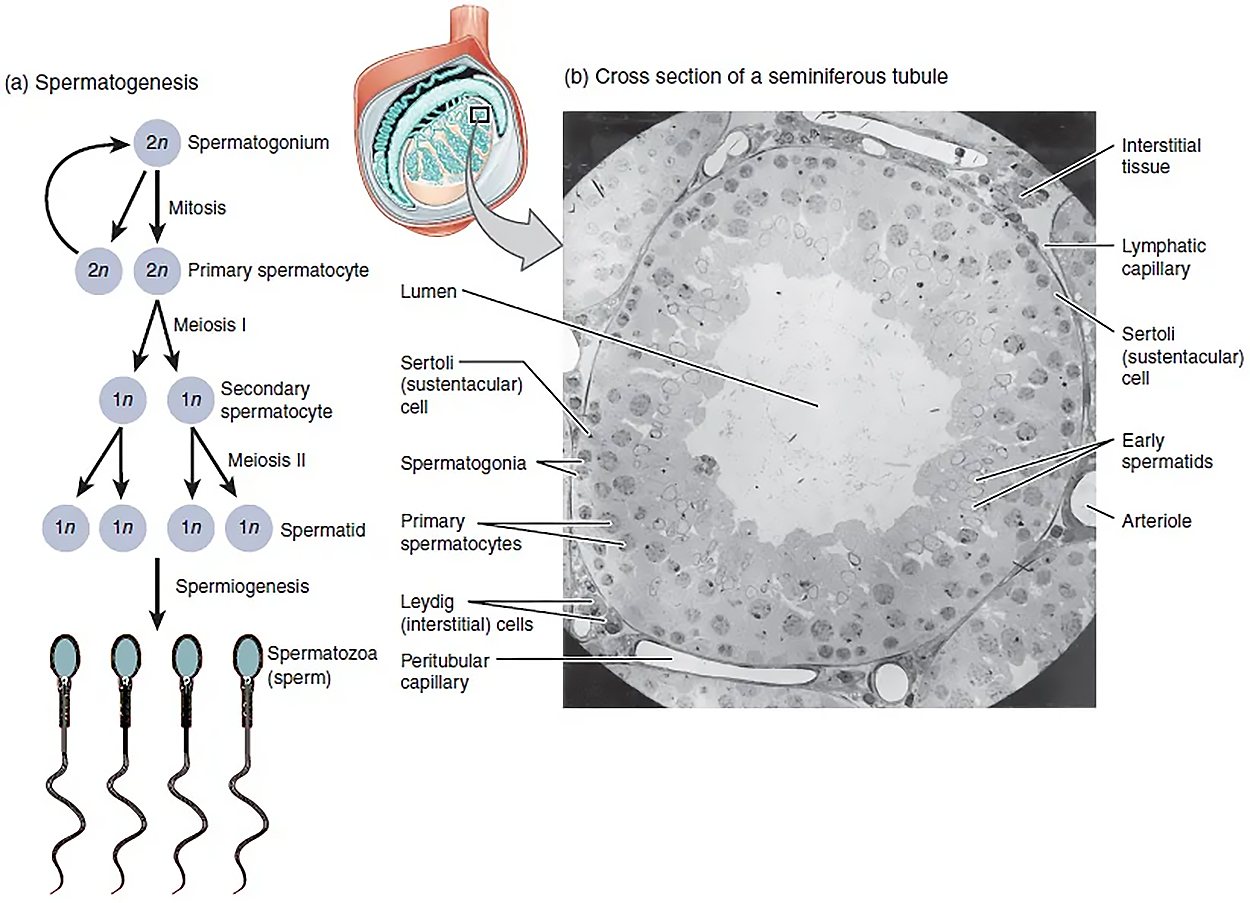
The process of spermatogenesis begins with mitosis (cell division that produces identical daughter cells) of the diploid spermatogonia. Because these cells are diploid (two sets of chromosomes; indicated as 2n), they each have a complete copy of the person's genetic material, or 46 chromosomes. However, mature gametes are haploid (one set of chromosomes; indicated as 1n), containing 23 chromosomes—meaning that daughter cells of spermatogonia must undergo a second cellular division through the process of meiosis (cell division resulting in four daughter cells, each with half the number of chromosomes of their parent cell).
key concept
Meiosis is the nuclear division that forms haploid cells from diploid cells, and it employs many of the same cellular mechanisms as mitosis. However, as you have learned, mitosis produces daughter cells whose nuclei are genetically identical to the original parent nucleus. Recall that, in mitosis, both the parent and the daughter nuclei are at the same “ploidy level”—diploid (two sets of chromosomes) in the case of most multicellular animals.
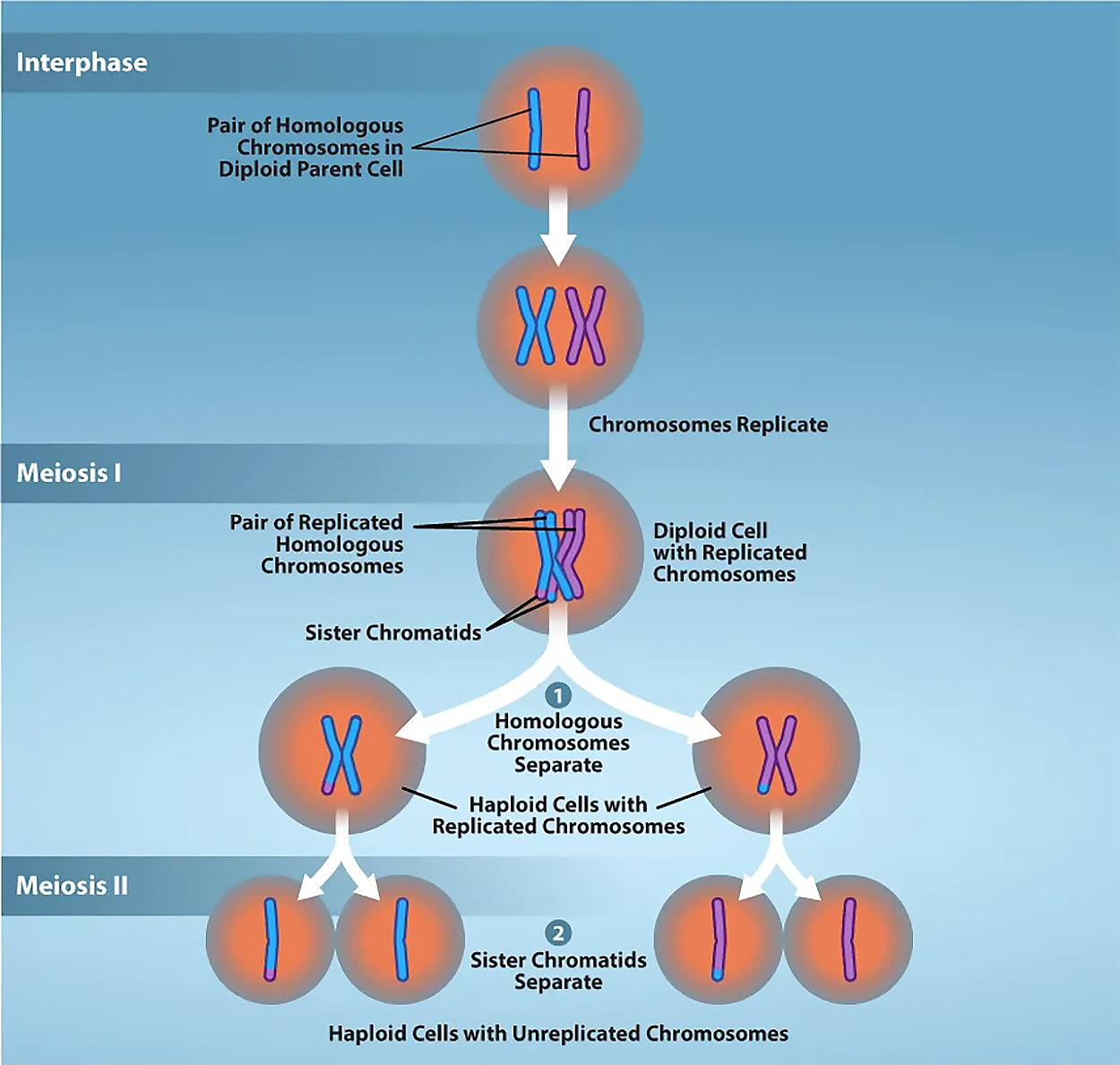
In meiosis, the starting nucleus is always diploid, and the daughter nuclei that result are haploid (one set of chromosomes). To achieve this reduction in chromosome number, meiosis consists of one round of chromosome replication followed by two rounds of nuclear division. Because many events that occur during each of the division stages are analogous to the events of mitosis, the same stage names are assigned. However, because there are two rounds of division, the major process and the stages are designated with a “I” or a “II.” Thus, meiosis I is the first round of meiotic division and consists of prophase I, prometaphase I, and so on. Likewise, meiosis II (during which the second round of meiotic division takes place) includes prophase II, prometaphase II, and so on. Overview of Meiosis - The production of gametes is a crucial process for sexually reproducing organisms. Meiosis is the mechanism used to reduce diploid cells to haploid gametes while introducing genetic diversity. Before meiosis, chromosomes are replicated in the S-phase to ensure a proper number of chromosomes in the resulting gametes. During meiosis, two successive rounds of division reduce the number of chromosomes (ploidy) of the cell by half, going from diploid cells to haploid gametes. Credit: Rao, A., Tag, A., Fletcher, S., and Ryan, K. Department of Biology, Texas A&M University.
Two identical diploid cells result from spermatogonia mitosis. One of these cells remains a spermatogonium, and the other becomes a primary spermatocyte, the next stage in the process of spermatogenesis. As in mitosis, DNA is replicated in a primary spermatocyte before it undergoes a cell division called meiosis I. During meiosis I, each of the 23 pairs of chromosomes separates. This results in two cells, called secondary spermatocytes, each with only half the number of chromosomes.
Now a second round of cell division (meiosis II) occurs in both of the secondary spermatocytes. During meiosis II, each of the 23 replicated chromosomes divides, similar to what happens during mitosis. Thus, meiosis results in separating the chromosome pairs. This second meiotic division results in a total of four cells with only half of the number of chromosomes. Each of these new cells is a spermatid. Although haploid, early spermatids look very similar to cells in the earlier stages of spermatogenesis, with a round shape, central nucleus, and a large amount of cytoplasm. A process called spermiogenesis transforms these early spermatids, reducing the cytoplasm and beginning the formation of the parts of a true sperm. The fifth stage of germ cell formation—spermatozoa (singular, spermatozoon), or formed sperm—is the result of this process, which occurs in the portion of the tubule nearest the lumen.
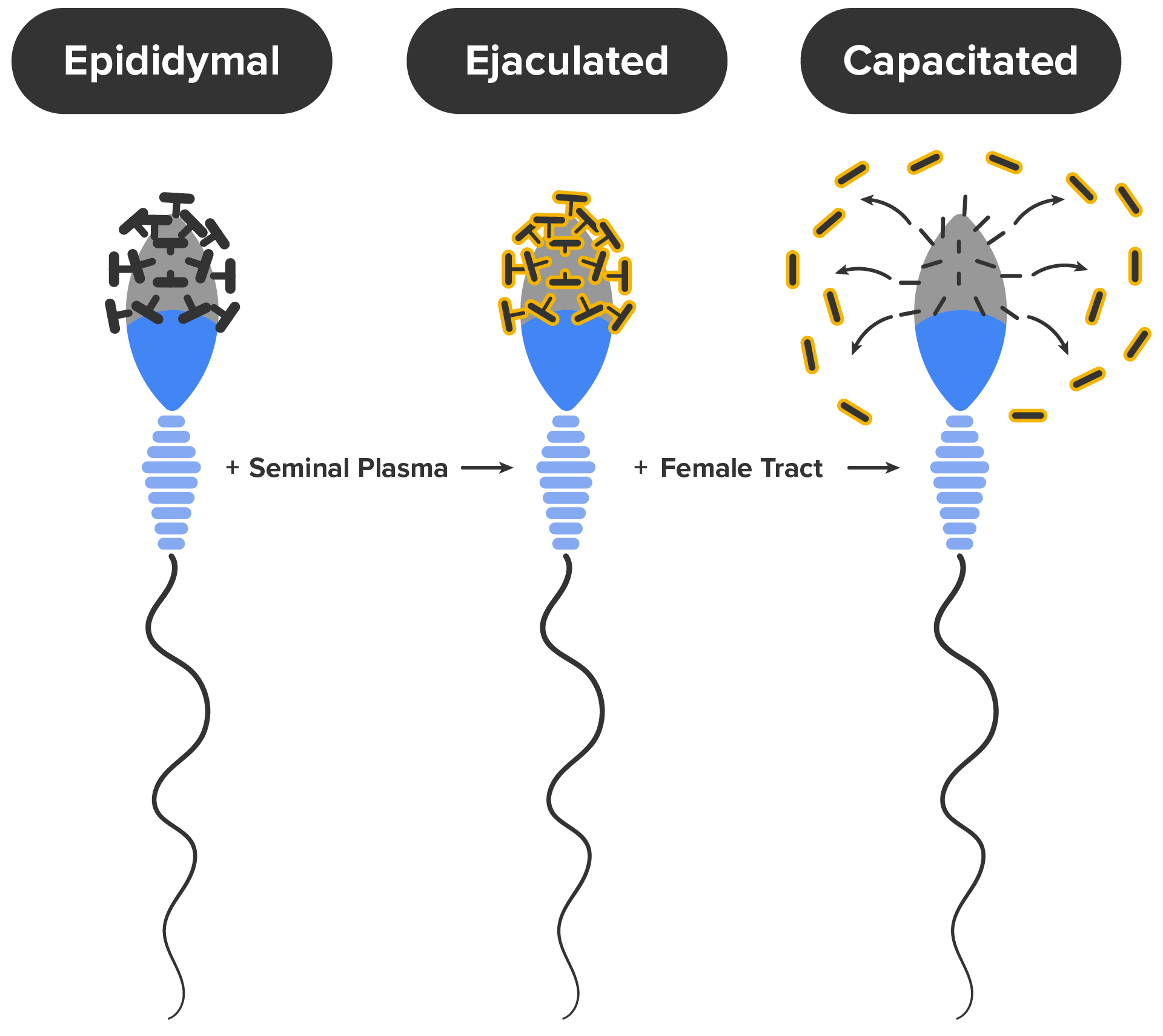
Eventually, the sperm are released into the lumen and are moved along a series of ducts in the testis toward the epididymis for the next step of sperm maturation, in which surface molecules (including proteins and carbohydrates) become coated with seminal plasma proteins. Seminal plasma is the fluid portion of semen that is secreted by both the epididymis and accessory glands.
Term Pronunciation Table
Term
Pronunciation
Audio File
Mitosis
mi·to·sis
Meiosis
mei·o·sis
Spermatocyte
sper·mato·cyte
Spermatid
sper·ma·tid
Spermiogenesis
sper·mio·gen·e·sis
Spermatozoa
sper·ma·to·zo·oa
terms to know
Mitosis
The part of the cell cycle during which the duplicated chromosomes are separated into identical nuclei.
Meiosis
Nuclear division that results in four haploid cells.
Spermatocyte
A cell that results from the division of spermatogonium and undergoes meiosis I and meiosis II to form spermatids.
Spermatid
Immature sperm cells produced by meiosis II of secondary spermatocytes.
Spermiogenesis
The transformation of spermatids to spermatozoa during spermatogenesis.
Spermatozoa
(singular, spermatozoon) Formed sperm.
2. Structure of Formed Sperm
key concept
Sperm are smaller than most cells in the body; in fact, the volume of a sperm cell is 85,000 times less than that of the female gamete. Approximately 100 to 300 million sperm are produced each day, whereas females typically ovulate only one oocyte (immature ovum) per month.
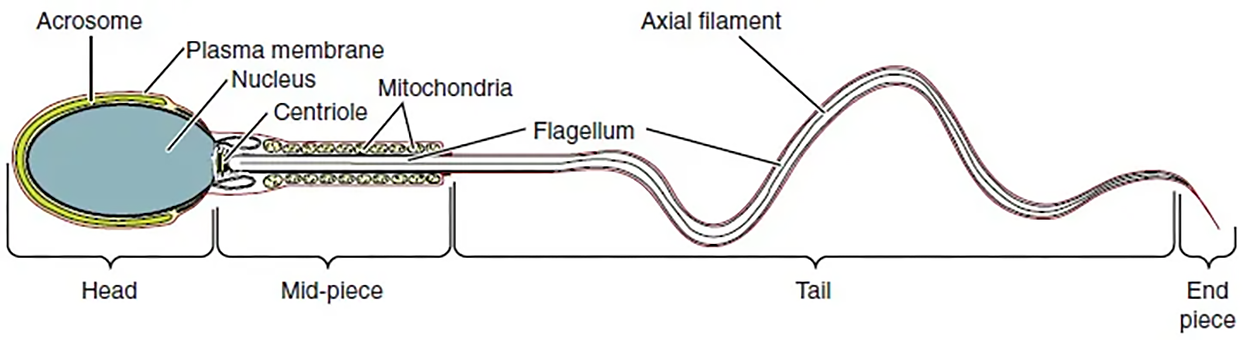
As is true for most cells in the body, the structure of sperm cells speaks to their function. Sperm have a distinctive head, mid-piece, and tail region. The head of the sperm contains an extremely compact haploid nucleus with very little cytoplasm. These qualities contribute to the overall small size of the sperm (the head is only 5 μm long). A structure called the acrosome covers most of the head of the sperm cell as a “cap” that is filled with lysosomal enzymes important for preparing sperm to participate in fertilization. Tightly packed mitochondria fill the mid-piece of the sperm. ATP produced by these mitochondria will power the flagellum, which extends from the neck and the mid-piece through the tail of the sperm, enabling it to move the entire sperm cell. The central strand of the flagellum, the axial filament, is formed from one centriole inside the maturing sperm cell during the final stages of spermatogenesis.
Structure of Sperm - Sperm cells are divided into a head, containing DNA; a mid-piece, containing mitochondria; and a tail, providing motility. The acrosome is oval and somewhat flattened.
watch
Please watch the following video for more information on this topic.
Term Pronunciation Table
Term
Pronunciation
Audio File
Acrosome
ac·ro·some
terms to know
Head
The part of the sperm that contains the haploid nucleus and has very little cytoplasm.
Mid-Piece
The part of the sperm that contains mitochondria, which provide energy for movement.
Tail
A long flagellum that facilitates movement of the sperm.
Acrosome
A “cap” that covers most of the sperm head and includes lysosomal enzymes that help prepare sperm for fertilization.
3. Capacitation
When semen is ejaculated into a female, fluids in the female reproductive tract prepare the sperm for fertilization through a process called capacitation, or priming. The fluids improve the motility of the spermatozoa. They also deplete cholesterol molecules embedded in the membrane of the head of the sperm, thinning the membrane in such a way that will help facilitate the release of the lysosomal (digestive) enzymes needed for the sperm to penetrate the oocyte’s exterior once contact is made.
Sperm must undergo the process of capacitation in order to have the “capacity” to fertilize an oocyte. If they reach the oocyte before capacitation is complete, they will be unable to penetrate the oocyte’s thick outer layer of cells.
Sperm Changes during Capacitation - In the epididymis, the surface molecules (indicated as black “T” shapes) become coated with seminal plasma proteins (indicated in yellow). After ejaculation, sperm becomes capacitated by the removal of seminal plasma proteins and some surface molecules; this exposes parts of the sperm that can then bind to and fertilize the oocyte.
Term Pronunciation Table
Term
Pronunciation
Audio File
Capacitation
ca·pac·i·ta·tion
term to know
Capacitation
A process that occurs in the female reproductive tract in which sperm are prepared for fertilization; leads to increased motility and changes in their outer membrane that improve their ability to release enzymes capable of digesting an oocyte’s outer layers.
summary
In this lesson, you learned about how sperm are formed and developed, enabling them to fertilize an egg. First, you explored how spermatogenesis forms sperm by meiotic and mitotic processes. Then, you examined the structure of formed sperm and how this contributes to their function. Finally, you learned about how capacitation of sperm in the female reproductive tract is necessary for sperm to be able to fertilize an egg.
A “cap” that covers most of the sperm head and includes lysosomal enzymes that help prepare sperm for fertilization.
Capacitation
A process that occurs in the female reproductive tract in which sperm are prepared for fertilization; leads to increased motility and changes in their outer membrane that improve their ability to release enzymes capable of digesting an oocyte’s outer layers.
Head
The part of the sperm that contains the haploid nucleus and has very little cytoplasm.
Meiosis
Nuclear division that results in four haploid cells.
Mid-Piece
The part of the sperm that contains mitochondria, which provide energy for movement.
Mitosis
The part of the cell cycle during which the duplicated chromosomes are separated into identical nuclei.
Spermatid
Immature sperm cells produced by meiosis II of secondary spermatocytes.
Spermatocyte
A cell that results from the division of spermatogonium and undergoes meiosis I and meiosis II to form spermatids.
Spermatozoa
(singular, spermatozoon) Formed sperm.
Spermiogenesis
The transformation of spermatids to spermatozoa during spermatogenesis.
Tail
A long flagellum that facilitates movement of the sperm.