Table of Contents |
Although presidents are not part of the legislative branch, their role has evolved, and they now play a significant part in setting the legislative agenda and persuading members of Congress to pursue their interests.
Having secured an election, an incoming president must quickly decide how to deliver upon what was promised during their campaign. The chief executive must set priorities, choose what to emphasize, and formulate strategies to get the job done. He or she labors under the shadow of a measure of presidential effectiveness known as the first hundred days, a concept popularized during Franklin Roosevelt’s first term in the 1930s. While one hundred days is possibly too short a time for any president to boast of any real accomplishments, most presidents recognize that they must address their major legislative initiatives during their first two years in office. This is the time when the president is typically most powerful and is given the benefit of the doubt by the public and the media (aptly called the honeymoon period), especially if entering the White House with a politically aligned Congress.
However, recent history suggests that even one-party control of Congress and the presidency does not ensure efficient policymaking. This difficulty is sometimes due as much to divisions within the governing party in Congress, as to obstructionist tactics practiced by the minority party.
The first act undertaken by a new president—the delivery of an inaugural address—can do much to set the tone for his or her term in office. The address is supposed to inspire, and it allows the president to establish priorities within their overarching vision.
IN CONTEXT
Abraham Lincoln used his first inaugural address to calm rising concerns in the South that he would act to overturn slavery. Nevertheless, the country still descended into war. Franklin Roosevelt used his first inaugural address to boldly proclaim that the country need not fear the change that would deliver it from the grip of the Great Depression, and he set to work immediately enlarging the federal government to that end. John F. Kennedy, who entered the White House at the height of the Cold War, made an appeal to talented young people around the country to help him make the world a better place. He followed up with new institutions like the Peace Corps, which continues to send young citizens around the world to work as secular missionaries for American values like democracy and free enterprise.
At the beginning of the calendar year, presidents also deliver an annual State of the Union address to a joint session of both chambers of Congress. In it, they report on the budget, the economy, and major developments. However, they also use this opportunity to once again outline their goals and to direct a legislative agenda.
Presidents employ a strategy of negotiation, persuasion, and compromise in order to secure policy achievements in cooperation with Congress. In 1960, political scientist Richard Neustadt put forward the thesis that presidential power is the power to persuade, a process that takes many forms, and which is expressed in various ways. Yet the successful employment of this technique can lead to significant and durable legislative victories. Legislative achievements tend to last longer because they are more difficult to overturn or replace. Overturning it will take a new president who opposes it, together with a Congress that can pass the dissolving legislation.
EXAMPLE
Health care reform enacted under President Barack Obama has faced court cases and repeated (if often symbolic) attempts to gut it in Congress, most of which have been unsuccessful.Presidents can also “go public” and try to exert pressure on Congress by rallying the American public to support their agenda. From the days of the early republic through the end of the nineteenth century, presidents were limited in the ways they could reach the public to convey their perspective and shape policy. Inaugural addresses and messages to Congress, while circulated in newspapers, proved clumsy devices to attract support even when a president used plain, blunt language. Some presidents undertook tours of the nation, notably George Washington and Rutherford B. Hayes. Others promoted good relationships with newspaper editors and reporters, sometimes going so far as to sanction a pro-administration newspaper. Presidents announce new policies or otherwise guide the nation through public speeches, like Lincoln's memorable Gettysburg Address (Figure 1).
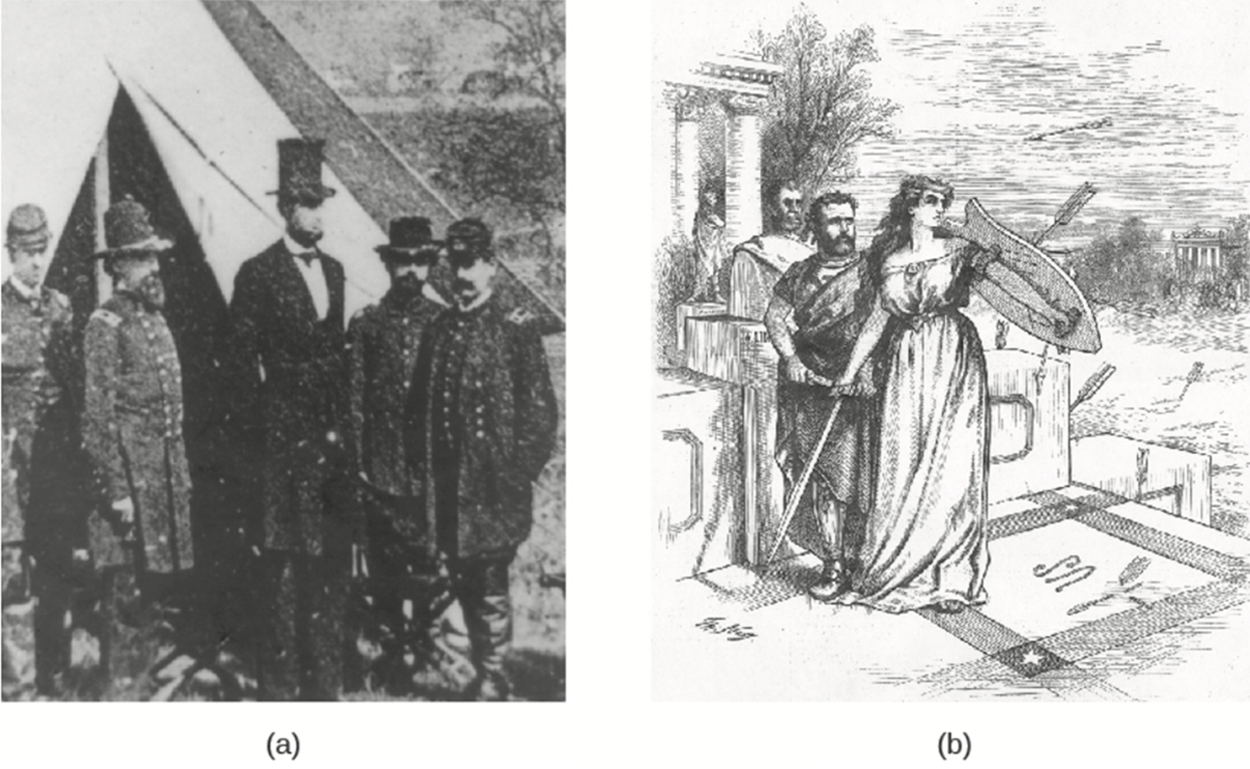
Some presidents exercised the power of patronage (or appointing people who are loyal and help them out politically to government positions), as well as private deal-making, to get what they wanted from Congress. But, patronage began to decline with the emergence of civil service reform in the later nineteenth century, which led to most government officials being hired on their merit instead of through their relationship with the president.
Changes in technology have influenced how presidents try to persuade. Theodore Roosevelt came to the presidency in 1901 at a time when movie newsreels were becoming popular. Roosevelt, who had always excelled at cultivating good relationships with the print media, eagerly exploited this new opportunity with the concept of the presidency as the bully pulpit or a platform from which to advocate for his agenda to the public. His successors followed suit, and they discovered and employed new ways of transmitting their message to the people in an effort to gain public support for policy initiatives. With the popularization of radio in the early twentieth century, it became possible to broadcast the president’s voice into many of the nation’s homes. Most famously, Franklin Roosevelt used the radio to broadcast his thirty “fireside chats” to the nation, between 1933 and 1944.
After the World War II era, television began to replace radio as the medium through which presidents reached the public. This technology enhanced the reach of the handsome young candidate John F. Kennedy and the trained actor Ronald Reagan. At the turn of the twentieth century, the new technology was the Internet. The extent to which this mass media technology can enhance the power and reach of the president has yet to be fully realized.
In the twenty-first century, presidents face a paradox. Because there are more ways than ever to get their message out, whether television channels or social media networks, the prospect of a president reaching a broad section of the public is less certain. Former president Donald Trump took going public to the extreme, accumulating over 80 million followers on Twitter. Some days, he would send dozens of tweets either to promote his agenda or to attack political opponents.
Presidents now have far more tools at their disposal to shape public opinion and build support for policies. While presidents may choose to go public in an attempt to put pressure on other groups to cooperate, most of the time they attempt to make deals and reach agreements out of the public eye.
Once they set the agenda, presidents have no direct role in the legislative process until it comes time for them to sign the bill into law or veto legislation. While a veto effectively kills legislation unless Congress is able to override the action, sometimes presidents use the threat of a veto to influence the content of the bills that Congress passes. If Congress does not have the 2/3rds vote necessary to override a presidential veto, presidents are able to wield more influence over legislation.
Presidents are also able to perform a pocket veto. Presidents have ten days to sign a bill into law after receiving it from Congress. Pocket vetoes occur when a president does not sign legislation within the ten-day period and Congress has adjourned. Otherwise, if a president doesn’t sign a bill within ten days of receiving it and Congress is in session, the bill becomes law.
More commonly, presidents use signing statements to alter or influence the application of the laws they sign. Signing statements are statements issued by a president when agreeing to legislation that indicate how the chief executive will interpret and enforce the legislation in question. Signing statements are less powerful than vetoes, though congressional opponents have complained that they derail legislative intent. Signing statements have been used by presidents since at least James Monroe, but they became far more common in the 21st century.
Presidents also exert some judicial powers, specifically the power to pardon people convicted of a federal crime and the power to appoint the federal judiciary.
The president exercises the power of pardon without conditions, which is to absolve an individual from blame for a federal crime. Once used fairly sparingly—apart from Andrew Johnson’s wholesale pardons of former Confederates after the Civil War—the pardon power has become more visible in recent decades. President Harry S. Truman issued over two thousand pardons and commutations, more than any other post-World War II president. President Gerald Ford is the only president to pardon another president (his predecessor Richard Nixon, who resigned after being accused of engaging in illegal activities during his 1972 reelection campaign, a scandal known as Watergate). (Figure 2).
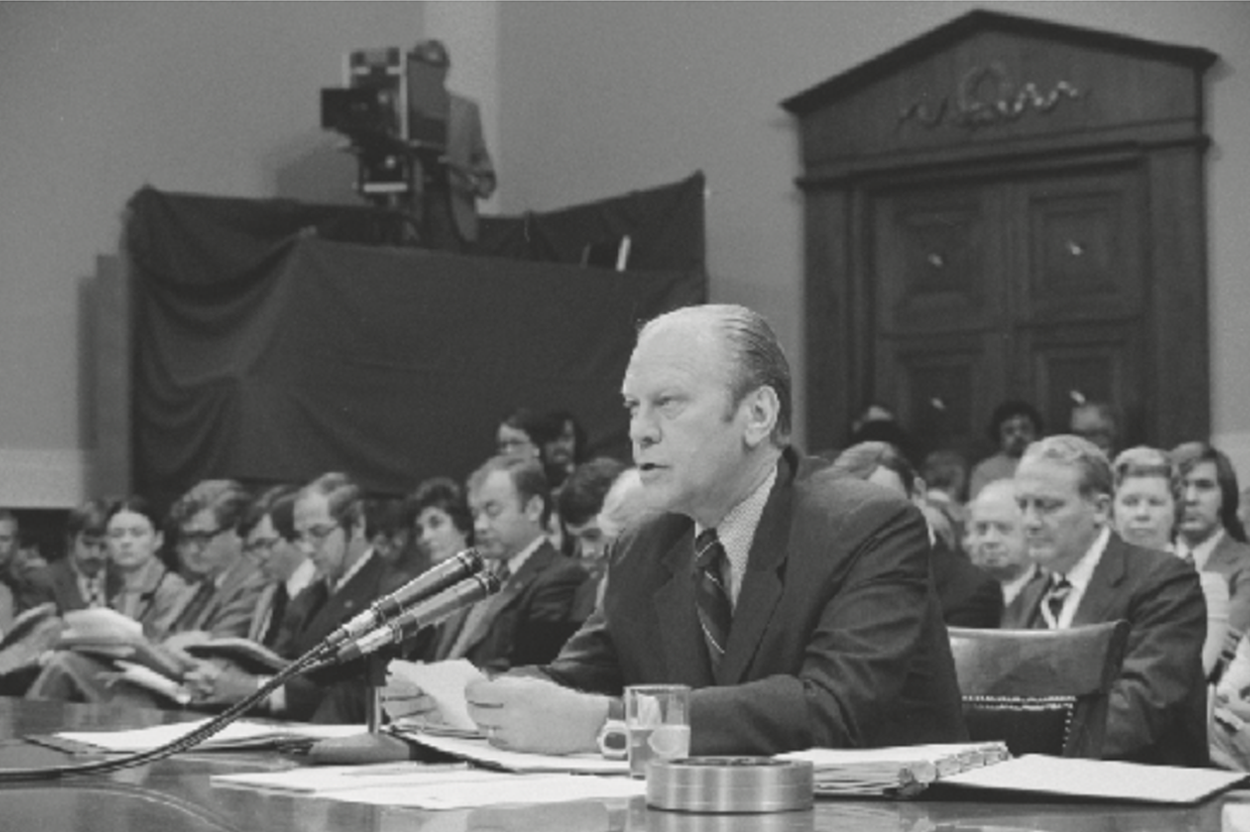
By the end of his presidency, Barack Obama had granted 212 pardons—6 percent of petitions received—similar to that of his predecessor, George W. Bush. Early on in his presidency, Donald Trump used the pardon in a few visible cases. He set aside sentences for controversial former Sheriff Joe Arpaio of Maricopa County, Arizona, and for former Vice President Dick Cheney’s confidante, Scooter Libby. Like other presidents, his use of pardons escalated at the close of his presidency. In the end, he granted 237 pardons in a single term.
President Joseph Biden preemptively pardoned several members of his family amid what he believed were politically motivated threats, despite those family members not being charged with any crimes. He also pardoned his son Hunter Biden, who had been convicted of violating tax and gun laws.
President Trump pardoned or commuted the sentences of the individuals convicted of storming the United States Capitol on January 6, 2021. While presidential pardons are considered final acts, pardons done by both President Biden and President Trump have been questioned.
Due to the fact that federal judges serve for life, nominating federal judges is one of a president’s most important powers. In recent decades, two-term presidents have nominated well over three hundred federal judges while in office. Vacancies for the federal courts and the U.S. Supreme Court occur gradually as judges retire.
The Senate must approve the president’s nominees and at times has used its power to rigorously scrutinize them. In the 1990s, Supreme Court nominee Clarence Thomas, who faced numerous sexual harassment charges from former employees, sat through repeated questioning of his character and past behavior during Senate hearings, before he was ultimately confirmed. More recently, the Senate has attempted a new strategy for rejecting presidential judicial nominees: refusing to hold hearings at all. Scholars have referred to this strategy as malign neglect.
IN CONTEXTThen in 2018, Trump appointed conservative Justice Brett Kavanaugh to replace retiring Justice Anthony Kennedy, who was regarded as a moderate conservative, and in 2020 appointed conservative Justice Amy Coney Barrett to replace liberal Justice Ruth Bader Ginsburg, who had passed away.
When Associate Justice Antonin Scalia died unexpectedly in early 2016, President Barack Obama nominated Merrick Garland, a longtime chief judge of the U.S. Court of Appeals for the D.C. Circuit, to fill the vacant seat on the Supreme Court. Despite the fact that one-third of U.S. presidents have appointed a Supreme Court justice in an election year, Senate majority leader Mitch McConnell declared that the Senate would not hold hearings on a nominee until after the upcoming presidential election.
Garland was highly respected by senators from both parties and had won confirmation to his DC circuit position by a 76–23 vote in the Senate. However, Garland was far less conservative than Scalia. With the 2016 presidential elections less than a year away, the Republican-controlled Senate hoped that a Republican presidential candidate would win the election, and appoint a more conservative justice to replace Scalia.
After Republican Donald Trump was subsequently elected president, the Republican Senate and Judiciary Committee confirmed Trump's nominee, Neil Gorsuch, in April 2017.
Thus, during his single term in office, President Trump was able to appoint three conservative justices to the Supreme Court, shifting the Court’s ideological leanings. This has already had profound consequences. In 2022, for example, the Supreme Court overturned Roe v. Wade, the pivotal case that had established a women’s right to have an abortion based on an assumed right to privacy.
Source: THIS TUTORIAL HAS BEEN ADAPTED FROM OPENSTAX “AMERICAN GOVERNMENT 3E”. ACCESS FOR FREE AT OPENSTAX.ORG/DETAILS/BOOKS/AMERICAN-GOVERNMENT-3E. LICENSE: CREATIVE COMMONS ATTRIBUTION 4.0 INTERNATIONAL.
References
Lerman, R. (2020, May 28). Trump says Twitter is trying to ‘silence’ conservatives. His growing number of followers suggests otherwise. Washington Post.
www.washingtonpost.com/technology/2020/05/28/trump-twitter-by-numbers/



