Table of Contents |
Suppose at 7 AM, you walk outside, and it is  At 11 AM, the temperature is
  Then, we know at some point between 7 AM and 11 AM, the temperature had to be
  Why?
Why?
This is because temperature doesn’t “jump” from one level to the next, meaning that the temperature is a continuous function of time. A continuous function contains no breaks.
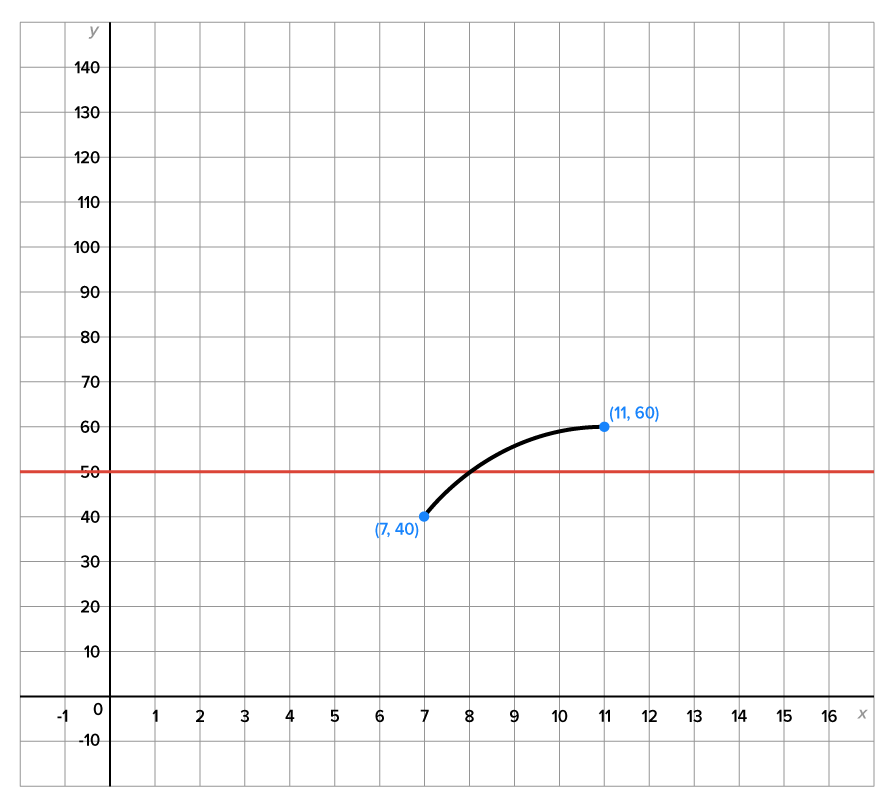
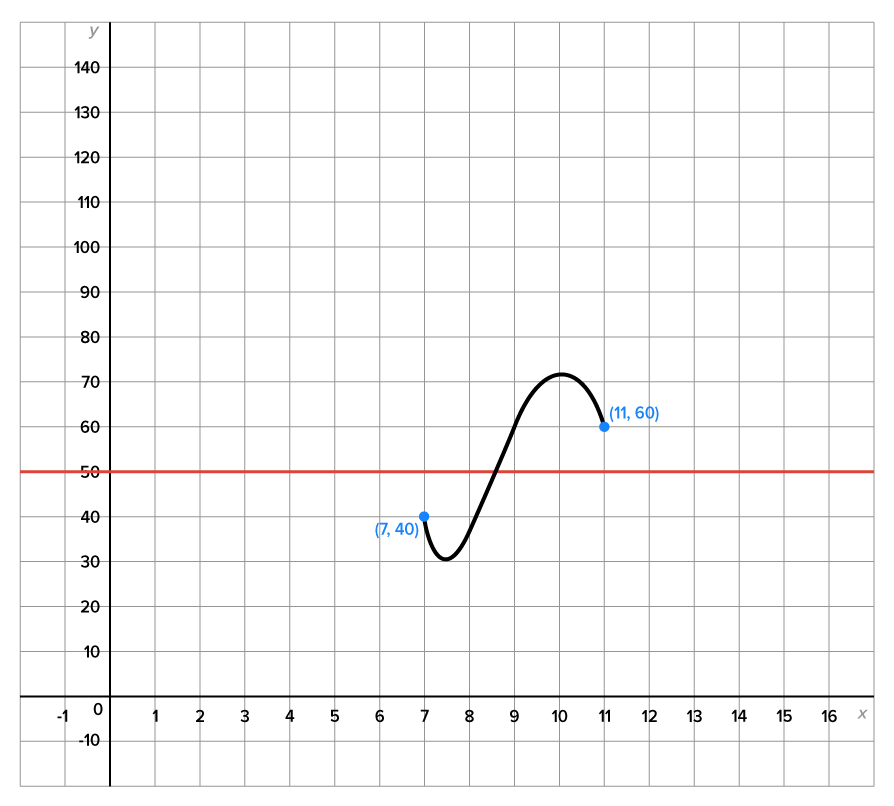
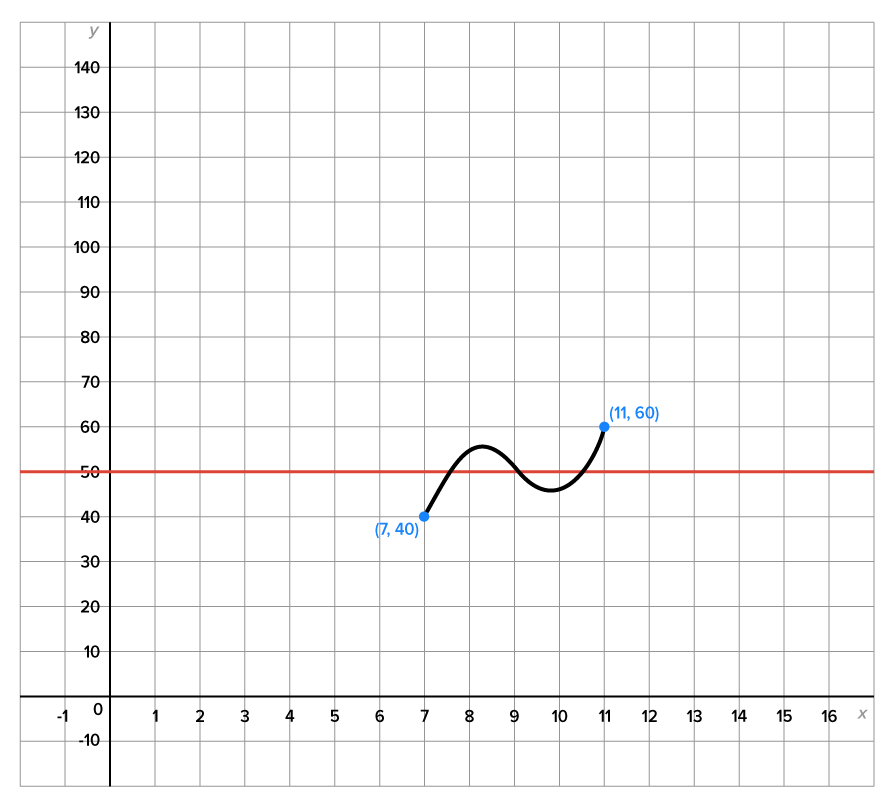
Another way to visualize this:
 and
and 
 between
  and
and  The answer should be yes. Otherwise, your graph is not continuous.
|
|
|
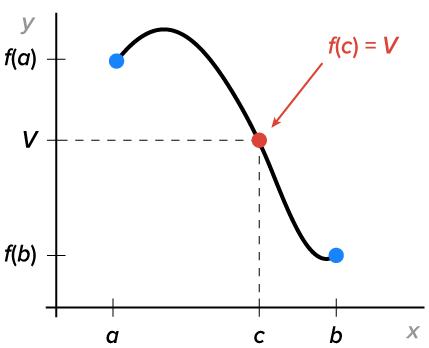
This idea is generalized by the intermediate value theorem (IVT). Suppose  is a continuous function on the closed interval
  Let V be a value between
  and
and  Then, there is at least one value of c between
  and b such that
Here is a picture to help visualize the IVT.
is a polynomial function, then is continuous, and therefore the IVT can be applied to polynomial functions.
EXAMPLE
Consider the function on the closed interval
 and
and 
 To illustrate, let’s look at the graph of on the interval
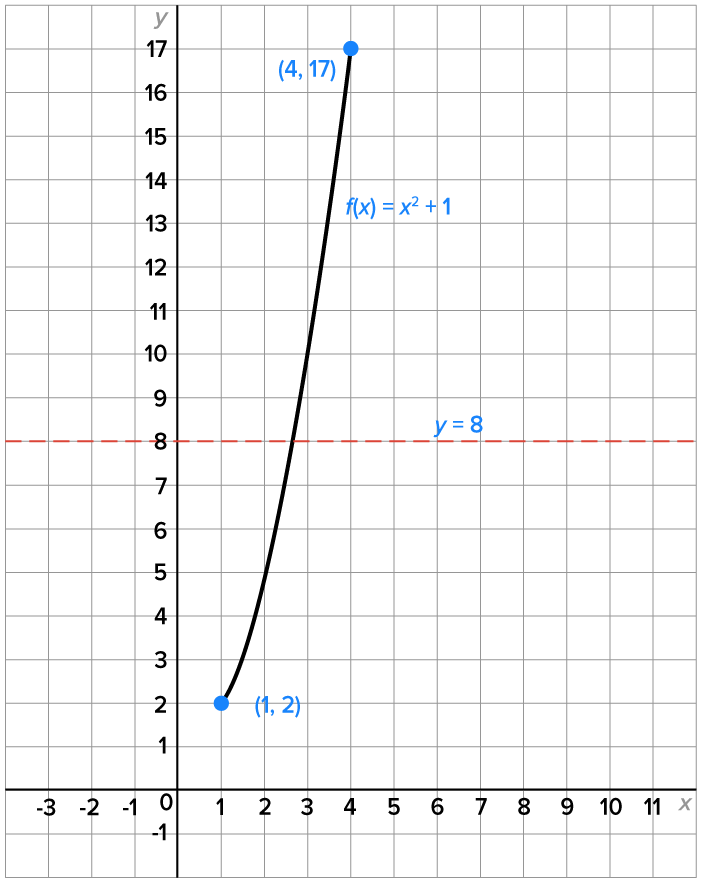
 and solve. Then, there is at least one value of c between 1 and 4 that is guaranteed by the intermediate value theorem.

|
Set
|

|
Subtract 1 from both sides. |

|
Use the square root principle. |
 is not between 1 and 4, this value of c is not guaranteed by the theorem. However, since
  is between 1 and 4, this is the value of c guaranteed by the theorem.
 on
on  .
.

 and
and  and 20 is between 7 and 25, there is a value of c between 1 and 2 such that
  is a continuous function on the closed interval Let V be a value between and Then, there is at least one value of c between and b such that
Here is an example of a real-world application in which the IVT can be useful. In this example, you will use the formula for the volume of a sphere. If you wish to review that and other geometry formulas, please consult the formula sheet that is referenced at the end of this tutorial.
EXAMPLE
Suppose a design requires a spherical shape with volume but the radius of the sphere is to be between 3 and 4 inches. Is it possible to meet these requirements?
 .
.
 for some value in the interval
 is continuous.
at the endpoints:
is continuous.
at the endpoints:



One particularly useful application of the IVT is locating x-intercepts. Here is the important point:
and  have different signs (one is positive and one is negative), then there is at least one value of c in the interval
  such that
This idea can be used to determine if there is a guarantee that the graph of has at least one x-intercept on the interval
EXAMPLE
Let Show that there is an x-intercept on the interval
  is a polynomial and therefore is continuous.


 and
and  have opposite signs, it follows from the IVT that there is at least one value of x in the interval
  such that
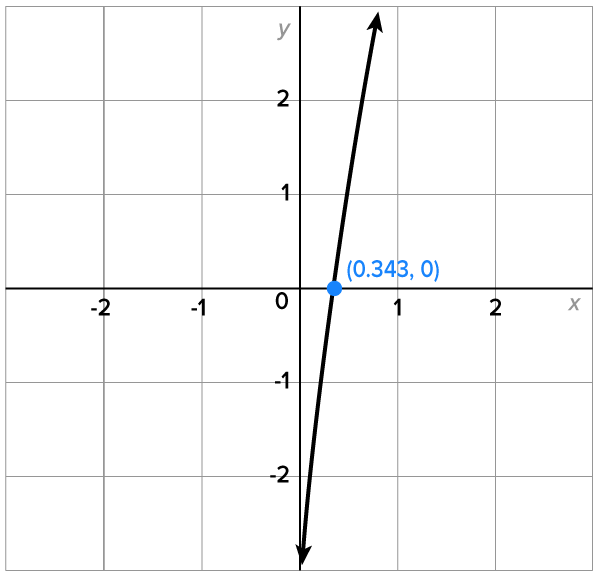

 and
and  the IVT guarantees that there is at least one x-intercept on the interval

 and
and  which are not opposite in sign. Therefore, the IVT does not guarantee that there is an x-intercept on the interval
If you were to graph  you will notice that there are two x-intercepts on So, what happened?
and have opposite signs, the IVT guarantees that there is at least one x-intercept on the interval If and have the same sign, the IVT cannot be used to tell us that there is not an x-intercept on
 , such that
  , given that V is between and Realizing that locating x-intercepts is also important, you explored some applications of the IVT, which illustrate how the IVT is helpful in determining if intercepts are guaranteed on a closed interval.
SOURCE: THIS TUTORIAL HAS BEEN ADAPTED FROM OPENSTAX "PRECALCULUS” BY JAY ABRAMSON. ACCESS FOR FREE AT OPENSTAX.ORG/DETAILS/BOOKS/PRECALCULUS-2E. LICENSE: CREATIVE COMMONS ATTRIBUTION 4.0 INTERNATIONAL.
A function whose graph contains no breaks.
Suppose  is a continuous function on the closed interval
  Let V be a value between
  and
and  Then, there is at least one value of c between
  and b such that




