In this lesson, you will learn about the elements of an income statement that aid valuation. Specifically, this lesson will cover the following:
1. The Income Statement
The income statement is the financial statement responsible for informing past performance, forecasting future performance, and evaluating the organization’s ability to produce future profits. It has also been referred to as a statement of operations, profit and loss statement, or statement of earnings.
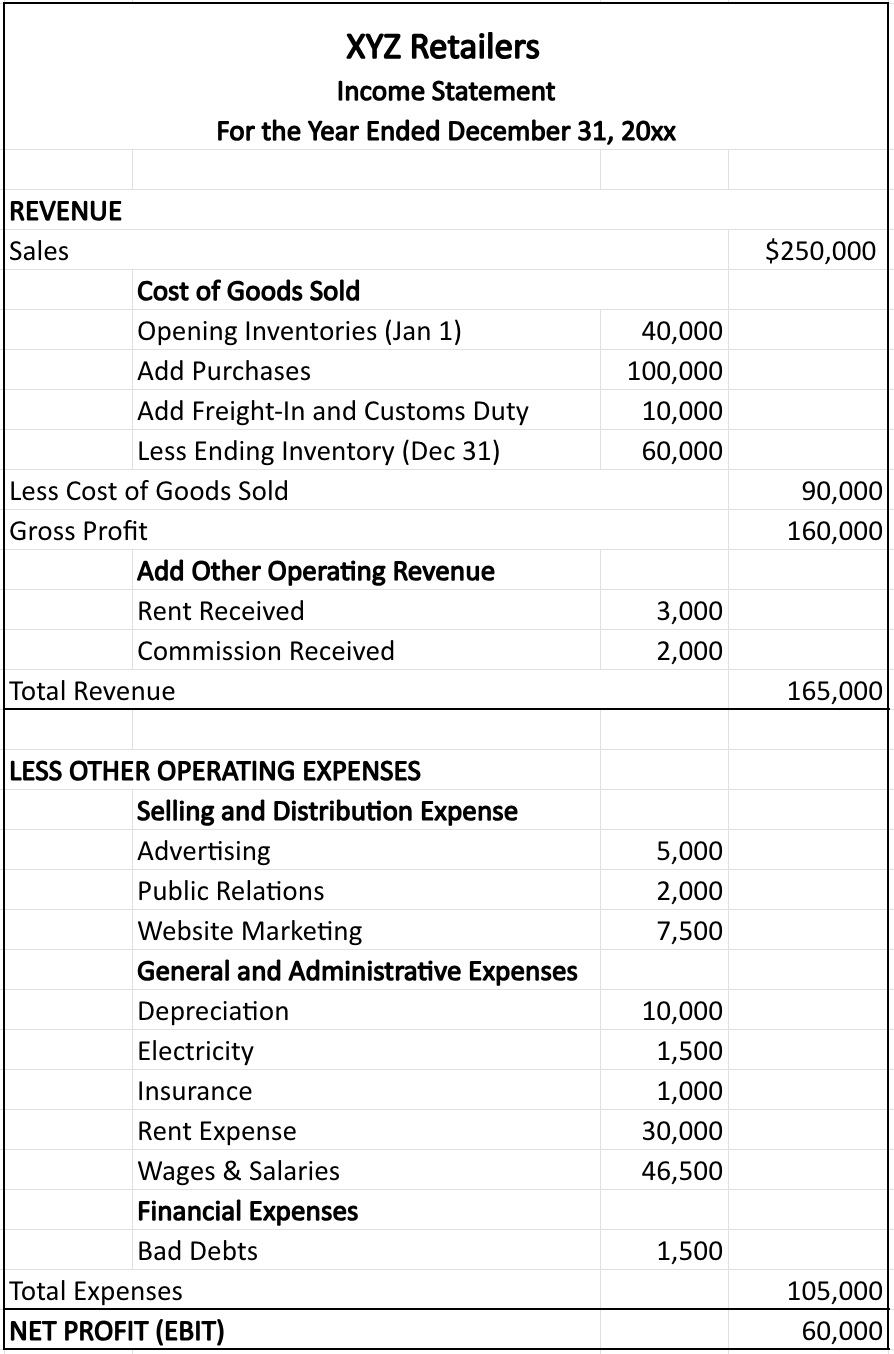
The income statement consists of revenues and expenses, along with the resulting net income or loss over a period of time due to earning activities. Net income, or the “bottom line,” is the result after all revenues and expenses have been accounted for. The income statement reflects a company’s performance over a period of time. This is in contrast to the balance sheet, which represents a single moment in time.
-
The most common method of constructing the income statement is the single-step method. This involves calculating all the revenues for the period and then calculating and subtracting all the expenses for the period to arrive at the net income.
The more complex multistep income statement (as the name implies) takes several steps to find the bottom line. First, operating expenses are subtracted from gross profit. This yields income from operations. Then, other revenues are added, and other expenses are subtracted. This yields income before taxes. The final step is to deduct taxes, which finally produces the net income for the period measured.
-
- Income Statement
- A calculation that shows the profit or loss of an accounting unit during a specific period of time, providing a summary of how the profit or loss is calculated from gross revenue and expenses.
- Net Income
- Gross profit minus operating expenses and taxes.
- Gross Profit
- The difference between net sales and the cost of goods sold.
1a. Operating Revenues and Expenses
The operating section includes revenue and expenses. Revenue consists of cash inflows or other enhancements of the assets of an entity. It is often referred to as gross revenue or sales revenue. Expenses consist of cash outflows or other assets that are used up or liabilities that are incurred.
Elements of expenses include the following:
-
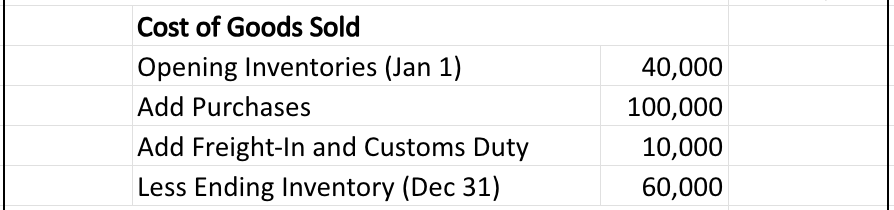
Cost of goods sold (COGS): This refers to the direct costs attributable to goods produced and sold by a business. It includes items such as material costs and direct labor.
-
-
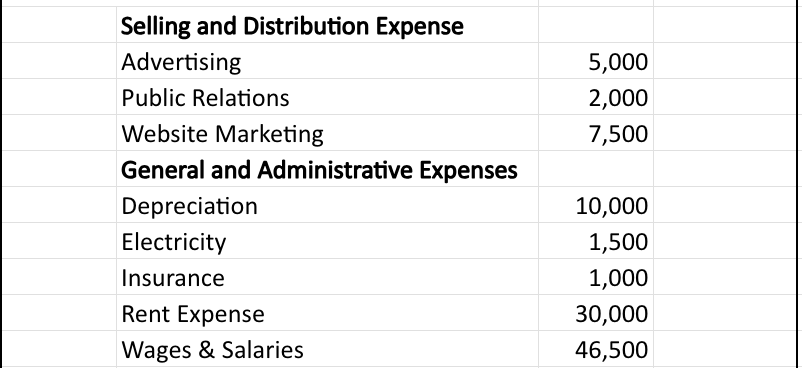
Selling, general, and administrative expenses (SG&A): They include the combined payroll costs, except for what has been included as direct labor.
-
-
Depreciation and amortization: These involve charges with respect to fixed assets (depreciation) and intangible assets (amortization) that have been capitalized on the balance sheet for a specific accounting period.
-
Research and development (R&D): This involves expenses included in the research and development of products.
1b. Nonoperating Revenues and Expenses
The nonoperating section includes revenues and gains from the following:
- Nonprimary business activities, such as rent or patent income
-
- Expenses or losses not related to primary business operations, such as foreign exchange losses
- Gains that are either unusual or infrequent but not both
- Finance costs (costs of borrowing), such as interest expense
- Income tax expense
In essence, if an activity is not related to making or selling products or services but still affects the business’s income, it is a nonoperating revenue or expense.
2. Reading the Income Statement
When reading an income statement, most people focus on net income or the bottom line. Net income is what remains after all expenses have been subtracted from gross profits. This number is important to investors because it helps determine the profit available to shareholders. Even though net income is important, one must be wary of solely focusing on it. Here are some other areas of the income statement and how they may affect net income:
-
Revenue
- High revenue levels can mean sales are going well or demand is increasing.
- Low revenue can mean trouble selling goods or a lower market demand.
-
Cost of goods sold (COGS)
- High costs of goods sold may mean the business is paying too much for its inventory.
- Low cost of goods sold may point to quality issues.
-
Expenses
- High levels of expenses can mean that a company is mismanaging its resources.
- Lower expenses may point to a lack of investment or innovation.
-
Net income
- A high net income could mean that the business is not taking advantage of revenue-reducing expenses like depreciation.
- A low net income may indicate slow sales, high expenses, or high costs of goods sold.
In addition to what you see on the income statement, certain items must be disclosed separately in the notes if they are material (significant). Often, you will see a small note or marker on the income statement if this is the case. These material items could include business activities like restructurings, discontinued operations, and disposals of investments or of property, plant, and equipment. Irregular items are reported separately so that users can better predict future cash flows.
3. Limitations of the Income Statement
Income statements are a key component of valuation but have several limitations stemming from estimation difficulties, reporting errors, and fraud.
The limitations are as follows:
-
Income is reported based on accounting rules, which may not represent actual cash flows: This could be due to the matching principle, which is the accounting principle that requires expenses to be reported at the same time as the revenues they are related to. Often, revenues and expenses do not fall in the same accounting period, causing unintentional misrepresentation.
-
Variations occur due to inventory valuation methods: Another common difference across income statements is the method used to calculate inventory, either FIFO or LIFO. FIFO stands for first-in, first-out; it assumes that the oldest inventory items are recorded as sold first. LIFO stands for last-in, first-out; it assumes that the most recently produced items are recorded as sold first.
-
Statements can be limited by intentional misrepresentation: Earnings management occurs when managers use judgment in financial reporting and in structuring transactions to alter financial reports in a way that usually involves the artificial increase (or decrease) of revenues, profits, or earnings per share figures. The goal of earnings management is to influence views about the finances of the firm. Aggressive earnings management is a form of fraud and differs from reporting errors.
-
EXAMPLE
If a manager earns their bonus based on revenue levels at the end of December, there is an incentive to try to represent more revenues in December so as to increase the size of the bonus.
While it is relatively easy for an auditor to detect errors, part of the difficulty in determining whether an error was intentional or accidental lies in the accepted recognition that calculations are estimates. It is, therefore, possible for legitimate business practices to develop into unacceptable financial reporting.
-
- FIFO
- Stands for first-in, first-out; a method for accounting for inventory that assumes the oldest inventory items are recorded as sold first.
- LIFO
- Stands for last-in, first-out; a method for accounting for inventory that assumes the most recently produced items are recorded as sold first.
4. Effects of GAAP on the Income Statement
Although most of the information on a company’s income tax return comes from the income statement, often, there is a difference between pretax income and taxable income. These differences are due to the recording requirements of GAAP for financial accounting (usually following the matching principle and allowing for accruals of revenue and expenses) and the requirements of the IRS’s tax regulations for tax accounting (which are more oriented to cash). Timing differences between financial accounting and tax accounting create temporary differences.
-
EXAMPLE
Rent or other revenue collected in advance, estimated expenses, and deferred tax liabilities and assets may create timing differences.
Also, there are events, usually one-time, that create “permanent differences,” such as GAAP, which recognize as an expense an item that the IRS will not allow to be deducted.
To achieve basic objectives and implement fundamental qualities, GAAP has four basic principles:
-
The historical cost principle: It requires companies to account and report based on the acquisition costs rather than the fair market value for most assets and liabilities.
-
The revenue recognition principle: It requires companies to record when revenue is (1) realized or realizable and (2) earned, not when cash is received.
-
The matching principle: This governs the matching of expenses and revenues, where expenses are recognized, not when the work is performed or when a product is produced but when the work or the product actually makes its contribution to revenue.
-
The full disclosure principle: This suggests that the amount and kinds of information disclosed should be decided based on a trade-off analysis, since a larger amount of information costs more to prepare and use. GAAP reporting also suggests that income statements should present financial figures that are objective, material, consistent, and conservative.
5. Noncash Items
Noncash items reported on an income statement will cause differences between the income statement and cash flow statement. Depreciation and amortization are common noncash items that affect the income statement.
-
Depreciation is a systematic decrease of a plant asset’s book value that artificially decreases net income. Plant assets include land, buildings, equipment, and vehicles.
-
Amortization is a similar process to depreciation but is the term used when applied to intangible assets. Examples of intangible assets are copyrights, patents, and trademarks.
When analyzing income statements to determine the true cash flow of a business, these items should be added back in because they do not contribute to the inflow or outflow of cash like other gains and expenses.
On a more detailed level, depreciation refers to two very different but related concepts: the decrease in the value of tangible assets (fair value depreciation) and the allocation of the cost of tangible assets to the periods in which they are used (depreciation with the matching principle). The former affects the values of businesses and entities, while the latter affects net income.
In each period, long-term noncash assets accrue a depreciation expense that appears on the income statement. Depreciation expense does not require a current outlay of cash, but the cost of acquiring assets does.
-
EXAMPLE
An asset worth $100,000 in Year 1 may have a depreciation expense of $10,000, so it appears as an asset worth $90,000 in Year 2.
-
When considering noncash items:
- Depreciation is prorating the cost of a tangible asset over its estimated useful life, such as land, buildings, equipment, and vehicles.
- Amortization is spreading the cost of an intangible asset over its useful life, like patents, copyrights, mining rights, and intellectual property.
-
- Depreciation
- The measurement of the decline in the value of assets; not to be confused with impairment, which is the measurement of the unplanned, extraordinary decline in the value of assets.
- Amortization
- The distribution of the cost of an intangible asset, such as an intellectual property right, over the projected useful life of the asset.
In this lesson, you learned about the elements of the income statement, which include operating revenues and expenses and nonoperating revenues and expenses. When reading the income statement, the focus is often on the “bottom line” or net income. The income statement has limitations similar to other financial statements, including variable accounting methods and human interference. GAAP also affect the income statement by creating both temporary and permanent discrepancies between income statements and income tax statements. Discrepancies are also created between the income statement and the cash flow statement by noncash items that must be depreciated or amortized.
Best of luck in your learning!