Table of Contents |
Criminology is the scientific study of crime causation. It started out as a branch of sociology but later morphed into its own field of study. Criminology has also been referred to as the scientific study of breaking the law, making the law, and society’s reaction to those who break the law (Sutherland, 1934). The professionals who practice in the field of criminology are called criminologists. Criminologists are experienced in a multitude of subject matters: psychology, sociology, economics, political science, biological science, religion, urban studies, social work, law, etc. This is because much of what goes into peeling back the multiple layers of criminal behavior has to do with the things that make people who they are and how they experience not just their inner struggles of right and wrong, but also those external forces that contribute to their interactions with themselves and the world.
So, when a criminologist researches a specific trend in crime, they are not just looking for one specific answer as to how or why; rather, they are looking for as many answers as possible. Criminologists need to understand the entire story behind the act of deviant behavior before they can make a recommendation on a policy shift or a creation of a law that could potentially equally serve a diverse population.
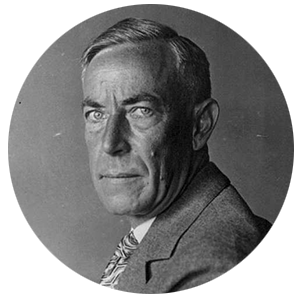 August Vollmer (1876–1955), former Berkeley, CA, police chief, is known as an early pioneer of police professionalism, including advancements in training and education. In 1916, Vollmer began teaching a course on police administration at the University of California, Berkeley. This course was one of the first of its kind in the United States and laid the foundation for the later establishment of a more comprehensive program. Vollmer's vision was to create an academic program that combined the study of police administration with the burgeoning field of criminology. His course covered topics such as criminal law, the sociology of crime, crime prevention strategies, and the psychological aspects of criminal behavior (Leonard, 2017).
The most common way a criminologist goes about proving or disproving a theory is through research. Research is the same with criminology as it would be for any other science:
Criminological theories can come from anywhere and everywhere. There are no guidelines for who can or cannot be a criminologist, nor is there any requirement for someone who can produce a criminological theory. Criminologists can be and have been economists, lawyers, doctors, social workers, police officers, teachers, psychologists, and counselors. All it takes is a keen interest in observation and research and the ability to ask the right questions to formulate a proper theory related to crime.
Criminological theories are broken down into different “schools,” depending on when they were developed chronologically, as well as the content that they focus on. There have been several schools throughout history, and they have all made contributions to the field:
| School | Description |
|---|---|
|
Classical school (18th century) |
Based on the idea that crime results from individuals making rational choices, driven by free will and a desire to maximize pleasure while minimizing pain. It emphasized the importance of a fair and proportionate legal system where punishments are clearly defined and serve as a deterrent to crime. |
|
Positivist school (19th century) |
Argued that criminal behavior is determined by factors beyond an individual's control, such as biological, psychological, or social influences. This school emphasized the need for scientific methods to study crime. |
|
Chicago school (early 20th century) |
Focused on how social environments and urbanization influenced criminal behavior, particularly in rapidly growing cities. It emphasized the role of social disorganization, community structures, and cultural factors in shaping crime patterns, highlighting how neighborhoods with weak social ties and limited resources can lead to higher crime rates. |
|
Neoclassical school (late 19th and early 20th centuries) |
Revisited the principles of the classical school by acknowledging human free will. However, it also considered individual differences and circumstances, such as age, mental state, and other factors, in criminal behavior. |
| Contemporary school | Encompasses a diverse range of theories and approaches that integrate insight from many disciplines, including sociology, psychology, biology, and economics, to understand the complex nature of criminal behavior. This school has a more holistic view of crime and considers individual, social, and structural factors. |
We will cover some of the most important points related to these schools throughout the remainder of this Challenge.
Source: THIS TUTORIAL HAS BEEN ADAPTED FROM LOUIS: The Louisiana Library Network'S “CCRJ 1013: Introduction to Criminal Justice”. ACCESS FOR FREE AT LOUIS. LICENSE: CREATIVE COMMONS ATTRIBUTION 4.0 INTERNATIONAL.
REFERENCES
Leonard, S. (2017). The evolution of American policing: August Vollmer's role in transforming law enforcement. Policing Studies Journal, 5(2), 123-135.
Morris, J. (2019). The pioneers of criminology: How August Vollmer shaped criminal justice education. Journal of Criminal Justice Education, 30(4), 457-472.
Sutherland, E. H. (1934). Principles of criminology (2nd ed.). Philadelphia: Lippincott.



