Table of Contents |
Michelangelo di Lodovico Buonarroti Simoni, commonly known as Michelangelo, was born on March 6, 1475, in Caprese, Italy. He was a Renaissance artist renowned for his exceptional skill in sculpture, painting, and architecture. Michelangelo's influence on the development of Western art is profound; his ability to blend physical realism with expressive intensity set new standards in both sculpture and painting.
Michelangelo was born into a family of modest means. His father, Ludovico di Leonardo di Buonarotto di Simoni, was a government administrator, and his mother, Francesca Neri, died when he was 6 years old. At 13, Michelangelo was sent to Florence, where he apprenticed to the painter Domenico Ghirlandaio. This apprenticeship exposed him to the rich artistic heritage of Renaissance Florence.
Michelangelo was known for his intense dedication to his craft. He often worked in isolation and was deeply committed to achieving perfection in his art. During his lifetime he enjoyed considerable fame and recognition. Contemporaries often referred to Michelangelo as “Il Divino” (The Divine) due to his extraordinary talents.
The genius of Michelangelo as a painter is a notable and defining moment of the High Renaissance. While Michelangelo is celebrated for his sculpture, such as David, his contributions to painting are equally significant. Commissioned by Pope Julius II, Michelangelo began painting the ceiling of the Sistine Chapel in 1508, completing the monumental project in 1512.
Take another look at this image of Michelangelo’s David. In a previous lesson, you learned about how this sculpture represented Florence. Now, let’s consider additional contextual and stylistic details for this renowned artwork.
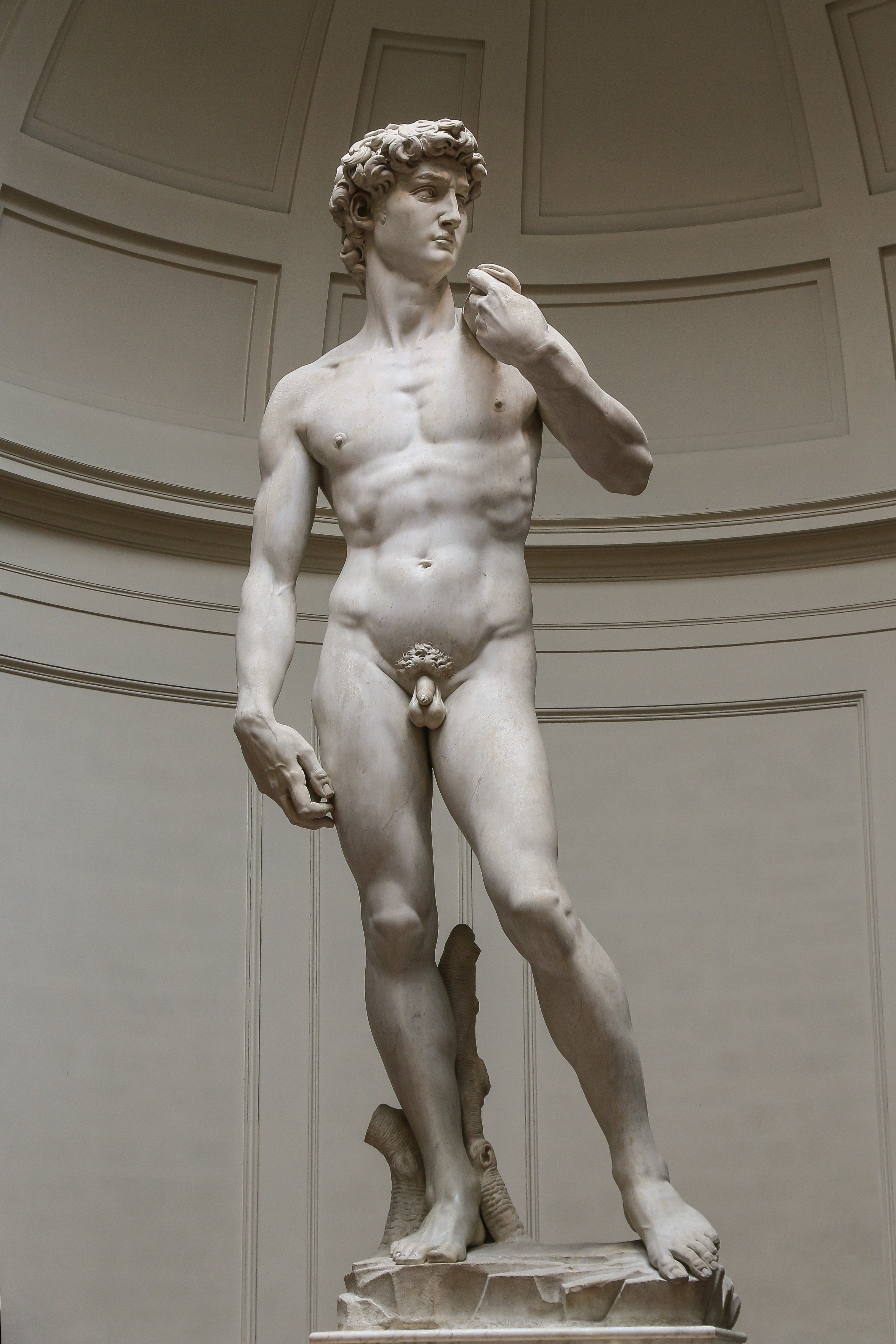
David
Galleria dell'Accademia, Florence
1501–1504
Marble
The sculpture itself is almost 17 feet tall, and it depicts the biblical hero in the moments leading up to his fight with Goliath. The contrapposto stance suggests David at ease upon first look, but the beautifully rendered details create a sense of tension as well as anticipation for what’s about to happen.
David’s large hands in this sculpture, one of which holds the stone that kills Goliath, convey power and strength. They also serve as a visual adjustment, like his slightly enlarged head, which compensates for the observer's lower viewpoint.
The sensation of impending action is a hallmark of Michelangelo’s style and is clearly rendered in the details of David’s face. His gaze extends beyond the immediate area and serves to pull in the character of Goliath. While Goliath is beyond the view of the observer, he is well within David’s line of sight.
The Sistine Chapel is part of the Vatican complex in Rome, which is the center of Christendom. The project to paint the interior was commissioned by Pope Julius II about 2 years after the groundbreaking on the new church of St. Peter’s in the Vatican. Michelangelo was selected, and though hesitant at first, he eventually accepted.
The scope of the project was enormous. It presented several challenges, such as the height of the ceiling. This problem, however, was eventually solved by the creation of a scaffolding system by Michelangelo. The brightly colored ceiling was painted by Michelangelo while he stood, neck tilted, on the scaffolding. The idea that Michelangelo painted on his back is a common misconception, which has been disproved by the artist’s own writings.
Notice the almost neon color palette of many of the figures. Because the ceiling was so far from the ground, the artist used vibrant colors to allow the scenes to stand out to the human eye far below.
The biblical scenes painted by Michelangelo depicted narratives detailing such events as:
The most famous image for the Sistine Chapel, and one of the most famous paintings from the Renaissance, is the image of The Creation of Adam.
Below is an image of The Creation of Adam.
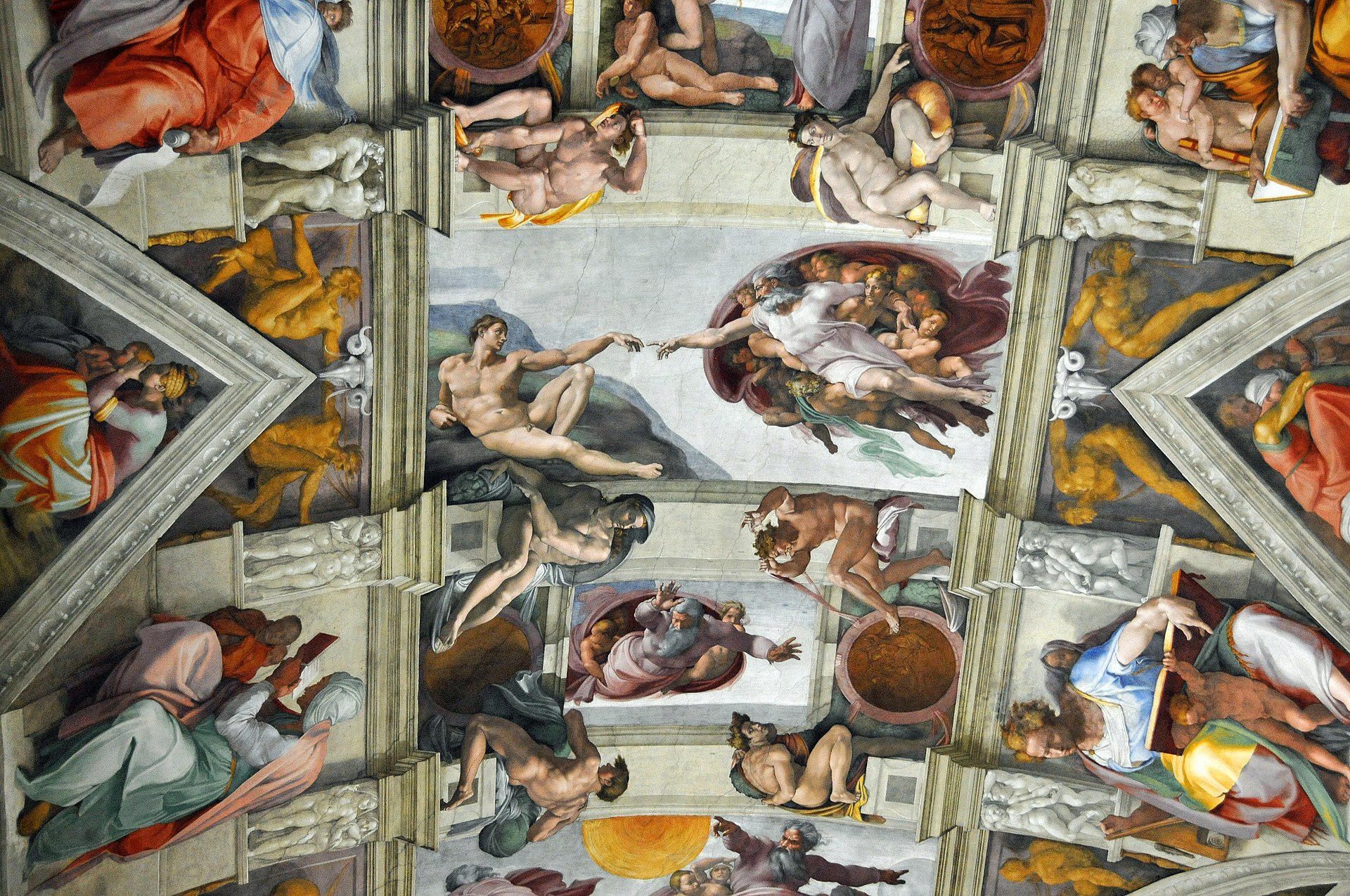
The Creation of Adam, Detail of the Ceiling of the Sistine Chapel
Sistine Chapel, Vatican City
1508–1512
Fresco
In this work of art, Michelangelo diverted from the biblical representation and chose a noticeably more mythical depiction of the event. Michelangelo’s touch is unmistakable, and in true Renaissance style, he shows the moment just before the action takes place. This depicts the point in time just before Adam is given life, as God reaches out his finger, nearly touching Adam in order to waken him with the spark of life. Notice how even when painting, Michelangelo adds a sculptural element to his works, emphasizing the lines and contours of the muscled bodies.
Decades after finishing the ceiling, Michelangelo returned to the chapel for another massive painting project. Michelangelo’s The Last Judgment, painted between 1536 and 1541, is one of the most significant works of art in the Sistine Chapel. Located on the back altar wall of the chapel, this monumental fresco depicts the second coming of Christ and the final judgment of souls. Imagine confronting this towering image face-on.
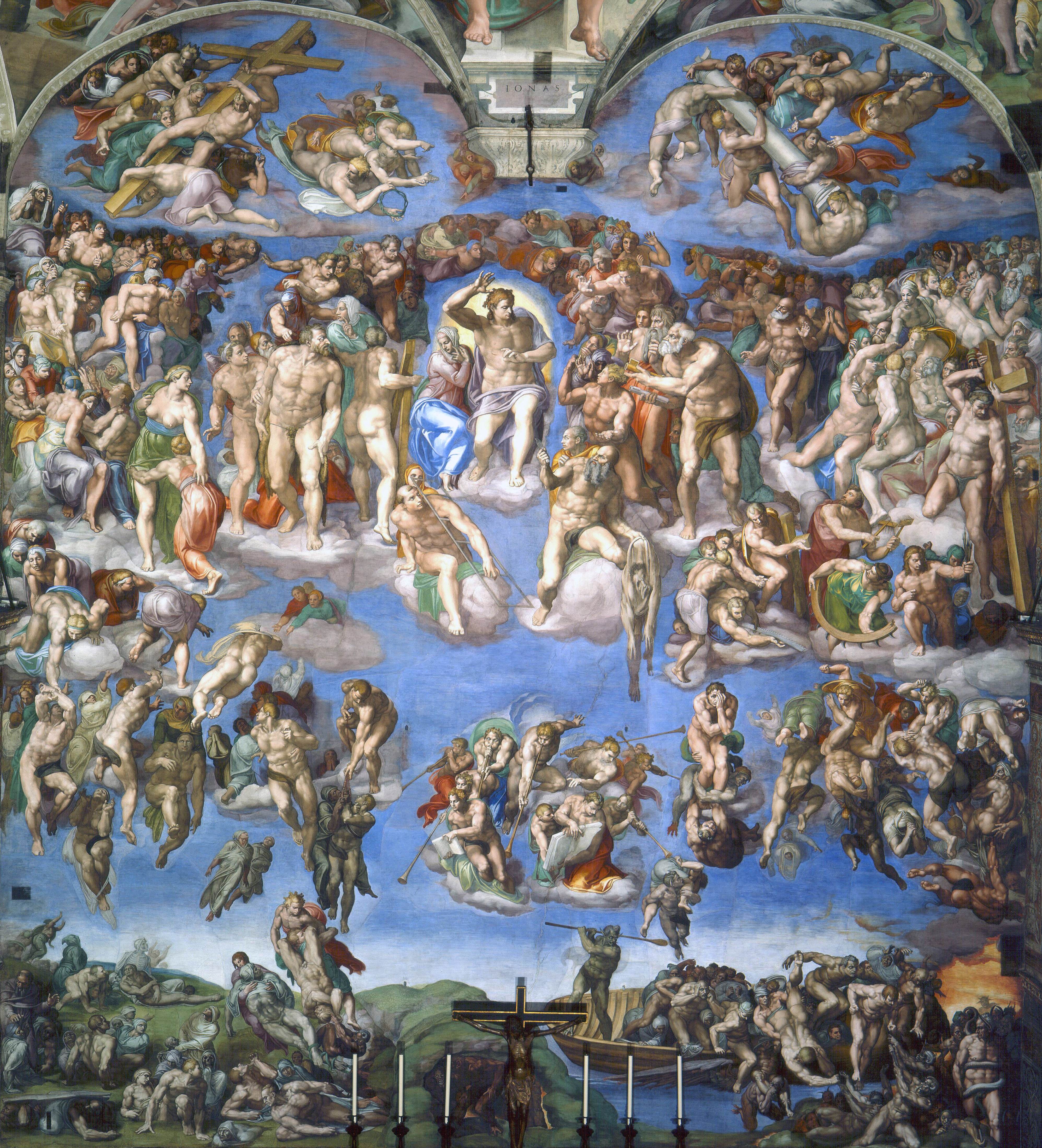
The Last Judgment, Altar Wall of Sistine Chapel
Sistine Chapel, Vatican City
1508–1512
Fresco
Christ is depicted in a dynamic pose, with a powerful gesture that commands attention. His muscular form reflects Michelangelo's background in sculpture and his fascination with the human body. Notice how Christ almost looks like Zeus or Poseidon with his heroic physique. This is a clear deviation from earlier eras of the Italian Renaissance.
The Virgin Mary, positioned next to Christ, turns her gaze downward, embodying mercy and compassion.
Surrounding Christ are saints and martyrs, identifiable by their attributes, such as St. Bartholomew holding his flayed skin (believed to be a self-portrait of Michelangelo) and St. Catherine with her wheel, the symbol of her martyrdom.
Michelangelo's use of foreshortening creates a dramatic sense of depth and movement in The Last Judgment. The vibrant color palette, with contrasting blues, reds, and flesh tones, further enhances the visual power and emotional intensity of the scene.
The Last Judgment marked a departure from the idealized beauty of Michelangelo's earlier Sistine Chapel ceiling frescoes, reflecting a more turbulent and expressive style. The fresco influenced subsequent generations of artists, contributing to the development of Mannerism later in the 16th century with its exaggerated forms and emotional vigor. These extreme visual changes can also be seen as the Catholic Church's reaction to the recent start of the Protestant Reformation, triggering a sense of religious fervor in Rome.
Source: THIS TUTORIAL WAS AUTHORED BY IAN MCCONNELL AND TAMORA KOWALSKI FOR SOPHIA LEARNING. PLEASE SEE OUR TERMS OF USE.



