Use Sophia to knock out your gen-ed requirements quickly and affordably. Learn more
×

The Female Reproductive Cycle: Folliculogenesis

Author: Sophia

what's covered
In this lesson, you will learn about how ovarian follicles develop by folliculogenesis. Specifically, this lesson will cover:

Table of Contents

1. The Ovarian Cycle

The ovarian cycle is a set of predictable changes in oocytes and ovarian follicles. During the reproductive years, it is a cycle that can be correlated with but is not the same as, the uterine cycle, which will be discussed in a future lesson.

The ovarian cycle includes three phases: the follicular phase, ovulation, and the luteal phase. Follicular maturation occurs during the follicular phase. Ovulation is when the egg is released from the ovaries. Finally, the luteal phase is when the uterus lining thickens to prepare for pregnancy: the corpus luteum, which is a transformed follicle following ovulation that secretes progesterone, is formed (and eventually degenerates if pregnancy does not occur), and the secretion of progesterone stimulates the thickening of the uterus lining.

The ovarian cycle is separated into follicular and luteal phases. The follicular phase occurs first, during this phase, the the follicle inside the uterus begins to grow. Halfway (about 14 days) the follicle is released and enters the luteal phase. The follicle grows into a corpus luteum and then degenerates.
The Follicular and Luteal phases of the Ovarian Cycle

The process of development that we have just described, from primordial follicle to early tertiary follicle, takes approximately two months in humans. The final stages of development of a small cohort of tertiary follicles, ending with ovulation of a secondary oocyte, occur over a course of approximately 28 days.

As you previously learned, the ovarian cycle includes two interrelated processes: oogenesis (the production of gametes) and folliculogenesis (the growth and development of ovarian follicles). You will learn more about folliculogenesis in the remainder of this lesson.

term to know
Ovarian Cycle
The approximately 28-day cycle of changes in the ovary consisting of a follicular phase and a luteal phase.


2. Folliculogenesis

Recall that ovarian follicles are oocytes and their supporting cells. They grow and develop in a process called folliculogenesis, which typically leads to ovulation of one follicle approximately every 28 days, along with death of multiple other follicles. The death of ovarian follicles is called atresia and can occur at any point during follicular development.

As you have learned, a female infant at birth will have one to two million oocytes within the ovarian follicles, and this number declines throughout life until menopause, when no follicles remain. As you’ll see next, follicles progress from primordial to primary, to secondary and tertiary stages before ovulation—with the oocyte inside the follicle remaining as a primary oocyte until right before ovulation.

Folliculogenesis begins with follicles in a resting state. These small primordial follicles are present in newborn females and are the prevailing follicle type in the adult ovary. Primordial follicles have only a single flat layer of support cells, called granulosa cells, that surround the oocyte, and they can stay in this resting state for years—some until right before menopause.

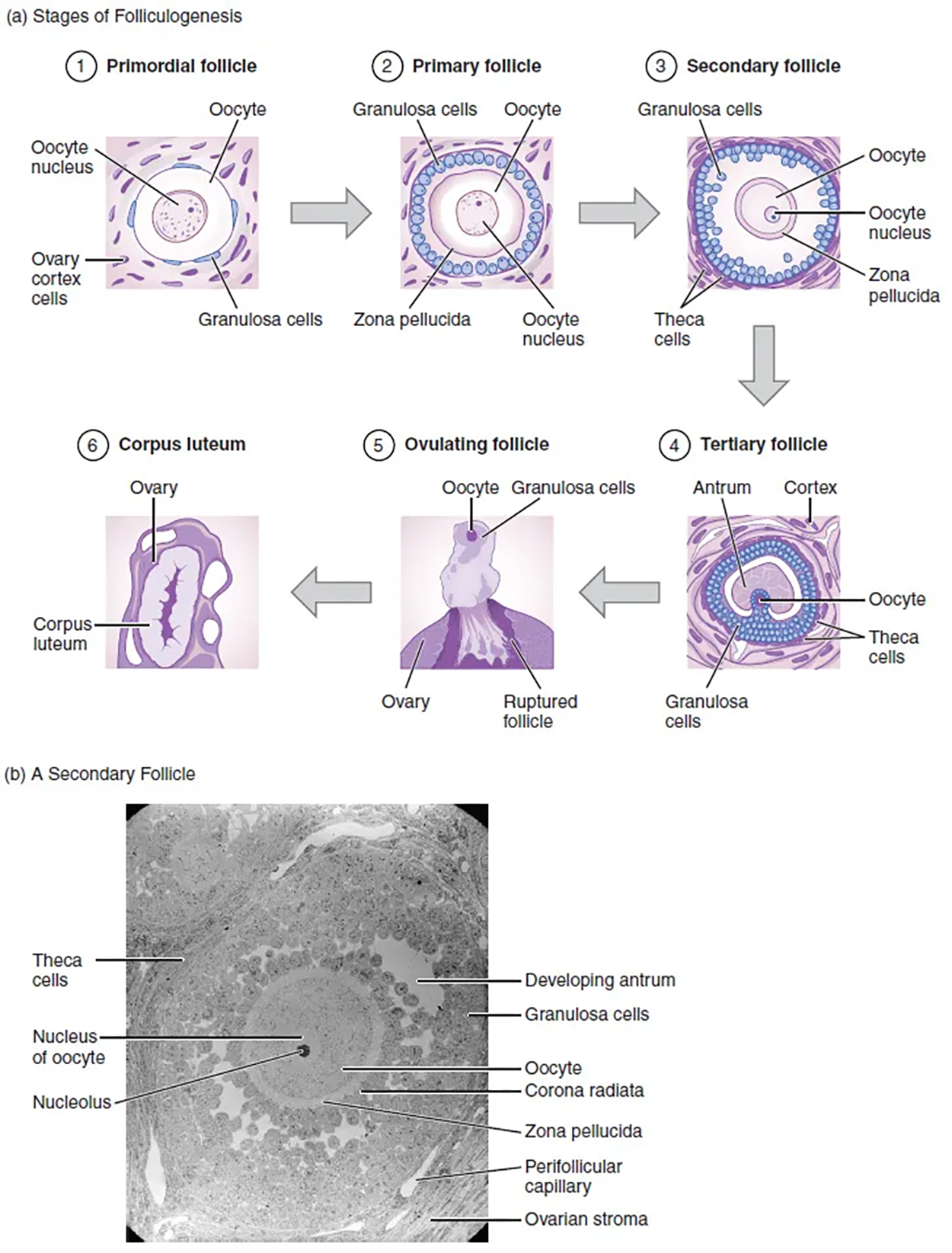
After puberty, a few primordial follicles will respond to a recruitment signal each day, and will join a pool of immature growing follicles called primary follicles. Primary follicles start with a single layer of granulosa cells, but the granulosa cells then become active and transition from a flat or squamous shape to a rounded, cuboidal shape as they increase in size and proliferate. As the granulosa cells divide, the follicles—now called secondary follicles (see the image below)—increase in diameter, adding a new outer layer of connective tissue, blood vessels, and theca cells—cells that work with the granulosa cells to produce estrogens.

Within the growing secondary follicle, the primary oocyte now secretes a thin acellular membrane called the zona pellucida that will play a critical role in fertilization. A thick fluid, called follicular fluid, that has formed between the granulosa cells also begins to collect into one large pool, or antrum. Follicles in which the antrum has become large and fully formed are considered tertiary follicles (or antral follicles). Several follicles reach the tertiary stage at the same time, and most of these will undergo atresia. The one that does not die will continue to grow and develop until ovulation when it will expel its secondary oocyte surrounded by several layers of granulosa cells from the ovary.
key concept
Keep in mind that most follicles don’t make it to this point. In fact, roughly 99% of the follicles in the ovary will undergo atresia, which can occur at any stage of folliculogenesis.


This multipart figure shows how follicles are generated. The top panel shows the six stages of folliculogenesis. In each stage, the major cell types are labeled. The bottom part shows a micrograph of a secondary follicle and the major parts are labeled.
Folliculogenesis - (a) The maturation of a follicle is shown in a clockwise direction proceeding from the primordial follicles. FSH stimulates the growth of a tertiary follicle, and LH stimulates the production of estrogen by granulosa and theca cells. Once the follicle is mature, it ruptures and releases the oocyte. Cells remaining in the follicle then develop into the corpus luteum. (b) In this electron micrograph of a secondary follicle, the oocyte, theca cells (thecae folliculi), and developing antrum are clearly visible. EM × 1100. (Micrograph provided by the Regents of University of Michigan Medical School © 2012)

EXAMPLE


Ovarian Disorders

As you have learned, the ovaries are one of the most essential organs in the female reproductive system. Therefore, when they are not functioning correctly, they can cause health issues. A couple of common disorders associated with the ovaries are cysts and polycystic ovarian syndrome (PCOS).

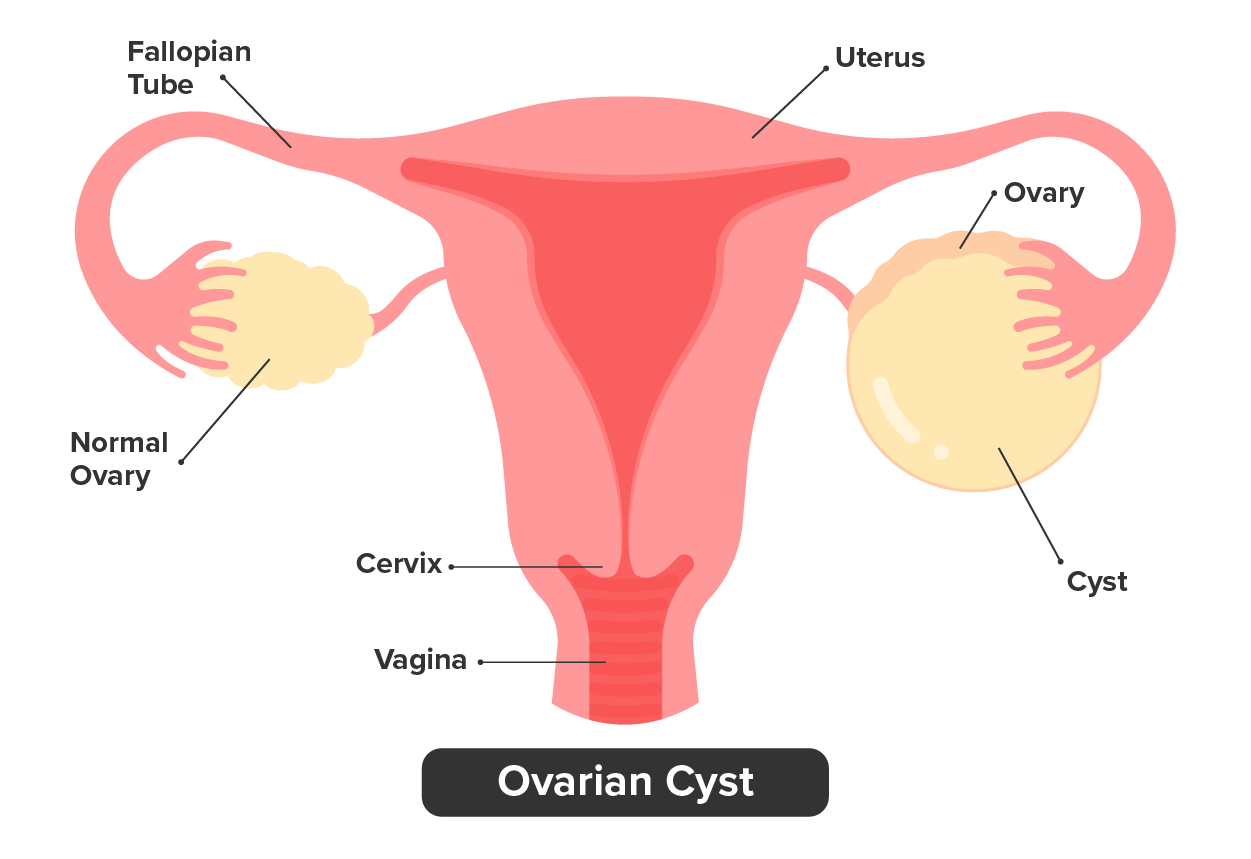
Ovarian cysts are sacs that are typically filled with fluid and form on or in the ovaries. Cysts are generally very common in females and often go away on their own after a few months. However, they can still cause relatively mild symptoms in some individuals, such as pelvic and abdominal pain, and in some cases they can become twisted or rupture, causing severe symptoms.

Illustration shows a cyst growing on the right side ovary. It is round and below the ovary.
An Ovarian Cyst
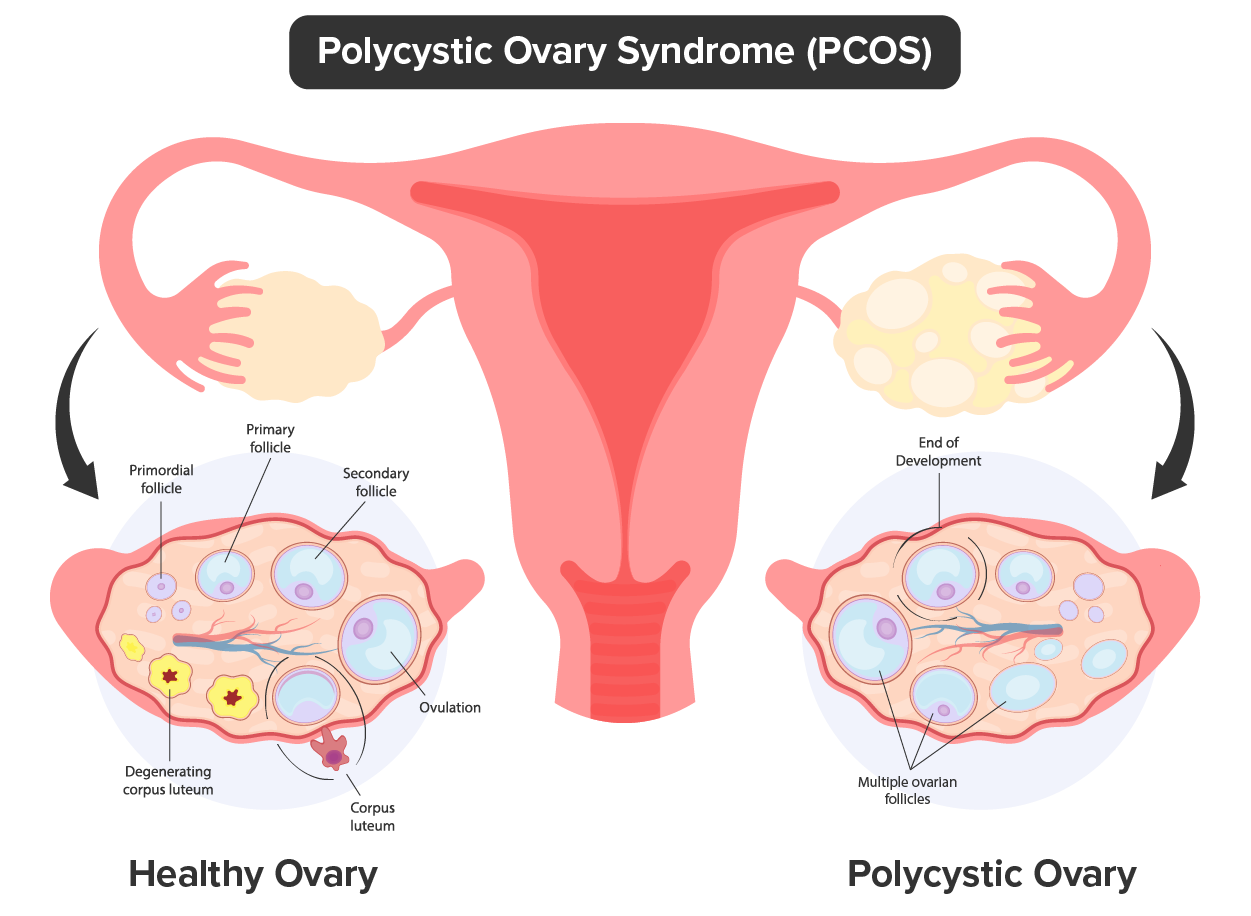
PCOS is a relatively common hormone disorder in women of reproductive age. In PCOS, there is the development of small cysts (sacs with fluid) along the ovary that have follicles within them, but the follicles are not able to release eggs as they are supposed to.

Some common symptoms of PCOS include irregular menstruation, abnormal hair growth, acne, obesity, and infertility. PCOS is also associated with some long-term complications, such as type 2 diabetes and heart disease. Although the exact causes of PCOS are not known, early diagnosis, treatment, and weight loss can lower the risks of long-term complications.

Illustration of the female reproduction organs.  The left shows a blowup of a healthy ovary. Inside the ovary, we see (in a clockwise pattern) the primordial follicle, then the primary follicle, then the secondary follicle, finally ovulation, which is followed by corpus luteum, the ovarian follicle, the degenerating corpus luteum, and finally corpus albicans. On the right side, there is a blown-up diagram of a polycystic ovary. Inside this ovary we see (in a counter-clockwise pattern) the primordial follicle, then the primary follicle, then secondary follicle which has the label “end of development” surrounding it, next we see multiple ovarian follicles.
Polycystic Ovarian Syndrome (PCOS)

Term Pronunciation Table

Term Pronunciation Audio File
Folliculogenesis Fol·li·cul·o·gen·e·sis
Primordial Follicles pri·mor·di·al fol·li·cles
Granulosa Cells gran·u·lo·sa cells
Theca Cells the·ca cells
Antrum an·trum

terms to know
Folliculogenesis
Development of ovarian follicles from primordial to tertiary under the stimulation of gonadotropins.
Primordial Follicles
The least developed ovarian follicles; they consist of a single oocyte and a single layer of flat (squamous) granulosa cells.
Granulosa Cells
Supportive cells in the ovarian follicle that produce estrogen.
Primary Follicles
Ovarian follicles with a primary oocyte and one layer of cuboidal granulosa cells.
Secondary Follicles
Ovarian follicles with a primary oocyte and multiple layers of granulosa cells.
Theca Cells
Estrogen-producing cells in a maturing ovarian follicle.
Antrum
The fluid-filled chamber that characterizes a mature tertiary (antral) follicle.
Tertiary Follicles
(also, antral follicles) Ovarian follicles with a primary or secondary oocyte, multiple layers of granulosa cells, and a fully formed antrum.

summary
In this lesson, you learned about how ovarian follicles grow and develop by the process of folliculogenesis. First, you explored that the ovarian cycle includes two processes: oogenesis and folliculogenesis. Then, you examined how folliculogenesis occurs by ovarian follicle development from primordial to tertiary follicles under gonadotropin stimulation.

Source: THIS TUTORIAL HAS BEEN ADAPTED FROM (1) "ANATOMY AND PHYSIOLOGY 2E" ACCESS FOR FREE AT OPENSTAX.ORG/DETAILS/BOOKS/ANATOMY-AND-PHYSIOLOGY-2E. (2) "BIOLOGY 2E" ACCESS FOR FREE AT OPENSTAX.ORG/DETAILS/BOOKS/BIOLOGY-2E. LICENSING (1 & 2): CREATIVE COMMONS ATTRIBUTION 4.0 INTERNATIONAL

REFERENCES
Mayo Clinic. “Ovarian cysts”. Retrieved November 8, 2023, from www.mayoclinic.org/diseases-conditions/ovarian-cysts/symptoms-causes/syc-20353405

Mayo Clinic. “Polycystic ovary syndrome (PCOS)”. Retrieved November 8, 2023, from www.mayoclinic.org/diseases-conditions/pcos/symptoms-causes/syc-20353439


Terms to Know
Antrum

The fluid-filled chamber that characterizes a mature tertiary (antral) follicle.

Folliculogenesis

Development of ovarian follicles from primordial to tertiary under the stimulation of gonadotropins.

Granulosa Cells

Supportive cells in the ovarian follicle that produce estrogen.

Ovarian Cycle

The approximately 28-day cycle of changes in the ovary consisting of a follicular phase and a luteal phase.

Primary Follicles

Ovarian follicles with a primary oocyte and one layer of cuboidal granulosa cells.

Primordial Follicles

The least developed ovarian follicles; they consist of a single oocyte and a single layer of flat (squamous) granulosa cells.

Secondary Follicles

Ovarian follicles with a primary oocyte and multiple layers of granulosa cells.

Tertiary Follicles

(also, antral follicles) Ovarian follicles with a primary or secondary oocyte, multiple layers of granulosa cells, and a fully formed antrum.

Theca Cells

Estrogen-producing cells in a maturing ovarian follicle.