In this lesson, you will learn how the DuPont equation breaks down return on equity (ROE) into components that reveal what drives a company’s profitability. You’ll explore how profit margin, asset turnover, and financial leverage interact to explain changes in performance and how each element can guide strategic decision making. Specifically, this lesson will cover:
1. The DuPont Equation
The DuPont equation is a means of calculating return on equity (ROE) based on three components:
- Net profit margin
- Total asset turnover
- Financial leverage
The title originates from the DuPont Corporation. This organization began using this formula as early as the 1920s in its strategic analysis. Ultimately, the name stuck and is what we commonly use today to refer to the formula.
In the DuPont equation, ROE equals profit margin multiplied by asset turnover multiplied by financial leverage, where each component can be broken down into further calculations.
-
- Return on Equity

ROE measures the rate of return on the ownership interest or shareholders’ equity of the common stock owners. It is a measure of a company’s efficiency in generating profits using the shareholders’ stake of equity in the business. In other words, ROE is an indication of how well a company uses investment funds to generate earnings growth. It is also commonly used as a target for executive compensation since ratios such as ROE tend to give management an incentive to perform better.
-
Returns on equity between 15% and 20% are generally considered to be acceptable.
-
EXAMPLE
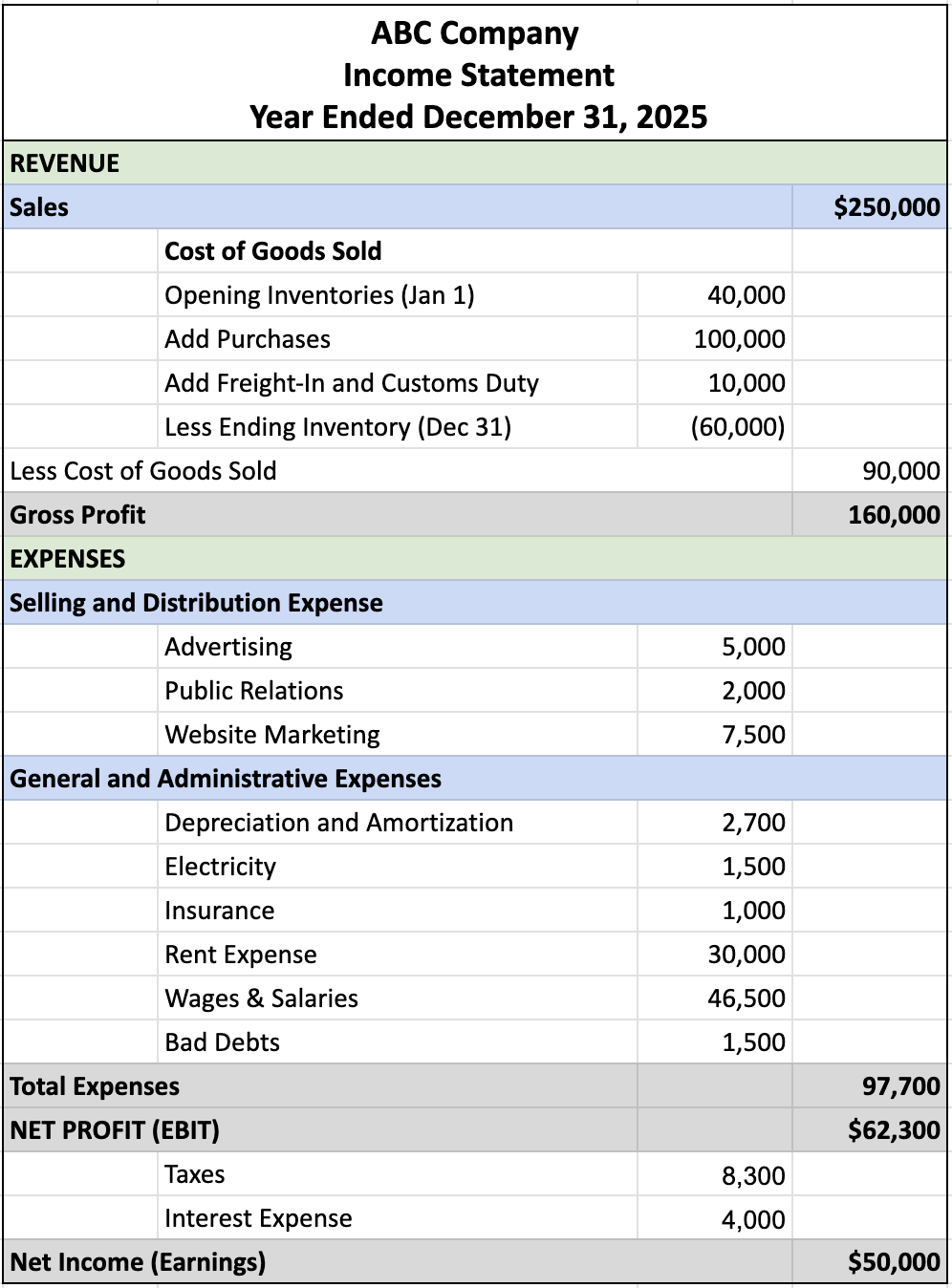
You are analyzing the financial performance of ABC Company. Below is their income statement on December 31, 2025:
Step 1: Calculate the return on equity using the DuPont equation (assets from the balance sheet are valued at $300,000, and equity is valued at $450,000).
 Step 2: Break down the DuPont equation to calculate the profit margin, the asset turnover, and the financial leverage.


 Step 3: Interpret what return on equity tells you about the financial health of ABC Company.
For return on equity, 15-20% is considered good, indicating strong profitability and efficient capital use, and ROE above 20% is exceptional, showcasing the company's ability to generate significant returns for its shareholders. If ROE is 14% or lower, it may be considered low, suggesting the company is not effectively utilizing its equity to generate profits. ABC’s ROE is 11% which means it needs to evaluate its use of equity due to it being too low.
A "good" profit margin should be above 10% with excellent eclipsing 20%. ABC’s profit margin is 20%, which means it is healthy to excellent and has strong profitability. Its asset turnover is moderate at 0.83, meaning it generates $.83 of revenue for every dollar of assets, and shows decent efficiency in using assets to generate revenue, Finally, its financial leverage is 0.67 indicating ABC has more equity than assets, which could suggest excess cash, underutilized capital, or a conservative capital structure.
-
You are analyzing the financial performance of the Pierviczu Company. Below is current, per share, data about its stock:
|
Financial Information
|
Amount ($)
|
|
Revenue (Sales)
|
900,000
|
|
Total Assets
|
640,000
|
|
Shareholders’ Equity
|
245,000
|
|
Net Income
|
150,000
|
Interpret what the return on equity tells you about the financial health of Pierviczu Company.
Pierviczu’s profit margin is 0.17, meaning the company earns 17 cents in profit for every dollar of sales. It is a decent margin, suggesting good cost control or pricing power.
Their asset turnover is 1.4. This is relatively high, indicating that the company is efficient at using its assets to generate revenue. They generate $1.40 of revenue for every dollar of assets.
Pierviczu’s financial leverage is 2.61, indicating the company uses a significant amount of debt relative to equity. Leverage amplifies returns. If a company earns more on its assets than it pays in interest on its debt, using debt can boost ROE, but it also increases risk. If profits fall, debt payments still need to be made, which can hurt equity returns.
The company is performing exceptionally well, with each component of the DuPont equation contributing positively to its high ROE of 0.61. This suggests strong operational efficiency, effective asset utilization, and strategic use of debt.
1a. Components
By splitting ROE into three parts, companies can more easily understand changes in their ROE over time. Let’s take a closer look at the three components of the DuPont equation:
-
Profit margin: This is a measure of profitability. It is an indicator of a company’s pricing strategies and how well the company controls costs. Profit margin is calculated by finding the net income as a percentage of the sales (total revenue). As one feature of the DuPont equation, if the profit margin of a company increases, every sale will bring more money to a company’s bottom line, resulting in a higher overall ROE.
-
Asset turnover: This is a financial ratio that is used to evaluate how effectively an organization is utilizing its assets to generate a profit. Organizations that typically have lower net margins will have higher total asset turnover, and vice versa for firms with higher net margins.
-
Financial leverage: This refers to the amount of debt that a company utilizes to finance its operations, as compared with the amount of equity that it utilizes. As is the case with asset turnover and profit margin, increased financial leverage will also lead to an increase in ROE. This is because the increased use of debt as financing will cause a company to have higher interest payments, which are tax deductible. Because dividend payments are not tax deductible, maintaining a high proportion of debt in a company’s capital structure leads to a higher ROE.
-
Expressed as a percentage, ROE is best used to compare companies in the same industry. The decomposition of ROE into its various factors presents various ratios useful to companies in fundamental analysis.
IN CONTEXT
As you are learning, ROE is a measure of how a company uses its shareholders’ equity in the business to earn a profit. Assume that Alphabet Inc., parent company of Google, has a current ROE of 26.04%. Even though that is an impressive ROE, Alphabet strives for continual improvement and wants to examine this return.
Using the ROE formula, Alphabet can only see a part of the story.

The problem with this equation is that ROE is multifaceted, and using this equation does not give the company or the investors the full picture. This is where the DuPont equation steps in. The DuPont equation dives deeper into the components of ROE so the individual pieces can be studied, and potential action can be taken to improve one or many of the components. You can find the component pieces in Alphabet’s financial statements:
|
Financial Information
|
Millions ($)
|
|
Net Income
|
73,795
|
|
Sales (Total Revenue)
|
305,360
|
|
Total Assets
|
402,392
|
|
Shareholder’s Equity
|
283,379
|
Now, let’s apply the DuPont equation to our example:

Using the component pieces of ROE, Alphabet can determine which, if any, of these parts can be improved upon to increase the ROE.
-
1b. Potential Limitations
A high ROE does not necessarily mean that a company will see immediate benefits. Stock prices are most strongly determined by earnings per share (EPS) as opposed to ROE. EPS is the amount of earnings for each outstanding share of a company’s stock. EPS is equal to profit divided by the weighted average of common shares.
-
- Earnings per Share

-
EXAMPLE
You are analyzing the financial performance of ABC Company. Below is current information about the company:
|
Financial Information
|
Amount ($)
|
|
Net Income
|
50,000
|
|
Weighted Average of Common Shares
|
10,000
|
Step 1: Calculate earnings per share.
 Step 2: Interpret what the earnings per share tells you about the financial health of ABC Company.
An earnings per share (EPS) that is greater than 5 is considered good, indicating strong profitability. If EPS falls into the 1 to 5 range, the company may be deemed to have fair and stable earnings. An EPS that is less than 1 suggests poor or weak earnings and may raise concerns about profitability.
ABC Company’s EPS ratio is 5. This falls into the fair/good area, indicating strong profitability. A high EPS is only “good” if it’s sustainable and not due to one-time gains or cost cutting.
The true benefit of a high ROE comes from a company’s earnings being reinvested into the business or distributed as a dividend. In fact, ROE is presumably irrelevant if earnings are not reinvested or distributed.
In this lesson, you learned about the DuPont equation, which decomposes return on equity (ROE) into three key components: profit margin, asset turnover, and financial leverage. This formula shows how efficiently a company generates profit from sales, uses its assets to produce revenue, and leverages debt to amplify returns. You saw that a higher ROE indicates strong profitability and effective capital use, while a low ROE may signal inefficiencies or underutilized resources.
You also considered potential limitations: While a high ROE can be attractive, it must be supported by sustainable earnings. The lesson also introduced earnings per share (EPS) as a related measure of profitability, highlighting that a company’s long-term success depends on reinvesting or distributing its profits wisely.
Together, these tools provide a deeper understanding of how operational efficiency, asset use, and financial structure shape shareholder returns.