Table of Contents |
In comparison with other industries, medical teams especially in the dynamic domains of healthcare (such as operating rooms, intensive care, emergency medicine, or trauma, and rapid response teams) work under conditions that:
The structure of the task and the situation in which a team functions are critical to understanding and improving teamwork. Healthcare teams interact dynamically and have the common goal of delivering health services to patients. Teams in healthcare can be geographically located, as in a surgical unit, or include a single discipline such as nursing. Multidisciplinary teams may include doctors, nurses, pharmacists, social workers, and administrative staff. The role these practitioners will play will vary between teams and within teams. Patients and caregivers are important members of the team especially in regard to shared-decision making, informed consent, and taking an active part in their care.
The Team STEPPS™ program is an evidence-based framework to optimize team performance across the healthcare delivery system. It identifies a number of different but interrelated team types that support the delivery of care (AHRQ, 2020):
| Types of Teams in Healthcare | Description |
|---|---|
| Core Teams | Team leaders and members who are directly involved in caring for the patient. |
| Coordinating Teams | Group responsible for daily operational management, coordination functions, and resource management |
| Contingency Teams | Formed for emergent or specific events (e.g., disaster, rapid-response). Members drawn from core teams |
| Ancillary Services | Individuals such as cleaners or staff who provide direct, task-specific, time-limited care to patients or support services that facilitate patient care. |
| Support services and administration | Individuals who provide indirect, task-specific services in a healthcare facility. Administration includes executive leadership of unit or facility and has 24-hour accountability for overall functioning of the organization. |
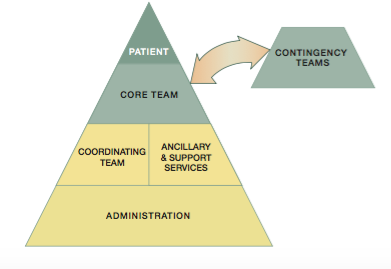
Source: AHRQ. (2020). TeamSTEPPS Fundamentals Course: Module 2. Team Structure. Retrieved 9 October 2020, from https://www.ahrq.gov/teamstepps/instructor/fundamentals/module2/igteamstruct.html
Research has shown that in order to become a highly effective team that is cohesive, and can navigate and overcome challenges, it usually passes through the following stages:
After the team is established and continues to grow, they will need to share certain characteristics to be successful.
Characteristics of a healthcare team include:
Support
If you are struggling with a concept or terminology in the course, you may contact [email protected] for assistance.
If you are having technical issues, please contact [email protected].



