Table of Contents |
The purpose of the cardiovascular system (sometimes called the circulatory system) is to move blood throughout the body. Blood provides our tissues with oxygen and other necessary materials. It also aids in the removal of carbon dioxide.
The cardiovascular system is composed of:
There is no single better word to describe the function of the heart other than “pump,” since its contraction develops the pressure that ejects blood into the major vessels: the aorta and pulmonary trunk. From these vessels, the blood is distributed to the remainder of the body. Although the connotation of the term “pump” suggests a mechanical device made of steel and plastic, the anatomical structure is a living, sophisticated muscle.
In this lesson, you will learn about the system of blood vessels in the human body. In a future lesson, you will learn more about the heart.
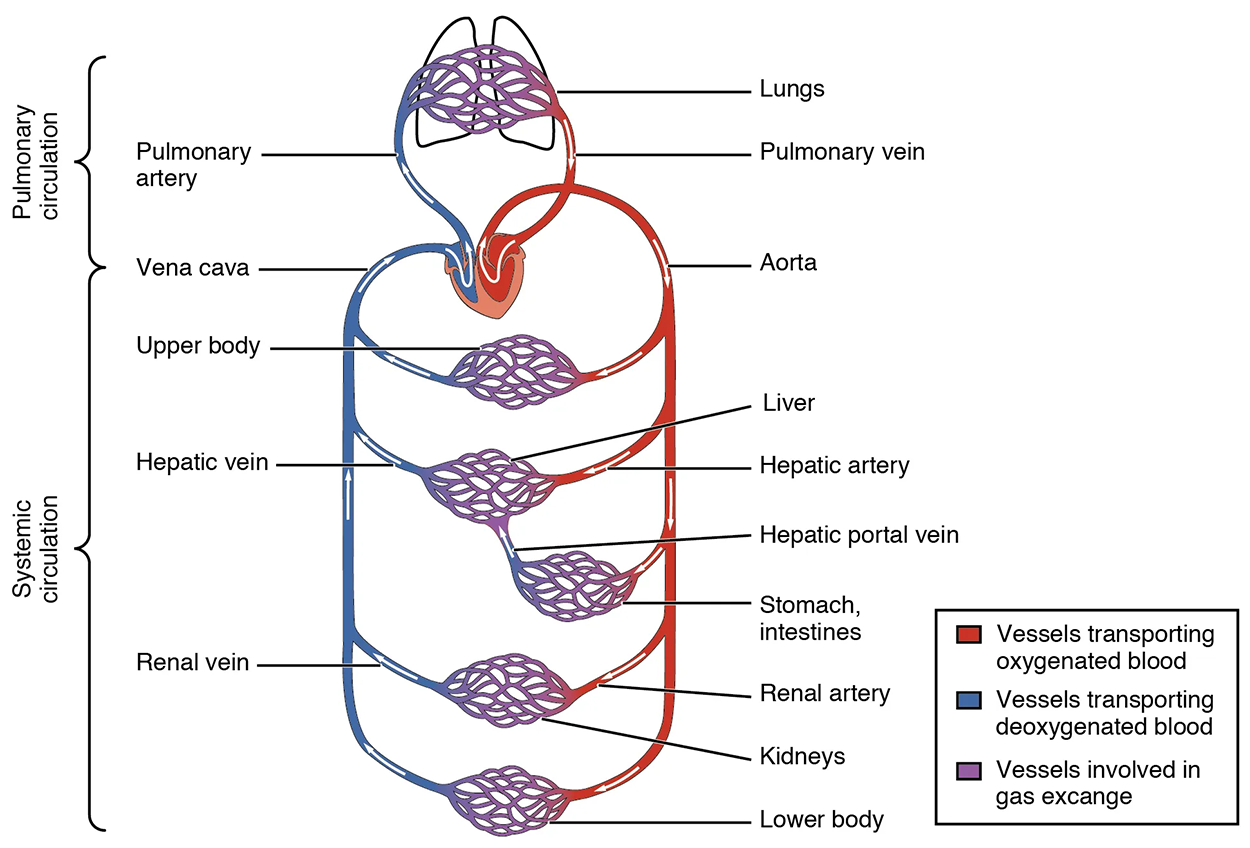
Blood is carried through the body via blood vessels. There are three general categories of blood vessels in the body: arteries, capillaries, and veins. An artery is a blood vessel that carries blood away from the heart, where it branches into ever-smaller vessels. Eventually, the smallest arteries branch into tiny capillaries, where nutrients and wastes are exchanged. Capillaries then combine with one another to form a vein, a blood vessel that returns blood to the heart.
Arteries, capillaries, and veins transport blood in two distinct circuits: the systemic circuit and the pulmonary circuit. Systemic arteries provide blood rich in oxygen to the body’s tissues. The blood returned to the heart through systemic veins has less oxygen, since much of the oxygen carried by the arteries has been delivered to the cells. In contrast, in the pulmonary circuit, arteries carry blood low in oxygen exclusively to the lungs for gas exchange. Pulmonary veins then return freshly oxygenated blood from the lungs to the heart to be pumped back out into systemic circulation.
The coronary circuit is another form of blood transport that is considered part of the systemic system. The heart is an organ in need of nutrients and the removal of wastes just like all tissues, and the coronary circuit is specific circulatory flow that accomplishes this. The coronary circuit provides oxygenated blood to the heart and removes deoxygenated blood.
Coronary circulation intrinsic to the heart takes blood directly from the main artery (aorta) coming from the heart. For pulmonary and the rest of systemic circulation, the heart has to pump blood to the lungs or the rest of the body, respectively.
Different types of blood vessels vary slightly in their structures, but they share the same general features. Arteries have thicker walls than veins because they are closer to the heart and receive blood that is surging at a far greater pressure. Each type of vessel has a lumen—a hollow passageway through which blood flows. Arteries have smaller lumens than veins, a characteristic that helps to maintain the pressure of blood moving through the system. Together, their thicker walls and smaller diameters give arterial lumens a more rounded appearance in cross section than the lumens of veins.
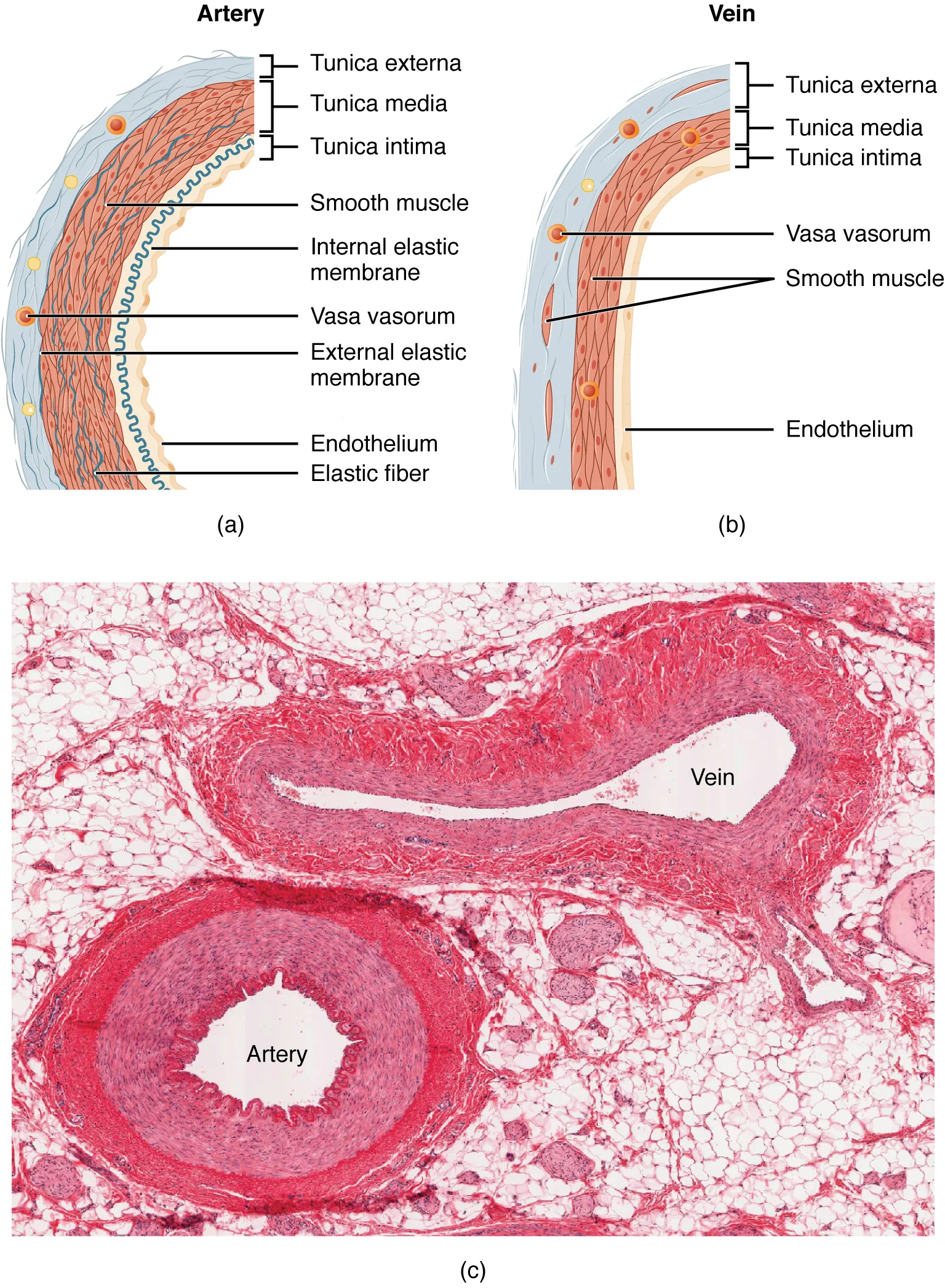
Both arteries and veins have the same three distinct tissue layers, called tunics (tunica, coat). From the most interior layer to the outer, these tunics are the tunica intima, the tunica media, and the tunica externa.
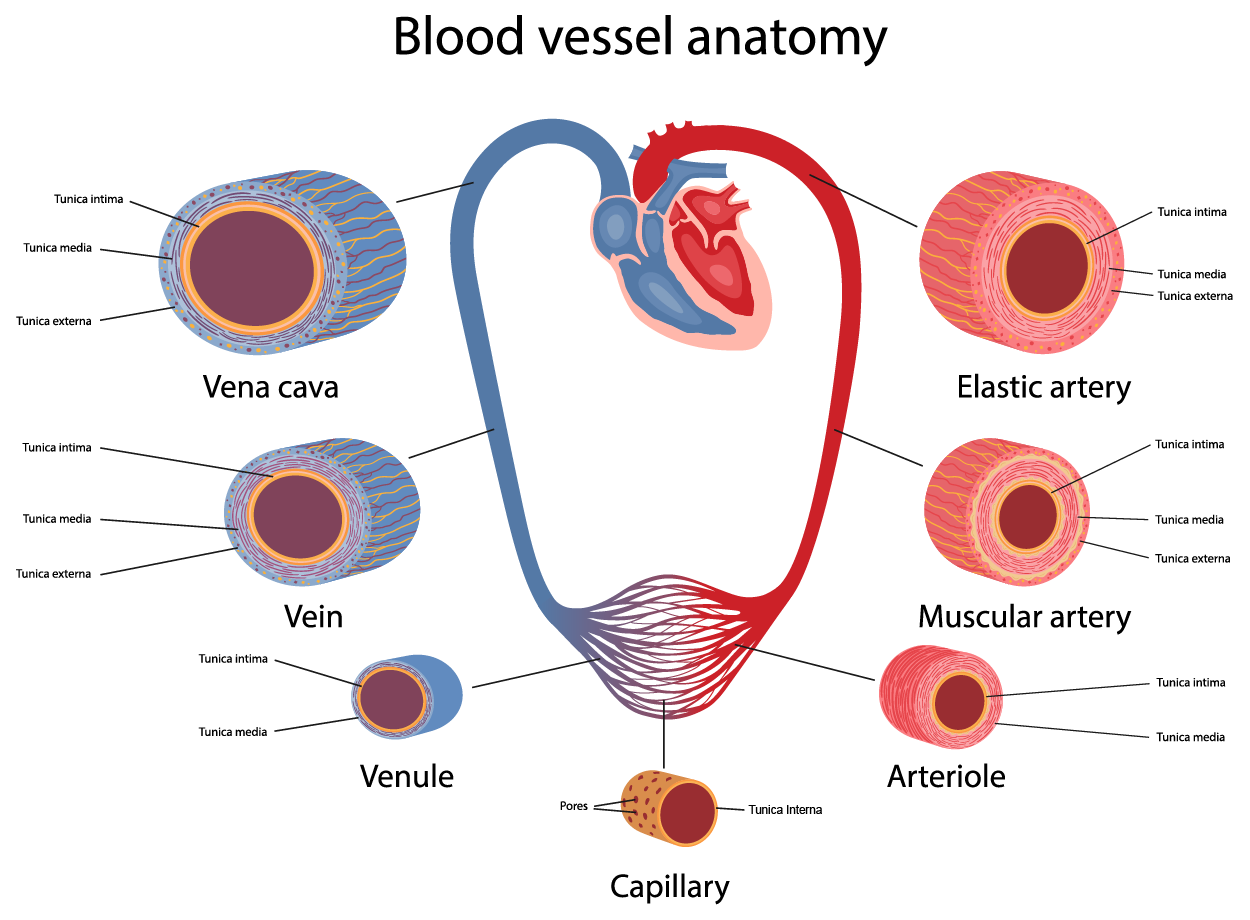
The tunica interna (also called the tunica intima) is composed of epithelial and connective tissue layers. Composing the tunica interna is the specialized simple squamous epithelium called the endothelium, which is continuous throughout the entire vascular system, including the lining of the chambers of the heart. Damage to this endothelial lining and exposure of blood to the collagenous fibers beneath is one of the primary causes of clot formation.
The tunica media is the substantial middle layer of the vessel wall. It is generally the thickest layer in arteries, and it is much thicker in arteries than it is in veins. The tunica media consists of layers of smooth muscle supported by connective tissue that is made up primarily of elastic fibers. Toward the outer portion of the tunic, there are also layers of longitudinal muscle. Contraction and relaxation of the circular muscles decrease and increase the diameter of the vessel lumen, respectively. Specifically in arteries, vasoconstriction decreases blood flow as the smooth muscle in the walls of the tunica media contracts, making the lumen narrower and increasing blood pressure. In contrast, vasodilation increases blood flow as the smooth muscle relaxes, allowing the lumen to widen and blood pressure to drop.
The outer tunic, the tunica externa (also called the tunica adventitia), is a substantial sheath of connective tissue primarily composed of collagenous fibers. Some bands of elastic fibers are found here as well. The tunica externa in veins also contains groups of smooth muscle fibers. This is normally the thickest tunic in veins and may be thicker than the tunica media in some larger arteries.
The outer layers of the tunica externa are not distinct but rather blend with the surrounding connective tissue outside the vessel, helping to hold the vessel in relative position.
Because blood passes through the larger vessels relatively quickly, there is limited opportunity for blood in the lumen of the vessel to provide nourishment to or remove waste from the vessel’s cells. Further, the walls of the larger vessels are too thick for nutrients to diffuse through to all of the cells. Larger arteries and veins contain small blood vessels within their walls known as the vasa vasorum—literally “vessels of the vessel”—to provide them with this critical exchange. Since the pressure within arteries is relatively high, the vasa vasorum must function in the outer layers of the vessel, or the pressure exerted by the blood passing through the vessel would collapse it, preventing any exchange from occurring. The lower pressure within veins allows the vasa vasorum to be located closer to the lumen.
The table below compares and contrasts the tunics of the arteries and veins.
| Comparison of Tunics in Arteries and Veins | ||
|---|---|---|
| Tunics | Arteries | Veins |
| General appearance |
Thick walls with small lumens Generally appear rounded |
Thin walls with large lumens Generally appear flattened |
| Tunica intima |
Endothelium usually appears wavy due to constriction of smooth muscle in the tunica media Internal elastic membrane present in larger vessels |
Endothelium appears smooth Internal elastic membrane absent |
| Tunica media |
Normally the thickest layer in arteries Smooth muscle cells and elastic fibers predominate (the proportions of these vary with distance from the heart) External elastic membrane present in larger vessels |
Normally thinner than the tunica externa Smooth muscle cells and collagenous fibers predominate Vasa vasorum present External elastic membrane absent |
| Tunica externa |
Normally thinner than the tunica media in all but the largest arteries Collagenous and elastic fibers Vasa vasorum present |
Normally the thickest layer in veins Collagenous and smooth fibers predominate Some smooth muscle fibers Vasa vasorum present |
SOURCE: THIS TUTORIAL HAS BEEN ADAPTED FROM OPENSTAX “ANATOMY AND PHYSIOLOGY 2E”. ACCESS FOR FREE AT OPENSTAX.ORG/BOOKS/ANATOMY-AND-PHYSIOLOGY-2E/PAGES/1-INTRODUCTION. LICENSE: CREATIVE COMMONS ATTRIBUTION 4.0 INTERNATIONAL.



