Table of Contents |
Over this challenge and the next, we will explore the intersection between the related concepts of leadership and management. While leadership can be assumed by someone in any role in an organization, management is the official capacity that often (but not always) involves directing others.
In talking about leadership, it is unavoidable to talk about management, as official leadership roles are associated with managers in guiding, motivating, and evaluating staff. Meanwhile, effective managers will usually be good leaders, though there are managerial roles with minimal leadership responsibilities.
Management and leadership are often used interchangeably, as they represent intertwined functions within an organization. However, management is not the same as, or equivalent to, leadership. Management primarily focuses on the systematic processes and efficient execution of tasks to achieve established goals. Managers are responsible for planning, organizing resources, directing operations, and controlling outcomes, ensuring that work is completed effectively and on schedule. They often deal with the "how" and "when" of tasks, maintaining stability and order within existing structures.
Leadership, on the other hand, centers on inspiring and influencing people toward a shared vision. Leaders are concerned with the "what" and "why," articulating a compelling future and motivating individuals to embrace change and innovation. They build trust, promote growth, and challenge the status quo, guiding teams through transformation rather than merely maintaining current operations. While a manager might oversee daily tasks, a leader encourages individuals to develop new skills and contribute to broader, long-term objectives. While both roles are vital, management ensures efficiency, while leadership sparks direction and commitment.
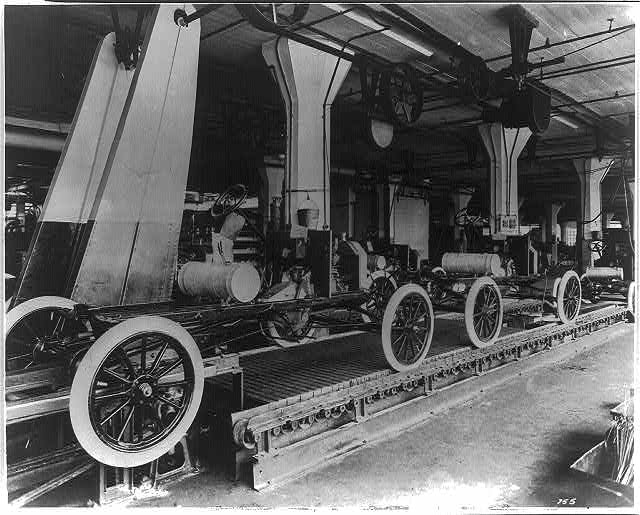
Frederick Winslow Taylor's groundbreaking work on scientific management was a pivotal moment in the history of organizational thought that directly relates to leadership. Taylor's approach sought to improve economic efficiency, especially labor productivity, by applying scientific methods to management (Hounshell, 1988). We examine his core ideas that aim at optimizing workflows. We focus on the four key principles of scientific management, understanding how they revolutionized industrial production and laid the foundational groundwork for many modern management practices, influencing how tasks are designed and executed in workplaces today.
Taylorism was based on four principles of management:
| Principle | Description |
|---|---|
| Develop a science for each element of work | This means analyzing tasks to find the most efficient method, moving beyond traditional "rule-of-thumb" approaches, like studying the best way for a factory worker to assemble a product. |
| Scientifically select and train workers | This involves choosing employees based on their aptitudes and then providing systematic training to perform their tasks with maximum efficiency. |
| Ensure cooperation between management and workers | This principle emphasizes collaboration and shared goals between managers and employees, shifting from potential conflict to mutual benefit. |
| Divide work and responsibility | Management plans and designs the work, while workers execute it, ensuring each group specializes in what they do best. |

Principle 1: A manager should develop a rule of science for each aspect of a job. Following this principle ensures that work is based on objective data gathered through research rather than rules of thumb. For example, many people believed that allowing workers to take breaks would limit how much work could be done. After all, how could a worker produce if he were not working? Taylor changed this attitude through research that demonstrated the benefits of breaks during the workday. Due to Taylor’s research, we now enjoy coffee breaks.
When Frederick Taylor spoke of "developing a science for each element of work," he meant replacing old, inefficient ways of doing things with methods based on careful study and analysis. This "science" involved breaking down each task into its smallest components, observing and measuring how long each step took, and then identifying the most efficient way to perform that task.
EXAMPLE
If workers were loading pig iron onto train cars, Taylor wouldn't just tell them to load faster. Instead, he would study their movements, the tools they used, and even how long they rested. From this scientific analysis, he could then determine the "one best way" to perform the task, which might include specific movements, tools, and even prescribed rest periods, to maximize efficiency and output. This objective, data-driven approach replaced the imprecise "rule-of-thumb" methods that were common in workplaces at the time.Principle 2. Scientifically select and train each worker. Prior to Taylor’s work, the selection of workers was made based on favoritism, nepotism, or random choice. Taylor himself got his job at Midvale because the owner was his father’s friend. Likewise, workers were usually selected for a particular job with little consideration of whether they were physically or mentally fit to perform it. Taylor changed this viewpoint by using research to find the best worker for the job.
Principle 3. Management and the workforce should work together to ensure that work is performed according to the principles of management. Taylor’s observation went against the long-established principles of both management and the worker who believed that each was the other’s enemy. Rather than enmity, Taylor stressed cooperation and the need for the work relationship to be mutually beneficial.
Principle 4. Work and responsibility should be equally divided between management and workers. Previously, management set the directives, and workers obeyed or blocked them. Taylor believed that management and workers had joint responsibilities to each other. Management’s responsibility was to scientifically select the quantity of output for the day and provide a fair wage. In return, workers were to provide a fair day’s work.
IN CONTEXT: Precision Parts, Inc.
At Precision Parts Inc., to apply Taylor’s first principle, managers develop a scientific rule for each job aspect. Instead of relying on guesswork, they analyze every step of machining a component. For instance, they use time-and-motion studies to precisely determine the optimal cutting speed, tool angle, and sequence of operations for each type of metal and part. This means breaking down complex tasks into smaller, measurable elements. By identifying the most efficient method for even simple actions, such as loading raw material onto a lathe or inspecting a finished part, management ensures that every worker performs their duties based on a scientifically determined "best way," rather than individual preference.
Applying Taylor's second principle, they select candidates through a series of dexterity tests and visual acuity assessments, identifying individuals with the innate fine motor skills and keen eyesight needed for the job. Once selected, new hires undergo rigorous scientific training. Instead of learning by trial and error, they are taught the "one best way" to solder, determined by motion studies. This training includes precise hand movements, optimal tool angles, and specific timing for each solder joint, ensuring consistent quality and peak efficiency from every worker.
Applying Taylor's third principle—that management and the workforce should work together—operations managers and engineers conduct detailed studies to identify the most efficient sequence for component placement. They then engaged the assembly line workers, not just instructing them, but actively seeking their input on the practicality of the new steps. Workers, understanding the goal of improved quality and speed, offered valuable suggestions to refine the process. This collaborative approach ensured the optimized method was both theoretically sound and effectively implemented on the factory floor, leading to consistent, high-quality output through shared commitment.
Applying the fourth principle of Taylor's scientific management, the management and staff of PPI have clear responsibilities to each other. Management meticulously plans the production process. They analyze blueprints, determine the most efficient sequence of operations, and design specialized tools for each component, all with consideration of efficiency and worker wellness.
Meanwhile, the skilled machinists on the shop floor focus entirely on executing these detailed plans. They operate the machinery, follow precise instructions for cutting and shaping materials, and ensure quality control in accordance with the standards set by management. This clear division enables managers to optimize methods and workers to become highly proficient in their respective tasks, resulting in consistent, high-quality output.
Henri Fayol, a pioneer in management theory, provided a comprehensive framework of fourteen principles that focus on how management is distinct from leadership, including the practical execution and efficient operation of an organization. These principles outline the "how" of getting work done, prioritizing efficiency and productivity above all else (Peek, 2025).
| Principle | Description |
|---|---|
| Division of Work | Specializing tasks among employees to increase efficiency through individual skill development. |
| Authority & Discipline | Managers have the right to give orders; employees must obey and respect rules, creating a clear operational framework. |
| Unity of Command | Each employee reports to only one superior, preventing conflicting instructions and ensuring clear reporting. |
| Unity of Direction | Groups with similar activities share one plan and one leader, aligning efforts for efficient goal achievement. |
| Subordination of Individual Interest to General Interest | Organizational goals take precedence over personal agendas, ensuring collective effort. |
| Remuneration | Fair payment for services, motivating employees, and contributing to overall productivity. |
| Centralization | The degree to which decision-making authority is concentrated at the top, impacting decision speed and effectiveness. |
| Scalar Chain | A clear line of authority from top to bottom, facilitating orderly communication and efficient directive flow. |
| Order | A place for everything and everyone, promoting a systematic and productive work environment. |
| Equity | Fair and kind treatment of employees, contributing to morale and consistent productivity. |
| Stability of Tenure of Personnel | Reducing employee turnover to maintain a stable, efficient, and productive workforce. |
| Initiative | Encouraging employees to develop and execute plans within their responsibilities, empowering task execution. |
| Esprit de Corps | Fostering team harmony and unity, leading to a positive work environment and enhanced collective productivity. |
In Context: Fayol’s Principles of Management + Amazon
Consider a large-scale e-commerce fulfillment center for a major online retailer, such as Amazon. Here, management is distinctly focused on the "how" of moving products efficiently from warehouse to customer, rather than the "why" of broader retail strategy or brand vision.
Within this center, the Division of Work is key; some employees specialize in picking items, others in packing, and still others in loading for shipment. This specialization dictates how each step of the order fulfillment process is executed with maximum speed. Authority is clearly defined, with shift managers directing supervisors, who in turn oversee teams of associates. This hierarchy ensures that instructions on how to process orders quickly are followed, with Discipline maintaining adherence to strict safety and productivity metrics.

Unity of Command means each picker or packer reports to one immediate supervisor, preventing conflicting instructions on how to perform their tasks. Unity of Direction ensures all departments—receiving, stocking, picking, packing, and shipping—are aligned towards the single goal of dispatching orders rapidly, illustrating how collective effort is channeled for productivity. Remuneration is often tied to hourly output or team productivity targets, directly motivating employees to work efficiently.
The Scalar Chain is visible in the clear lines of communication and reporting from the warehouse floor up to the operations manager, detailing how information about inventory flow or bottlenecks is communicated. Order is critical; every product has a precise location, and every piece of equipment is maintained for immediate use, defining how the chaos of millions of items is managed to ensure quick retrieval and dispatch. Even Initiative is framed around improving processes: an employee might suggest a better way to scan items to save seconds, directly boosting efficiency. This focus on the "how" through Fayol's principles enables the fulfillment center to achieve its core management objectives of high efficiency and rapid productivity (Spencer, et al., 2021).
Building on his principles, Henri Fayol also outlined five essential functions that define the manager's role, providing a practical framework for how organizations are run. These functions describe the active duties managers perform to ensure efficiency and productivity within any enterprise.
| Function | Definition/Example |
|---|---|
| Planning | This involves looking ahead to set goals and outline the actions required to achieve them, like creating a roadmap for a project. |
| Organizing | This is about establishing the structure of the enterprise, arranging resources, and delegating tasks. Think of it as building the framework for how work will be done. |
| Staffing | This focuses on finding, hiring, training, and retaining the right personnel for various roles, making sure the team has the people it needs. |
| Coordinating | This means guiding and motivating employees to perform their duties and achieve organizational objectives, similar to a coach inspiring a team. |
| Controlling | This is the function of monitoring performance against established standards, identifying deviations, and taking corrective action to keep the organization on track. |
In Context: Sticker Stop
Sticker Stop is a small business making custom window stickers. This example shows Henri Fayol's management functions at work.

Planning involves Penny, the owner, who creates detailed six-month plans twice per year. These plans, like her idea for hand-painted stickers, often include ambitious goals and unlikely contingencies but rarely work out as intended. For example, her plan to launch a line of artisanal, hand-painted vinyl stickers fell apart when she realized no one on her team could actually paint.
Organizing falls to Omar, who assigns tasks based on proximity or availability. His method for allocating resources involves shouting across the workshop, "Who needs more vinyl?" Workflows resemble a chaotic dance where tasks get done just before they're due.
Staffing is Sheila's domain. Interviews are informal and often come as referrals. She hires people she likes and thinks will fit well in the company. Training new hires involves a quick demonstration and hands-on experience with the tricky sticker-cutting machine. Retention is good because the workers like the low-key environment.
Coordinating is handled by David, the senior team leader, who leads by example, even if that example is panicking before a deadline. He motivates staff with passionate speeches and impromptu pizza parties. When errors occur, David offers guidance through re-enactments.
Controlling is Carl's serious responsibility. He monitors performance with a stopwatch, timing sticker production. Deviations lead to detailed, handwritten reports that no one reads. His corrective actions involve moving office supplies or creating complex filing systems. He once tried to implement a system where employees had to log their bathroom breaks to "optimize time management," which was quickly overturned.
Few businesses have as starkly defined functions as this small business, and even at Sticker Stop, they can vary in details. Can you think of a local business where you have seen these functions in action? What improvements would you recommend based on this description?
Source: Adapted from Principles of Leadership at the University System of Georgia, licensed under Creative Commons 4.0
REFERENCES
Hounshell, D. A. (1988, November). The same old principles in the new manufacturing. Harvard Business Review. hbr.org/1988/11/the-same-old-principles-in-the-new-manufacturing
Peek, S. (2025, July 10). Management theory of Henri Fayol: Henri Fayol’s management theory outlines 14 principles and 5 key functions that shaped modern leadership, from planning and organizing to controlling. Business.com. www.business.com/articles/management-theory-of-henri-fayol/
Spencer, S., Harris, E. A., & Yaffe‑Bellany, D. (2021, February 18). They were Amazon’s eyes and ears in a pandemic. The New York Times Magazine. www.nytimes.com/2021/02/18/magazine/amazon-workers-employees-covid-19.html