Table of Contents |
The art, architecture, and design that you’ll see today date from 1919 to 1933.
The Bauhaus was a pioneering design school in Germany that embraced the utopian ideal of integrating art into everyday life. The Bauhaus aimed to bridge the gap between fine art and practical design, promoting the philosophy that art should be accessible to everyone and embedded in all aspects of daily living.
Similarly, a key principle of the International Style of architecture is that “form follows function.” Buildings were designed based on their intended use, rejecting unnecessary ornamentation and focusing on efficiency, practicality, and simplicity.
Today, you will embark on a journey to Dessau, Germany, where one of the most iconic Bauhaus schools was located. The Bauhaus was not merely a conceptual movement or philosophy about design; it was a tangible, physical school where the principles of Bauhaus design were put into practice.
The central mission of the Bauhaus was to improve the daily human experience through design. It sought to integrate the arts with industrial processes, emphasizing the harmonious relationship between form and function. The Bauhaus embraced pro-industrialization, believing that design could play a crucial role in shaping a better, more efficient, and more aesthetically pleasing world.
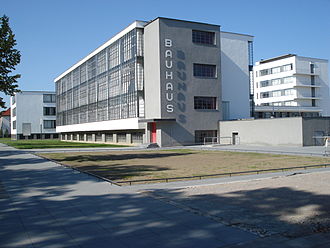
Bauhaus, Dessau (rebuilt according to Gropius’s original design)
1925 (original plan)
Dessau, Germany
The Bauhaus Dessau in Germany was designed by Walter Gropius in 1925. It follows the ideas of the International Style in how the building’s form follows its intended function, which Gropius outlined in his Bauhaus manifesto. Walter Gropius founded the Bauhaus in 1919 as a fusion of two other academies growing out of the foundation set by the Arts and Crafts movement.
The Bauhaus embraced the idea that was shared by De Stijl of improving humanity through design, along with the utopian vision of merging art and everyday life. It also emerged as a response to the perceived bleakness of Expressionism, which reflected the troubled political and economic conditions in Germany after World War I. The Bauhaus aimed to move beyond these dark themes, focusing instead on creating a more optimistic and functional approach to art and design.
Although the Bauhaus shared commonalities with the Arts and Crafts movement, they disagreed with some fundamental tenets, such as the Arts and Crafts movement’s rejection of industrialization and mass production. Bauhaus sought to integrate art with machines in the creation of useful yet beautiful objects that would be cheap to reproduce and available to everyone.
The Bauhaus was only open for 14 years before being shut down in 1933, and it had fewer than 500 students. Despite this, it has become one of the most influential design schools in Europe and the world. Its influence can still be felt in the world today, with iconic designs like the Barcelona chair that was designed by Mies van der Rohe.
This chair is called the Wassily Chair:
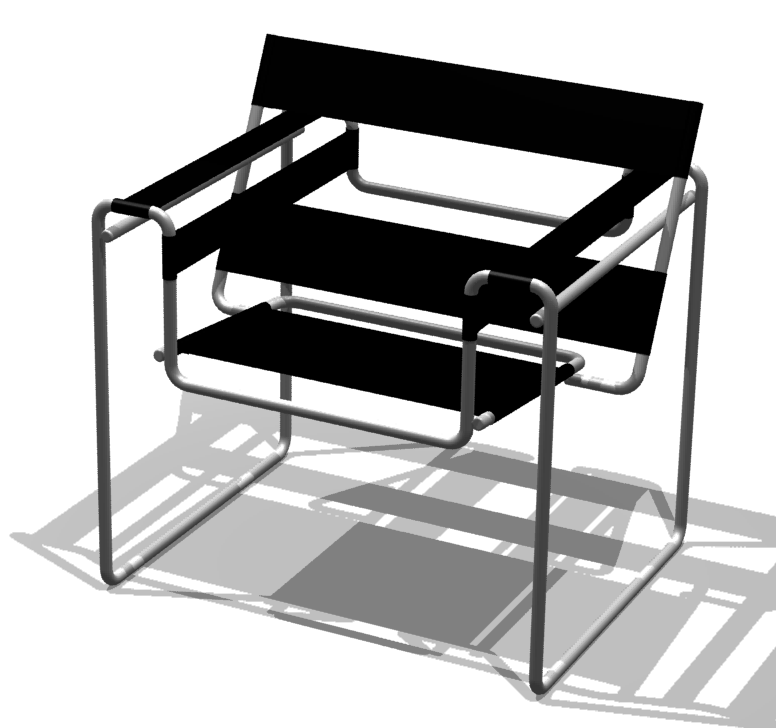
Wassily Chair
1925–1926
Tubular steel and canvas
Originally crafted from tubular steel without any welds and featuring a canvas seat, this piece is a quintessential example of Bauhaus design. It embodies key Bauhaus principles such as functional design, the use of innovative materials, the potential for mass production, and affordability. The irony, however, is that these designs, once intended to be accessible to all, are now often considered quite expensive.
Josef Albers was an artist associated with the Bauhaus, and his Homage to the Square, one of several similar paintings, demonstrates the influence of his studies as a student there in the 1920s.
 View Homage to the Square: Apparition.
His work is a deep exploration of the relationship between forms, textures, and colors, which captivated his artistic focus. After the Bauhaus, where he worked for nearly 9 years before it was shut down by the Nazi regime, he immigrated to the United States. There, he made a lasting influence on the study of color theory, writing a seminal treatise that remains influential in art education today.
At the Bauhaus, Albers was not just an artist but also an influential instructor, teaching alongside notable figures such as Marianne Brandt. The Bauhaus model of education was revolutionary, breaking away from traditional academic methods and instead adopting an interdisciplinary approach. This model was inspired by the structure of medieval guilds, where students learned directly from masters in a hands-on environment. In addition to Albers and Brandt, the Bauhaus faculty included renowned artists like Paul Klee and Wassily Kandinsky, who contributed to the school’s rich, collaborative atmosphere that blurred the lines between different art forms and crafts. This innovative approach to teaching and learning helped shape a new generation of artists and designers, leaving a profound legacy in the art world.
Brandt’s teapot design (pictured below) has gone on to become one of the most iconic, albeit less practical, designs from the Bauhaus school:

Teapot
Collections of the Smart Museum of Art, Chicago
1924
Silver and ebony wood
It’s a wonderful play of spherical and flat shapes that suggest the influence of Russian constructivism. Marianne Brandt’s teapot is a masterful composition that harmonizes spherical and flat shapes, showcasing a sophisticated understanding of form and function. The design reflects the influence of Russian Constructivism, with its emphasis on geometric abstraction and the fusion of art with practical, everyday objects. Brandt’s teapot is not merely a functional item; it is an exploration of how simple, geometric forms can be combined to create something both aesthetically striking and highly practical.
The architecture you’ll explore today dates from 1928 to 1960.
The International Style of architecture had a philosophy that was as straightforward as the aesthetic. It was a completely modern, unadorned aesthetic that followed three basic rules:
Charles-Edouard Jeanneret-Gris, known as Le Corbusier, was one of the pioneers of this new aesthetic and one of the most important figures in the history of modern architecture.
The Villa Savoye exemplifies Le Corbusier’s idea of a machine aesthetic or the beauty found in the purely functional:
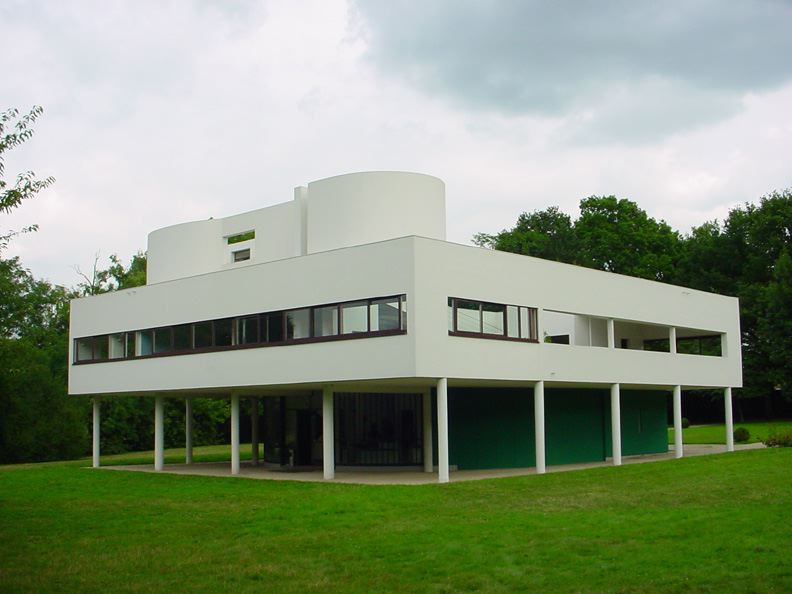
Villa Savoye
1928–1931
Poissy, France
This concept extended into Le Corbusier’s revolutionary idea of the house as a “machine for living.” In his designs, form and function were harmoniously aligned, with good design optimizing this relationship. The Villa Savoye stands as an early and iconic example of the International Style, embodying these principles.
One of the defining aspects of the Villa Savoye is its deliberate disconnection from its site—it could be placed anywhere without altering its beauty. Le Corbusier valued this detachment, believing that a building should not dominate or disrupt its environment. Instead, the Villa Savoye is elevated on thin columns, known as pilotis, which lift the reinforced concrete structure off the ground, creating an illusion of levitation. This technique opens the ground floor, allowing the landscape to flow beneath the building—a stark contrast to the more commonly used cantilever, which creates an overhanging effect without the need for columns.
The building’s exterior is finished in white stucco, highlighting its minimalist design and lack of ornamental detail. This approach reflects Le Corbusier’s commitment to purity in design, focusing on functionality and the essential elements of architecture rather than decorative embellishments. The Villa Savoye remains a quintessential example of Modernist architecture, illustrating how Le Corbusier’s ideas transformed the way in which we think about the relationship between buildings, their functions, and their surroundings.
The building incorporates three units that are present in almost all of Le Corbusier’s designs:
The Schröder House in Utrecht, the Netherlands, is the only architectural example in which the final building is constructed entirely based on the De Stijl design principles.
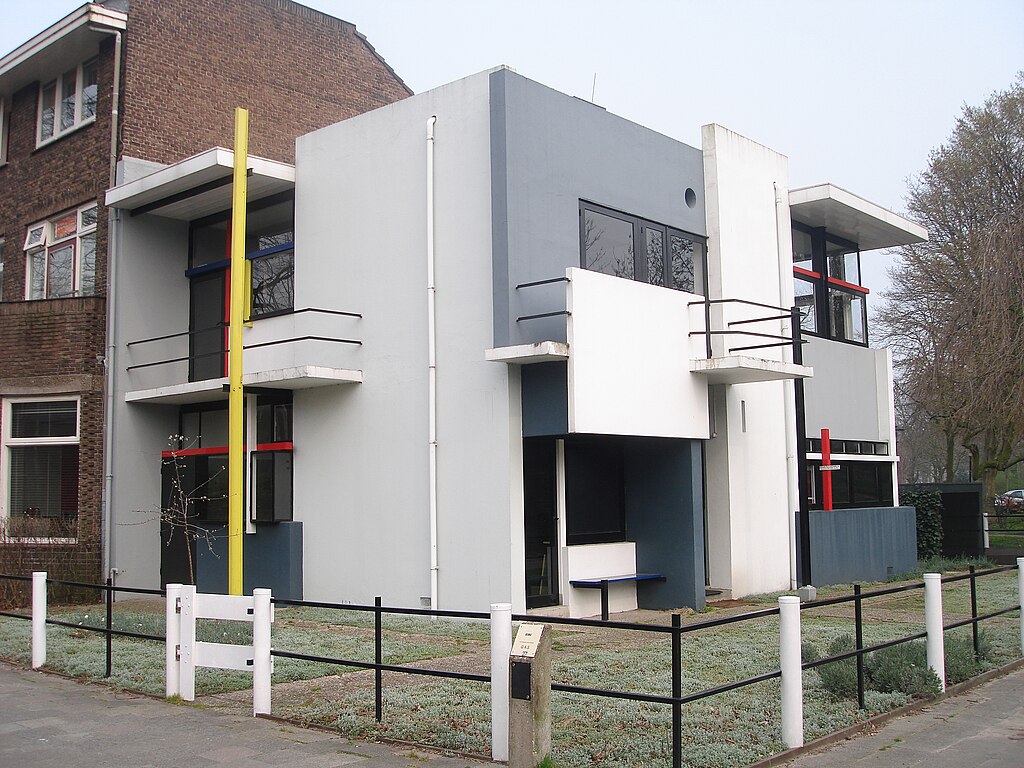
Schröder House
1923–1924
Utrecht, the Netherlands
This means that from conception to completion, the Schröder House is a pure embodiment of De Stijl principles. The entire structure is composed of intersecting perpendicular and parallel, or rectilinear, lines and planes, reflecting the movement’s emphasis on simplicity and geometric abstraction. Unlike traditional homes with distinct, separate rooms, the interior of the Schröder House—though not shown here—was designed as a dynamic, open space that could be reconfigured in multiple ways. The only fixed, enclosed area was the restroom, which provided the necessary privacy.
The De Stijl philosophy was applied to every detail of the house, down to the smallest elements, such as the window hinges that allowed the windows to open only to 90°, maintaining the strict right angles that are characteristic of the style.
Gerrit Rietveld, the architect, established a studio on the lower level of the house. After the death of his wife, he moved in with Mrs. Truus Schröder, who had commissioned the project. Rietveld lived in the Schröder House until his death in 1965. Mrs. Truus Schröder, who was deeply involved in the design process, resided in the house for nearly 60 years, until her own passing in 1985. Her long residence in the house underscores the enduring relevance and functionality of the De Stijl design principles that shaped its creation.
Ludwig Mies van der Rohe’s design of the Seagram Building in New York City is a powerful embodiment of his famous philosophy, “less is more.” This iconic skyscraper, completed in 1958, is a masterclass in minimalist architecture, where every element is carefully considered and nothing is superfluous.
Mies van der Rohe believed that architectural beauty could be achieved through simplicity and precision rather than through ornamentation or excess. The Seagram Building reflects this belief with its sleek, elegant form. The building’s exterior is characterized by clean lines, uniformity, and an absence of decorative details, emphasizing the structure’s form and materials. The facade, made of bronze-tinted glass and bronze I beams, gives the building a timeless, refined appearance. The choice of materials not only contributes to the building’s aesthetic but also to its structural integrity, aligning with Mies’ principle that materials should be used in a way that is true to their nature.
One of the most innovative aspects of the Seagram Building is the way in which it interacts with its urban environment. Mies van der Rohe chose to set the building back from the street, creating a large open plaza at its base. This open space contrasts sharply with the dense urban fabric of Midtown Manhattan and serves as a serene, minimalist counterpoint to the surrounding hustle and bustle. The plaza, with its reflecting pools and careful landscaping, is a physical manifestation of the “less is more” philosophy, providing a tranquil oasis amidst the city’s chaos.
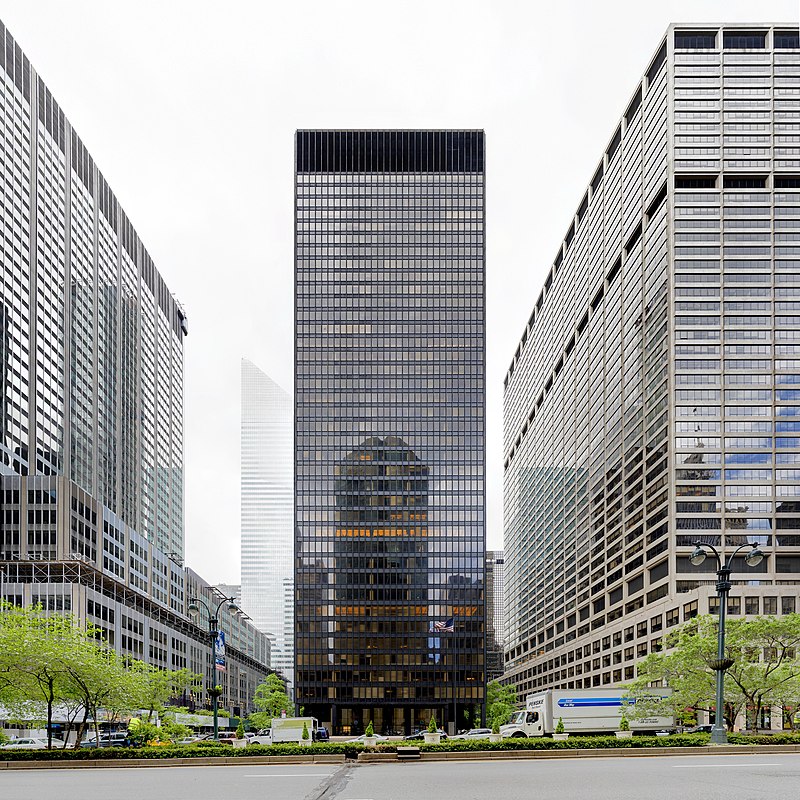
Seagram Building
1958
New York City, New York
In the interest of improving humanity through design, architects and urban planners would build streamlined buildings in the middle of wide-open spaces, genuinely believing that this would help improve people’s lives. This model was used for many housing projects in Brasilia, the capital of Brazil, but it had the opposite effect, increasing crime in those areas.
This Utopian ideal can be seen in the design and construction of Brasilia’s National Congress Building by the architect Oscar Niemeyer.

Brazilian National Congress Building
1960
Brasilia, Brazil
Niemeyer’s design is a composition of horizontal lines and vertical forms, thoughtfully arranged within an open space. The asymmetrical design achieves visual balance by positioning the vertical towers to the left, counterbalancing the visual weight of the larger inverted dome on the far right. This design is a prime example of the International Style’s versatility and ability to harmonize form and function.
As we saw with the Villa Savoye, the building is not integrated within its surroundings but appears to float above it. Note that while the design aesthetic may be universal, the execution isn’t. Each building that’s built in the International Style is unique, as the overall form was always dictated by the intended function.
Source: THIS TUTORIAL WAS AUTHORED BY IAN MCCONNELL AND TAMORA KOWALSKI FOR SOPHIA LEARNING. PLEASE SEE OUR TERMS OF USE.



