In this lesson, you will learn how interest rates work, what factors influence them, and how yield curves reflect expectations for future economic conditions. Specifically, this lesson will cover:
Interest is the cost of borrowing money or the reward for saving it. Charging interest is how lenders earn money and how borrowers pay for the privilege of using someone else’s money.
In business, the amount of interest a company has to pay to borrow money depends on market interest rates, its credit rating, and who the company is borrowing from. Interest rates are crucially important because they directly affect a business’s costs, profitability, investment decisions, and financial strategy.
How interest plays a role in business:
Cost of Borrowing: If the business takes out loans or issues bonds, interest is the cost of using that borrowed capital.
Investment Evaluation: Businesses use discounted cash flow (DCF) models to evaluate projects. A higher interest rate means future cash flows are worth less today, which can make some projects look less attractive.
Capital Structure Decisions: A business must decide how much funding should come from debt vs. equity. If borrowing is cheap (low interest), debt might be preferred, but too much debt increases financial risk.
Inflation and Interest Rate Risk: Interest rates often rise with inflation. Businesses must manage the risk of rising interest costs on variable-rate debt.
Performance Metrics: Metrics like Return on Investment (ROI) or Economic Value Added (EVA) are influenced by the company’s cost of capital, which assesses whether the company is generating value above its financing costs.
2. Interest Rate Levels
An interest rate is the rate at which a borrower pays interest for the use of money that they borrow from a lender. Changes in interest rate levels signal the status of the economy. As a vital tool of monetary policy, interest rates are kept at target levels—taking into account variables like investment, inflation, and unemployment—for the purpose of promoting economic growth and stability. In the United States, the Federal Reserve, often referred to as “the Fed,” implements monetary policies largely by targeting the federal funds rate. This is the rate that banks charge each other for overnight loans of federal funds, which are the reserves held by banks at the Fed.
Monetary policy can be classified as being either expansionary or contractionary:
Expansionary policy is traditionally used to try to combat unemployment in a recession by lowering interest rates in the hope that easy credit will entice businesses into expanding. An expansionary policy increases the total supply of money in the economy more rapidly than usual.
Contractionary policy is intended to slow inflation in hopes of avoiding the resulting distortions and deterioration of asset values. Contractionary policy increases interest rate levels by expanding the money supply more slowly than usual or even shrinking it.
Most central banks around the world assume and expect that lowering interest rates (expansionary monetary policies) would increase investments and consumption. However, lowering interest rates can sometimes lead to the creation of massive economic bubbles when a large number of investments are poured into the real estate market and stock market.
Crowding out is a phenomenon that occurs when expansionary fiscal policy causes interest rates to rise, thereby reducing investment spending. That means an increase in government spending crowds out investment spending. This change in fiscal policy shifts the equilibrium in the goods market. A fiscal expansion increases equilibrium income. If interest rates are unchanged, an increase in the level of aggregate demand will follow. This increase in demand must be met by a rise in output.
With this increase in equilibrium income, the quantity of money demanded is higher. Because there is an excessive demand for real balances, the interest rate rises. Firms’ planned spending declines at higher interest rates; thus, the aggregate demand falls. The adjustment of interest rates and their impact on aggregate demand dampens the expansionary effect of the increased government spending.
terms to know
Interest Rate
The percentage of an amount of money charged for its use for some period of time. It can also be thought of as the cost of not having money for one period or the amount paid on an investment per year.
Monetary Policy
The process by which the monetary authority of a country controls the supply of money, often targeting a rate of interest for the purpose of promoting economic growth and stability.
3. Drivers of Market Interest Rates
Market interest rates are mostly driven by deferred consumption, inflationary expectations, alternative investments, risk of investment, and liquidity preference.
Deferred consumption: When money is loaned, the lender delays spending the money on consumption goods. According to time preference theory, people prefer goods now to goods later. In a free market, there will be a positive interest rate.
Inflationary expectations: Most economies generally exhibit inflation, meaning a given amount of money buys fewer goods in the future than it will now. The borrower needs to compensate the lender for this. If the inflationary expectation goes up, then so does the market interest rate and vice versa.
Alternative investments: The lender can choose between using their money in different investments. If they choose one, they forgo the returns from all the others. Different investments effectively compete for funds, boosting the market interest rate.
Risks of investment: The chance of an investment defaulting is always prevalent. Because of this, lenders will assess a risk premium to account for this risk and compensate the lender for taking on additional units of risk. The greater the risk, the higher the market interest rate.
Liquidity preference: This describes the fact that investors prefer to be able to easily convert their investments into cash. If people are willing to hold more money in hand for convenience, the money supply will contract, increasing the market interest rate.
There is a market for investments that ultimately includes the money market, bond market, stock market, and currency market, as well as retail financial institutions like banks. Exactly how these markets function is sometimes complicated. However, economists generally agree that the interest rates yielded by any investment take the following into account:
Risk-free cost of capital
Inflationary expectations
Level of risk in the investment
Costs of the transaction
This rate incorporates the deferred consumption and alternative investment elements of interest.
4. The Term Structure
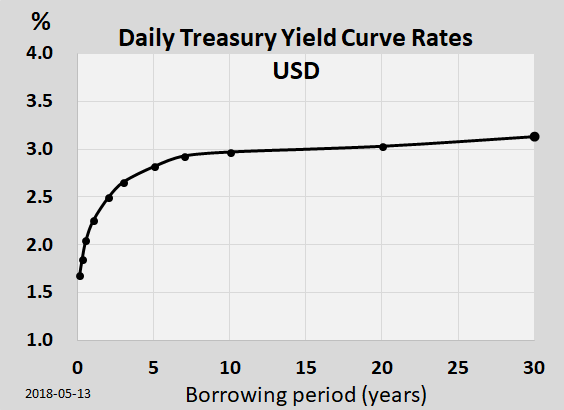
“Term structure” is a phrase used to describe how a given quantity or variable changes with time. In the case of bonds, time to maturity, or terms, vary from short-term (usually less than a year) to long-term (10, 20, 30, 50 years, etc.). Term structure of interest rates is often referred to as a yield curve. A yield curve indicates various interest rates across various contract lengths. The curve illustrates the relationship between the time of maturity and the interest rate.
The yield curve for the U.S. dollar
The curve allows an interest rate pattern to be determined, which can then be used to discount cash flows appropriately. Unfortunately, most bonds carry coupons, so the term structure must be determined using the prices of these securities.
terms to know
Term Structure of Interest Rates
The relationship between the interest on a debt contract and the maturity of the contract.
Yield Curve
The graph of the relationship between the interest on a debt contract and the maturity of the contract.
4a. Shapes of the Yield Curve
Based on the shape of the yield curve, we have normal yield curves, steep yield curves, flat or humped yield curves, and inverted yield curves.
Normal: The yield curve is normal, meaning that yields rise as maturity lengthens (i.e., the slope of the yield curve is positive). This positive slope reflects investor expectations for the economy to grow in the future and, importantly, for this growth to be associated with a greater expectation that inflation will rise in the future rather than fall. This expectation of higher inflation leads to expectations that the central bank will tighten monetary policy by raising short-term interest rates in the future to slow economic growth and dampen inflationary pressure.
Steep: Sometimes, Treasury bond yield averages higher than that of Treasury bills (e.g., 20-year Treasury yield rises higher than the 3-month Treasury yield). In situations when this gap increases, the economy is expected to improve quickly in the future. This type of steep yield curve can be seen at the beginning of an economic expansion (or after the end of a recession). Here, economic stagnation will have depressed short-term interest rates. However, rates begin to rise once the demand for capital is reestablished by growing economic activity.
Flat: A flat yield curve is observed when all maturities have similar yields, whereas a humped curve results when short-term and long-term yields are equal and medium-term yields are higher than those of the short term and long term. A flat curve sends signals of uncertainty in the economy.
Inverted: An inverted yield curve occurs when long-term yields fall below short-term yields. This occurs when lenders seek long-term debt contracts more aggressively than short-term debt contracts. The yield curve “inverts,” with interest rates (yields) being lower and lower for each longer period of repayment so that lenders can attract long-term borrowing.
4b. Theories
There are three main economic theories that attempt to explain different term structures of interest rates. Two of the theories take extreme positions, while the third attempts to find a middle ground between them.
Expectation hypothesis: This theory of the term structure of interest rates proposes that the long-term rate is determined by the market’s expectation for the short-term rate plus a constant risk premium. A shortcoming of the expectation theory is that it neglects the risks inherent in investing in bonds, namely interest rate risk and reinvestment rate risk.
Liquidity premium theory: This theory asserts that long-term interest rates not only reflect investors’ assumptions about future interest rates but also include a premium for holding long-term bonds (investors prefer short-term bonds to long-term bonds), called the term premium or the liquidity premium. This premium compensates investors for the added risk of having their money tied up for a longer period, including the greater price uncertainty. Because of the term premium, long-term bond yields tend to be higher than short-term yields, and the yield curve slopes upward. Long-term yields are also higher, not just because of the liquidity premium but also because of the risk premium added by the risk of default from holding a security over the long term.
Segmented market hypothesis: With this theory, financial instruments of different terms are not substitutable. As a result, the supply and demand in the markets for short-term and long-term instruments are determined largely independently. Prospective investors decide in advance whether they need short-term or long-term instruments. If investors prefer their portfolio to be liquid, they will prefer short-term instruments to long-term instruments. Therefore, the market for short-term instruments will receive a higher demand. A higher demand for the instrument implies higher prices and a lower yield. This explains the stylized fact that short-term yields are usually lower than long-term yields. This theory also explains the predominance of the normal yield curve shape. However, because the supply and demand of the two markets are independent, this theory fails to explain the observed fact that yields tend to move together (i.e., upward and downward shifts in the curve).
5. Using the Yield Curve to Estimate Interest Rates in the Future
For debt contracts, the overall duration of time of the debt security coupled with the interest rate compounded over that time frame will illustrate the overall yield of the security during its lifetime, also referred to as a yield curve. When this is applied to U.S. Treasury securities with respect to interest rates, useful information regarding projected interest rates in the future over time can be estimated. This is carefully monitored by many traders and utilized as a point of comparison or benchmark for other investments (particularly the valuation of bonds).
Relationship to the business cycle: Through assessing the slope of a yield curve on debt instruments such as governmental Treasury bonds, investors can estimate the overall health of the economy in the future (i.e., inflation, interest rates, recessions, and growth). Inverted yield curves are typically predictors of a recession, while positively sloped yield curves indicate inflationary growth.
The Financial Stress Index: Defined as the rate of difference between a 10-year Treasury bond rate and a 3-month Treasury bond rate, the Financial Stress Index is a useful tool in projecting future economic well-being. In fact, each of the recessionary periods since 1970 has demonstrated an inverted yield curve when subjected to a financial stress test just prior to that recessionary period.
Market expectations (i.e., pure expectations): When it comes to interest rates specifically, yield curves are useful constructs in projecting future behavior. The market expectations theory assumes that various maturities are perfect substitutes; as a result, the shape of the yield curve represents market expectations over time in relation to interest rates. In short, through investor expectations of what the 1-year interest rates will be next year, the current 2-year interest rate can be calculated as the compounding of this year’s 1-year interest rate by next year’s expected 1-year interest rate.
The Heath-Jarrow-Morton framework: When it comes to predicting future interest rates, the Heath-Jarrow-Morton framework is considered a standard approach. It focuses on modeling the evolution of the interest rate curve (instantaneous forward rate curve in particular). The equation itself is a rather evolved derivation, incorporating bond prices, forward rates, risk-free rates, the Wiener process, Leibniz’s rule, and Fubini’s theorem.
summary
In this lesson, you explored how to understand interest, which represents the cost of borrowing or the reward for saving, influencing business decisions, borrowing costs, and investment strategies. You examined how interest rate levels fluctuate based on economic policy, inflation, and market forces, with the Federal Reserve adjusting rates to promote stability and growth. You also studied drivers of market interest rates, including inflation expectations, risk, liquidity preferences, and alternative investments.
The lesson introduced the term structure of interest rates, represented by the yield curve, which shows the relationship between interest rates and bond maturities. You investigated different shapes of the yield curve (normal, steep, flat, and inverted) along with different yield curve theories. Finally, you explored how to use the yield curve to estimate interest rates in the future, with inverted curves often signaling potential recessions.
Yield Curve | Author: Wikipedia | License: Creative Commons
Terms to Know
Interest Rate
The percentage of an amount of money charged for its use for some period of time. It can also be thought of as the cost of not having money for one period or the amount paid on an investment per year.
Monetary Policy
The process by which the monetary authority of a country controls the supply of money, often targeting a rate of interest for the purpose of promoting economic growth and stability.
Term Structure of Interest Rates
The relationship between the interest on a debt contract and the maturity of the contract.
Yield Curve
The graph of the relationship between the interest on a debt contract and the maturity of the contract.