Table of Contents |
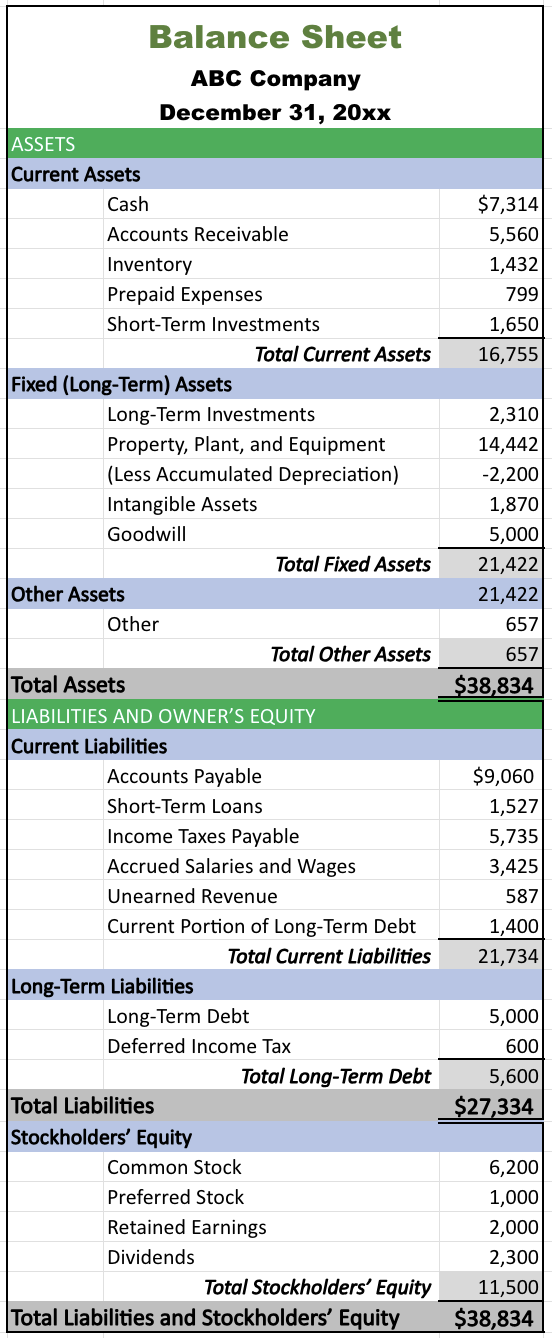
A standard company balance sheet has three parts: assets, liabilities, and ownership equity. The main categories of assets are usually listed first and typically in order of liquidity.
The first part of a balance sheet comprises assets. In finance, assets are any resource owned by a business. On the left side of a balance sheet, assets are typically classified into current assets and fixed (long-term) assets.
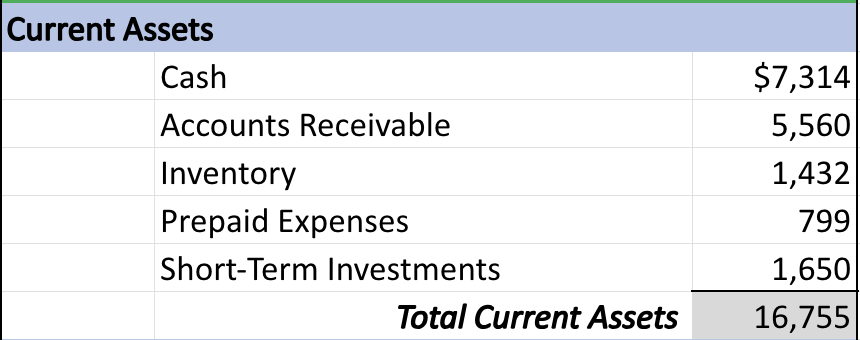
A current asset on a balance sheet is an asset that can be either converted to cash or used to pay current liabilities within 12 months. Typical current assets include cash and cash equivalents, short-term investments, accounts receivable, inventories, and the portion of prepaid liabilities that will be paid within a year.
The most liquid financial assets are arranged at the top of a balance sheet. This begins with cash and cash equivalents. Cash equivalents are those assets that can be quickly and easily converted into cash. These are differentiated from other types of investments by their short-term nature. They must mature within 3 months. Other short-term investments typically mature in 12 months.
Accounts receivable (AR) is an account representing funds owed to the organization by other entities through the sale of goods and services on the nature of credit. This is typically denoted by the creation of an invoice, which will then include terms of payment.
Most manufacturing organizations usually divide their inventory into the following:
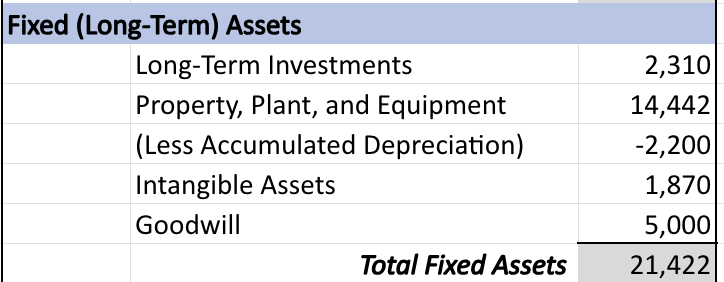
A fixed (long-term) asset is a term used in accounting for assets and property that cannot easily be converted into cash. This can be compared with current assets such as cash or bank accounts, which are described as liquid assets.
Fixed assets include the following:
Intangible assets are defined as identifiable, nonmonetary assets that cannot be seen, touched, or physically measured. They are created through time and effort and are identifiable as separate assets. There are two primary forms of intangibles: legal intangibles, such as trade secrets (e.g., customer lists), copyrights, patents, and trademarks, and competitive intangibles, such as knowledge activities (know-how and knowledge), collaboration activities, leverage activities, and structural activities. The intangible asset ”goodwill” reflects the difference between the firm’s net assets and its market value; the amount is first recorded at the time of acquisition. The additional value of the firm in excess of its net assets usually reflects the company’s reputation, talent pool, and other attributes that separate it from the competition. Goodwill must be tested for impairment on an annual basis and adjusted if the firm’s market value has changed.
Investments accounted for using the equity method are 20%-50% stake investments in other companies. The investor keeps such equities as an asset on the balance sheet. The investor’s proportional share of the associate company’s net income increases the investment (and a net loss decreases the investment), and the proportional payment of dividends decreases it. In the investor’s income statement, the proportional share of the investee’s net income or net loss is reported as a single line item.
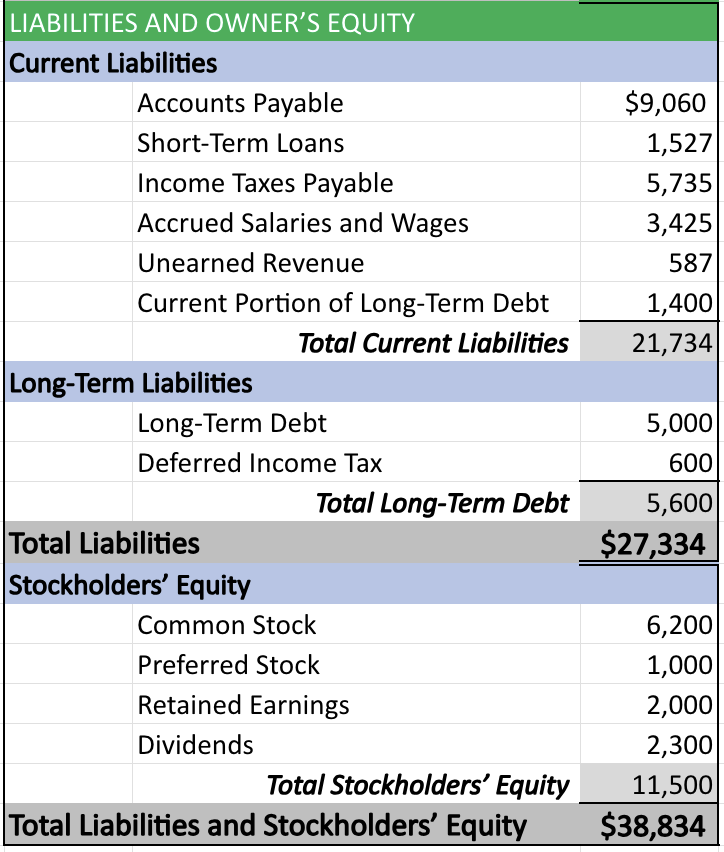
The balance sheet contains details on company liabilities and owner’s equity. In financial accounting, a liability is defined as an obligation of an entity arising from past transactions or events, the settlement of which may result in the transfer or use of assets, provision of services, or other yielding of economic benefits in the future.
A liability is defined by the following characteristics:
In accounting and finance, equity is the residual claim or interest of the most junior class of investors in assets, after all liabilities are paid. If liability exceeds assets, negative equity will exist. In an accounting context, shareholders’ equity (or stockholders’ equity, shareholders’ funds, shareholders’ capital, or similar terms) represents the remaining interest in the assets of a company, spread among individual shareholders of common or preferred stock.
At the start of a business, owners put some funding into the business to finance operations. This creates a liability for the business in the shape of capital, as the business is a separate entity from its owners. For accounting purposes, businesses can be considered sums of liabilities and assets: This is the accounting equation. After liabilities have been accounted for, the positive remainder is deemed the owner’s interest in the business.
In financial accounting, owner’s equity consists of the net assets of an entity. Net assets are the difference between the total assets of the entity and all its liabilities. Equity appears on the balance sheet, one of the four primary financial statements.
The assets of an entity include both tangible and intangible items, such as brand names and reputation or goodwill. The types of accounts and their descriptions that comprise the owner’s equity depend on the nature of the entity and may include common stock, preferred stock, capital surplus, retained earnings, treasury stock, stock options, and reserve.
The total changes to equity are calculated as follows:
Dividends are typically cash distributions of earnings to stockholders on hand, and they are recorded as a reduction to the retained earnings account reported in the equity section.
Working capital represents the liquidity that the organization currently has. In addition to fixed assets such as PPE, this metric is also considered a component of operating capital.
Net working capital is calculated as current assets minus current liabilities. It is a derivation of working capital that is commonly used in valuation techniques such as discounted cash flows (DCFs). If current assets are less than current liabilities, an entity has a working capital deficiency, also called a working capital deficit. A rise in working capital typically shows that a business has either had a rise in current assets or experienced a decrease in current liabilities, which could consist of paying down short-term liabilities.
Current assets and current liabilities include three accounts that are of special importance. These accounts represent the areas of the business where managers have the most direct impact: accounts receivable (current asset), inventories (current assets), and accounts payable (current liability). The current portion of debt (payable within 12 months) is critical because it represents a short-term claim to current assets and is often secured by long-term assets. Common types of short-term debt are bank loans and lines of credit.
On the surface, it can easily appear that a company has a ready supply of assets and overall profitability. However, if these assets are difficult to convert to cash, it can lead to complications. These types of decisions make up the task of working capital management. These decisions help manage a firm’s short-term assets and short-term liabilities. The end goal is for the firm to be able to adequately satisfy short-term debt obligations and sustain its day-to-day operational expenses. This creates the need for the effective management of a number of accounts, including inventory, cash, accounts receivable, and accounts payable.

In accounting, liquidity is a measure of the ability of a debtor to pay debts when they fall due. A standard company balance sheet has three parts: assets, liabilities, and ownership equity. The main categories of assets are usually listed first and typically in order of liquidity. Money, or cash, is the most liquid asset and can be used immediately to perform economic actions like buying, selling, or paying debt and meeting immediate wants and needs. Next are cash equivalents, short-term investments, inventories, and prepaid expenses.
Liquidity also refers to a business’s ability to meet its payment obligations in terms of possessing sufficient liquid assets and to such assets themselves. For assets themselves, liquidity is their ability to be sold without causing a significant movement in the price and with minimum loss of value.
The ratio known as debt to equity is used to indicate the relationship between instruments used to finance the assets of a company. It compares the degree to which both debt and equity are used for this purpose. The most efficient manner of deriving this information is through the firm’s balance sheet.
The debt-to-equity ratio is calculated as follows:
Financial analysts and stock market quotes will generally not include other types of liabilities, such as accounts payable, although some will make adjustments to include or exclude certain items from the formal financial statements. Adjustments are sometimes also made, for instance, to exclude intangible assets, and this will affect the formal equity; therefore, debt to equity (dequity) will also be affected.

When considering the differences between book value and market value, it is important to keep in mind that the market value is the price that can be obtained in a competitive setting, such as an auction or live sale. Market value is also considered to be the price that an asset would be valued at, given the buyer and seller are willing and engaging in a transaction without being compelled to do so.
Book value, otherwise thought of as accounting value, is the worth of an asset based on the original cost, less applicable depreciation, amortization, or impairment costs related to that asset.
The book value is different from market value, as it can be higher or lower depending on the asset in question and the accounting practices that affect book value, such as depreciation, amortization, and impairment. In many cases, the carrying value of an asset and its market value will differ greatly. If the asset is valued on the balance at the market value, then its book value will be equal to the market value.
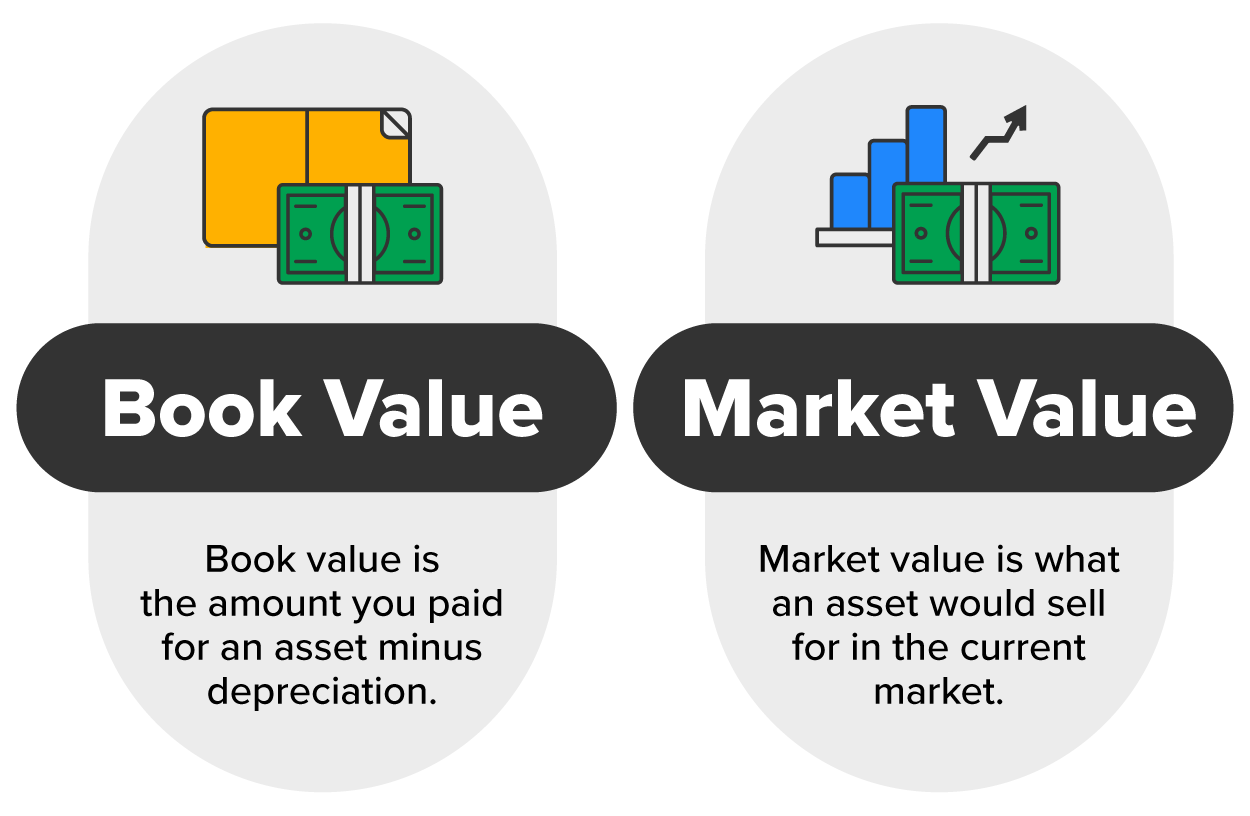
Ways of measuring the value of assets on the balance sheet include historical cost, market value, or lower of cost or market. Historical cost is typically the purchase price of the asset or the sum of certain costs expended to put the asset into use. Market value is the asset’s worth if it were to be exchanged in the open market in an arm’s length transaction; it can also be derived based on the asset’s present value of the expected cash flows it will generate. Certain assets are disclosed at lower of cost or market in order to conform to accounting’s conservatism principle, which stresses that assets should never be overstated.
Book value is the price paid for a particular asset, while market value is the price at which you could presently sell the same asset.
In financial accounting, a balance sheet or statement of financial position is a summary of the financial balances of a sole proprietorship, business partnership, corporation, or other business organization, such as an LLC or an LLP. Assets, liabilities, and ownership equity are listed as of a specific date, such as the end of the financial year. A balance sheet is often described as a “snapshot of a company’s financial condition.” Of the four basic financial statements, the balance sheet is the only statement that applies to a single point in time of a business’s calendar year. There are three primary limitations to balance sheets, including the fact that they are recorded at historical cost, the use of estimates, and the omission of valuable things, such as intelligence.
Fixed assets are shown in the balance sheet at historical cost less depreciation up to date. Depreciation affects the carrying value of an asset on the balance sheet. The historical cost will equal the carrying value only if there has been no change recorded in the value of the asset since acquisition. Therefore, the balance sheet does not show the true value of assets. The historical cost is criticized for its inaccuracy since it may not reflect current market valuation.
Some of the current assets are valued on an estimated basis, so the balance sheet is not in a position to reflect the true financial position of the business. Intangible assets like goodwill are shown in the balance sheet with imaginary figures, which may bear no relationship to the market value. The International Accounting Standards Board (IASB) offers some guidance (IAS 38) as to how intangible assets should be accounted for in financial statements. In general, legal intangibles that are developed internally are not recognized, and legal intangibles that are purchased from third parties are recognized. Therefore, there is a disconnect—the goodwill from acquisitions can be booked, since it is derived from a market or purchase valuation. However, similar internal spending cannot be booked, although it will be recognized by investors who compare a company’s market value with its book value.
Finally, the balance sheet cannot reflect assets that cannot be expressed in monetary terms, such as workers’ skill, intelligence, honesty, and loyalty.
Source: THIS TUTORIAL HAS BEEN ADAPTED FROM "BOUNDLESS FINANCE" PROVIDED BY LUMEN LEARNING BOUNDLESS COURSES. ACCESS FOR FREE AT LUMEN LEARNING BOUNDLESS COURSES. LICENSED UNDER CREATIVE COMMONS ATTRIBUTION-SHAREALIKE 4.0 INTERNATIONAL.