Table of Contents |
Operations management is the oversight and control of all the processes that transform inputs (labor and raw material) into outputs (goods and services) that customers pay for. The goal of operations management is to maximize efficiency while producing goods and services that effectively fulfill customer needs.
Operations management acts as the backbone of businesses, ensuring efficient and effective production, delivery, and service provision. By continually optimizing processes, it can promote cost reduction, quality control, and timely fulfillment, ultimately contributing significantly to an organization's competitive edge and profitability.
Countless operating decisions must be made that have both long- and short-term impacts on the organization’s ability to produce goods and services that provide added value to customers. If the organization has made mostly good operating decisions in designing and executing its transformation system to meet the needs of customers, its prospects for long-term survival are greatly enhanced.
IN CONTEXT: FURNITURE
For a furniture manufacturer, some of the operations management decisions include the following:
If the organization makes good operations decisions, it will be able to produce affordable, functional, and attractive furniture that customers will purchase at a price that will earn profits for the company.
- Designing furniture that is consistent with current styles
- Purchasing wood and fabric
- Hiring and training workers
- Location and layout of the furniture factory
- Purchasing cutting tools and other fabrication equipment
- Checking finished products to ensure quality
- Managing inventory
- Delivering furniture to customers and sellers
- Continuous improvement of both product and processes
As you might guess, operations management is a vast topic. However, OM can be bundled into a few distinct categories, each of which will be covered in later units. It should be noted that entire courses are devoted to each of these topics individually.
We described operations management as a series of decisions made in turning raw materials and labor into goods and services. These decisions could be called tactics, or actions taken to achieve an end. That end is called a strategy, a broader plan of action to accomplish large-scale goals.
Operations is one of the three strategic functions of any organization. The other two areas of strategic importance to the organization are marketing and finance. The operations strategy should support the overall organizational mission and align with the other functional teams to do so. Operations are a vital part of accomplishing the organization’s mission and ensuring its long-term survival.
IN CONTEXT: JETBLUE
JetBlue airlines is an airline that has an organization strategy of providing high-value air transportation service to travelers. JetBlue’s marketing message is that they provide fun, comfortable, and safe air service to popular destinations at a price that middle-income passengers can afford.
Given JetBlue’s organization strategy, the airline features an operations strategy that focuses on low costs, competent and service-oriented employees, and reliable aircraft. JetBlue’s main transportation hub is New York City, a city of 19 million people, which helps ensure that JetBlue’s planes fly at full capacity. In the area of equipment decisions, JetBlue operates only one type of aircraft, the Airbus 320, which has high passenger carrying capacity (to maximize revenue), provides good fuel economy, and requires only two pilots (versus three) to operate. Having one type of aircraft reduces training costs for pilots and mechanics, reduces investments in parts inventories, and enables JetBlue to negotiate greater discounts on high-volume purchases from Airbus.
Strategic decisions in operations are those that have long-term consequences and often involve a great deal of expense and resource commitments. Key decisions include:
In contrast, tactical decisions have short- to medium-term impact on the organization, usually involve less commitment of resources, and can be changed more easily than strategic decisions. Tactical decisions include:
IN CONTEXT: BIG LOTS!
Big Lots! is a retailer based in Columbus, Ohio, with a focus on discount products ranging from household goods to food and even furniture. Big Lots!, who found itself on the Retail Drive’s bankruptcy list, has a strategy of “extreme value sourcing to provide unmatched prices to customers.” As part of this strategy, a tactical plan was to acquire the entire inventory of toy company Hearthsong, which consists of over 500 different products. This purchase allows them to resell those products to customers at very deep discounts, thereby meeting their overall strategic plan (Walk-Morris, 2024).
Throughout this tutorial, you have seen the term “goods and services.” What’s the difference? Simply put, goods are the products you pay for, and services are the tasks you pay people to do. Many transactions involve both, such as buying a cup of coffee—you are paying for the coffee (a good), but a bigger chunk of the cost is to pay the person who makes it for you (a service). When you buy a pound of coffee at the supermarket, you are primarily paying for a good (the coffee), but a portion of the price is paying the stockers and clerks (services). In general, however, all stores and restaurants are considered part of the service industry, and the term “goods” refers to manufacturers. Service and manufacturing operations share many similarities. However, there are some important differences. This section provides an overview of those differences.
Though the primary function of both manufacturers and service providers is to satisfy customer needs, there are several important differences between the two types of operations. Let’s focus on three of them:
IN CONTEXT: DOORDASH
DoorDash is a perfect example of how a service industry transforms resources to create value. While many would prefer to go out to eat, restaurant food delivery services are a $150 billion market, and have tripled since 2017 (Ahuja, et al., 2021). DoorDash works with restaurants to provide a platform for customers to order online and have their food delivered and gives restaurants access to logistics and a network of drivers.
This business model creates value for the customer and for the restaurants. Restaurants can obtain new customers that otherwise may not have dined at their location, and through the app, drivers can earn extra income by picking up orders at the restaurant and delivering them. Of course, customers are happy to have food and other items delivered to their door.
DoorDash’s service is intangible; it is also customizable in that the customers can choose where they want to order from. The drivers also have contact with the restaurant when they pick up the order, and the customer when they drop the order off.
While all businesses essentially follow many of the same operations processes we will discuss throughout the class, understanding the distinction is crucial for understanding how they differ for businesses that manufacture goods and businesses that deliver services.
There are many careers in operations management in both the public sector, within federal or local government, and the private sector, within individual companies or nonprofit organizations. In fact, the need for operations managers is expected to grow by 4.2% through 2032 (U.S. News, n.d.). When you consider the vast definitions of operations management, nearly every industry needs operations professionals, including retail, banking, healthcare, manufacturing, tourism, restaurants, and most other fields. Operations management is crucial for organizational success, ensuring efficient transformation of inputs into outputs while overseeing the production and delivery of goods and services. Each employee contributes as the business optimizes processes, fostering cost reduction, improving quality and timely delivery, ultimately enhancing customer satisfaction and securing a competitive edge.
Within the broad category of operations management, there are many different specialties.
Examples of job titles in operations management might include:
| Entry Level | Middle Management | Top Management |
|---|---|---|
| Operations Analyst | Scheduler | Chief Operating Officer (COO) |
| Process Analyst | Operations Supervisor | Director of Operations |
| Operations Coordinator | Project Manager | Vice President of Operations |
| Warehouse Assistant | Production Planner | Senior Operations Manager |
| Supply Chain Analyst | Materials Manager | |
| Inventory Coordinator | Quality Control Specialist | |
| Inventory Specialist | Operations Manager | |
| Facilities Assistant | Program Manager | |
| Office Assistant | Supply Chain Manager | |
| Safety Coordinator | Inventory Manager | |
| Quality Inspector | Facilities Manager | |
| Quality Assurance Coordinator | Office Manager | |
| Logistics Planner | Health and Safety Manager | |
| Quality Assurance Manager | ||
| Logistics Specialist |
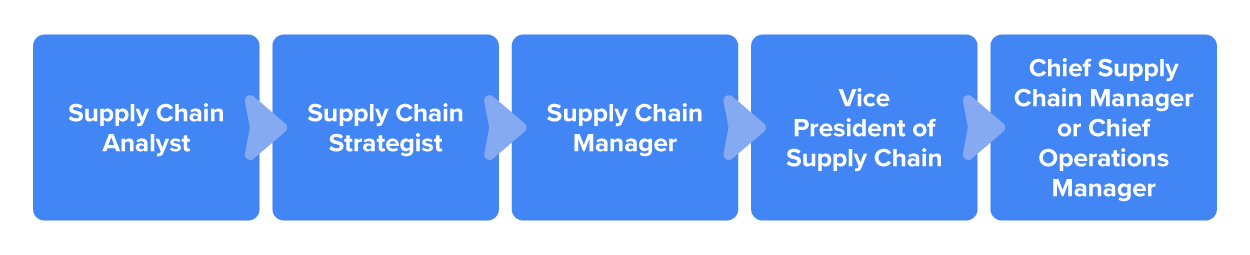
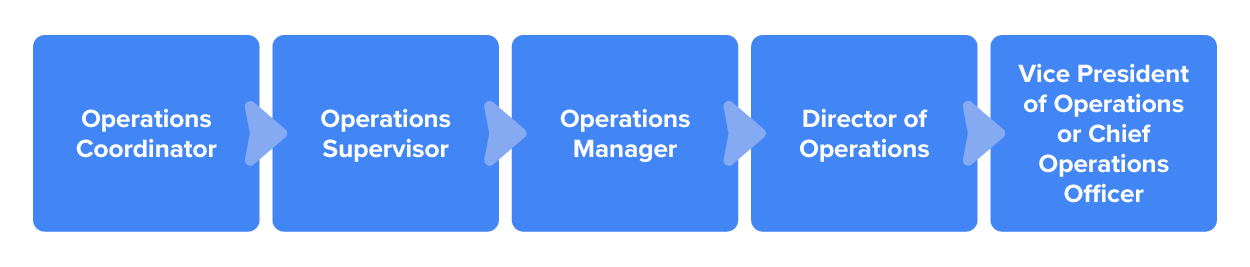
Some sample career paths are depicted below. As you can see, there many areas one can specialize in within operations management, such as supply chain management, quality assurance, facilities, and many more.

Source: This tutorial has been adapted from Saylor Academy and NSCC “Operations Management”. Access for free at https://pressbooks.nscc.ca/operationsmanagement2/. License: Creative Commons Attribution 4.0 International.
REFERENCES
Ahuja, K., Chandra, V., Lord, V., and Peens, C. (2021, September 22). Ordering in: The rapid evolution of food delivery. McKinsey. www.mckinsey.com/industries/technology-media-and-telecommunications/our-insights/ordering-in-the-rapid-evolution-of-food-delivery
U.S. Bureau of Labor Statistics (2023, October 6). A Look at Manufacturing Jobs on National Manufacturing Day. www.bls.gov/opub/ted/2023/a-look-at-manufacturing-jobs-on-national-manufacturing-day.htm
U.S. News & World Report (n.d.). Operations Manager Overview. U.S. News & World Report. money.usnews.com/careers/best-jobs/business-operations-manager
Walk-Morris, A. (2024, February 27). Big Lots acquires entire inventory of toy company Hearthsong. Supply Chain Dive. www.supplychaindive.com/news/big-lots-acquires-hearthsong-toys-inventory/708520/



