 provides a good estimate to
  near . Another way to use the tangent line is to find its x-intercept to approximate the x-intercept of . In this lesson, you will learn Newton’s method, which uses successive tangent lines to approximate an x-intercept. Most graphing utilities use Newton’s method to locate x-intercepts and points of intersections of graphs. Specifically, this lesson will cover:
Table of Contents |
The goal of Newton’s method is to use tangent lines to approximate an x-intercept of the graph of  . In other words, the goal is to solve the equation
  .
.
Consider the function  .
.
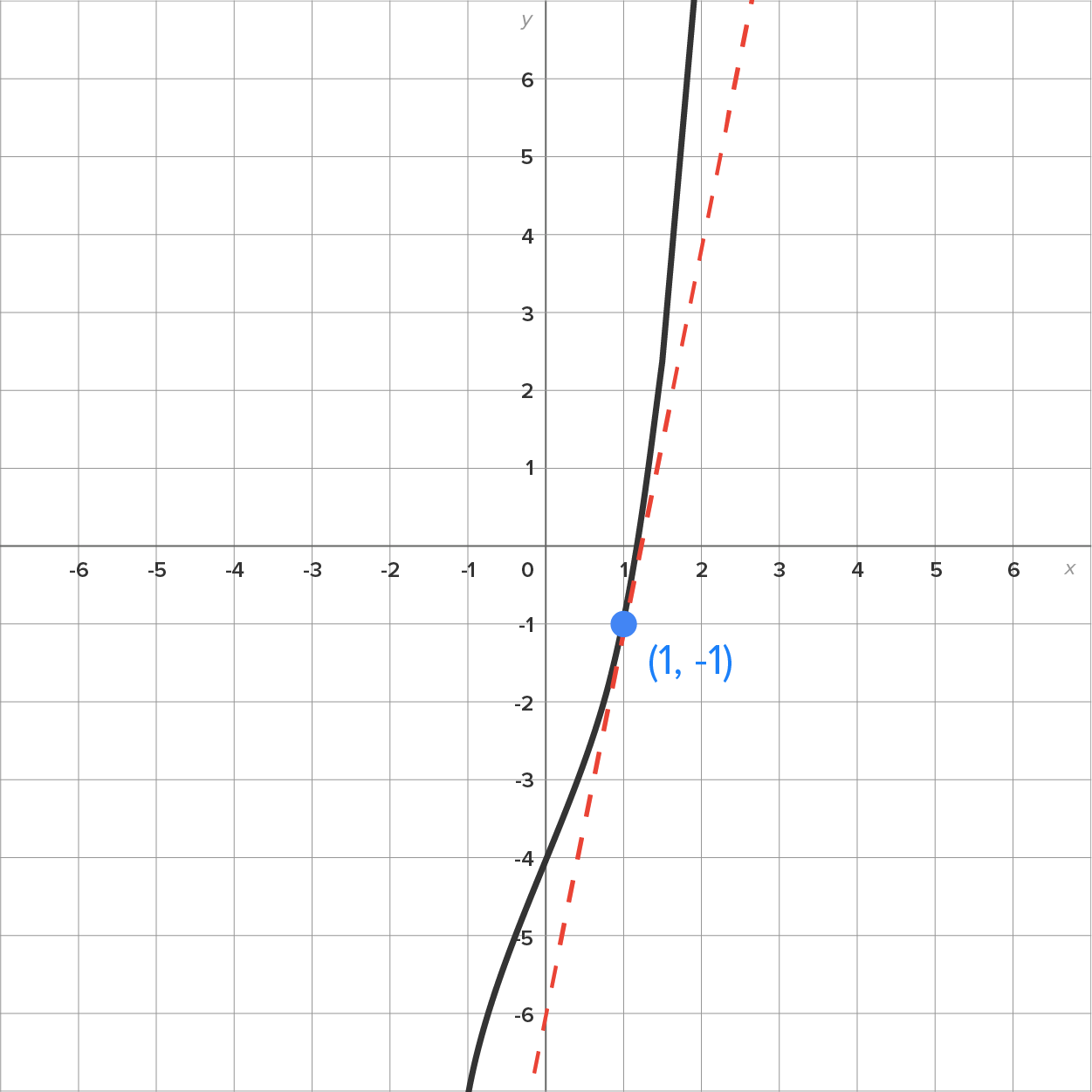
Now, consider the picture shown above, which has two graphs:
. (this corresponds to our “guess”). as the x-intercept.
Notice that the x-intercept of is very close to the x-intercept of the tangent line. The advantage of using the tangent line is that it is much easier to solve a linear equation than it is a cubic equation.
First step: Find the equation of the tangent line at .
Given , the derivative is  . Then, the slope of the tangent line is
  .
.
Then, the equation of the tangent line is:

 and solving for x:


So, where would we go from here?
We now have a new “guess” for the x-intercept of the graph of . To continue with this process, find the equation of the tangent line to at  , then find its x-intercept. We’ll formalize this process and then complete this problem in the next part of this challenge.
Consider a function and let  be the first guess for its x-intercept.
Write the equation of the tangent line at  .
.
Find the x-intercept of the tangent line, which means :

|
Replace y with 0. |

|
Subtract  from both sides. from both sides.
|

|
Divide both sides by  . .
|

|
Add to both sides.
|
Now, this x-intercept is the next guess for the intercept, which under normal conditions, is a closer estimate than . Since this process will continue, let’s call the x-intercept of the tangent line  . Then,
  .
.
Now, suppose we want to continue this process:
 .
.  . Then,
  .
. , ... for the estimates of the x-intercept that get closer to some number (which would be the actual x-intercept). Performing these iterations is what is known as Newton’s method.
Suppose the goal is to find an approximation to an x-intercept of a function , which is equivalent to finding a solution to . Starting with an initial guess at  , the sequence of guesses
  , ... is generated by the formula
  .
.
The process stops when one of two things occurs:
.EXAMPLE
Let’s pick back up with the function. When we left off, we had  and
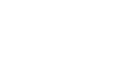
and  . Let’s perform two more iterations of Newton’s Method to get a better approximation of the x-intercept. To use Newton’s method, it is best to organize the information into a table:
and .
. Let’s perform two more iterations of Newton’s Method to get a better approximation of the x-intercept. To use Newton’s method, it is best to organize the information into a table:
and .
| n |

|

|

|
|
|---|---|---|---|---|
| 0 | 1 | -1 | 5 | 1.2 |
| 1 | 1.2 | 0.128 | 6.32 | 1.179746835 |
| 2 | 1.179746835 | 0.001468379 | 6.175407787 | 1.179509057 |
| 3 | 1.179509057 | 0.0000002 | 6.173724847 | 1.179509025 |
is (1.179509, 0). This also means that the equation  has the solution
  .
.
In this next example, we’ll see how we can apply Newton’s Method to approximating a square root of a number.
EXAMPLE
We’re going to use Newton’s Method a little differently to approximate the value of which is a solution to the equation

 which is

 Using
Using  and
and  we have:

 Recall that we need a starting value. In this case, we’ll use
  since we know that
  is between 3 and 4; likely closer to 4.

 we have:

 we have:

 is approximately 3.605551276.
 which is very close!
 .
. Newton's method is a very straightforward approximation method designed to solve equations of the form (equivalent to finding the x-intercepts of the graph of ). You learned how to apply Newton's method using its algorithm, by starting with an initial guess at , then generating a sequence of guesses , ... to arrive at a close approximation of the x-intercept.
.
. Newton's method is a very straightforward approximation method designed to solve equations of the form (equivalent to finding the x-intercepts of the graph of ). You learned how to apply Newton's method using its algorithm, by starting with an initial guess at , then generating a sequence of guesses , ... to arrive at a close approximation of the x-intercept.
Source: THIS TUTORIAL HAS BEEN ADAPTED FROM CHAPTER 2 OF "CONTEMPORARY CALCULUS" BY DALE HOFFMAN. ACCESS FOR FREE AT WWW.CONTEMPORARYCALCULUS.COM. LICENSE: CREATIVE COMMONS ATTRIBUTION 3.0 UNITED STATES.
To find the next estimate for an x-intercept, use the formula  .
.




