Table of Contents |
As children pass through adolescence on their way to becoming adults, they change in many ways. Their physical changes make their nutrient needs high, and their emotional, intellectual, and social changes make meeting those needs a challenge. Teenagers make many more choices for themselves than they did as children. Food choices made during the teen years profoundly affect their present and future health. As they navigate their developing bodies, there are other decisions such as whether to drink alcoholic beverages and what activities to join that compete with their nutrition choices.
In many households, adults work outside the home, and teenagers help with some of the tasks, such as shopping for groceries or choosing fast or prepared foods. Adolescents may also begin to regularly skip breakfast, which means they are missing out on important nutrients that are not made up at later meals during the day. Eating breakfast each day, especially a breakfast rich in fiber and protein, improves satiety and reduces hunger throughout the day.
The adolescent growth spurt begins at age 10 to 11 for females and at 12 to 13 for males and can last about 2½ years. Before puberty, male and female body compositions differ only slightly, but during adolescence, differences between the genders becomes greatly apparent in the skeletal system, lean body mass, and fat stores. In females, fat assumes a larger percentage of total body weight, and in males, the lean body mass increases much more than in females. During adolescence, males grow an average of 8 inches taller, and females, 6 inches taller. Males gain approximately 45 pounds, and females, about 35 pounds. For both genders, primary and secondary sex characteristics have fully developed, and the rate of growth slows with the end of puberty.
IN CONTEXT
Adolescents have increased appetites due to increased nutritional requirements. Nutrient needs are greater in adolescence than at any other time in the life cycle, except during pregnancy. Older adolescents are more responsible for their dietary choices than younger children, but caregivers must make sure that teens continue to meet their nutrient needs. The energy requirements for ages fourteen to eighteen are 1,800 to 2,400 calories for girls and 2,000 to 3,200 calories for boys, depending on activity level. For example, a very athletic or active 15-year-old boy may need even more than 3,200 kcalories a day just to maintain his weight. The extra energy required for physical development during the teenage years should be obtained from foods that provide nutrients instead of empty calories.
For carbohydrates, the AMDR is 45 to 65 percent of daily calories (203–293 grams for 1,800 daily calories). Adolescents require more servings of grains than younger children, and should eat whole grains, such as wheat, oats, barley, and brown rice. The Institute of Medicine recommends higher intakes of protein for growth in the adolescent population. The AMDR for protein is 10 to 30 percent of daily calories (45–135 grams for 1,800 daily calories), and lean proteins, such as meat, poultry, fish, beans, nuts, and seeds are excellent ways to meet those nutritional needs.
The AMDR for fat is 25 to 35 percent of daily calories (50–70 grams for 1,800 daily calories), and the AMDR for fiber is 25–34 grams per day, depending on daily calories and activity level. It is essential for young athletes and other physically active teens to intake enough fluids because they are at a higher risk for becoming dehydrated.
Older adolescents experience numerous physical changes and must increase their energy intake to support these changes and meet nutrient needs. Nutrient needs are greater during adolescence than at any other time in the life cycle, except during pregnancy. The daily energy requirements for ages fourteen to eighteen are 1,800 to 2,400 calories for girls, and 2,000 to 3,200 calories for boys, depending on activity level. Nutritional concerns for older adolescents include eating disorders.
Micronutrient recommendations for adolescents are mostly the same as for adults, though children this age need more of certain minerals to promote bone growth (e.g., calcium and phosphorus, along with iron and zinc for girls). Again, vitamins and minerals should be obtained from food first, with supplementation for certain micronutrients only (such as iron).
| Nutrient | Males, Ages 14–18 | Females, Ages 14–18 |
|---|---|---|
| Vitamin A (mcg) | 900.0 | 700.0 |
Vitamin  (mg) (mg)
|
1.3 | 1.2 |
Vitamin  (mcg) (mcg)
|
2.4 | 2.4 |
| Vitamin C (mg) | 75.0 | 65.0 |
| Vitamin D (mcg) | 5.0 | 5.0 |
| Vitamin E (mg) | 15.0 | 15.0 |
| Vitamin K (mcg) | 75.0 | 75.0 |
| Calcium (mg) | 1,300.0 | 1,300.0 |
| Folate mcg) | 400.0 | 400.0 |
| Iron (mg) | 11.0 | 15.0 |
| Magnesium (mg) | 410.0 | 360.0 |
Niacin ( ) (mg) ) (mg)
|
16.0 | 14.0 |
| Phosphorus (mg) | 1,250.0 | 1,250.0 |
Riboflavin ( ) (mg) ) (mg)
|
1.3 | 1.0 |
| Selenium (mcg) | 55.0 | 55.0 |
Thiamine ( ) (mg) ) (mg)
|
1.2 | 1.0 |
| Zinc (mg) | 11.0 | 9.0 |
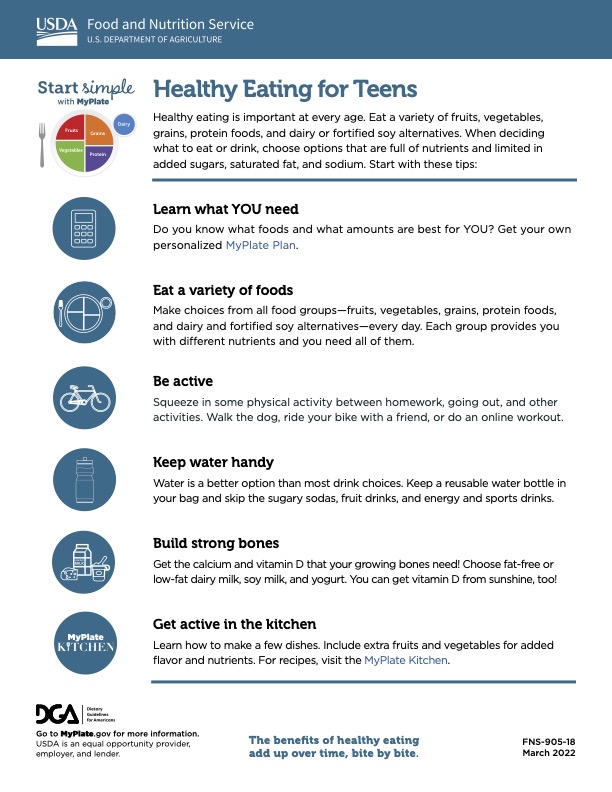
There are several great tools for teens to use to help them learn more about health and nutrition. The MyPlate Daily Checklist can help them create a daily food plan with how many daily calories and what amounts of fruit, vegetables, grains, protein, and dairy they should eat to stay within calorie targets. Another tool, called the NIH Body Weight Planner lets them tailor calorie and physical activity plans to reach personal goals within a specific time period. Being a healthy teen doesn’t have to be hard and here is an example menu:
Some teens may struggle with disordered eating, which can have a detrimental effect on diet and long-term health. Disordered eating is used to describe a range of irregular eating behaviors that may or may not result in a diagnosis of a specific eating disorder. The term "disordered eating" is a way to describe eating patterns, not a medical diagnosis. However, eating disorders, such as anorexia nervosa or bulimia nervosa, are diagnosed according to specific and narrow criteria, and all irregular patterns should be treated seriously and with care.
IN CONTEXT
Disordered eating is generally more prevalent among adolescent girls but has been increasing among adolescent boys in recent years. Eating disorders involve extreme behavior related to food and exercise. Sometimes referred to as “starving or stuffing,” they encompass a group of conditions marked by undereating and/or overeating. Some of these conditions include:
- Anorexia Nervosa. Anorexia nervosa is a potentially fatal condition characterized by undereating and excessive weight loss. People with this disorder are preoccupied with dieting, calories, and food intake to an unhealthy degree. Generally, they have a poor body image, which leads to anxiety, avoidance of food, a rigid exercise regimen, fasting, and a denial of hunger.
- Binge-Eating Disorder. People who suffer from binge-eating disorder experience regular episodes of eating an extremely large amount of food in a short period of time. Binge eating is a compulsive behavior, and people who suffer from it typically feel it is beyond their control. This behavior often causes feelings of shame and embarrassment, and leads to obesity, high blood pressure, high cholesterol levels, Type 2 diabetes, and other health problems.
- Bulimia Nervosa. Bulimia nervosa is characterized by alternating cycles of overeating and undereating. People who suffer from it partake in binge eating, followed by compensatory behavior, such as self-induced vomiting, laxative use, and compulsive exercise.
Eating disorders stem from stress, low self-esteem, and other psychological and emotional issues. It is important for parents to watch for signs and symptoms of these disorders, including sudden weight loss, lethargy, vomiting after meals, and the use of appetite suppressants. Eating disorders can lead to serious complications or even be fatal if left untreated. Treatment includes cognitive, behavioral, and nutritional therapy.
Source: THIS TUTORIAL HAS BEEN ADAPTED FROM LUMEN LEARNING’S “NUTRITION FLEXBOOK”. ACCESS FOR FREE AT https://courses.lumenlearning.com/suny-nutrition/. LICENSE: creative commons attribution 4.0 international.
REFERENCES
Institute of Medicine. www.iom.edu



