Use Sophia to knock out your gen-ed requirements quickly and affordably. Learn more
×

T-Accounts, Cash Entries

Author: Sophia

what's covered
This lesson will cover the topic of T-accounts, including what they are, their structure and how they are used. In addition, we will cover how T-accounts can be applied with cash entries. Specifically, this lesson will cover:

Table of Contents

1. T-Accounts

T-accounts are a shorthand method of displaying journal entries and balances within individual accounts. T-accounts are used to record increases and decreases in specific accounts within the different account groups. It is a way to organize the debits and credits within specific accounts, recording those increases and decreases. Remember, debits are on the left side and credits are on the right side.

Let's look at an actual T-account structure, below.
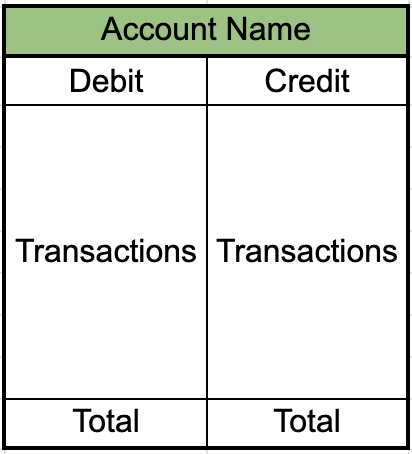
There are different attributes that need to be put into the T-account:

  • The account name goes on the top. This is where you would put, for example, cash, liabilities, owner's capital, revenue, etc.
  • Next are credits and debits. Remember, credits are on the right side, and debits are on the left side.
  • Since you are detailing transactions with a T-account, the transactions are listed in the middle section.
  • The final attribute is the total. Where do you put the total? Well, if total debits exceed total credits, then you put the difference on the debit side. If total credits exceed total debits, then you put the difference on the credit side.
hint
Remember that T-accounts are used for planning, not for posting to actual records.


2. T-Accounts and Cash Entries: Application

Now, using our new knowledge of a T-account structure, let's apply it to a transaction.

2a. Cash Contributed by Owner

Suppose you are creating a business with a $10,000 cash investment. What accounts will you use? What accounts will require T-accounts?

You need cash, because you're receiving a cash investment. Cash is an owner contribution, which is your first clue. The first T-account needed is cash. When cash is increased, because it's an asset, it's a debit. Therefore, you will have a $10,000 debit into your cash T-account.

What other account is affected? Owner's capital, a contribution made by owners, is increased with a credit, so you will put $10,000 on the credit side. Total credits are $10,000.

Don't forget the final check and balance. Do the total debits equal the total credits? The answer is yes: $10,000 debit, $10,000 credit. You are good to move on!
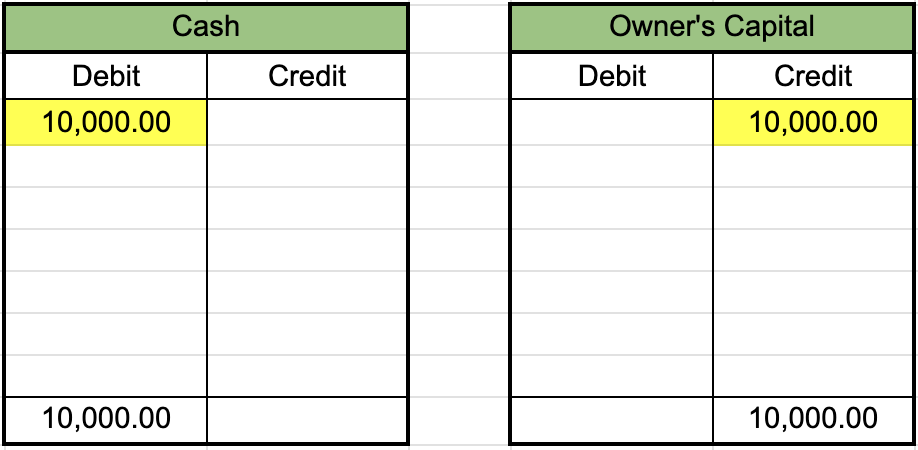
Table from a T-account labeled cash showing a debit and balance of $10,000 and a second table from a T-account labeled owner's capital showing a credit and balance of $10,000.
View this spreadsheet in Google Sheets

2b. Cash Received for Sale

Suppose you record a $5,000 cash sale. What accounts are impacted? Cash is received for a sale, so owner's capital stays the same, since it's not impacted. However, there is the cash from the transaction, so you know that cash is impacted, because you've received $5,000 more. Therefore, your cash goes up, and your total cash is now $15,000.

Note, you now need one other T-account. You need a T-account for revenue, because you made a sale. You know that revenue is increased by credits, and because you made a sale, you have a $5,000 credit to your revenue. Check to ensure that your debit of $5,000 equals your credit of $5,000. Does it? Yes. You are good to go!
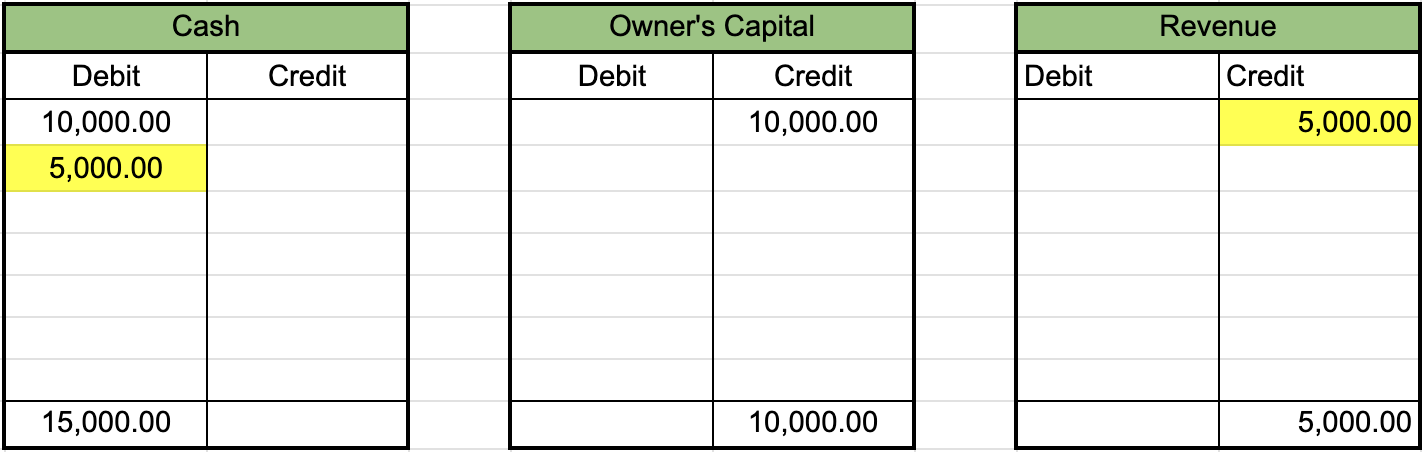
Table from a T-account labeled cash showing a debit of $10,000 and $5,000, with a balance of $15,000, a second table from a T-account labeled owner's capital showing a credit and balance of $10,000, and a third table from a T-account labeled revenue showing a credit and balance of $5,000.
View this spreadsheet in Google Sheets

2c. Cash Payment for Expense

Now you record a $1,000 cash payment for salaries expense. Which accounts are impacted? Cash payment for an expense. Owner's capital and revenue stay the same; neither of these are impacted.

However, your cash is impacted again. You have the $10,000 and the $5,000 from the last two transactions, but this time, cash is going out the door, so you need to reduce cash with a credit of $1,000. This leaves you with a $14,000 debit in your cash.

One final T-account is impacted: expenses. You have salaries expense, and your expenses are increased with debits. You have a $1,000 debit to your salaries expense.

It's time for one last check and balance. Does that $1,000 debit to your salaries expense equal that $1,000 credit? It does. Once again, you are good to go!
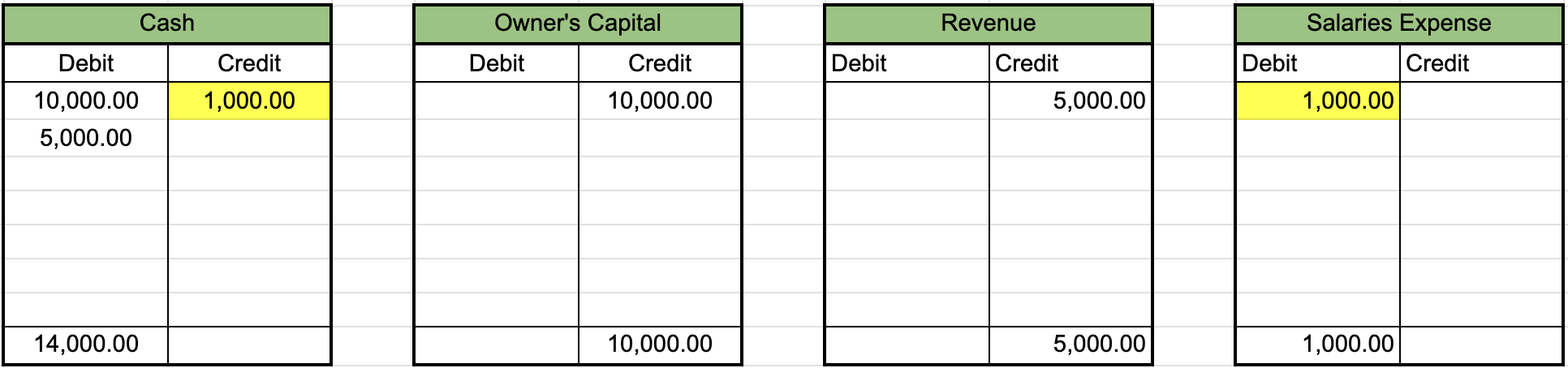
Table from a T-account labeled cash showing a debit of $10,000 and $5,000, a credit of $1,000, with a balance of $14,000, a second table from a T-account labeled owner's capital showing a credit and balance of $10,000, a third table from a T-account labeled revenue showing a credit and balance of $5,000, and a fourth table from a T-account labeled salaries expense showing a debit and balance of $1,000.
View this spreadsheet in Google Sheets

key concept
Remember, an increase to an asset account, like cash, is a debit; a decrease is a credit to the account.

watch

try it
Frank comes to the store and buys $200 worth of lumber and pays in cash.
How should this transaction be booked?
Cash
Revenue
Debits Credits
Debits Credits
$200
$200


The store buys $1500 in merchandise on its account from its supplier to be sold.
How should this transaction be booked?
Inventory
Accounts Payable
Debits Credits
Debits Credits
$1,500
$1,500


summary
Today we learned about the T-account structure. We learned that the account name goes on the top, and that it is always important to remember that debits go on the left side and credits go on the right side. This helps to organize all of the different transactions, whether it's a debit or a credit to that individual account. In the application section, we applied our knowledge of the T-account structure to a cash transaction. We looked at our totals, noting that if the total credits exceed the total debits, the total goes on the credit side, whereas if the total debits exceed the total credits, the total belongs on the debit side.

Source: THIS TUTORIAL WAS AUTHORED BY EVAN MCLAUGHLIN FOR SOPHIA LEARNING. PLEASE SEE OUR TERMS OF USE.


