Use Sophia to knock out your gen-ed requirements quickly and affordably. Learn more
×

Systems of Nonlinear Equations and Inequalities

Author: Sophia

what's covered
In this lesson, you will solve systems of nonlinear equations and inequalities. Specifically, this lesson will cover:

Table of Contents

1. Solving Systems of Nonlinear Equations

A system of nonlinear equations contains at least one equation that is not linear.

For example, the system open curly brackets table attributes columnalign left end attributes row cell x plus y equals 12 end cell row cell y equals x squared minus 2 x end cell end table close is a system of nonlinear equations since the equation y equals x squared minus 2 x is not linear.

The key methods used to solve a system of nonlinear equations are substitution or elimination.

EXAMPLE

Consider this system: open curly brackets table attributes columnalign left end attributes row cell x plus y equals 12 end cell row cell y equals x squared minus 2 x end cell end table close

To solve this system, we will use the substitution method, as follows:

open curly brackets table attributes columnalign left end attributes row cell x plus y equals 12 end cell row cell y equals x squared minus 2 x end cell end table close This is the system we wish to solve.
x plus open parentheses x squared minus 2 x close parentheses equals 12 Replace y with x squared minus 2 x in the first equation, which results in an equation with one variable.
x squared minus x equals 12 Combine like terms on the left side.
x squared minus x minus 12 equals 0 Subtract 12 from both sides.
open parentheses x minus 4 close parentheses open parentheses x plus 3 close parentheses equals 0 Factor.
x equals 4 comma space short dash 3 Set each factor equal to 0 and solve.
x plus y equals 12
4 plus y equals 12
y equals 8
Choose an equation containing both x and y, substitute x equals 4 comma then solve for y. This means that open parentheses 4 comma space 8 close parentheses is one solution.
x plus y equals 12
short dash 3 plus y equals 12
y equals 15
Choose an equation containing both x and y, substitute x equals short dash 3 comma then solve for y. This means that open parentheses short dash 3 comma space 15 close parentheses is another solution.

The solutions to this system are open parentheses 4 comma space 8 close parentheses and open parentheses short dash 3 comma space 15 close parentheses.

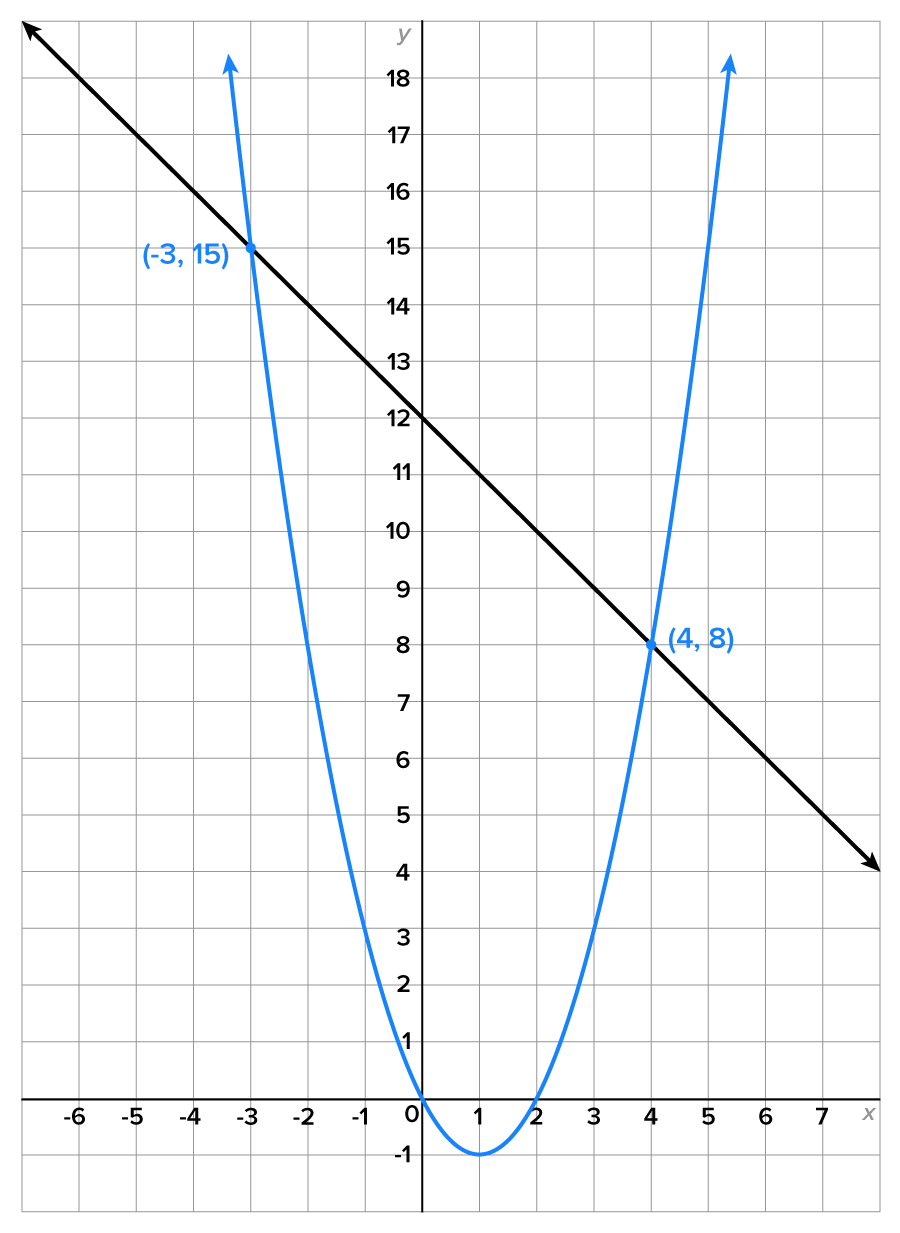
Examining the graphs of the equations, the solutions are the points where the graphs intersect, as shown in the figure below.

Note: the line is the graph of x plus y equals 12 comma and the graph of the parabola is y equals x squared minus 2 x.

A graph with an x-axis ranging from –6 to 7 and a y-axis ranging from –1 to 18. The graph has a parabola and a line. The parabola opens upward from its vertex at (1, -1) and passes through the points (0, 0) and (2, 0). The line slants downward from the second quadrant and passes through the marked points at (–3, 15) and (4, 8), intersecting the curve at these points.

try it
Consider the system: open curly brackets table attributes columnalign left end attributes row cell y equals x squared end cell row cell 2 x plus y equals 15 end cell end table close
Solve the system. Write your answers as ordered pairs.
Notice that y is isolated in the first equation, so substitute into the second equation, then solve:

2 x plus x squared equals 15 Substitute y equals x squared into the second equation.
x squared plus 2 x minus 15 equals 0 This is a quadratic equation, so rewrite so that one side is 0.
open parentheses x plus 5 close parentheses open parentheses x minus 3 close parentheses equals 0 Factor the quadratic expression.
x equals short dash 5 comma space 3 Set each factor equal to 0 and solve.

Next, use an equation with these known x-values to solve for y. It is most convenient to use y equals x squared.

If x equals short dash 5 comma then y equals open parentheses short dash 5 close parentheses squared equals 25. This means one solution is open parentheses short dash 5 comma space 25 close parentheses.

If x equals 3 comma then y equals 3 squared equals 9. This means the other solution is open parentheses 3 comma space 9 close parentheses.

Thus, the solutions to this system are open parentheses short dash 5 comma space 25 close parentheses and open parentheses 3 comma space 9 close parentheses.

EXAMPLE

Consider the system: open curly brackets table attributes columnalign left end attributes row cell 3 x squared plus 4 y squared equals 19 end cell row cell x plus 3 y equals 7 end cell end table close

Notice that it is quite simple to solve for x in the second equation, which gives x equals 7 minus 3 y.

Now, substitute into the first equation and solve.

open curly brackets table attributes columnalign left end attributes row cell 3 x squared plus 4 y squared equals 19 end cell row cell x plus 3 y equals 7 end cell end table close This is the system we wish to solve.
3 open parentheses 7 minus 3 y close parentheses squared plus 4 y squared equals 19 Substitute x equals 7 minus 3 y.
3 open parentheses 49 minus 42 y plus 9 y squared close parentheses plus 4 y squared equals 19 Expand the square of the binomial.
147 minus 126 y plus 27 y squared plus 4 y squared equals 19 Distribute on the left side.
31 y squared minus 126 y plus 147 equals 19 Simplify the left side.
31 y squared minus 126 y plus 128 equals 0 Subtract 19 from both sides.
y equals fraction numerator short dash open parentheses short dash 126 close parentheses plus-or-minus square root of open parentheses short dash 126 close parentheses squared minus 4 open parentheses 31 close parentheses open parentheses 128 close parentheses end root over denominator 2 open parentheses 31 close parentheses end fraction Factoring looks difficult, so use the quadratic formula, x equals fraction numerator short dash b plus-or-minus square root of b squared minus 4 a c end root over denominator 2 a end fraction.

y equals fraction numerator 126 plus-or-minus square root of 4 over denominator 62 end fraction Simplify each term.
y equals fraction numerator 126 plus-or-minus 2 over denominator 62 end fraction Simplify the radical.
y equals fraction numerator 126 plus 2 over denominator 62 end fraction equals 128 over 62 equals 64 over 31 This is the solution when the second term is added.
y equals fraction numerator 126 minus 2 over denominator 62 end fraction equals 124 over 62 equals 2 This is the solution when the second term is subtracted.

Next, substitute each x-value into an equation to find y. It is easiest to use the equation x equals 7 minus 3 y.

When y equals 2 comma x equals 7 minus 3 open parentheses 2 close parentheses equals 1. One solution is open parentheses 2 comma space 1 close parentheses.

When y equals 64 over 31 comma x equals 7 minus 3 open parentheses 64 over 31 close parentheses equals 7 minus 192 over 31 equals 25 over 31. This means the other solution is open parentheses 25 over 31 comma space 64 over 31 close parentheses.

The solutions are open parentheses 2 comma space 1 close parentheses and open parentheses 25 over 31 comma space 64 over 31 close parentheses.

watch
In this video, we will find all points where the hyperbola x squared minus y squared equals 4 and the ellipse 3 x squared plus 2 y squared equals 7 intersect by solving a system of equations.

try it
Consider the system: open curly brackets table attributes columnalign left end attributes row cell 3 x squared plus 2 y squared equals 26 end cell row cell x squared plus y squared equals 10 end cell end table close
Find all solutions to the system of equations.
Notice that all the terms are either x squared or y squared. This system can be solved using elimination.

space space space 3 x squared plus 2 y squared equals 26
short dash 2 x squared minus 2 y squared equals short dash 20 Multiply the second equation by -2.
x squared equals 6 Add the equations together.
x equals plus-or-minus square root of 6 Solve for x by applying the square root principle.

Next, for each value of x, substitute into either equation to find the corresponding value(s) of y. Since the equation x squared plus y squared equals 10 is simpler, we’ll use this one.

We'll start with x equals square root of 6 colon

open parentheses square root of 6 close parentheses squared plus y squared equals 10
space space space space space space space space space 6 plus y squared equals 10
space space space space space space space space space space space space space space space space y squared equals 4
space space space space space space space space space space space space space space space space space space y equals plus-or-minus 2

This means the solution points are open parentheses square root of 6 comma space 2 close parentheses and open parentheses square root of 6 comma space short dash 2 close parentheses.

Next, x equals short dash square root of 6 colon

open parentheses short dash square root of 6 close parentheses squared plus y squared equals 10
space space space space space space space space space space space space 6 plus y squared equals 10
space space space space space space space space space space space space space space space space space space space y squared equals 4
space space space space space space space space space space space space space space space space space space space space space y equals plus-or-minus 2

This means the solution points are open parentheses short dash square root of 6 comma space 2 close parentheses and open parentheses short dash square root of 6 comma space short dash 2 close parentheses.

Thus, this system has four solution points: open parentheses square root of 6 comma space 2 close parentheses comma open parentheses square root of 6 comma space short dash 2 close parentheses comma open parentheses short dash square root of 6 comma space 2 close parentheses comma and open parentheses short dash square root of 6 comma space short dash 2 close parentheses.


2. Systems of Nonlinear Inequalities in Two Variables

2a. Solving an Inequality in Two Variables

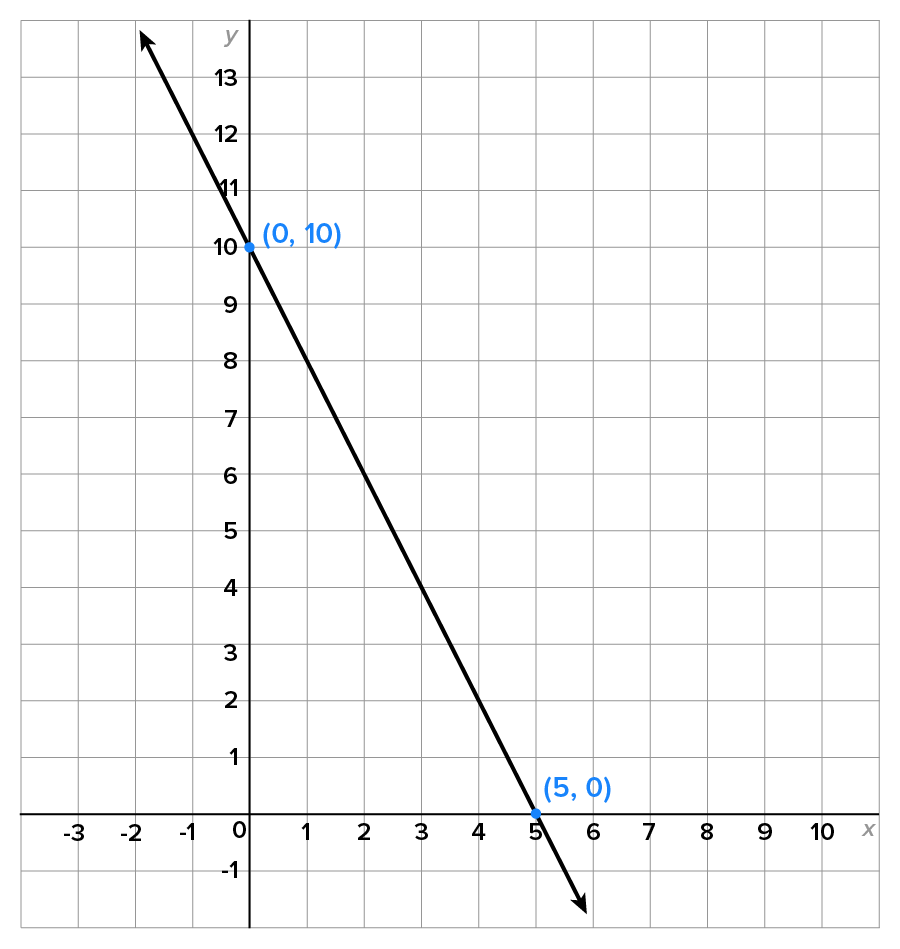
Consider the equation y equals 10 minus 2 x comma whose graph is shown below.

A solid line slants downward from the left of the y-axis, passes through the marked points at (0, 10) and (5, 0), and extends below the x-axis.

Remember that the graph of the equation is the visual representation of all solutions to the equation.

Using this idea, how would we represent the solutions to the inequality y less or equal than 10 minus 2 x ?

To start, we use the equation y equals 10 minus 2 x as a reference.

Consider the point open parentheses 0 comma space 10 close parentheses comma which is on the line y equals 10 minus 2 x.

Now, consider the points open parentheses 0 comma space 9 close parentheses and open parentheses 0 comma space 11 close parentheses. Are they solutions to y less or equal than 10 minus 2 x ?

Point Substitute Into bold italic y bold less or equal than bold 10 bold minus bold 2 bold italic x Solution?
open parentheses 0 comma space 9 close parentheses 9 less or equal than 10 minus 2 open parentheses 0 close parentheses
9 less or equal than 10
Yes
open parentheses 0 comma space 11 close parentheses 11 less or equal than 10 minus 2 open parentheses 0 close parentheses
11 less or equal than 10
No

try it
Consider the inequality y less or equal than 10 minus 2 x comma and the fact that the point open parentheses 1 comma space 8 close parentheses is on the line.
Does the point (1, 9) satisfy the inequality?
The point open parentheses 1 comma space 9 close parentheses does not satisfy the inequality.
Does the point (1, 6) satisfy the inequality?
The point open parentheses 1 comma space 6 close parentheses does satisfy the inequality.

Based on these results, it stands to reason that any point on or below the line y equals 10 minus 2 x is a solution to the inequality y less or equal than 10 minus 2 x.

To express the solution set, the portion of the plane that satisfies the inequality is shaded, much like we shade a number line to describe the solution set for an inequality with one variable.

The solution to y less or equal than 10 minus 2 x is shown below, with some solution and non-solution points shown.
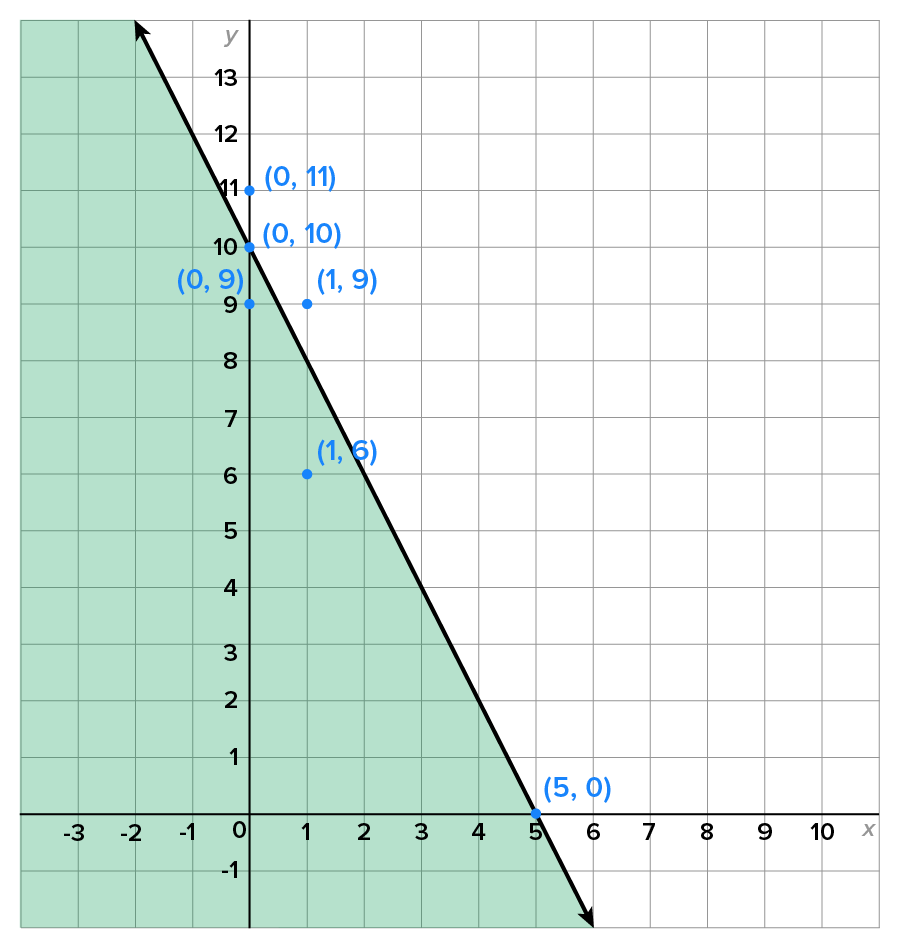
A solid line slants downward from the left of the y-axis, passes through the marked points at (0, 10) and (5, 0), and extends below the x-axis. The area of the graph below the line is shaded. The labeled points (0, 11) and (1, 9) are above the line and the points (0, 9) and (1, 6) are below the line.

The line y equals 10 minus 2 x is solid since the points on the line are also solutions. When the points on the graph are not solutions, the line would be represented by a dashed line rather than a solid line.

In general, the solution set to an inequality depends on the direction of the inequality and whether or not equality is allowed. Given a function y equals f open parentheses x close parentheses comma we have the following:

Inequality Description of Solution Set
y less or equal than f open parentheses x close parentheses All points below or on the graph of y equals f open parentheses x close parentheses.
The graph of y equals f open parentheses x close parentheses is expressed by a solid line or curve.
y less than f open parentheses x close parentheses All points below the graph of y equals f open parentheses x close parentheses.
The graph of y equals f open parentheses x close parentheses is expressed by a dashed line or curve.
y greater or equal than f open parentheses x close parentheses All points above or on the graph of y equals f open parentheses x close parentheses.
The graph of y equals f open parentheses x close parentheses is expressed by a solid line or curve.
y greater than f open parentheses x close parentheses All points above the graph of y equals f open parentheses x close parentheses.
The graph of y equals f open parentheses x close parentheses is expressed by a dashed line or curve.

EXAMPLE

Consider the inequality 2 x plus 3 y less than 24.

First, solve the inequality for y  :

2 x plus 3 y less than 24 This is the original inequality.
3 y less than 24 minus 2 x Subtract 2 x from both sides.
y less than fraction numerator 24 minus 2 x over denominator 3 end fraction Divide both sides by 3.
y less than 8 minus 2 over 3 x Write each term with a denominator of 3, then simplify.

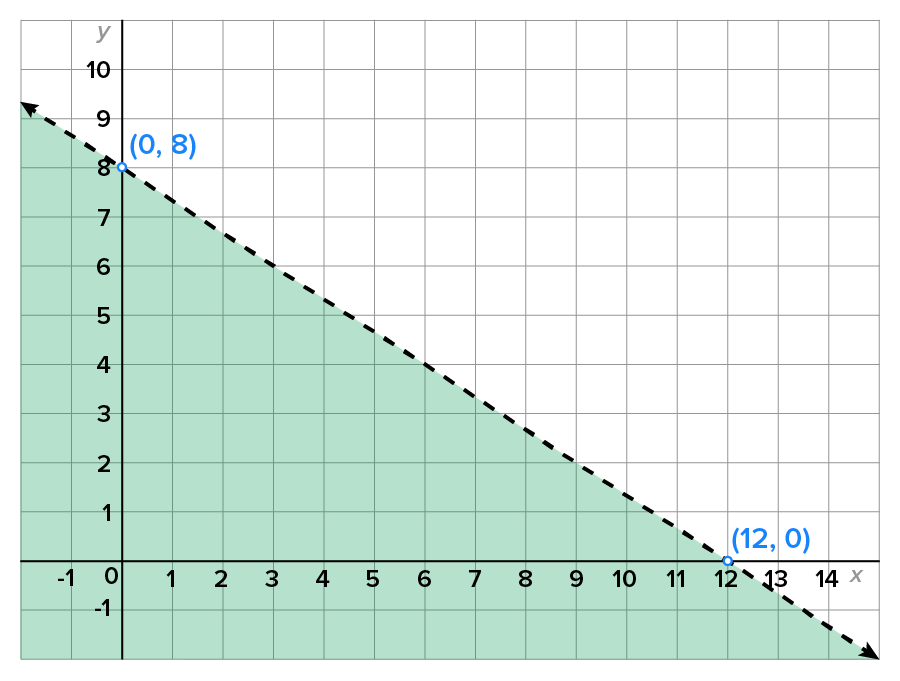
Thus, the solution set is any point that is below the line y equals short dash 2 over 3 x plus 8 comma which has slope short dash 2 over 3 and y-intercept at open parentheses 0 comma space 8 close parentheses.

Its graph is shown below. The intercepts are plotted using open circles since the line is not included, therefore the intercepts are also not included.

A dashed line slants downward from the left of the y-axis, passes through the open circles at (0, 8) and (12, 0), and extends below the x-axis. The area of the graph below the dashed line is shaded.

try it
Consider the inequality y greater or equal than x squared minus 4.
Graph the inequality, labeling all intercepts.
Since the inequality is in the form y greater or equal than f open parentheses x close parentheses comma graph y equals x squared minus 4. Then, the solution is the shaded region above the graph, as shown below.
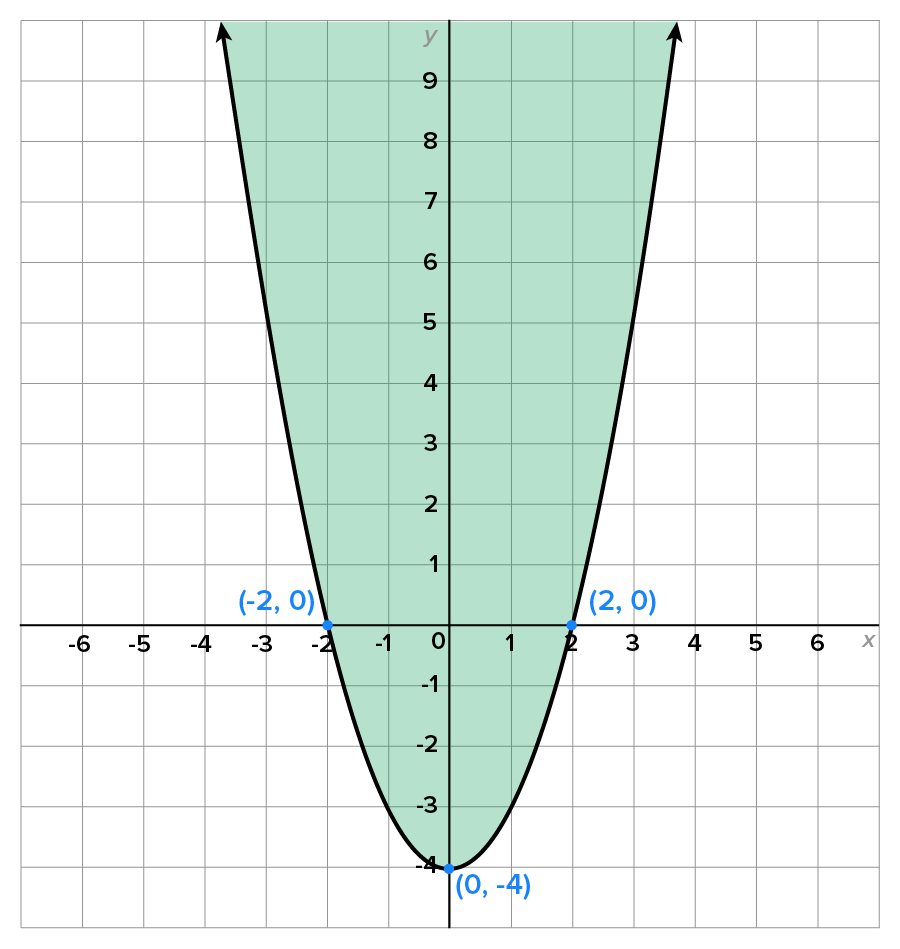
A parabola with vertex (0, -4) opening upward, also contains the points (-2, 0) and (2, 0). The area above the vertex and inside the 'U' of the parabola is shaded.

When the inequality is not convenient to solve for y, there are other techniques that can be used.

EXAMPLE

Sketch the solution to the inequality x squared plus y squared less or equal than 16.

Just as before, the graph of x squared plus y squared equals 16 is used as a reference. Recall that this is a circle with radius 4 with its center at the origin. It is graphed below.
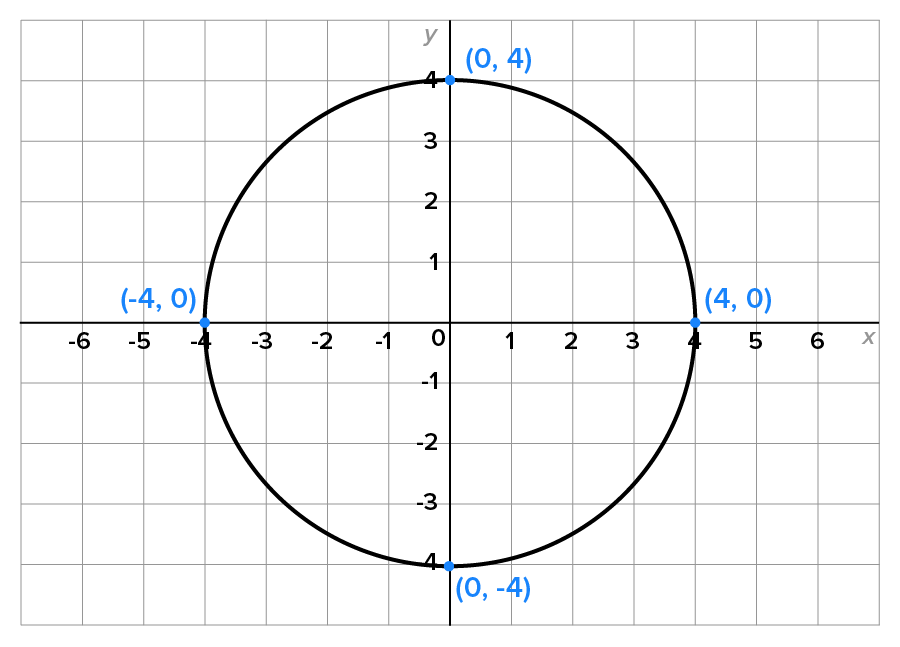
 A circle with a radius of 4 units centered at the origin (0, 0) extends from −4 to 4 on both axes and passes through the marked points at (4, 0), (0, 4), (−4, 0), and (0, −4).

In this case, it is more convenient to select points both inside and outside the circle to determine which are solutions. Here is a selection of points.

Point Substitute Into bold italic x to the power of bold 2 bold plus bold italic y to the power of bold 2 bold less or equal than bold 16 Solution?
open parentheses 0 comma space 5 close parentheses
(Outside)
0 squared plus 5 squared less or equal than 16
25 less or equal than 16
No
open parentheses 0 comma space 0 close parentheses
(Inside)
0 squared plus 0 squared less or equal than 16
0 less or equal than 16
Yes
open parentheses 1 comma space 2 close parentheses
(Inside)
1 squared plus 2 squared less or equal than 16
5 less or equal than 16
Yes
open parentheses 5 comma space 2 close parentheses
(Outside)
5 squared plus 2 squared less or equal than 16
29 less or equal than 16
No
open parentheses short dash 4 comma space short dash 5 close parentheses
(Outside)
open parentheses short dash 4 close parentheses squared plus open parentheses short dash 5 close parentheses squared less or equal than 16
41 less or equal than 16
No

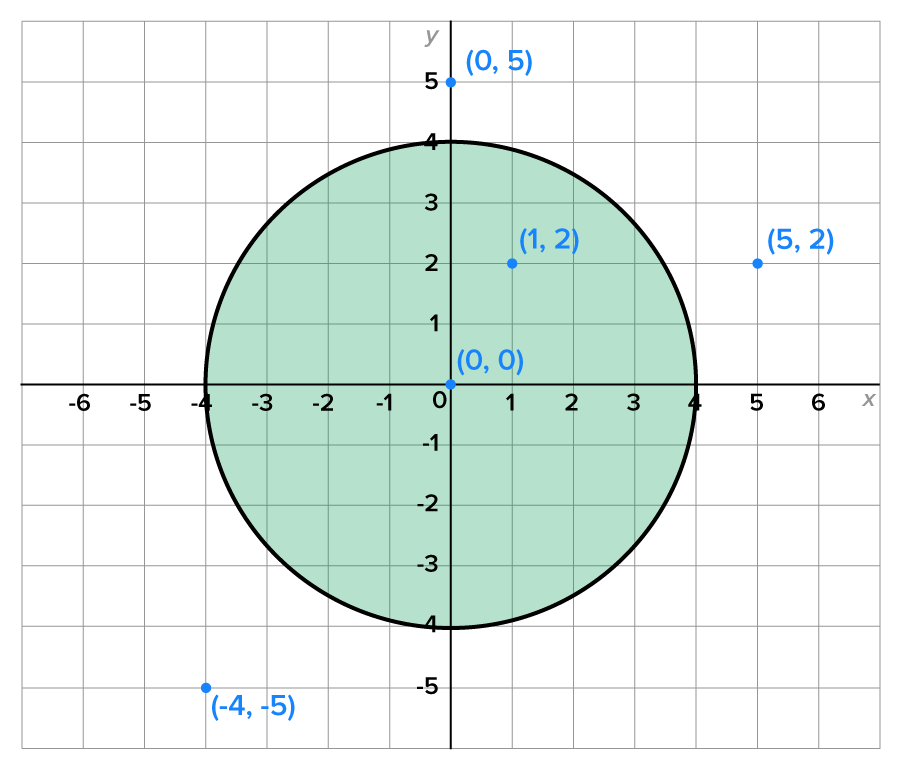
Therefore, any point inside or on the circle is a solution to the inequality. The solution set is shown below, with all the points we tested.

A graph with an x-axis ranging from –6 to 6 and a y-axis ranging from –5 to 5. A circle with a radius of 4 units centered at the origin (0, 0) is shaded. The circle extends from –4 to 4 on both axes. There are five marked points on the graph at the coordinates (0, 0) (1, 2), (0, 5), (5, 2), and (–4, –5).

try it
Consider the inequality open parentheses x minus 1 close parentheses squared plus y squared greater than 25.
Describe the solution set of this inequality.
All points outside the circle with center open parentheses 1 comma space 0 close parentheses with radius 5, not including the circle.

2b. Solving Systems of Inequalities in Two Variables

When solving a system of inequalities, we are looking at the common solution set to both inequalities.


watch
In this video, we will find the solution set to the system: open curly brackets table attributes columnalign left end attributes row cell y less or equal than 12 minus x squared end cell row cell y minus 2 x greater than 4 end cell end table close

watch
In this video, we will find the solution set to the system: open curly brackets table attributes columnalign left end attributes row cell x squared plus y squared less or equal than 25 end cell row cell y greater or equal than 1 minus x end cell end table close

try it
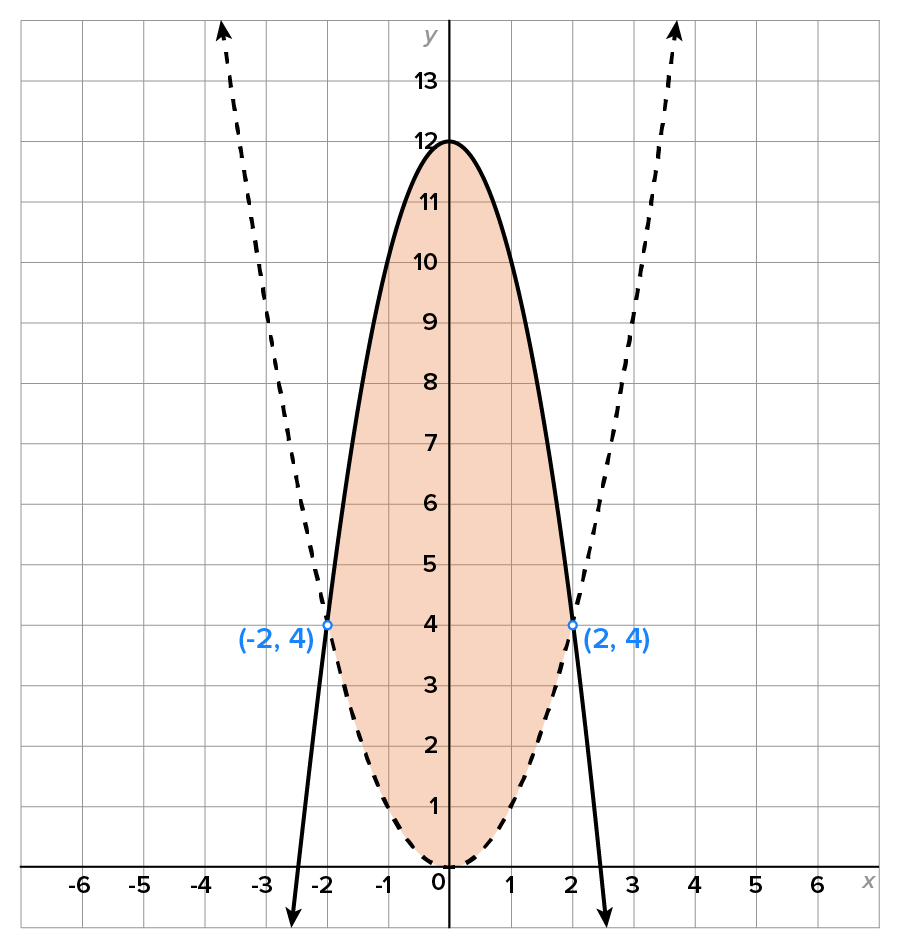
Consider the system: open curly brackets table attributes columnalign left end attributes row cell y less or equal than 12 minus 2 x squared end cell row cell y greater than x squared end cell end table close
Sketch the solution of the system, labeling all intersection points.
The inequality y less or equal than 12 minus 2 x squared includes all points that are below the graph of y equals 12 minus 2 x squared or are on the graph.

The inequality y greater than x squared includes all points that are above the graph of y equals x squared.

The solution to this system of inequalities, which is graphed below, is the intersection of the two regions described above. The dashed curve is y equals x squared and the solid curve is y equals 12 minus 2 x squared.

A graph consists of two parabolic curves. One curve is dashed, has vertex at the point (0, 0) and opens upward on both sides, passing through open cirvles at (-2, 4) and (2, 4). The second curve is solid, has vertex at (0, 12), and opens downward, passing through (-2, 4) and (2, 4). The region between the parabolas is shaded.

summary
In this lesson, you recalled that a system of nonlinear equations contains at least one equation that is not linear. You learned that in most cases, the preferred method for solving systems of nonlinear equations is to use the substitution method, but there are times when the elimination method is more convenient. You also learned how to solve an inequality in two variables by graphing and that solving systems of inequalities in two variables requires finding the region that is common to the solution sets of each inequality, as well as labeling the intersection points.

SOURCE: THIS TUTORIAL HAS BEEN ADAPTED FROM OPENSTAX "PRECALCULUS” BY JAY ABRAMSON. ACCESS FOR FREE AT OPENSTAX.ORG/DETAILS/BOOKS/PRECALCULUS-2E. LICENSE: CREATIVE COMMONS ATTRIBUTION 4.0 INTERNATIONAL.