Table of Contents |
At its most basic, symmetry means equal across an axis, or the imaginary line of division. In contrast, asymmetry means unequal across an axis, and bilateral symmetry means identical across an axis.
This work by Barbara Kruger is symmetrical, but not perfectly bilaterally symmetrical. One half of the image is a negative of the other half. If you drew an imaginary line through the center of this image, the two halves would not be identical, but it would be close.
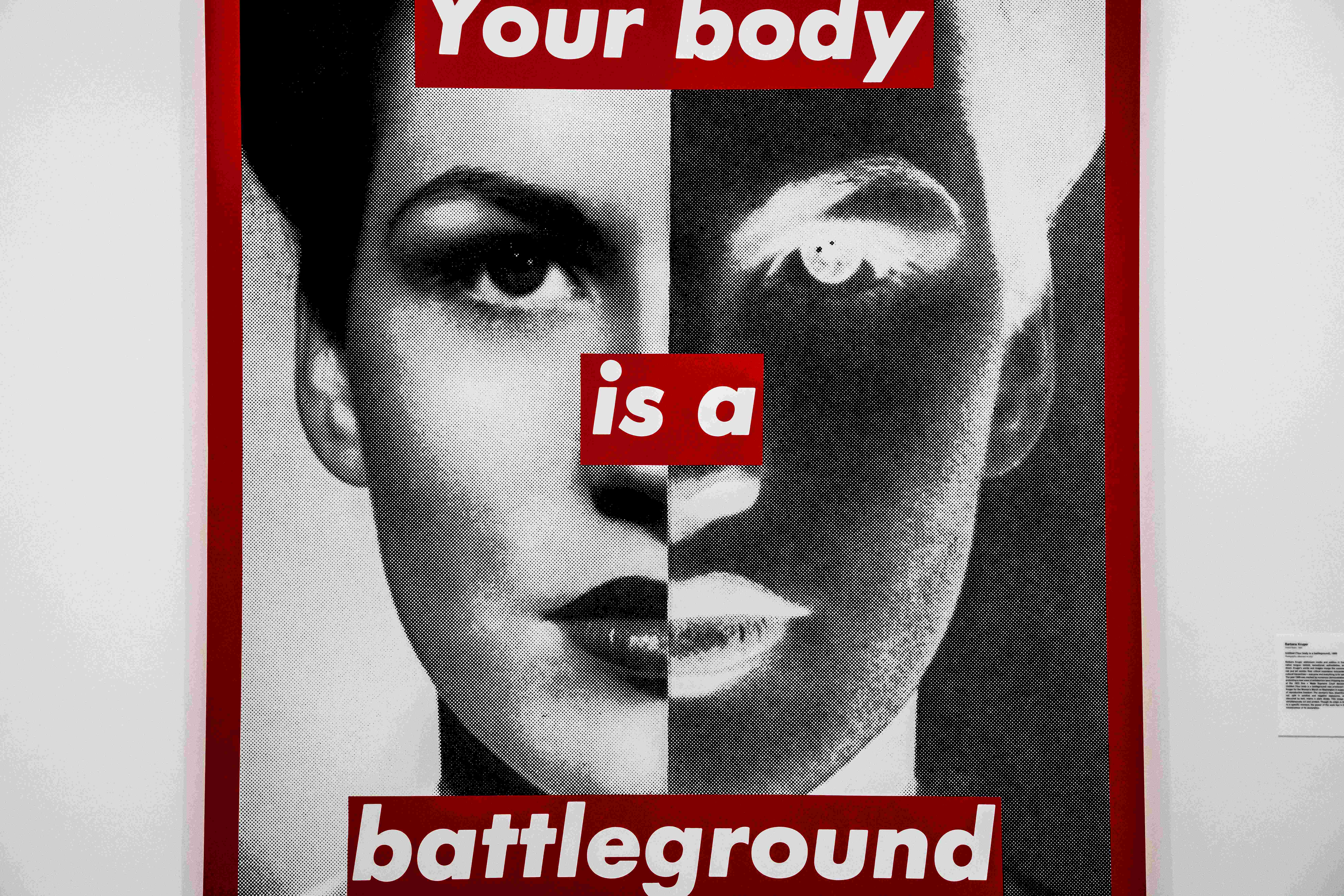
Untitled (Your Body Is a Battleground)
Los Angeles, California, USA
1989
Photographic silkscreen on vinyl
The sculpture below is a portrait of a king from Benin, or present-day Nigeria. There are some slight imperfections in this object, with the eyes being slightly different sizes, but aside from that, it is an example of bilateral symmetry. Bilateral symmetry means that the two halves of something are identical or mirror images of each other. If you drew a line through this image, the two halves would be the same. Notice how the idea of formal perfection adds to the idea of kingly power and authority that this object projects.
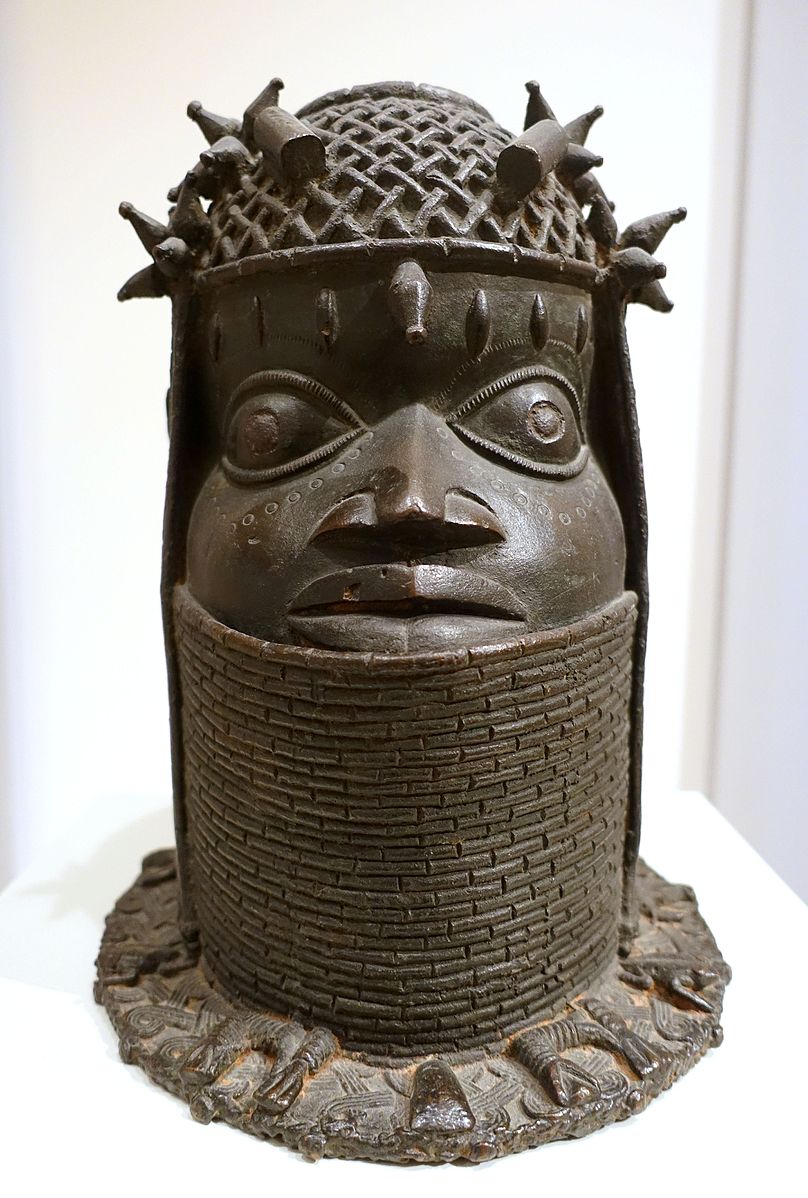
Head of an Oba
Nigeria, Court of Benin
18th century
Brass, iron
The woodcut print below, by Hokusai, is an excellent example of asymmetry. Nearly a quarter of this image consists of negative, or empty, space, with the sparrows and flowers occupying the right and bottom halves. There is, however, still a sense of balance between the elements of the composition, the birds and flowers, and the empty space.
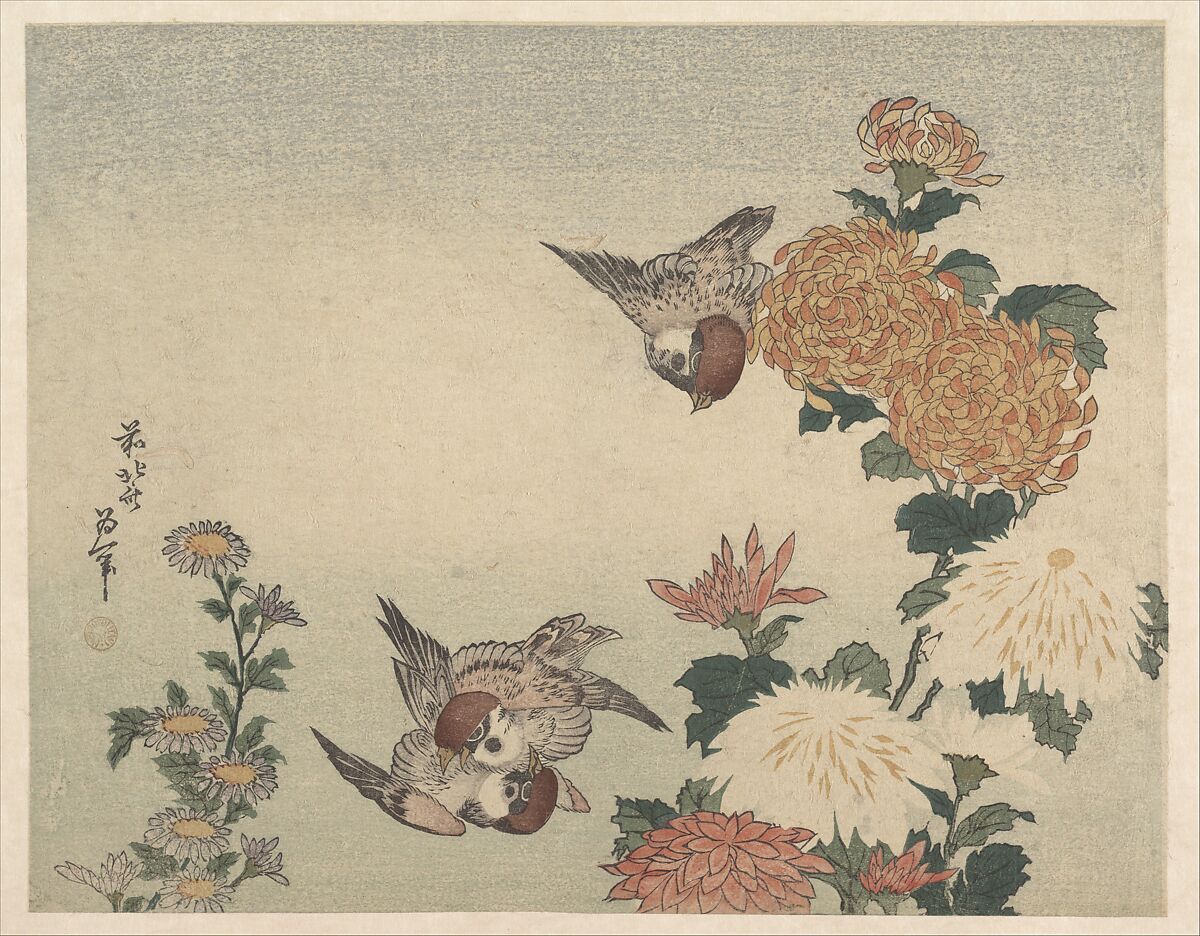
Sparrows and Chrysanthemums
Japan
ca. 1825, Edo period
Woodblock print; ink and color on paper
Asymmetry doesn’t necessarily mean unbalanced. Balance is when elements of a composition carry equal weight or create harmony. A composition can be asymmetrical and balanced at the same time.
Balance and dynamism are achieved by a careful distribution of elements through the composition. We can get a better sense of this by breaking the image into quadrants, as in this next image.
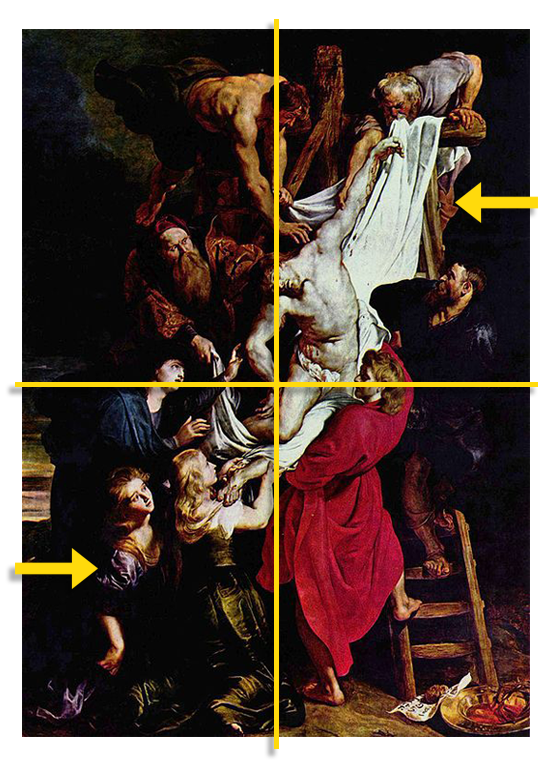
The Descent from the Cross
Cathedral of Our Lady, Antwerp, Belgium
1612 -1614
Oil on panel
Notice how the two quadrants identified by the arrows hold the majority of the visual weight in this image. These same two quadrants hold a roughly equal amount of weight in each quadrant and are diagonally opposed to each other. The other diagonally opposed composing quadrants have an equal distribution of empty space—empty of people, at least—which forces the eye, again, toward the diagonal axis and up to the right, creating the sense of dynamism. It can still be balanced even though it’s asymmetrical.
Source: THIS TUTORIAL WAS AUTHORED BY IAN MCCONNELL AND ERIN ALDANA FOR SOPHIA LEARNING. PLEASE SEE OUR TERMS OF USE.



